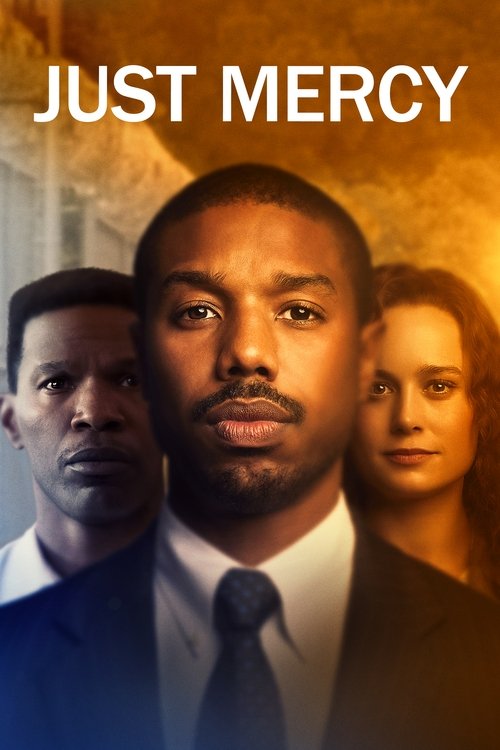
Just Mercy
2019 · Destin Daniel Cretton
For when you want a film that makes you angry at injustice and hopeful about people in the same evening — a serious watch that still sends you out believing the fight is worth it. Comfort food for the conscience, but with real weight.
What it's about
A young Harvard-trained lawyer, Bryan Stevenson, moves to Alabama in the late 1980s to represent death-row prisoners no one else will touch. His defining case is Walter McMillian, a Black man condemned for a murder the evidence says he didn't commit, and the film follows the grinding legal fight against a system with every incentive to look away. It's drawn from Stevenson's own memoir about founding the Equal Justice Initiative.
The experience
Measured, sober, and quietly furious — it builds its power through courtroom scenes and prison-visit conversations rather than melodrama, and it earns its emotional peaks honestly. Expect a lump in the throat more than an adrenaline rush.
Performances
Michael B. Jordan plays Stevenson with a restrained, coiled decency, while Jamie Foxx does some of his finest dramatic work as McMillian — a man whose dignity and exhaustion register in every silence. Their scenes together across a prison table carry the film.
The craft
Destin Daniel Cretton directs in the classical American courtroom-drama mode: unshowy, patient, built to put the performances and the moral argument front and center. The writing trusts the true story's own outrages rather than inflating them, which makes the injustices sting more, not less.
Why it matters
Released in the 2019 awards corridor, it found a much larger second life in 2020 when its subject converged with a national reckoning over race and criminal justice, becoming a go-to film for understanding the death-penalty fight. It also cemented Bryan Stevenson's story in the popular imagination.
Snapshot
Just Mercy is a legal drama adapted from Bryan Stevenson's 2014 memoir Just Mercy: A Story of Justice and Redemption, dramatizing the young lawyer's early years founding the Equal Justice Initiative in Alabama and his fight to overturn the wrongful capital conviction of Walter McMillian. Directed by Destin Daniel Cretton and headlined by Michael B. Jordan as Stevenson and Jamie Foxx as McMillian, the film belongs to the tradition of the American social-conscience courtroom picture — measured, classically constructed, and built around performance and moral argument rather than stylistic flourish. It arrived in the awards-season corridor of late 2019 and took on a second, unplanned life in 2020, when its subject matter converged with a national reckoning over racial injustice. Its distinction lies less in formal innovation than in the calibrated restraint with which it stages the machinery of the death penalty and the specific, procedural texture of exoneration work.
Industry & production
The film was produced for Warner Bros. under a constellation of production entities including Gil Netter's shingle, Endeavor Content, One Community, and Michael B. Jordan's Outlier Society Productions, with Jordan serving as both star and producer. Stevenson's memoir had been a substantial nonfiction bestseller, and the adaptation carried the imprimatur of its real-world subject, who was closely associated with the project's development. Cretton co-wrote the screenplay with Andrew Lanham, with whom he had also worked on The Glass Castle.
The production is notable as an early, prominent adopter of the inclusion rider — the contractual diversity provision that gained public attention after Frances McDormand invoked the term at the 2018 Academy Awards. Jordan's Outlier Society publicly committed to the practice, and Just Mercy was cited as one of the productions applying it, situating the film within a broader late-2010s industry conversation about representation both on screen and behind the camera. Principal photography took place in Alabama, with the story's setting in Monroeville — Harper Lee's hometown and the model for the fictional town of To Kill a Mockingbird — carrying an explicit intertextual weight the film acknowledges directly.
The film premiered at the Toronto International Film Festival in September 2019 before a platform release in the United States over the December holiday window, the customary positioning for prestige, awards-oriented drama. Its most consequential distribution event came later: in June 2020, amid the nationwide protests following the killing of George Floyd, Warner Bros. made the film available to rent free of charge across major digital platforms, an explicit gesture linking the film to the contemporary movement. Because I want to avoid citing figures I cannot verify, I will not attach specific box-office numbers to its theatrical run.
Technology
Just Mercy was captured digitally in a naturalistic, restrained register consistent with cinematographer Brett Pawlak's prior work with Cretton. I do not want to assert a specific camera or lens package as fact without confirmation, so I will describe the approach rather than the hardware: the imaging is clean, low-contrast in its exteriors and controlled in its interiors, favoring available-light naturalism over the high-gloss sheen typical of studio drama. The film uses no conspicuous digital-effects apparatus; its "technology" is essentially invisible, in service of a documentary-adjacent credibility. The most technically demanding sequences are not spectacle but the intimate, near-real-time staging of an execution, where the calibration of image and sound — rather than any effect — carries the load.
Technique
Cinematography
Pawlak's photography is deliberately unshowy. The Alabama exteriors are rendered in a soft, humid, slightly desaturated palette; the prison and courtroom interiors are composed with a stillness that resists melodrama. The camera tends to hold on faces in medium and close framing, granting actors room to work without cutting for emphasis. Compositional symmetry and eye-line discipline reinforce the film's procedural sobriety — the visual grammar of a system rather than a thriller. Where the film reaches for expressive effect, it does so sparingly: in the framing of men behind glass and bars, in the physical separation the camera insists upon between Stevenson and his clients, and in the quiet visual dignity it extends to death-row prisoners who are more often photographed as threats.
Editing
Cut by Nat Sanders — a longtime Cretton collaborator whose credits include Short Term 12 and work on Moonlight — the film's editing prioritizes clarity and emotional patience over pace. Scenes are allowed to breathe; the rhythm is that of accumulating procedural detail and mounting moral pressure rather than kinetic momentum. The execution sequence is the editorial centerpiece, structured to slow time and force the viewer to sit inside a process the film refuses to elide. Elsewhere, Sanders builds the case against McMillian and its unraveling through a legible chronology, trusting the audience to follow the evidentiary reversals without aggressive signposting.
Mise-en-scène / staging
The production design commits to the specificity of early-1990s Alabama: the cramped EJI office, the fluorescent institutional flatness of prisons and county courthouses, the modest domestic interiors of McMillian's family. Staging repeatedly dramatizes barriers — glass partitions, holding cells, the physical architecture of incarceration — as spatial expressions of the theme. Cretton stages conversations frontally and simply, letting the geography of a room (who sits where, who stands, who is restrained) carry meaning. The recurring motif of separation glass between Stevenson and the condemned is the film's most sustained staging idea.
Sound
Joel P. West, another regular Cretton collaborator, composed a restrained score that leans on strings and sparse piano, generally underplaying rather than swelling to cue emotion. The film's most powerful sound decisions are arguably its silences and diegetic textures — the mechanical sounds of the prison, the ambient hum of institutional spaces — which reach their apex in the execution sequence, where sound design rather than score carries the horror. The film generally trusts quiet, avoiding the wall-to-wall scoring that often marks the genre.
Performance
Performance is the film's true medium. Michael B. Jordan plays Stevenson with a banked, watchful composure — a portrait of controlled endurance rather than showboating heroism — allowing the character's fury to register in restraint. Jamie Foxx, as Walter McMillian, delivers a weathered, interior performance that moves from wariness to fragile hope; it drew the film's most sustained critical praise and awards attention. Rob Morgan's turn as Herbert Richardson, a traumatized veteran on death row, anchors the film's most devastating passage and is frequently singled out as its emotional high point. Brie Larson, in a supporting role as EJI co-founder Eva Ansley, works in a deliberately unstarry key, while Tim Blake Nelson brings squirming complexity to the compromised witness Ralph Myers. The ensemble's collective restraint is a directorial choice as much as an actorly one.
Narrative & dramatic mode
The film operates in the mode of the fact-based social-problem drama, organized around the investigation-and-vindication structure of the wrongful-conviction narrative. Its dramatic engine is procedural: the slow assembly of exculpatory evidence, the recantation of coerced testimony, the appeals process, and the institutional resistance that meets each step. Cretton and Lanham braid this legal spine with a parallel emotional narrative — Stevenson's relationships with the men on death row, and the toll the work exacts. The film resists the genre's temptation toward a single cathartic courtroom triumph; it distributes its emotional weight across multiple prisoners and insists that even a victory is shadowed by the executions it could not prevent. The dramaturgy is essentially classical — clear stakes, moral clarity, a protagonist tested — with the notable ethical choice of humanizing the condemned as fully as the exonerated.
Genre & cycle
Just Mercy sits at the intersection of the courtroom drama, the biographical picture, and the American racial-justice film. It descends directly from the tradition of liberal legal dramas — the lineage running through To Kill a Mockingbird, a film it explicitly invokes through its Monroeville setting — while updating that tradition's paternalism by centering a Black lawyer and Black defendants rather than a white savior. It also belongs to a late-2010s cycle of studio films engaging directly with mass incarceration, the death penalty, and structural racism, and to the broader biopic-of-living-activist trend. Within Cretton's own filmography it extends the humanist, institutionally-attentive sensibility of Short Term 12, scaled up to a studio canvas and a national subject.
Authorship & method
Destin Daniel Cretton emerged from independent film with Short Term 12 (2013), a widely admired drama set in a group home for at-risk youth, followed by the family memoir adaptation The Glass Castle (2017); after Just Mercy he moved to large-scale studio work with Marvel's Shang-Chi and the Legend of the Ten Rings (2021). His authorial signature is an interest in institutions and the vulnerable people inside them, rendered through understated realism and generous, actor-forward direction. Just Mercy is characteristic in its refusal of stylistic ostentation and its faith in performance and moral seriousness.
Crucially, Cretton is a director of collaborators: the film reunites him with cinematographer Brett Pawlak, composer Joel P. West, and editor Nat Sanders, the core creative team from his earlier work. This continuity accounts for the film's tonal consistency with his independent output despite its studio scale. His co-writer Andrew Lanham shared the adaptation duties, and the presence of Bryan Stevenson himself as a real-world touchstone shaped the film's fidelity to the case and its restraint around sensational embellishment.
Movement / national cinema
The film is firmly a work of mainstream American studio cinema, not aligned with any formal movement. It can, however, be read within a distinctly American strain of socially engaged, message-driven realist filmmaking — the descendant of the "problem picture" — and within the 2010s current of Black-centered American cinema that gained institutional traction in the wake of films like 12 Years a Slave, Selma, and Moonlight (the last connecting through editor Nat Sanders). Its inclusion-rider provenance and Outlier Society production also mark it as part of a specific industrial moment in American filmmaking rather than an aesthetic school.
Era / period
Produced and released in 2019, Just Mercy is a period piece set primarily in the late 1980s and early 1990s, the era of Stevenson's early EJI work and the McMillian case. Its production sits at the tail end of the 2010s prestige-drama ecosystem, when studios still routinely mounted mid-budget, awards-facing adult dramas — a category increasingly squeezed by the streaming era. The film's reception era, however, effectively extended into mid-2020, when its free digital release recontextualized it within the George Floyd protests and the surge of public attention to the criminal-justice system, giving a 2019 release a distinctly 2020 cultural resonance.
Themes
The film's central theme is the presumption of guilt that attaches to Black defendants within the American criminal-justice system, and the difficulty of dislodging a wrongful conviction once the machinery has committed to it. Radiating from this are its treatments of the death penalty as a moral catastrophe — dramatized most forcefully through Herbert Richardson's execution — and of mercy itself as the title's organizing value, framed not as leniency but as the recognition of full humanity in the condemned. The film examines the economics and geography of poverty and race in the American South, the psychological toll of justice work, and the persistence of To Kill a Mockingbird's mythology in a town that had not lived up to it. Underlying all of it is Stevenson's own formulation, dramatized rather than merely quoted, that each person is more than the worst thing they have done.
Reception, canon & influence
Critical reception was broadly positive, with particular and consistent praise for the performances — Jamie Foxx and Rob Morgan most of all — and for the film's emotional sincerity and its unflinching treatment of the death penalty. A recurring critical reservation held that the film was formally conventional, adhering closely to the familiar beats of the inspirational legal drama and smoothing the harder edges of its material into an accessible, uplifting shape; several reviewers framed it as an effective, well-made "message movie" rather than a formally adventurous one. It featured in the awards conversation chiefly through its acting — Foxx and the ensemble drew nominations and recognition, including from the Screen Actors Guild and the NAACP Image Awards — though it was largely absent from the top Academy categories, a fact noted in that year's discourse about representation in the nominations. To avoid overstating the record, I will not enumerate specific wins I cannot confirm precisely.
Looking backward, the film's influences are legible: Stevenson's memoir as source; the liberal courtroom-drama tradition epitomized by To Kill a Mockingbird, which the film consciously converses with; and the recent wave of Black-centered historical dramas (Selma, 12 Years a Slave) that established a commercial and critical space for the subject. Cretton's own Short Term 12 provides the closest stylistic antecedent within his authorship.
Looking forward, the film's most measurable impact is arguably extra-cinematic. Through its free 2020 release it became a widely-viewed educational and advocacy text during a moment of national protest, amplifying the profile of Bryan Stevenson and the Equal Justice Initiative and functioning as a point of entry into debates about mass incarceration and capital punishment. Its adoption of the inclusion rider contributed to the industry's ongoing conversation about diversity practices. As cinema, its legacy is more modest than its social one: it stands as a well-crafted, humane entry in the wrongful-conviction genre and as a bridge in Cretton's career from independent realism to studio-scale filmmaking, rather than as a film that reshaped the language of its form.
Reception
Landed in awards season 2019 as a well-liked but 'conventional' legal drama that many felt got snubbed at the Oscars — then found a second life in June 2020, when Warner Bros. made it free to rent during the George Floyd protests and it became required viewing overnight.
How Just Mercy was received, from release to now →
How to watch Just Mercy: what to notice on a first viewing
- Watch for the glass partitions between Stevenson and his clients. The film keeps returning to this separation glass motif, staging nearly every visit as a physical barrier between lawyer and client. The barrier makes incarceration something you can literally see standing between two people.
- Notice how long the camera holds on faces without cutting away. Cretton frames actors in medium and close shots and lets scenes play out, granting performances room instead of cutting for emphasis. The stillness asks you to read faces the way a jury would.
- Notice the soft, slightly muted color of the Alabama exteriors. Cinematographer Brett Pawlak shoots the state in a humid, desaturated palette rather than glossy or dramatic light. The plainness of the look matches the film's refusal of melodrama.
- Watch who sits, stands, or is restrained in each room. Cretton blocks conversations frontally and simply, so the geometry of a room, who has power and who doesn't, is visible before anyone speaks. The staging tells you about power before the dialogue catches up.
- Listen for how sparingly the score is used. Composer Joel P. West's music leans on strings and piano and generally underplays rather than swelling to cue emotion. The restraint lets the institutional sounds themselves carry weight.
The whole guide to watching Just Mercy, with the keys for a rewatch →
Influences: the films it descends from and the films it influenced
- To Kill a Mockingbird (1962) — Supplies the template Just Mercy openly converses with: the principled Southern lawyer as moral center, the courtroom staged as a civic morality play, and restrained framing that lets the trial's ethical stakes register through faces rather than camera flourish.
- 12 Angry Men (1957) — Establishes the procedural-patience method of dismantling a presumption of guilt point by point through dialogue and reasoned re-examination, the same evidentiary unspooling that drives McMillian's exoneration.
- In the Name of the Father (1993) — Anchors the wrongful-conviction structure Just Mercy inherits, including the recurring prison-visitation scene shot across the separation-glass motif that partitions the innocent man from his advocate.
- Dead Man Walking (1995) — Models the execution set-piece rendered as sober procedural ritual and the death-penalty critique built from restraint rather than melodrama, the exact tonal register Just Mercy adopts for Herbert Richardson's execution.
- The Thin Blue Line (1988) — Pioneers the exoneration narrative built around a specific flawed capital case, treating the reconstruction of coerced testimony and buried evidence as the film's central formal engine.
- Short Term 12 (2013) — The closest antecedent in Cretton's own authorship, made with the same core team (DP Brett Pawlak, editor Nat Sanders, composer Joel P. West) whose understated realism, held-close framing, and actor-forward direction carry directly into Just Mercy.
- 12 Years a Slave (2013) — Establishes the unflinching, restraint-driven grammar for Black historical trauma — long-held compositions that refuse to look away — that opened commercial-critical space for Just Mercy's subject.
- Selma (2014) — Bradford Young's available-light naturalism and its dignified, ensemble-restrained treatment of a Black civil-rights struggle set the visual and performance register Just Mercy works within.
- A Time to Kill (1996) — Fixes the Southern courtroom-race drama as a genre — the white and Black legal figures navigating a prejudiced jurisdiction — that Just Mercy revises by centering the Black attorney rather than the white one.
- The Hate U Give (2018) — A studio-scale, Black-centered social-problem picture that, like Just Mercy, smooths urgent racial-justice material into an accessible, emotionally sincere shape aimed at a broad and educational audience.
- When They See Us (2019) — Extends the same procedural-patience anatomy of a wrongful conviction — coerced testimony, presumption of guilt, the slow labor of exoneration — into long-form, deepening the genre space Just Mercy occupies.
- Spider-Man: Brand New Day (2026) — Brett Pawlak's restrained naturalistic lighting and Cretton's patient conversational two-shot blocking privilege performance over spectacle, the prestige-drama toolkit carried forward here.
- Fruitvale Station (2013) — Shares Michael B. Jordan as its lead and a handheld, available-light naturalism that builds procedural patience toward a foreknown fatal outcome, the same dread-structured march Just Mercy applies to death row.
- If Beale Street Could Talk (2018) — A contemporaneous wrongful-conviction drama that turns the separation-glass prison-visitation setup into intimate held-close two-shots, using restraint and framing to convey love across incarceration exactly as Just Mercy does.
- Loving (2016) — Extends the same faith in performance minimalism — a civil-rights landmark told through quiet, interior, ostentation-refusing acting rather than rhetorical set-pieces.
- Clemency (2019) — Released the same year, it centers the identical death-row execution procedure and capital-punishment critique, rendering the mechanics of state killing through restrained diegetic sound and stillness, a direct formal cousin to Richardson's execution.
- Marshall (2017) — A Black-centered legal biopic that likewise dramatizes a real attorney fighting a racially rigged trial, sharing the wrongful-accusation courtroom structure Just Mercy builds on.
- The Hurricane (1999) — Direct descendant wrongful-conviction exoneration biopic structured as a redemptive social-justice campaign to free a wronged Black man, Hurricane's thematic-ethical model matured.
- Belén (2025) — Adapts a nonfiction account of a wrongful conviction while centering the advocate's crusade and keeping scoring restrained, the same fact-to-fiction advocacy method Fonzi applies to Correa's book.
Similar films
- Dead Man Walking (1995) — influence & lineage · same viewing thread
- 12 Years a Slave (2013) — influence & lineage · same viewing thread
- If Beale Street Could Talk (2018) — influence & lineage
- Selma (2014) — influence & lineage
- Fruitvale Station (2013) — influence & lineage
- The Thin Blue Line (1988) — influence & lineage
- To Kill a Mockingbird (1962) — influence & lineage
- 12 Angry Men (1957) — influence & lineage · same viewing thread
All the films related to Just Mercy →
Watch it with: curated runs of related films
- Judgment and Mercy — Watch these together for the way each puts a life on the scales — a jury room, a death-row block, a slave plantation, a gunfighter's conscience — and asks what mercy costs the people handing down the verdict.