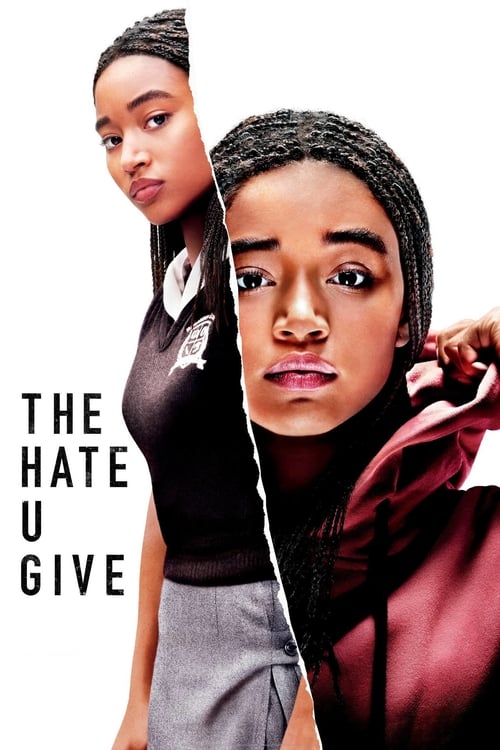
The Hate U Give
2018 · George Tillman Jr.
When you want a film with moral weight that still embraces you — a good cry that's also a conversation starter, especially for watching with teenagers. It challenges without being punishing.
What it's about
Sixteen-year-old Starr Carter lives in two worlds she keeps carefully separate: Garden Heights, the Black working-class neighborhood where she's from, and Williamson Prep, the mostly white suburban school where she softens every edge of herself. Then she witnesses a white police officer shoot her unarmed childhood friend during a traffic stop. As protests build and pressure mounts from every side, she has to decide whether to speak — and which version of herself gets to do the talking.
The experience
Emotionally direct and often wrenching, but warmer than its subject suggests — it's anchored in a loving, funny family, so the anger lands alongside real tenderness. Expect to be moved, and expect it to stay with you.
Performances
Amandla Stenberg is remarkable as Starr, visibly shifting between the two selves she performs for her two worlds, and Russell Hornsby brings quiet, formidable gravity to her father — a man teaching his kids both pride and survival.
The craft
Adapted from Angie Thomas's bestselling novel by screenwriter Audrey Wells, the film's sharpest craft is in how it dramatizes code-switching — you can see Starr's voice, posture, and vocabulary change at the school doors. George Tillman Jr. directs with the confidence of a mainstream drama, aiming the material at the widest possible audience without sanding off its anger.
Why it matters
Arriving out of the post-Ferguson cultural moment, it became the defining studio film of the Black Lives Matter era for young audiences and a fixture of classroom and family viewing.
Snapshot
The Hate U Give is a studio adaptation of Angie Thomas's 2017 debut young-adult novel, itself a phenomenon that topped the New York Times bestseller list and became a fixture of the post-Ferguson cultural moment. Directed by George Tillman Jr. from a screenplay by Audrey Wells, the film follows Starr Carter (Amandla Stenberg), a sixteen-year-old who moves between two worlds: Garden Heights, the predominantly Black, working-class neighborhood where she lives, and Williamson Prep, the mostly white suburban school she attends. When Starr witnesses a white police officer shoot and kill her unarmed childhood friend Khalil (Algee Smith) during a traffic stop, she is forced to reconcile the code-switched selves she has carefully kept apart and to decide whether — and how — to speak. The title derives from Tupac Shakur's gloss on "THUG LIFE": "The Hate U Give Little Infants Fucks Everybody," a thesis the film treats as sociological argument rather than slogan. It is at once a coming-of-age story, a family drama, and one of the most prominent mainstream American features to dramatize police violence and the Black Lives Matter movement.
Industry & production
The film originated in the publishing world's appetite for socially urgent YA. Fox 2000 — the prestige-literary arm of 20th Century Fox led by Elizabeth Gabler — acquired the screen rights in a competitive bidding situation before Thomas's novel was even published, an unusually early bet that reflected both the manuscript's buzz and the studio's track record with book adaptations (The Fault in Our Stars, Life of Pi, Hidden Figures). Amandla Stenberg, already publicly identified with conversations about race and representation after The Hunger Games and a widely circulated video essay on cultural appropriation, was attached early and functioned as a kind of anchor for the project's sensibility.
George Tillman Jr. — whose filmography runs from Soul Food (1997) and Men of Honor (2000) to Notorious (2009) — came aboard as director, bringing an accessible, family-centered classical style rather than a formally radical one. The screenwriter was the veteran Audrey Wells (Under the Tuscan Sun, The Kid), whose adaptation compresses and streamlines Thomas's first-person novel while preserving its central device of a narrating protagonist caught between registers. Wells died of cancer on October 4, 2018, days before the film's wide release; The Hate U Give carries a dedication to her, and her death lent the picture's arrival an added elegiac weight in the press coverage of the moment.
The film premiered at the Toronto International Film Festival in September 2018 and rolled out theatrically in the United States that October. It was a mid-budget studio release rather than a blockbuster, and its commercial performance was modest rather than spectacular; precise grosses should be checked against a reliable box-office database, but the film is generally understood to have been a respectable earner buoyed by strong reviews and a durable afterlife in schools and on streaming rather than a runaway theatrical hit. Its production sat at an interesting industrial hinge: it was among the last films shepherded by Fox 2000 before the Disney acquisition of 21st Century Fox effectively dissolved that specialty unit.
Technology
Technologically the film is conventional for a late-2010s studio drama, and that conventionality is itself a choice: nothing in the apparatus is meant to call attention to itself. It was shot digitally with contemporary cinema cameras and finished through a standard digital-intermediate pipeline, allowing the controlled, slightly desaturated naturalism that governs its look. The most consequential "technology" in the film is diegetic and thematic rather than production-side: the smartphone. Cell-phone cameras, viral video, hashtags, and cable-news chyrons are woven through the story as the infrastructure by which a private killing becomes a public event, and the film is acutely aware — in a way that dates it precisely to its historical moment — of how mediation shapes both grief and protest. The screen-within-the-screen, the recorded testimony, the broadcast interview: these are the film's real machines.
Technique
Cinematography
The cinematographer is Mihai Mălaimare Jr., a distinctive choice whose presence elevates the film's craft ceiling. Mălaimare had shot several Francis Ford Coppola features (Youth Without Youth, Tetro, Twixt) and, most consequentially, Paul Thomas Anderson's The Master (2012); he would go on to Jojo Rabbit (2019). Here he adopts a restrained, character-forward approach that shifts palette and proximity with Starr's two worlds — warmer, closer, more textured in Garden Heights; cooler and more architecturally composed at Williamson. The camera stays disciplined and close during the film's emotional peaks, and the pivotal traffic-stop killing is staged for maximum legibility and dread, the handheld intimacy of the friendship curdling into the fixed, helpless vantage of a witness. Mălaimare's instinct for faces gives Stenberg's performance room to carry meaning that the dialogue leaves unspoken.
Editing
The cutting favors clarity and emotional continuity over montage bravado, in keeping with Tillman's classical instincts: scenes are built to let performances land, and the film's tonal pivots — from domestic comedy to sudden violence, from teen romance to political awakening — are managed through pacing rather than disorientation. The specific editorial credit is less prominently documented in the general record than the film's above-the-line names, and I won't attribute it to an individual without confidence; what is clear is the strategy, which is to keep the audience oriented and inside Starr's point of view even as her world fractures.
Mise-en-scène / staging
Production design does much of the film's argumentative work by making the two worlds physically distinct: the lived-in, communal density of the Carter home and Garden Heights against the sleek, legible affluence of Williamson Prep and Chris's world. The film's most famous piece of staging is its opening — "the talk" — in which Maverick Carter sits his young children down and instructs them, calmly and specifically, on how to survive an encounter with police, while also teaching them the Black Panther Party's Ten-Point Program. That scene establishes the picture's method: political education dramatized as family ritual, the kitchen table as a site of inheritance.
Sound
The score is by Dustin O'Halloran, a composer associated with spare, emotionally direct neo-classical piano (his work includes Lion and Transparent). His cues underscore interiority rather than spectacle, keeping the film's register intimate. Around that, the soundtrack leans heavily on hip-hop — Tupac above all — as both period texture and thematic argument, with the THUG LIFE acronym functioning as the film's organizing sonic and conceptual motif. The interplay of source music (the culture Starr carries) and score (her private feeling) tracks the film's central tension between public and personal voice.
Performance
Performance is the film's core strength. Amandla Stenberg's Starr is a genuine dual role — the muted, agreeable "Williamson Starr" and the fuller self of Garden Heights — and the film asks Stenberg to let those masks slip and reassert in real time; the arc from silence to public testimony is theirs to carry, and they do. Russell Hornsby's Maverick, a reformed former gang member turned neighborhood grocer and moral center, is the film's other pillar, giving weight and dignity to its arguments about fathers, community, and dignity. The ensemble is deep: Regina Hall as Lisa, the pragmatic mother; Common as Uncle Carlos, a Black police officer whose presence complicates the film's view of policing; Anthony Mackie as King, the local drug lord who embodies the "hate" the system recycles; Issa Rae as the activist April Ofrah; Algee Smith as Khalil, whose brief warmth the whole tragedy depends upon; and K.J. Apa as Chris, Starr's white boyfriend.
Narrative & dramatic mode
The film's dominant mode is first-person coming-of-age realism, and it retains from the novel a strong sense of subjective narration and interior stakes. Structurally it is a witness-and-testimony drama: the inciting killing occurs early, and the remaining action concerns not a mystery of fact but a crisis of voice — whether Starr will testify, speak publicly, and thereby collapse the wall between her worlds. Around that spine the film braids several modes: domestic family drama, teen romance, and a community-crime subplot involving King that raises the stakes toward the third act. This generic breadth is both the film's accessibility and, for some critics, its risk — the picture works hard to metabolize enormous subject matter into a legible, emotionally satisfying shape, and it resolves on catharsis and reaffirmed family rather than on ambiguity.
Genre & cycle
The Hate U Give sits at the intersection of two cycles. The first is the late-2010s wave of American films responding directly to Black Lives Matter and the visibility of police killings — a cluster that includes Blindspotting (2018), Monsters and Men (2018), The Hate U Give, and, in a more lyrical register, If Beale Street Could Talk (2018), all of which followed Ryan Coogler's foundational Fruitvale Station (2013). The second is the YA literary adaptation, the studio pipeline that produced The Fault in Our Stars and The Hunger Games. What makes the film notable within both cycles is precisely its fusion of them: it brought the moral urgency of the BLM cycle into the mainstream YA and teen-drama vernacular, reaching a young audience that art-house treatments did not.
Authorship & method
Authorship here is genuinely distributed. Angie Thomas is the originating voice, and the film's fidelity to her novel's structure and politics is a defining feature rather than an incidental one. Audrey Wells, as screenwriter, performed the essential adaptive labor of turning an internal, narrated novel into dramatized scenes, and her death on the eve of release made her the film's ghost author in the coverage that surrounded it. George Tillman Jr.'s directorial signature is one of warmth, legibility, and family-centered classicism — he is not a stylist in the auteurist sense but a director who trusts actors and scenes, an approach well matched to material that needed to be broadly reachable. The strongest craft signatures below the line belong to cinematographer Mihai Mălaimare Jr. and composer Dustin O'Halloran, both of whom bring art-cinema pedigrees to a studio-drama frame. Amandla Stenberg's off-screen public identity as a young activist is inseparable from the film's authorship in practice: casting was itself an authorial statement.
Movement / national cinema
The film belongs firmly to a tradition of American Black cinema and, more specifically, to the lineage of films that dramatize the pressures of neighborhood, family, and structural violence — a line that runs through John Singleton's Boyz n the Hood (1991), Spike Lee's body of work, and Tillman's own Soul Food. Unlike the independent, festival-forward register of much of the 2018 BLM cycle, The Hate U Give is a studio film aimed at wide distribution, which places it in a particular national-industrial position: mainstream Hollywood's attempt to absorb and popularize a political subject that independent cinema had reached first. It is American commercial cinema working in a socially conscious mode, self-consciously continuous with the "hood film" and the message picture while updating both for a hashtag-era protagonist.
Era / period
The film is a document of the mid-to-late 2010s, and its texture is inseparable from that moment: the Black Lives Matter movement, the cycle of viral videos of police killings (Oscar Grant, Trayvon Martin, Michael Brown, Tamir Rice, Philando Castile — the real-world reference points that shaped Thomas's novel), and the concurrent rise of politically engaged Black popular culture across film, television, and music. Its arrival in October 2018 placed it in a remarkably rich year for Black American filmmaking, alongside Black Panther, BlacKkKlansman, Sorry to Bother You, If Beale Street Could Talk, and Blindspotting. Industrially it also belongs to the final chapter of Fox 2000 and the pre-Disney Fox, giving it a valedictory place in a studio history that was about to be reorganized.
Themes
The film's governing theme is voice — the cost and necessity of speaking — refracted through the everyday violence of code-switching. Starr's two selves dramatize W.E.B. Du Bois's "double consciousness" in a contemporary teenage key, and the plot literalizes the danger of that division and the liberation of collapsing it. Around this spine cluster the film's other concerns: police violence and the machinery (legal, media, communal) that surrounds it; the reproduction of harm captured by the THUG LIFE acronym — that hate given to children returns to injure everyone; the tension between activism and safety, between protest and family survival; interracial friendship and romance as a site of both intimacy and misrecognition; and the role of the father and the family as engines of political and moral inheritance. The film is notably interested in the internal frictions of Black life as well — Uncle Carlos the police officer, King the drug lord, and the community's own disagreements complicate any single message.
Reception, canon & influence
Critical reception was broadly positive, with particular and near-unanimous praise for Amandla Stenberg's central performance and for the film's willingness to bring difficult material to a wide, young audience; it accumulated recognition on the awards circuit oriented toward Black cinema and youth audiences (including NAACP Image Award attention). The most common critical reservation concerned tonal breadth — that the film sometimes strains to hold coming-of-age drama, romance, message movie, and crime subplot in a single frame, and that its studio-drama polish rounds off some of the harder edges. Even skeptics, however, tended to credit its sincerity and its reach.
Looking backward, the film's influences are legible and acknowledged: Angie Thomas has cited the killing of Oscar Grant and the broader post-Ferguson movement as the impetus for the novel, which makes Fruitvale Station a clear spiritual predecessor; the "hood film" tradition of Singleton and the socially conscious Black cinema of Spike Lee stand behind it; and Tupac Shakur's THUG LIFE is not merely referenced but adopted as the film's interpretive key.
Looking forward, its most significant legacy is one of access and durability. As a mainstream studio film pitched to teenagers, The Hate U Give became a widely taught and widely streamed text — a common entry point, especially in secondary-school and library contexts, for young viewers encountering the politics of police violence and the vocabulary of code-switching on screen. It confirmed Amandla Stenberg as a serious lead and stands, alongside its 2018 cousins, as evidence that the Black Lives Matter era's concerns could be carried into the commercial mainstream. Its influence is measured less in stylistic imitation than in demonstrating a market and an audience for socially urgent, Black-authored studio drama aimed at the young — a template whose full downstream effects continue to unfold and are best assessed with the caution due to still-recent film history.
Reception
Warmly reviewed in 2018 (Stenberg and Russell Hornsby drew awards buzz that never materialized — its total Oscar shutout still rankles) but only a modest box-office performer, it found a second life in summer 2020 when it topped anti-racism watchlists and surged on streaming during the George Floyd protests.
How The Hate U Give was received, from release to now →
How to watch The Hate U Give: what to notice on a first viewing
- Watch the color and light change between her two neighborhoods. Mălaimare shoots Garden Heights warmer and more textured, Williamson Prep cooler and more architecturally composed. You can tell which self Starr is wearing just from the light in the frame.
- Watch Starr's voice and posture shift between her two schools. Stenberg plays a muted, agreeable version of Starr at Williamson and a fuller, looser self back in Garden Heights, letting the masks slip and reassert. The performance makes code-switching visible as physical labor, not just a personality quirk.
- Watch how calmly Maverick instructs his children in the opening scene. He walks Starr and her siblings through exactly how to behave in a police stop, treating it as an ordinary lesson at the kitchen table. The film establishes political education as an inherited family ritual before the plot even begins.
- Listen for Tupac's music threading through the soundtrack. Hip-hop, especially Tupac, runs as source music throughout, carrying the THUG LIFE acronym as the film's organizing idea. The music does thematic work here, not just scene-setting, tying culture directly to the film's argument.
- Notice the camera's closeness change during the traffic stop. The handheld warmth of the friendship shifts into a fixed, helpless vantage point the moment danger enters the car. The camera makes you feel the shift from companionship to powerlessness in your own body.
The whole guide to watching The Hate U Give, with the keys for a rewatch →
Influences: the films it descends from and the films it influenced
- Fruitvale Station (2013) — Establishes the day-in-the-life intimacy and real-killing-recontextualized structure that Angie Thomas cited as her impetus — the humanizing build toward an off-screen police death that retroactively reframes every earlier scene.
- Boyz n the Hood (1991) — Originates 'the talk' as a staged family ritual — the father delivering survival protocol for a Black child facing police — which Tillman restages almost beat-for-beat as Maverick's driveway lesson.
- Do the Right Thing (1989) — Supplies the block-as-ensemble staging and the police-chokehold death igniting communal uprising, the aftermath-and-protest arc THUG inherits wholesale.
- Juice (1992) — Inaugurates Tupac's on-screen THUG LIFE persona; the film literally decodes Shakur's acronym as its interpretive key, making this the source text for that motif.
- Poetic Justice (1993) — Models first-person voice-over interiority for a young Black woman (Maya Angelou poems as narration), the narrated coming-of-age register Starr's testimony updates.
- To Kill a Mockingbird (1962) — Sets the template of a child-narrator's moral awakening organized around courtroom witness and testimony against racial injustice — first-person conscience-formation as narrative engine.
- The Master (2012) — Mihai Mălaimare Jr.'s controlled, art-cinema compositional palette here is the DP pedigree he imports to THUG's two-world Garden Heights/Williamson color separation.
- Selma (2014) — Demonstrates studio-scale, legibly-staged Black protest cinema pitched to a mainstream audience without abandoning docu-realist gravity — the commercial register THUG adopts.
- Queen & Slim (2019) — Extends the viral-witness police-violence narrative into folk myth, carrying forward the recorded-encounter-becomes-public-testimony structure THUG helped mainstream.
- Just Mercy (2019) — Deploys the same legible, actor-trusting studio-classical staging around courtroom testimony as the instrument of Black justice — clarity over stylization in service of reach.
- On the Come Up (2022) — Adapts Angie Thomas's next Garden Heights novel, directly inheriting the code-switching, family ritual, and voice-through-art (rap-as-testimony) apparatus THUG established on screen.
- Sorry to Bother You (2018) — Literalizes code-switching as a dual-register vocal performance ('white voice'), the same two-selves mechanism THUG dramatizes through Starr's Garden Heights/Williamson speech.
- Blindspotting (2018) — Builds to a spoken-word climax as the eruption of suppressed voice and threads code-switching between neighborhood registers — the voice-and-witness arc in a shared 2018 BLM frame.
- Monsters and Men (2018) — Centers the smartphone-captured police shooting and the bystander's moral burden over the footage — the identical technology-of-witness device driving THUG's testimony.
- If Beale Street Could Talk (2018) — Scores Black love against systemic injustice with Nicholas Britell's neoclassical strings — a direct parallel to O'Halloran's scoring — while adapting a literary source around testimony.
- BlacKkKlansman (2018) — Delivers studio-scaled BLM-era address that fuses period drama to a real-footage coda, sharing THUG's project of connecting a dramatized narrative to contemporary movement politics.
Similar films
- Boyz n the Hood (1991) — influence & lineage · same viewing thread
- BlacKkKlansman (2018) — influence & lineage · same viewing thread
- If Beale Street Could Talk (2018) — influence & lineage
- Blindspotting (2018) — influence & lineage
- Do the Right Thing (1989) — influence & lineage · same viewing thread
- Menace II Society (1993) — same viewing thread
- Nickel Boys (2024) — shared sensibility
- Waves (2019) — shared sensibility
All the films related to The Hate U Give →
Watch it with: curated runs of related films
- Reckoning with the Color Line — A run through a century of American film on race — from the movie that industrialized screen racism to the ones that talk back to it — best watched in rough chronological conversation.