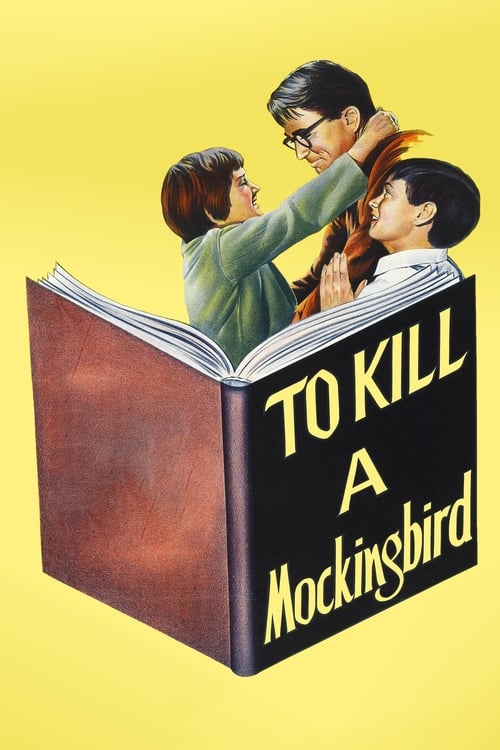
To Kill a Mockingbird
1962 · Robert Mulligan
For when you want a film with a moral spine — something humane and old-fashioned in the best sense, that makes you feel both nostalgic and quietly stirred. Comfort viewing with a conscience.
What it's about
In a sleepy Alabama town during the Depression, six-year-old Scout Finch and her older brother Jem fill their summers with games, dares, and a running obsession with Boo Radley, the unseen recluse next door. Their widowed father Atticus, a quietly principled lawyer, agrees to defend a Black man falsely accused of rape — and the trial pulls the children out of their childhood world and into the town's ugliest currents. It's a story about growing up told from the ground level, at a kid's eye height, where adult injustice arrives as something bewildering and enormous.
The experience
Warm and unhurried at first, like a remembered summer, then increasingly grave as the courtroom takes over. It moves between porch-swing tenderness and genuine moral weight, and the mix of childhood mystery and adult reckoning gives it a gentle, haunted quality that stays with you.
Performances
Gregory Peck as Atticus Finch is the performance of his career — a portrait of decency so steady and unshowy it became the screen's lasting image of the principled father. The child actors, especially Mary Badham as Scout, feel unusually natural for the era.
The craft
Russell Harlan's black-and-white photography gives Maycomb a soft, storybook glow that curdles into shadow when the story darkens, and Horton Foote's screenplay trims a beloved novel down to its essentials without losing its voice. Elmer Bernstein's delicate, music-box-like score is one of the most quietly influential in Hollywood history.
Why it matters
Released at the height of the civil rights movement, it became a defining work of Hollywood's social-conscience tradition and fixed Atticus Finch as a cultural ideal of integrity — even as later generations have debated its framing of whose story gets centered.
Snapshot
Robert Mulligan's adaptation of Harper Lee's 1960 Pulitzer Prize-winning novel stands as one of the defining works of Hollywood's social-conscience tradition. Shot in luminous black and white by Russell Harlan, carried by Gregory Peck's career-defining performance, and anchored by Horton Foote's judicious screenplay, the film distills Lee's semi-autobiographical Alabama childhood into a dual narrative: a child's Gothic fascination with a reclusive neighbor, and a grown world's capacity for murderous injustice. Released at the crest of the American civil rights movement, it arrived as testimony and intervention—though its moral framework, centering a white patriarch's heroism over the Black man whose life is at stake, has been debated with increasing rigor in the decades since.
Industry & production
Universal Pictures distributed the film; it was produced by Alan Pakula, then at the outset of a career that would later yield Klute (1971), All the President's Men (1976), and Sophie's Choice (1982). Pakula and Mulligan had formed a production partnership that generated a series of sensitive, character-driven studio pictures in the early 1960s. Their collaboration on Mockingbird represented the partnership's apex.
Harper Lee sold the film rights while the novel was still in galleys, and Pakula secured the property before its publication made it a cultural phenomenon. The novel's success turned the adaptation into a high-profile project; Gregory Peck's casting was effectively settled before production began, a choice Lee publicly endorsed and reportedly wept upon seeing on screen. Peck had been approached for the role of Atticus almost immediately, his off-screen reputation for liberal principle mapping cleanly onto the character's moral authority.
Horton Foote, the Texas playwright and screenwriter whose ear for Southern vernacular and whose instinct for spare, behaviorally precise drama made him an ideal adapter, wrote the screenplay. Production took place largely on Universal's back lot in California, where production designer Alexander Golitzen and art director Henry Bumstead constructed the Maycomb streetscape—a clapboard courthouse square, the Finch house with its wide porch and oak tree, the Radley place—from scratch. Bumstead drew on period photographs and architectural references from Alabama to achieve period and regional specificity. The constructed sets gave Mulligan precise control over light and framing that location shooting in the actual Monroeville, Alabama (Lee's model for Maycomb) would have complicated. Bumstead and Golitzen won the Academy Award for Best Art Direction.
The film earned eight Academy Award nominations and won three: Best Actor (Peck), Best Adapted Screenplay (Foote), and Best Art Direction. It received nominations for Best Picture, Best Director, Best Supporting Actress (Mary Badham), Best Cinematography, and Best Original Score.
Technology
The choice to shoot in black and white was deliberate and period-appropriate in spirit if not quite in industry practice: by 1962, color was dominant in American studio production, and black-and-white features were increasingly associated with prestige seriousness or art-house ambition. Mulligan and Harlan used monochrome to invoke the hazy, memory-saturated quality of childhood recollection and to ground the film's Alabama setting in the documentary photographic tradition of Walker Evans and Dorothea Lange—images that had defined Depression-era Southern poverty for a national audience.
Harlan worked within the Academy ratio (1.37:1), still standard for Universal productions of this type. The film predates the widespread adoption of newer widescreen formats for intimate dramatic work; the near-square frame enforces proximity and enclosure, useful for the domestic and courtroom spaces that anchor the narrative.
Technique
Cinematography
Russell Harlan's cinematography is among the most thoughtfully calibrated of his career. His approach is essentially low-key realist: deep blacks, controlled highlights, shadow deployed to thicken atmosphere without tipping into expressionist abstraction. The nighttime sequences—the children's approach to the Radley house, the shadowed rear of the courthouse—carry a genuine Gothic weight, while the daylit domestic scenes are bathed in a warm, diffused light that codes Maycomb as a place of innocence not yet surrendered.
One of the film's most consistently remarked-upon formal strategies is its systematic use of low camera angles scaled to Scout's height. Placing the lens at roughly four feet from the ground, Harlan and Mulligan render the adult world literally looming—Atticus as tower, the courthouse steps as monument, Bob Ewell as threat materializing out of darkness. This perspectival literalism earns its emotion: when Scout sees Boo Radley standing behind her bedroom door, the framing is the framing of a child's terrified recognition. The technique was not novel—child-POV low-angle work appears in earlier Hollywood pictures—but it is deployed here with uncommon consistency and dramatic intelligence.
Editing
Aaron Stell's editing is classical in the best sense: invisible, purposeful, governed by character rhythm rather than pace for its own sake. The courtroom sequences, which occupy a substantial portion of the film's second half, are cut to preserve the theatrical momentum of Foote's dialogue while allowing Peck's delivery sufficient room to register. Stell holds on reaction shots—the gallery watching, the children in the balcony—in ways that allow the audience to absorb the proceedings' social and moral weight before moving on. The film does not cut to relieve tension; it sits in it.
Mise-en-scène / staging
Mulligan was primarily a director of actors, and his staging subordinates spatial design to behavioral precision. The Finch house porch is the film's moral center—a threshold space where Atticus appears in repose, thinking, reading—and Mulligan returns to it as a ground note. The knothole in the oak tree, where Boo Radley leaves gifts for Scout and Jem, is photographed as a site of mystery and generosity simultaneously; Mulligan stages each discovery with a child's mixture of caution and delight.
The trial staging is notably theatrical—long, unbroken takes in the courtroom, a careful geography of the witness box and jury rail—but Mulligan earns this theatricality. The physical distance between Tom Robinson (Brock Peters) and his accusers is spatialized: Mayella Ewell and her father occupy one side of the frame's moral universe, Tom the other. Peters's performance under cross-examination—he weeps openly on the stand, a detail that cost Mulligan some resistance from the studio—is staged in close mid-shot that refuses the audience any comfortable distance.
Sound
Elmer Bernstein's score is one of the most celebrated of his career, and one of the most precisely suited to its film. The main theme is built around a single child's hand picking out simple notes on a piano—an evocation of innocence, of playing at comprehension, of things only half understood. Bernstein deploys the score sparingly in the film's dramatic center, allowing the trial to proceed largely without musical reinforcement. The score does most of its work at the film's emotional poles: in the quiet summer reverie of the children's games and in the Gothic nighttime sequences. Bernstein was nominated for the Academy Award; the score lost, but has outlasted most of the competition.
Performance
Gregory Peck's Atticus Finch has become so foundational to American cinematic iconography that separating performance from myth requires deliberate effort. What Peck actually does is economical, behavioral, and anti-theatrical in the best sense: he speaks slowly, listens fully, moves without urgency. The performance encodes moral certainty not as righteousness but as ordinary daily practice—the way Atticus puts on his glasses, the way he turns to face Bob Ewell's insult. There is almost no vanity in it.
Mary Badham, who received a Supporting Actress nomination at age ten—the youngest at that time in Oscar history—gives a performance of natural, unconsidered authenticity. Phillip Alford as Jem captures the particular register of early adolescence: the desire to be adult, the instinctive retreat to childhood when the adult world reveals itself as catastrophic. Robert Duvall, in his film debut, has perhaps six minutes of screen time as Boo Radley, but his physical stillness and transparent emotional exposure—Boo weeping over Scout's scratched forehead—land with the force of the film's entire accumulated dread finally releasing.
Brock Peters as Tom Robinson operates under the film's central constraint: the narrative is not about him, and he is given relatively limited screen time and interiority in proportion to his centrality to the moral action. What Peters does within those constraints is remarkable—his courtroom breakdown remains genuinely harrowing—but the structural limits are real.
Narrative & dramatic mode
Foote's screenplay is notable for what it excels and for what it chooses to sacrifice. The novel's sprawling episodic structure—three summers of childhood incident—is compressed into a tight parallel construction: the Boo Radley mystery and the Tom Robinson case run concurrently, converging in the film's final act when Boo's existence shifts from uncanny curiosity to moral reality. Several of the novel's most beloved secondary characters (Miss Maudie Atkinson's role is substantially reduced) and subplots are stripped away to achieve dramatic coherence.
The adult Scout's voice-over narration, delivered by Kim Stanley, frames the story as memory and retrospect—a mode Foote uses to establish the film's elegiac register from its opening image of a child's keepsake box. The temporal distance between the narrating Scout and the experiencing Scout is the film's epistemological engine: we are watching a child learn things she cannot yet fully comprehend, filtered through an adult consciousness that can name what the child could only feel.
The film's dramatic mode is fundamentally realist tragedy within a framework of childhood pastoral: the summer world of the children is rendered with warmth and specificity so that its rupture—when Tom Robinson is convicted despite Atticus's defense, and is then killed attempting escape—carries genuine devastation.
Genre & cycle
To Kill a Mockingbird belongs to the social-problem film tradition that runs from the late 1940s through the early 1960s in Hollywood: Gentleman's Agreement (1947), Pinky (1949), Intruder in the Dust (1949), The Defiant Ones (1958), and Stanley Kramer's cycle of message pictures are its immediate generic ancestors. It also participates in the Southern Gothic mode that had moved from literature (Faulkner, Flannery O'Connor) into cinema: the reclusive figure of Boo Radley, the decaying social order of Maycomb, the Gothic night sequences all carry that current.
The film is further classifiable as a courtroom drama, a coming-of-age film, and a period picture (set in the mid-1930s, produced in 1962). Its position at the intersection of these cycles gave it unusual access to multiple audience constituencies and contributed to its broad critical and commercial reception.
Authorship & method
Robert Mulligan's career resists easy auteurist categorization; he is better understood as a sensitive craftsman and actor's director working within studio structures than as a strong-signature stylist. His subsequent work—Love with the Proper Stranger (1963), Baby the Rain Must Fall (1965), Summer of '42 (1971)—confirms a consistent interest in liminal emotional states, in characters under pressure from social convention, and in naturalistic performance. But the individual films vary considerably in formal approach, and Mockingbird stands as the peak of his achievement precisely because Foote's material, Harlan's cinematography, Bernstein's score, and Peck's performance aligned around a coherent vision.
Horton Foote's contribution is arguably as central as Mulligan's. Foote's screenplay won the Oscar and has been widely taught as a model of faithful, intelligent adaptation. His ear for Southern dialogue—unhurried, indirect, clipped in the wrong places—gives the film authentic regional texture.
Russell Harlan had shot westerns and thrillers before Mockingbird; his black-and-white work here is arguably the summit of his career in terms of tonal coherence. Henry Bumstead's production design established a benchmark for period-authentic American set construction. Elmer Bernstein was in the midst of a remarkable run in the early 1960s; the Mockingbird score sits alongside The Magnificent Seven (1960) as his most enduring work.
Movement / national cinema
The film is squarely within classical Hollywood narrative filmmaking, with no visible influence from the concurrent French New Wave, Italian neorealism, or the British Free Cinema movement that were reshaping global cinema at the same moment. Its technical and aesthetic approach is conservative by international standards of 1962: no jump cuts, no handheld disruptions, no break with the fourth wall. This conservatism is not incuriosity but purpose—Mulligan and Pakula were making a film for a mainstream American audience they intended to move and persuade.
Era / period
The film was released in December 1962, three months before the Birmingham Campaign of spring 1963 and less than a year before the March on Washington. It entered American culture at the precise moment when the Civil Rights Movement was reaching its national crisis point. The gap between the film's 1930s setting—the era of the Scottsboro Boys trials, which Lee's narrative is widely understood to invoke—and its 1962 release date charged that historical material with immediate contemporary relevance.
The film's implicit argument—that racism is a moral failure of individuals susceptible to the transformative influence of a good man—was both the source of its power for contemporary audiences and the basis of later critique. It suited the liberal integrationist politics of the early civil rights era better than the structural analyses that would follow in the late 1960s and 1970s.
Themes
The film is organized around the education of moral perception: Scout and Jem must learn to see clearly in a world that enforces distorted vision. Atticus's central instruction—"You never really understand a person until you consider things from his point of view... until you climb into his skin and walk around in it"—is both the film's explicit thesis and the principle governing its formal strategy of perspectival low-angle shooting.
Empathy and its limits; the corruption of innocence as social initiation; the failure of legal institutions to deliver justice; the relationship between moral courage and social isolation; the uncanny figure of the outcast (Boo Radley) as secret protector: these are the film's organizing concerns. The Boo Radley plot and the Tom Robinson plot share a structural logic—both involve unjust community projections onto an other, both test whether the Finch family can see past those projections—but the film's resolution treats them asymmetrically. Tom Robinson is killed; Boo Radley is protected from exposure and allowed to retreat back into mystery. The film does not interrogate this asymmetry.
Reception, canon & influence
Critical reception. The film received overwhelmingly favorable reviews upon release and was among the most discussed American films of its year. Critics in 1962 largely treated it as a serious, honorable adaptation that succeeded in translating a beloved novel's moral substance to the screen. Gregory Peck's performance was universally praised; the child performances were described as exceptional. Bosley Crowther of the New York Times gave it a strongly positive review, representative of mainstream critical consensus.
Influences on the film. Beyond Lee's novel, the film's most direct precursors are Intruder in the Dust (1949, dir. Clarence Brown)—also adapted from a novel (Faulkner), also a Southern racial-injustice narrative shot in black and white with a child's perspective as moral compass—and the Kramer social-problem tradition. The Southern Gothic atmospheric passages owe something to the William Wyler of The Little Foxes (1941) and to the broader tradition of literary adaptations in classical Hollywood.
Legacy. The film's influence divides into several streams. Formally, it established a template for the prestige literary adaptation: period-authentic production design, restrained cinematography, performance-centered direction, a score that opens in innocent register and darkens as the narrative demands. Its courtroom sequences influenced subsequent legal dramas in American cinema and television.
The American Film Institute placed Atticus Finch at the top of its list of greatest movie heroes in 2003, a ranking that crystallized the film's canonical status and, simultaneously, the nature of the critical conversation that had grown around it. Beginning in the 1990s and accelerating through the 2010s, scholars and critics subjected the film's racial politics to sustained scrutiny: the argument, associated in particular with Monroeville-born legal scholar Monroe Freedman and developed by many others, holds that the film (and novel) enact a "white savior" narrative that centers white liberal virtue over Black suffering and agency, and that Tom Robinson exists primarily as an occasion for Atticus Finch's moral heroism rather than as a subject in his own right.
This critique did not dislodge the film from its canonical position but has substantially complicated how it is taught and discussed. The controversy surrounding Aaron Sorkin's 2018 Broadway adaptation of the novel, and the ongoing debate over Harper Lee's work more broadly, have kept the film's ideological formation under active scrutiny. What is less contested is the film's formal achievement, the quality of its performances, and its historical significance as a document of how American liberal culture chose to narrate its confrontation with racism at a specific, charged moment.
A Deleuzian reading
Watch where the camera sits.
The full Deleuzian reading of To Kill a Mockingbird →
Reception
One of the rare classics with no rediscovery arc — it was a hit and an Oscar-winner on arrival and never left the canon. What's shifted is the conversation around it: modern viewers increasingly debate its white-saviour framing, a reappraisal turbocharged by the 2015 publication of Go Set a Watchman.
How To Kill a Mockingbird was received, from release to now →
Influences: the films it descends from and the films it influenced
- How Green Was My Valley (1941) — Arthur C. Miller's monochrome cinematography and Ford's adult male voiceover narrating an idealized boyhood community's dissolution establishes the form's central grammar: low-angle child-height framing of a looming adult world filtered through retrospective elegy, which Mulligan and Kim Stanley's narration inherit wholesale.
- The Grapes of Wrath (1940) — Gregg Toland's low-key monochrome, explicitly modeled on Walker Evans and Dorothea Lange's FSA photography, establishes the visual register Harlan consciously inherits to ground Mockingbird's Depression-era Maycomb in documentary moral authority rather than studio artifice.
- Intruder in the Dust (1949) — The first Hollywood studio film to stage a Southern community's racial murder trial as primary dramatic arena, with a Black defendant's life hinging on white community conscience; the courtroom's theatrical blocking and the town-as-jury moral architecture are the direct structural template for Foote's adaptation.
- The Member of the Wedding (1952) — Carson McCullers adaptation stages the Southern Gothic domestic interior—porch as threshold between child's world and adult knowledge—through behavioral naturalism from child actor Brandon de Wilde, establishing the pre-adolescent Southern character staging grammar Mulligan extends in every Finch porch scene.
- A Streetcar Named Desire (1951) — Harry Stradling's monochrome cinematography and Kazan's protocol for transposing Williams's stage text into behavioral film acting—naturalism in enclosed domestic spaces replacing theatrical projection—provides the Southern Gothic theatrical-adaptation method that Horton Foote's Mockingbird screenplay directly inherits.
- The Night of the Hunter (1955) — Stanley Cortez's low-angle, deep-shadow monochrome—children navigating Gothic darkness under adult menace—directly precedes Harlan's cinematographic strategy; the child-height camera as instrument of terror and wonder is nowhere more systematically developed in American cinema before Mockingbird's Radley sequences.
- Anatomy of a Murder (1959) — Mulligan and Russell Harlan photograph Atticus Finch's courtroom defense in deep-focus black-and-white with sustained frontal group compositions — a direct inheritance of Anatomy's visual and moral architecture for the lawyer-as-protagonist film in which staging, not cutting, carries the epistemological weight.
- Judgment at Nuremberg (1961) — Extends the social-problem courtroom built around a monumental closing summation delivered into monumental silence as the film's moral fulcrum.
- The Ox-Bow Incident (1943) — Extends the foregone-injustice trial-of-conscience — a doomed defense argued in low-key shadow before a prejudiced community — with the same ensemble restraint and refusal of consolation.
- A Tree Grows in Brooklyn (1945) — Perfects the child's-eye literary-adaptation-of-a-beloved-novel — episodic, memory-toned black-and-white Americana filtered through a young girl's growing awareness — that Tree Grows in Brooklyn pioneered.
- Sergeant Rutledge (1960) — Builds a racial-injustice courtroom drama on a Black man falsely accused and a lone defender's summation, carrying forward Rutledge's fusion of trial form and race protest.
- Sounder (1972) — A structural inversion and extension of Mockingbird's dual-track narrative: the child's-eye-view witnesses racial injustice in the rural South (imprisonment, forced labor), here centered on the Black family rather than the white defender, carrying forward the formal premise that a child's partial comprehension of adult institutional cruelty is the film's moral instrument.
- Tender Mercies (1983) — Horton Foote's second major original screenplay deploys the identical grammar of behavioral stillness and diegetically sparse score he developed for Mockingbird: Robert Duvall's physical containment, the Texas porch as threshold space, withheld emotion as primary vehicle for feeling—Foote's dramaturgical signature, unbroken across two decades.
- The Trip to Bountiful (1985) — Horton Foote's third theatrical adaptation to use threshold-space staging—bus station platform, childhood porch—as emotional crucible; Geraldine Page's anti-theatrical restraint crystallizes the behavioral performance mode Foote scripted for Peck and had been refining since Mockingbird, now fully codified as a house style.
- Stand by Me (1986) — Adult voiceover retrospect narrating a boyhood summer whose climactic discovery reshapes the narrator's moral world; the dual-track structure—children's Gothic adventure converging on adult violence and loss—directly extends Mockingbird's narrative architecture, with Richard Dreyfuss's voice occupying the retrospective position Kim Stanley holds in Mulligan's film.
- Beasts of the Southern Wild (2012) — Cinematographer Ben Richardson maintains the child-height low-angle framing as an unwavering compositional principle, rendering the adult world as literally looming; Quvenzhané Wallis's debut physical stillness—somatic, unlearned restraint rather than trained technique—directly descends from the non-actor performance mode Mulligan elicited from Mary Badham.
- Mud (2012) — Jacob Lofland's debut physical stillness as adolescent protagonist navigating threshold spaces—the Mississippi River bank as Southern Gothic boundary between childhood innocence and adult moral knowledge—extends Mulligan's perspectival staging grammar; Nichols's consistent placement of adult danger within a child's restricted visual field carries Mockingbird's formal strategy into contemporary American independent cinema.
- The Shawshank Redemption (1994) — Prestige literary adaptation filtered through warm, nostalgic retrospective narration, earning its moral fable through accumulated naturalist period detail rather than announcement.
- The War (1994) — Establishes the template The War copies wholesale: a Southern summer rendered through a child's-eye memory POV, with the father (Atticus/Costner) as the film's didactic moral conscience delivering pacifist lessons against a backdrop of communal violence.
- Bridge of Spies (2015) — The lawyer-hero defending a despised, presumed-guilty client on pure constitutional principle, the moral-clarity courtroom drama from which Donovan's defense of Abel descends.
- The Attorney (2013) — Establishes the template of the closing-argument oration as a film's moral and structural climax — a principled attorney's sustained courtroom speech defending the powerless against communal prejudice, the same oratory-centerpiece design The Attorney builds toward.
- Midnight in the Garden of Good and Evil (1997) — Prestige Southern literary adaptation that builds its courtroom on Elmer Bernstein restraint and a deep evocation of a single town as moral environment, anchoring the place-plus-trial mode.
- My Cousin Vinny (1992) — A defense built methodically on physical impossibility (the left-handed assailant vs. Tom Robinson's crippled arm) — the same 'cross-examination proves the eyewitness cannot have seen what they claim' engine Vinny runs three times.
- Hud (1963) — James Wong Howe's low-key widescreen monochrome—an equally deliberate against-the-grain choice in 1963—uses the same FSA-inflected documentary realism as Harlan; Brandon de Wilde's adolescent narrator witnessing a morally compromised patriarch directly mirrors Mockingbird's dual-track structure of child's-eye innocence versus adult corruption.
- The Pawnbroker (1964) — Boris Kaufman's deliberate monochrome in a color-dominant production landscape uses shadow and threshold-space staging with the same moral intentionality as Harlan; Rod Steiger's behavioral containment—stillness alternating with eruption—models the anti-theatrical performance register that Peck's Atticus occupies on the courtroom floor.
- In the Heat of the Night (1967) — Editor Hal Ashby's extended reaction holds—particularly on Rod Steiger registering discomfort in close-up—are the direct continuation of Aaron Stell's Mockingbird strategy: sitting in tension rather than cutting to relieve it, allowing the audience to absorb racial injustice's weight in real time before the scene moves.
- Sling Blade (1996) — Establishes the silent, watchful Southern outsider (Boo Radley) as redemptive moral presence, revealed through frontal, held framing and a child's-eye fable structure.
- My Sweet Orange Tree (2012) — Mulligan's canonical-novel adaptation method — trusting a beloved text's emotional architecture and filtering a period social world through a child's moral perception — models the fidelity-driven adaptation approach Bernstein adopts.
- The Young One (1960) — The contemporaneous social-problem race film built on the blameless victim and noble defender — the exact consolatory model The Young One's moral-reversal structure was designed to withhold.
- The Defiant Ones (1958) — Shares the liberal-Hollywood social-problem film's strategy of dramatizing racial injustice through a morally testing scenario in luminous black-and-white realism.
Similar films
- In the Heat of the Night (1967) — influence & lineage
- The Grapes of Wrath (1940) — influence & lineage
- How Green Was My Valley (1941) — influence & lineage
- Stand by Me (1986) — influence & lineage
- The Night of the Hunter (1955) — influence & lineage
- A Streetcar Named Desire (1951) — influence & lineage · same viewing thread
- The Help (2011) — same viewing thread
- Mississippi Burning (1988) — same viewing thread
All the films related to To Kill a Mockingbird →
Watch it with: curated runs of related films
- Heat and Reckoning in the American South — A run of Southern dramas where family, race, and old money simmer under the same unbearable heat — watch them together to trace the region from the plantation myth through the civil-rights march.