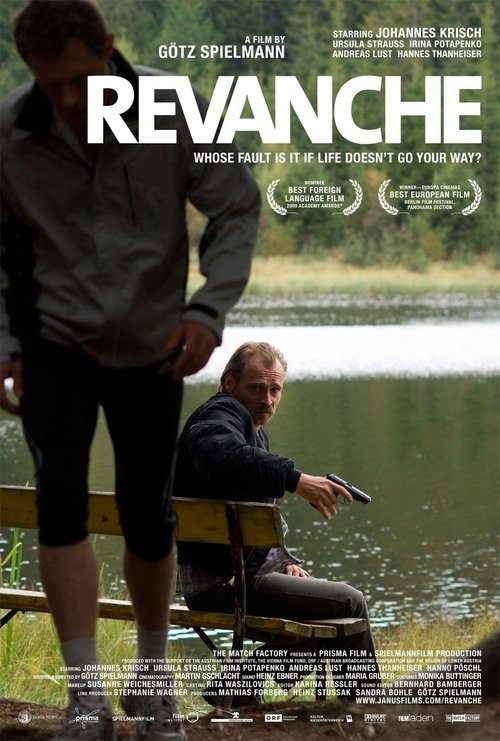
Revanche
2008 · Götz Spielmann
For when you want a slow-burn thriller with a soul — something that trades jolts for moral weight and stays with you for days. A challenge in pace, a reward in depth.
What it's about
Alex works security at a Vienna brothel and is quietly planning an escape with Tamara, the woman he loves, who works there too. His way out is a bank robbery in the countryside — and when the plan goes wrong, his life becomes entangled with a rural police officer and the officer's troubled marriage. On an isolated farm, grief, guilt, and the pull of revenge circle each other.
The experience
It starts as a taut crime thriller and then goes quiet — long, patient scenes where the tension is all interior, and the question of what Alex will do hangs over every ordinary chore. Austere but deeply absorbing; it earns its stillness.
The craft
Götz Spielmann shoots with rigorous restraint: static compositions, natural sound, no score telling you what to feel, so a man chopping wood can carry as much dread as any chase. The rural landscapes and the silence between characters do the heavy lifting.
Why it matters
An Academy Award nominee for Best Foreign Language Film and one of the defining works of Austria's severe, morally serious cinema of the 2000s.
Snapshot
Revanche is an Austrian crime drama that begins as a heist-and-escape thriller and quietly metamorphoses into a study of grief, guilt, and the temptation of revenge — the meaning encoded in its title, which in German carries the double sense of "revenge" and "rematch." Written and directed by Götz Spielmann, the film follows Alex, an ex-convict working security at a Vienna brothel, and Tamara, a Ukrainian sex worker with whom he plans to flee. A botched bank robbery in the countryside ends in Tamara's death when a rural policeman fires at their fleeing car, and the remainder of the film unfolds on and around Alex's grandfather's isolated farm, where the lives of the grieving fugitive, the guilt-stricken officer, and the officer's childless wife become fatally entangled. The film is best understood as a work of the Austrian New Wave: austere, morally serious, formally rigorous, and deeply suspicious of the catharsis its genre framework seems to promise. It earned Austria an Academy Award nomination for Best Foreign Language Film and became one of the most internationally visible Austrian films of its decade, later canonized through a Criterion Collection release.
Industry & production
Revanche was produced within the ecosystem of Austrian art-cinema production that matured in the 1990s and 2000s on the strength of public subsidy — chiefly the Austrian Film Institute (Österreichisches Filminstitut), the Vienna Film Fund, and the public broadcaster ORF, whose co-financing has underwritten much of the country's auteur output. Spielmann worked with his own production base; the film was made through Prisma Film, the Vienna company with which he had long been associated. This is a modestly budgeted national production rather than an international co-production spectacle, and its economy is visible on screen in the concentration of resources: few locations, a small principal cast, natural light, and no reliance on effects or spectacle.
The film's commercial afterlife was disproportionate to its scale. It traveled the 2008 festival circuit and was picked up for North American distribution, where it accumulated strong critical notices, and its selection as Austria's official submission to the 81st Academy Awards — culminating in a nomination for Best Foreign Language Film — gave it a visibility rare for a low-budget Austrian drama. Its subsequent home-video release under the Criterion Collection cemented its status as a reference title. I do not have reliable box-office figures and will not invent them; the film's significance is better measured in critical and canonical terms than commercial ones.
Technology
Revanche was made with conventional, unshowy production technology at a moment when Austrian art cinema had not yet uniformly migrated to digital capture, and its images have the grain, density, and tonal depth associated with photochemical origination. Whatever the precise capture format, the decisive technological choices are subtractive rather than additive: available and naturalistic lighting, a fixed or minimally mobile camera, and a soundtrack built almost entirely from location and diegetic sound. The film is notable — and frequently remarked upon — for its near-total refusal of non-diegetic music. What music exists tends to arise within the world of the story, above all the accordion played on the farm. This is a technological aesthetic of restraint: the apparatus is present but effaced, and the film's power derives from what it withholds.
Technique
Cinematography
The cinematography, by Martin Gschlacht — one of the defining camera artists of contemporary Austrian cinema, whose work spans the films of directors including Jessica Hausner — is the film's signature achievement. Gschlacht favors static, carefully composed frames held long enough to become uncomfortable, using the fixed camera as an instrument of moral attention rather than distance. The visual grammar draws a sharp contrast between the cramped, artificially lit interiors of the Vienna brothel and the open, naturally lit expanse of the rural farm, so that the film's movement from city to country is also a movement into a different register of light and space. Compositions repeatedly frame characters through doorways, windows, and the geometry of the landscape, holding them within the world rather than isolating them from it. Depth of field and the placement of figures within the frame do much of the film's dramatic work; Gschlacht lets significance accrue through duration and stillness.
Editing
The editing — credited, per the standard record, to Karina Ressler — is patient and elliptical, honoring the long take rather than fragmenting it. Cuts tend to fall between scenes rather than within them, and the film trusts sustained shots to carry tension and emotion without the accelerating rhythm conventional to the thriller. The most consequential violence is handled with deliberate economy, refusing the coverage and montage that genre cinema would ordinarily lavish on a shooting. This editorial reticence is central to the film's ethical stance: it declines to convert catastrophe into spectacle.
Mise-en-scène / staging
Spielmann's staging is organized around labor and repetition. The recurring image of Alex splitting wood on the farm is the film's central physical motif — an image of grief and rage discharged into manual work, and of a body trying to exhaust itself. The two worlds of the film are staged as moral environments: the brothel as a place of transactional confinement, the farm as a place of elemental exposure. Objects and gestures — a gun, an accordion, the routines of chores and meals — are arranged so that the drama emerges from the accumulation of small, concrete actions rather than from dialogue. The staging keeps its characters embedded in physical space, and the intersecting lives of Alex, the policeman Robert, and Robert's wife Susanne are choreographed across a rural geography compressed enough that revenge is always within reach.
Sound
Sound is arguably the film's most distinctive technical dimension. In place of a musical score, Revanche offers an intensely detailed field of ambient sound — wind, water, birds, the physical noise of the axe and the wood, the mechanical hum of the city. The near-absence of underscoring removes the emotional guidance a conventional score provides and forces the viewer into unmediated attention. The accordion, played diegetically, becomes all the more charged for being nearly the only music in the film. Silence is used structurally, as a space in which guilt and grief become audible precisely because nothing covers them.
Performance
The performances are calibrated to the film's realism and restraint. Johannes Krisch, as Alex, gives a coiled, interiorized performance in which rage is largely suppressed and legible mainly in the body — the labor, the stillness, the withheld violence. Andreas Lust plays Robert, the policeman, as a decent man unmoored by guilt, and Ursula Strauss brings a grave tenderness to Susanne, whose childlessness and quiet dissatisfaction draw her toward Alex. Irina Potapenko's Tamara, present for only the first movement of the film, establishes the emotional stakes that haunt everything after. Hannes Thanheiser, as Alex's grandfather, anchors the farm sequences with an unforced, almost documentary gravity. The ensemble works in a naturalistic key that refuses melodrama.
Narrative & dramatic mode
The film's most striking structural feature is its genre bifurcation. It opens in the mode of a lean crime thriller — the brothel, the plan, the escape, the robbery — and then, at the moment of Tamara's death, it abandons the thriller's momentum and settles into the slow, observational mode of the psychological drama. What had looked like a story about a heist becomes a story about aftermath. The dramatic engine is dramatic irony: the audience understands the web of connections among the characters — Alex's grief, his revenge fantasy, Robert's guilt, Susanne's involvement with the man who has reason to destroy her husband — while the characters themselves remain partially blind to one another. Suspense is generated not by action but by proximity, by the possibility that Alex will act on his desire for revanche. The film's resolution is deliberately anti-cathartic, redirecting the revenge plot toward something closer to release, endurance, and moral ambiguity.
Genre & cycle
Revanche sits at the intersection of crime, drama, romance, and thriller, but it belongs to a specifically art-cinema lineage that uses genre scaffolding to explore ethical and existential questions. It participates in a broader tendency in European auteur cinema to appropriate the machinery of the thriller — the crime, the getaway, the pursuit — while suppressing its pleasures in favor of moral inquiry. The revenge-narrative tradition provides the film's title and its expected trajectory, but the film systematically disappoints the genre's demand for retribution. In this it aligns with a cycle of contemporary "slow" crime dramas that treat violence as consequence rather than climax.
Authorship & method
The film is comprehensively Spielmann's: he wrote and directed it, and its method reflects a coherent authorial sensibility built on restraint, long takes, moral seriousness, and the refusal of easy resolution. Spielmann, who came to film after theatrical training, constructs drama through situation and behavior rather than exposition. His most important collaborator is cinematographer Martin Gschlacht, whose static, composed, naturally lit images are inseparable from the film's meaning and who is among the most significant figures in contemporary Austrian cinematography. The editing, credited to Karina Ressler, sustains the film's patient rhythm. The most conspicuous authorial choice concerns music: rather than commissioning a conventional score, Spielmann builds the film's aural world from diegetic sound and near-silence, so that the "composition" of the film is effectively a sound-design decision. The result is a work in which direction, camera, cutting, and sound speak with a single, disciplined voice.
Movement / national cinema
Revanche is a central document of the Austrian New Wave — the remarkable efflorescence of Austrian auteur cinema associated with Michael Haneke, Ulrich Seidl, Barbara Albert, Jessica Hausner, and Spielmann himself, sustained by the country's system of public film subsidy. This cinema is characterized by formal austerity, an unflinching gaze at violence and social malaise, a suspicion of sentiment, and a moral rigor that can shade into severity. Spielmann shares this milieu's commitment to the long take, the composed frame, and the refusal of consolation, though Revanche is somewhat warmer and more redemptively inclined than the most confrontational works of Haneke or Seidl. It also participates in that cinema's recurring attention to Austria's social margins — here, the migrant sex economy of Vienna and the isolation of rural life — and to the porous, uneasy relationship between city and country.
Era / period
The film is a product of the mid-to-late 2000s, a high-water mark for Austrian art cinema's international standing and for a broader European mode of slow, observational, morally inflected filmmaking. Its concerns are contemporary rather than historical: the transnational labor of the sex trade, migration from Eastern Europe, and the private disappointments of ordinary provincial lives. Made near the end of the celluloid era and before the full normalization of digital art cinema, it belongs to a moment when the photochemical image and the sparse, ambient soundtrack could still be deployed as deliberate aesthetic statements rather than nostalgic gestures.
Themes
The film's governing theme is revenge and its renunciation — the gap between the desire for retribution and the recognition of its futility. Around this pivot cluster the film's other preoccupations: guilt, both criminal and moral, distributed across Alex and Robert alike; grief and the labor of mourning, literalized in the endless splitting of wood; chance and fate, since the entire tragedy turns on a single contingent shot; and the possibility of redemption without resolution. Fertility and its absence run beneath the surface — Susanne's childlessness set against the film's larger economy of loss — and the recurring contrast between confinement and openness, city and country, gives the moral drama a spatial form. Above all, the film is concerned with how ordinary people absorb catastrophe and continue living, and with whether one can be released from guilt without ever being absolved.
Reception, canon & influence
Revanche was widely praised on its international release, singled out for the rigor of its form, the intelligence of its genre subversion, and the restraint of its performances and sound design; critics repeatedly noted the way the film withholds musical score and easy catharsis. Its nomination for the Academy Award for Best Foreign Language Film — Austria's official submission at the 81st ceremony — brought it a level of attention unusual for a film of its scale, and its subsequent Criterion Collection release confirmed its passage into the art-cinema canon as a touchstone of 2000s Austrian filmmaking.
Backward, the film draws on the tradition of European auteur crime cinema that uses genre as a vehicle for moral inquiry, and on the specific formal vocabulary of the Austrian New Wave — the long take, the composed frame, the ambient soundtrack — inherited from and shared with figures such as Haneke and Seidl. Its revenge narrative engages a deep tradition of retribution stories precisely in order to refuse them. Forward, its influence is best understood as exemplary rather than schematic: it stands as one of the most admired demonstrations that a thriller premise can be redirected into patient ethical drama, and it consolidated the international reputation of both Spielmann and cinematographer Martin Gschlacht. Tracing a precise line of descent from Revanche to specific later films would risk overstatement, and the honest account is that its legacy lies chiefly in its status as a model of restrained, morally serious genre cinema and as a defining work of Austria's remarkable cinematic decade.
Reception
Acclaimed from the start — an Oscar nomination and a Criterion release within two years — yet it never broke out beyond the arthouse; today it's less 'reappraised' than perpetually rediscovered, the film cinephiles keep pressing on each other.
How Revanche was received, from release to now →
How to watch Revanche: what to notice on a first viewing
- Watch how long the camera holds a shot. Gschlacht favors static, carefully composed frames held long enough to feel uncomfortable, using stillness as a form of attention rather than distance. The held shot asks you to keep looking at something most films would cut away from.
- Watch the light change between the brothel and the farm. Cramped, artificially lit city interiors give way to open, naturally lit rural expanse once the story moves to the countryside. The shift in light marks a shift in what kind of story you're watching, before the plot explains it.
- Watch Alex splitting wood, and how often it recurs. The recurring image of the axe and the woodpile becomes the film's central physical motif, a body working itself toward exhaustion. It's labor standing in for feeling the film never has him say out loud.
- Listen for how little music plays under any scene. In place of a score, the soundtrack is built almost entirely from wind, water, birds, and the mechanical noise of the city and farm. Nothing covers the silence, so whatever guilt or grief is building has nowhere to hide.
- Watch how little Alex's face gives away. Krisch plays him coiled and interiorized, with rage legible mainly in posture and stillness rather than open expression. You're left reading his body the way you'd read a stranger's, guessing at what's underneath.
The whole guide to watching Revanche, with the keys for a rewatch →
Influences: the films it descends from and the films it influenced
- Pickpocket (1959) — Establishes the model of crime-as-moral-inquiry built from behavioral 'models' rather than expressive acting, the flat affect and downcast restraint that Spielmann's naturalistic performances inherit in place of thriller emotion.
- L'Argent (1983) — Codifies elliptical off-screen violence and the chain-of-consequence structure driven by money, cutting away from the fatal act exactly as Revanche withholds and displaces its own killing.
- A Short Film About Killing (1988) — Redirects a genre murder into an austere ethical dossier through desaturated compositions and a refusal of the thriller's cathartic beats — the same 'use genre to indict genre' method.
- L'Avventura (1960) — Pioneers narrative genre-bifurcation, abandoning its own disappearance/mystery premise midway to become a patient study of guilt and drift — the structural rupture Revanche stages between heist-thriller and rural moral drama.
- The Seventh Continent (1989) — Sets the Austrian New Wave grammar of static composed frames, labor-and-repetition captured in near-real time, and a soundtrack of diegetic-only noise that Spielmann adopts wholesale.
- Dog Days (2001) — Shot by Revanche's own cinematographer Martin Gschlacht, whose frontal static tableaux and hard natural light establish the exact composed-frame vocabulary Spielmann reuses.
- Le Fils (The Son) (2002) — Models the same revenge-and-renunciation arc — a grieving man in proximity to the one responsible for a death — resolved through withheld, naturalistic restraint rather than a confrontation payoff.
- The Robber (2010) — Another Austrian redirection of a thriller premise (the serial bank-robber) into cool, observational anti-psychology, replacing genre momentum with repetitive physical labor and flat affect.
- Michael (2011) — Applies Revanche's discipline to abhorrent material via static frames, domestic labor-and-repetition, and elliptical withholding of violence, trusting behavior and dramatic irony over exposition.
- Goodnight Mommy (2014) — Shot by Martin Gschlacht, it inherits his rigid symmetrical compositions and hard natural light, weaponizing dramatic irony and elliptical withholding within a genre frame the way Spielmann did.
- Blue Ruin (2013) — An international sibling in revenge-thriller subversion: it strips the vengeance premise of competence and payoff, rendering violence clumsy, consequential, and anti-cathartic rather than triumphant.
- Caché (2005) — Contemporary Austrian crime built on the long static take, a complete absence of non-diegetic score, and sustained dramatic irony in which the audience holds knowledge the characters lack.
- Import/Export (2007) — A Gschlacht-shot companion piece using the same locked-off wide frames, natural light, and staging of menial labor to make behavior rather than dialogue carry the drama.
- Lourdes (2009) — Also photographed by Gschlacht, it deploys the identical toolkit of symmetrical composed frames, diegetic-only sound, and near-total absence of score to withhold emotional cueing and refuse catharsis.
- The White Ribbon (2009) — Extends the Austrian austere method — rigorously composed frames, no score, ambient sound, and moral guilt left deliberately unresolved — into a period register.
- Amour Fou (2014) — A Gschlacht-lit continuation of the composed-frame, natural-light, score-averse aesthetic, staging a death-pact narrative with the same anti-cathartic detachment.
Similar films
- The White Ribbon (2009) — influence & lineage
- The Baader Meinhof Complex (2008) — shared sensibility
- The Mastermind (2025) — shared sensibility
- The Butcher (1970) — shared sensibility
- No Country for Old Men (2007) — shared sensibility
- The American (2010) — shared sensibility
- Ripley's Game (2002) — shared sensibility
- Amour (2012) — shared sensibility