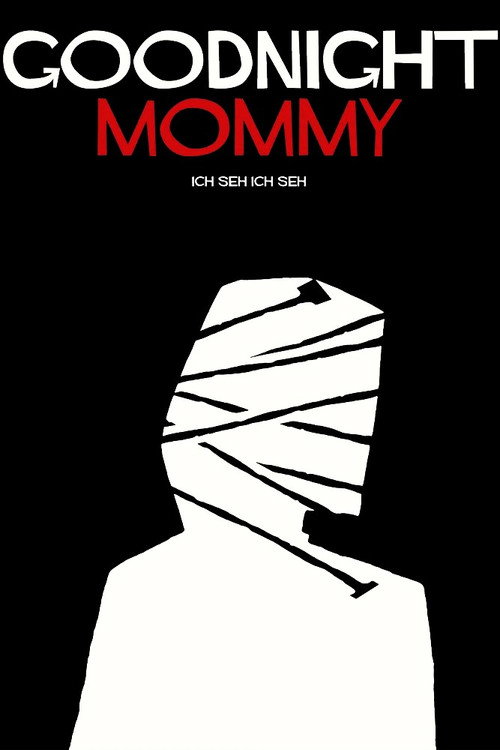
Goodnight Mommy
2015 · Severin Fiala
In the heat of the summer lays a lonesome house in the countryside where nine year old twin brothers await their mother’s return. When she comes home, bandaged after cosmetic surgery, nothing is like before and the children start to doubt whether this woman is actually who she says she is.
Snapshot
Goodnight Mommy (original title Ich seh, Ich seh, "I See, I See") is an Austrian psychological horror film written and directed by Veronika Franz and Severin Fiala. Sightlines' metadata credits Fiala alone, but the film is a co-direction, and all serious discussion of it treats Franz and Fiala as joint authors. It premiered in the Orizzonti section of the Venice Film Festival in 2014, played the Toronto International Film Festival's Vanguard programme, and reached English-language audiences in 2015. That release dated it to the year it became internationally known, and it is the year Sightlines uses.
The premise is very simple. Twin boys, Elias and Lukas, spend a hot summer in an isolated modernist house among cornfields and woods. Their mother comes home from cosmetic surgery with her face wrapped in bandages, and she is cold, strict and strange. The boys decide she is not their mother. What begins as a Grimm-like suspicion about a substitute parent turns into a long and very hard sequence of captivity and torture. A late revelation then recasts everything: Lukas died before the film began, and Elias has been imagining him. The family is falling apart through grief, guilt and denial, and the supernatural plays no part.
The film became one of the most discussed European horror titles of the mid-2010s. It was Austria's official submission for the Academy Award for Best Foreign Language Film and was not nominated. A widely seen trailer helped make it an international word-of-mouth success, and it was remade in English in 2022. It belongs to a moment when the European art film and the horror film met openly. It brought the Austrian cinema of cruelty, associated with Michael Haneke and Ulrich Seidl, into the language of genre.
Industry & production
The film was produced by Ulrich Seidl Film Produktion, with Ulrich Seidl as producer. The personal links matter. Veronika Franz is Seidl's longtime partner and had co-written his films for years, including the Paradise trilogy (2012–13). Severin Fiala is Seidl's nephew. The project therefore came out of one of the most distinctive production companies in Austrian cinema, a company known for patient shooting schedules, non-professional performers and a tolerance for discomfort. It was not, however, made in Seidl's documentary-inflected style. Franz and Fiala chose to make a genre film inside that house.
Before this feature, Franz and Fiala had made the documentary Kern (2012), a portrait of the Austrian actor and director Peter Kern. Franz had also worked as a film critic before she moved into screenwriting. Goodnight Mommy was their first fiction feature.
Financing came through the usual Austrian public channels for a film of this kind, such as the Austrian Film Institute and regional and broadcaster support. A detailed public breakdown of the budget is not part of the readily available record. The film was modest in scale: one main location, three principal performers and a handful of supporting players.
International distribution followed the festival run. In the United States the film was released by RADiUS-TWC, the Weinstein Company's specialty label, in 2015. Its English-language marketing, and especially a trailer that circulated widely online, presented it more plainly as a horror film than its Venice launch had. That framing broadened its audience and also shaped expectations about the twist. Commentators at the time noted that the trailer's popularity raised the film's profile far beyond that of a typical Austrian art-house release. Reliable gross figures are not given here.
Technology
By the directors' own account and the production's publicity, the film was shot on 35mm film rather than digitally. That choice sat against the industry's rapid move to digital capture in the mid-2010s. The details of the camera package and stocks are not well documented in accessible sources and should not be overstated. The visible result is a clean, high-key image with a fine texture. Summer light floods the house's glass walls and pale surfaces.
The film relies on practical effects. Its most notorious moments, such as glue sealing a mouth shut, a magnifying glass focused on skin, wounds and the cockroaches, are handled with prosthetics, real insects and careful framing, not digital spectacle. Most of the horror comes from implication and duration rather than effects work.
Technique
Cinematography
Martin Gschlacht, one of Austria's leading cinematographers and a frequent collaborator in the Austrian new wave (he shot Jessica Hausner's Lourdes among others), shot the film. His images are formal and symmetrical, with locked-off or very slow camera movement. The compositions often use the house's architecture: long horizontal windows, framed doorways and frosted glass that turns figures into silhouettes.
The look is unusual for horror because it avoids darkness. Much of the film takes place in bright daylight, among golden cornfields, a still lake and white interiors. The menace is built into clarity, not shadow, a strategy that ties the film to Haneke's clinical exposure of violence. When night does come, Gschlacht keeps the darkness controlled. Torchlight, flashlights and the glow of a fire pick out details without the stylised gloom typical of studio horror.
The bandaged face is the film's central visual problem, and the camera returns to it obsessively. It frames the mother in partial views, through glass, from behind and in mirrors, so the audience shares the boys' uncertainty about what is under the gauze and, later, under the healed skin.
Editing
Michael Palm, an Austrian editor and filmmaker with a background in experimental and essay film, edited the film. The cutting is patient. Scenes hold past the point of comfort, and the film's sense of dread comes from rhythm rather than shock cuts: long stretches of near-inactivity broken by sudden, very physical violence.
The editing also has to conceal the film's central secret. Lukas is not physically present to anyone except Elias, so the cutting and framing quietly arrange that the mother never addresses him directly. Two-shots, shot/reverse-shot patterns and the placement of the twins are built to survive a second viewing, when that pattern becomes legible. This careful, fair-play construction is a large part of why the twist reads as an earned reframing and not a cheat, although critics differed on how successful it is.
Mise-en-scène / staging
The house is effectively the film's third main character. It is an austere, angular modernist building of concrete, glass and open-plan rooms, set apart from any village, and it combines luxury with alienation. Interiors are sparsely furnished, and the décor includes blurred or ghostly photographic portraits of the mother. These make identity and a vanishing face a design motif. The boys' world includes a bedroom, a cellar, the cornfield, a forest, a lake, a crypt-like ruin and their collection of insects, most memorably Madagascar hissing cockroaches. These spaces mix childhood play with morbid curiosity.
The staging draws on fairy tale and folk-horror imagery. Two children wander dark woods and fields, a parent may be an impostor, and there is a house where the adult world becomes a trap. Halloween-style masks, the mother's gauze and the twins' identical clothing all treat the face and the double as things to be worn and swapped. The film's opening, with archival footage of the Trapp family singing Brahms' lullaby "Guten Abend, gut' Nacht", sets an ironic register right away. It invokes a sentimental, postcard image of Austrian family harmony that the film goes on to take apart.
Sound
The soundtrack is restrained. There is little conventional scoring, and the film avoids the stingers and swelling cues of mainstream horror. Ambient sound carries most of the work: wind in the corn, insects, the creak of the house, water, children's whispered voices, and the mother's sudden harsh commands. Silence is used as a pressure.
Brahms' lullaby works as the film's ironic signature, and its title, Ich seh, Ich seh, echoes the German version of the children's game "I spy". Both point to childhood, sight and recognition. Specific sound credits beyond the department crew are not prominent in the critical literature.
Performance
Susanne Wuest plays the mother and gives the film's most technically demanding performance. For much of the running time her face is bandaged, and she has to work through posture, voice and eyes. Her performance has to support two readings at once. On first viewing she is a frightening, possibly false parent. In retrospect she is a grieving woman whose surviving son refuses to acknowledge his brother's death. Her severity is ambiguous enough to sustain both.
The twins are played by the real-life twins Lukas and Elias Schwarz, who were non-professionals. The use of non-professional performers continues Seidl's practice. The directors have described working with the boys carefully, partly by withholding the full story, and have described shooting in a largely chronological order so the children's understanding developed with the film's events. This should be read as the filmmakers' own account and not as independently documented. The boys' unaffected, often eerily calm presence is central to the film's power. They never play "evil children" in the theatrical manner of the genre's tradition.
Narrative & dramatic mode
The film is built on restricted, unreliable focalisation. The audience mostly shares Elias's point of view without knowing it, so the narrative's suspicion of the mother is really Elias's delusion and grief made visible. The structure has two acts. A slow-burn mystery about the mother's identity gives way to a captivity drama in which the boys tie her up and interrogate her. Their "tests" turn into torture.
The late reveal that Lukas is dead converts the film from a "who is she?" story into a "what happened to them?" story. In retrospect, the mother's refusal to "see" Lukas becomes grief rather than cruelty, and Elias's violence becomes the extreme form of a child's refusal to accept a loss. A lingering backstory, the parents' separation and an accident in which Lukas died, is withheld or only sketched. The film prefers to leave guilt and causation partly uncertain.
The dramatic mode is cruel fable rather than psychological realism. The film moves through deliberate, almost ritual stages, such as an intrusion by Red Cross collectors and an escalating set of punishments. It ends in fire, with a final dreamlike image of mother and sons reunited in a field of corn. That coda's sentimental tableau, which echoes the opening lullaby, is open to interpretation as death, fantasy or reconciliation.
Genre & cycle
Goodnight Mommy sits at the meeting point of several traditions:
- The evil-or-uncanny child film. It descends from The Other (Robert Mulligan, 1972), whose concealed dead twin is the clearest narrative precedent. Many critics cited it. Further back are The Bad Seed (1956) and The Innocents (1961).
- The impostor-identity or face thriller. The bandaged face recalls Georges Franju's Eyes Without a Face (1960) and the wider tradition of masks and surgical identity.
- The home-invasion and captivity film. It echoes Haneke's Funny Games (1997), with its tormentors in a bourgeois country house, reflexive cruelty and refusal of catharsis.
- Folk-horror and fairy tale. These include Hansel and Gretel and the changeling motif.
Its most important cycle placement is in the wave of mid-2010s art-horror sometimes labelled, contentiously, "elevated horror". This includes The Babadook (2014), which is also about a grieving mother and a son, It Follows (2014), The Witch (2015) and later Hereditary (2018). These films used horror's forms to explore grief, trauma and family breakdown, gained critical respectability and reached young, online-savvy audiences. Goodnight Mommy was one of the European contributions to this cycle and among the most uncompromising.
Authorship & method
Veronika Franz and Severin Fiala write and direct as a pair, and the partnership has continued. Goodnight Mommy established a signature that ran through their later work: isolated settings, children or caregivers in psychological breakdown, rigorous framing, and violence that is unbearable precisely because it is clear. Their English-language film The Lodge (2019) again centres on children, a woman in a substitute-mother position, isolation and doubted perception. Des Teufels Bad (The Devil's Bath, 2024), an Austrian period film about an 18th-century woman driven to violence by depression, extends their interest in religious and familial pressure on women. It won the Silver Bear for outstanding artistic contribution at the Berlinale for Martin Gschlacht's cinematography.
Their method takes much from the Seidl school, including its long preparation, non-professional performers, an interest in Austrian bourgeois space and the refusal to make the viewer comfortable. They pair this with an open embrace of genre devices such as the twist, the shock image and the horror set-piece. Franz's background as a critic and Seidl collaborator, and Fiala's as a younger cinephile filmmaker, are often cited as complementary. Detailed accounts of how they divide labour are mostly found in interviews and should not be fixed more precisely than that.
Key collaborators:
- Martin Gschlacht (cinematography): an established Austrian DP whose clinical, luminous framing defines the film's look. The collaboration continued into later Franz/Fiala films.
- Michael Palm (editing): an editor and essay filmmaker whose control of duration and concealment is essential to the twist.
- Ulrich Seidl (producer): provided the company, the industrial base and an aesthetic context.
- Susanne Wuest, Lukas Schwarz and Elias Schwarz (cast).
There is no prominent credited composer whose score is central to the film's identity. The music relies mainly on pre-existing material and ambient sound.
Movement / national cinema
The film belongs to contemporary Austrian cinema, a national cinema that gained unusual international standing from the 1990s onward. It did so through Michael Haneke, Ulrich Seidl, Jessica Hausner, Barbara Albert, Götz Spielmann and others, often grouped loosely as a "new Austrian cinema" or Austrian new wave. That cinema is known for formal rigour, long takes, detached observation and a harsh critique of bourgeois comfort, family and Austria's postwar self-image. Recurring figures include the cellar, the hidden crime and the respectable façade over violence.
Goodnight Mommy adapts those traits to genre. The opening Trapp family lullaby, with its echo of The Sound of Music-style Austrian kitsch, is a deliberate gesture of national irony. It sets a sentimental exported image of Austrian family harmony against a story of violence in an expensive, isolated home. Critics often linked the film's captivity imagery and its interest in secret rooms and closed houses to an Austrian tradition of uncanny domestic confinement. Such links are interpretive, and the filmmakers have not presented the film as an allegory of any specific case.
The film is also part of a broader Central European turn to genre in the 2010s. Art-house-trained filmmakers in the German-speaking world increasingly made horror and thriller films for international festival and streaming circuits.
Era / period
The film was made in the early 2010s and launched internationally in 2014–15, a period shaped by:
- The festival-to-genre pipeline. Major festivals (Venice, Toronto, Sundance) began programming horror in competitive or curated sidebars. Toronto's Vanguard and Midnight Madness programmes became key launch platforms.
- The rise of specialty distributors and online trailer culture. A trailer could make a small foreign-language film a viral object. Goodnight Mommy is a clear example, and its English-language marketing reached far beyond the usual art-house audience.
- The critical legitimisation of horror under the "elevated horror" label. The film's reception was part of that conversation.
- The late transition from celluloid to digital, which makes its 35mm capture a mark of aesthetic choice.
Its contemporary world of cosmetic surgery, a wealthy single-parent household and a television career hinted at for the mother also places it in a 2010s concern with self-image, appearance and the managed face.
Themes
Identity and the face. The bandages make the face a question: is this person the same person? The film links cosmetic surgery, recognition and love, and asks whether children love a parent or the parent's familiar image.
Grief and denial. Read backward, the film is a study of mourning gone wrong. A child refuses to accept his twin's death, a mother cannot reach her surviving son, and the house holds a loss nobody names.
Doubles and twins. The twin is the oldest image of the double. Lukas is both brother and projection, a part of Elias that will not die. The motif extends to the mirrored blurry portraits and identical clothes.
Seeing and not seeing. The title Ich seh, Ich seh ("I spy") turns perception into the theme. The mother "doesn't see" Lukas, the boys "see" an impostor, and the audience is made to see as Elias sees.
The family as a site of violence. The film follows the Austrian critique of bourgeois domesticity. The modernist home, wealth and the image of family harmony hide coldness, guilt and the potential for violence.
Childhood cruelty and innocence. The boys' games of collecting insects, wearing masks and playing in the woods slide into torture without any change in their calm. The film refuses the clean opposition between innocent child and monstrous adult.
Motherhood under scrutiny. The mother is judged, interrogated and punished. The film, like The Babadook, explores the ambivalence and exhaustion of a mother's role, but from the child's accusatory side.
Reception, canon & influence
Critical reception. The film was received strongly on the festival circuit and in its 2015 English-language release. Critics praised its compositions, Wuest's performance, the twins' unnerving naturalism and its sustained, unbearable tension. Many reviewers, often favourably, placed it in the line of Haneke. Reservations focused on two points. One was the twist, which some found predictable or felt was signalled too early, especially by viewers primed by the genre's precedents. The other was the escalating violence of the final act, which some found gratuitous or emotionally exhausting rather than illuminating. The film nonetheless became one of the most discussed non-English horror films of its year and a recurring presence on lists of the best horror films of the 2010s. In Austria it was recognised at national film awards. The precise categories are not recorded here and should be checked against the Österreichischer Filmpreis records. Its selection as Austria's Oscar submission confirmed its national standing.
Influences on the film (backward).
- The Other (1972): the concealed dead twin and a child's identity confusion.
- Eyes Without a Face (1960): surgical faces, the mask, the uncanny of the bandaged head.
- Les Diaboliques (1955) and the tradition of the trick-structured psychological thriller.
- Michael Haneke, especially Funny Games (1997) and The White Ribbon (2009) with its cruel children. Critics consistently cited his clinical, reflexive treatment of violence.
- The cinema of Ulrich Seidl: the observational frame, the Austrian domestic interior, non-professional performers.
- Fairy-tale and folk-horror traditions: Hansel and Gretel and the changeling.
Legacy and influence (forward).
- The Franz/Fiala career. The film launched their international career, leading directly to The Lodge (2019), produced in English with Hammer Films' involvement, and The Devil's Bath (2024). All are recognisably extensions of its concerns.
- The 2022 American remake. Goodnight Mommy, directed by Matt Sobel and starring Naomi Watts, was released on Amazon Prime Video. It was widely reviewed as a softer, less effective version of the original, and that reception reinforced the 2014/15 film's status.
- The European art-horror cycle. The film is regularly cited alongside The Babadook as a defining work of mid-2010s grief horror. It helped establish a template, since followed by many films, in which the horror plot is revealed as the outward form of a family trauma, especially grief over a dead child.
- The festival-genre economy. Its path from Venice and Toronto to wide international attention through a viral trailer became a common model for later international horror films.
Within Sightlines, Goodnight Mommy is best placed at a crossroads. It is where the Austrian cinema of clinical cruelty enters international genre filmmaking, and where the twin, the mask and the false parent meet the 2010s horror of grief.
Influences: the films it descends from and the films it influenced
- A Tale of Two Sisters (2003) — Pairs siblings against an ambiguous maternal figure whose true status is withheld, leaning on double-legibility performances and a late reframing twist.
- The Skin I Live In (2011) — Confines its dread to an isolated modernist villa and withholds an identity twist about the person behind the altered face, echoing the seed's captivity-plus-reveal machinery.
- Orphan (2009) — Cold, symmetrical domestic horror in which children menace a mother and a key identity is withheld until a reframing reveal — the withholding-then-reversal structure applied as art-house minimalism.
- Revanche (2008) — Shot by Martin Gschlacht, it inherits his rigid symmetrical compositions and hard natural light, weaponizing dramatic irony and elliptical withholding within a genre frame the way Spielmann did.
- The Good Son (1993) — It reworks the two-boy structure of The Other and The Good Son around grief and a mother figure, putting cruelty in still, sunlit, catalogue-clean rural spaces.
- The Babadook (2014) — Same-year maternal-ambiguity horror in which the mother becomes the locus of dread and the supernatural-versus-psychological boundary is deliberately blurred to the end.
- Bring Her Back (2025) — A domestic chamber of children and an uncanny maternal figure driven by perceptual unreliability and a withheld truth about who is caregiver and who is threat.
- Marrowbone (2017) — Sibling blocking that conceals a head-count: the children are framed and cut so the audience is never permitted to audit whether both are present — the same withholding strategy governing Marrowbone's group staging.