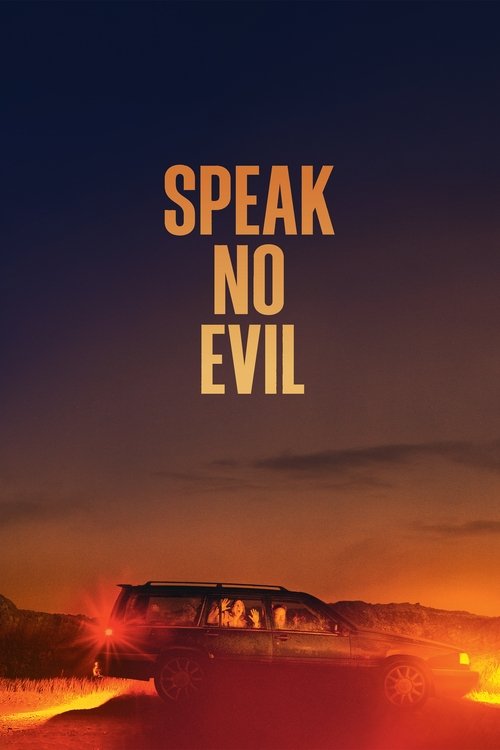
Speak No Evil
2022 · Christian Tafdrup
For when you want horror that gets under your skin socially, not just viscerally — the kind you watch through your fingers because of a dinner conversation. A bleak, confrontational pick; absolutely not a feel-good night.
What it's about
On holiday in Tuscany, a reserved Danish couple hits it off with a charismatic Dutch couple, and weeks later they accept an invitation to spend a weekend at the Dutch family's remote farmhouse with their young daughter. The hosts' little rudenesses and boundary-crossings begin to pile up — and at every turn, the Danes' politeness and fear of making a scene override their instincts to leave.
The experience
Excruciating in the best way: it runs on cringe before it runs on fear, every awkward dinner and overstepped boundary ratcheting the dread a notch tighter. The comedy of manners curdles so gradually that by the time it tips into horror, you're implicated — you also kept hoping it would be fine.
Performances
Morten Burian is quietly devastating as a man whose yearning to be liked becomes his undoing, and Fedja van Huêt makes charm itself feel predatory — his warmth always a half-degree off.
The craft
The Tafdrup brothers' script is a precision machine: every escalation is small enough to be explained away, which is exactly what makes it merciless. An ominous, swelling score plays against sunny, ordinary images, telling you from the first frames to trust your dread and not the smiles.
Why it matters
A Sundance sensation that became one of the most argued-about horror films of its year, it struck a nerve about the cost of politeness and was quickly remade in Hollywood.
Snapshot
Speak No Evil (Danish title Gæsterne, "The Guests") is a Danish–Dutch horror film directed by Christian Tafdrup and co-written with his brother Mads Tafdrup. It is a comedy of manners that slowly becomes an atrocity. On holiday in Tuscany, a reserved Danish couple, Bjørn (Morten Burian) and Louise (Sidsel Siem Koch), befriend an outgoing Dutch couple, Patrick (Fedja van Huêt) and Karin (Karina Smulders). Some weeks later they accept an invitation to spend a weekend at the Dutch family's remote farmhouse, bringing their young daughter Agnes (Liva Forsberg). Their hosts' small violations pile up: food the guests can't eat, intrusions on their privacy, cruelty toward the hosts' mute son Abel (Marius Damslev). Each time, the Danes' politeness and fear of making a scene win out over their instincts.
The film premiered in the Midnight section at the Sundance Film Festival in January 2022. Shudder released it in North America later that year. It became known as one of the bleakest horror films of its decade, mostly because of its ending, and Blumhouse remade it in English in 2024. In Sightlines, it sits where three lines meet: Scandinavian social satire about bourgeois conformity, the European "punishment" thriller in the tradition of Spoorloos and Funny Games, and the art-horror boom of the late 2010s and early 2020s.
Industry & production
The film was a Danish production by Profile Pictures, produced by Jacob Jarek, with Dutch co-production partners. Its funding fits the usual Nordic pattern for mid-budget auteur films: national film-institute support (the Danish Film Institute) combined with a European co-production partner. Here the co-production also suits the story, since the film is about the friction between two national temperaments. The available record on its budget, financing breakdown and funding bodies is thin, and this account makes no claims about them.
Tafdrup has said in interviews that the premise came from his own experience: on a holiday, he and his partner met a Dutch couple who later invited them to visit, and he started imagining what might happen if they went. The script grew from that ordinary scenario, a social obligation nobody quite knows how to turn down.
The cast is split by nationality, which matters to the film. Burian and Koch are Danish actors who were little known abroad. Van Huêt and Smulders are established Dutch performers. The film is in Danish, Dutch and English, and the English the two couples share serves as a neutral, slightly stilted middle ground. The story moves from Italy to the Netherlands, and both the Tuscan opening and the Dutch farmhouse are central to its design.
After Sundance, Shudder (AMC Networks' horror streaming service) acquired North American rights. Its release there in September 2022 gave the film a large international audience of genre fans, which a Danish art-horror title would rarely reach through theatrical distribution alone.
Technology
The film was shot digitally in a conventional, unshowy way, typical of contemporary Nordic art cinema. There is no notable technical innovation on record, and its effects work is restrained. Most of the violence happens in implication, in ellipsis or off-screen until the climax, and the climax relies on staging and editing more than prosthetic spectacle. The "technology" that matters most is the sound design and the orchestral score, which the film uses as an instrument of dread. These are discussed below.
Technique
Cinematography
Erik Molberg Hansen, a Danish cinematographer, shot the film. His images move from the bright Mediterranean light of the Tuscan opening to the overcast, flat grey-green of the Dutch countryside, so the shift in mood is mapped onto light and landscape. Interiors in the farmhouse are framed with a cool, documentary-like steadiness that keeps the audience in the same uneasy observing position as the Danes. The camera often holds on faces during awkward silences, making the viewer sit through the social discomfort instead of cutting it short.
Several compositions isolate the Danish family in wide frames against empty land, especially during car journeys and the night scenes. The opening is a notable gesture: an overhead shot of a car winding along a dark road, accompanied by the score. Before anything has happened, it announces that the film will be about a journey toward something terrible.
Editing
The film's rhythm is patient, almost glacial, for most of its running time, and that is a deliberate strategy. Scenes of social friction (the dinner where Louise, a vegetarian, is pressed to eat meat; the restaurant bill; the uncomfortable dance; the sleeping arrangements) are allowed to run long. Tension builds through accumulation, not shock cuts. A key structural turn is the Danes' early-morning flight from the farmhouse. Then Agnes's lost toy rabbit makes them turn back, and the couple let themselves be talked back into staying. Through that cutting, the film holds its moral premise: there were exits, and the characters declined to take them. The final act cuts more sharply and moves quickly toward its end, so the earlier slowness pays off as a sudden collapse. The editor's credit is not something this account can confirm with confidence, so it is not stated here.
Mise-en-scène / staging
The production design separates the two households sharply. The Danes' home is tidy, neutral and middle-class. The Dutch farmhouse is cluttered, rustic and slightly rundown, and initially reads as bohemian warmth. Staging often puts the Danes in positions of submission: seated while the hosts stand, sleeping where they are told, driven where Patrick chooses to drive. Each invasion of space is small on its own: Karin moves Agnes to sleep on a mattress in Abel's room, Patrick enters the bathroom while Louise is showering, the guests find photographs. The film's whole argument rests on that pattern of small violations adding up.
The climax takes place in a stone quarry. It is a stripped, almost primal location that ends the film's movement from civilization (Tuscany, restaurants, polite conversation) to something older and crueler. The image of the couple stoned to death there, unresisting, has an almost ritual or biblical quality.
Sound
Sune Kølster's score may be the film's most distinctive formal element. It is overtly operatic, using swelling strings and choral voices pitched at a register usually reserved for epic tragedy or supernatural horror. Laid over ordinary scenes like a car ride, a family breakfast or a drive to a restaurant, its grandeur first feels almost ironic, even comic. It warns of a catastrophe long before the narrative earns it, and the mismatch is unsettling in itself. By the end, the score's foreboding turns out to have been literally accurate. Critics often compared this approach to the use of classical and choral music in Stanley Kubrick's horror work, and the mix of irony and sincere doom is central to the film's tone.
The sound design otherwise favors silence and ambient room tone. The awkward pauses are audible, and the gap between what characters feel and what they say opens up in the quiet.
Performance
Morten Burian is the centre of the film. His Bjørn is a man with a vague, inarticulate dissatisfaction with his own comfortable life. That makes him susceptible to Patrick's apparent vitality and masculinity, and Burian plays the character's passivity without making him merely contemptible. Sidsel Siem Koch's Louise is sharper and more suspicious, and in several scenes she voices the audience's alarm. Her objections, though, keep dissolving under social pressure and her husband's reluctance.
Fedja van Huêt's Patrick is the film's great creation. He is charming, generous and physically expansive, and his warmth turns into aggression by such small degrees that it's hard to name the moment it changes. Karina Smulders matches him with a performance that switches between hospitable sweetness and wounded reproach. That reproach is a weapon: each time the guests object, the hosts recast the objection as their own hurt feelings. As Abel, the child actor Marius Damslev carries much of the film's horror without speech, which makes the eventual revelation about him all the more terrible.
Narrative & dramatic mode
The film has a three-movement structure: an idyll (Tuscany), an escalating stay at the farmhouse, and a catastrophe. Its dramatic mode is a cross between social satire and tragedy. For much of its length it plays like a cringe comedy of manners, close to the uncomfortable humour of Ruben Östlund. Some audiences laugh at the guests' contortions, and the film invites that laughter before punishing it.
The plot is built around a series of missed exits, where the characters could leave and choose not to. The final revelation comes in fragments: the hosts are not who they claimed to be. Abel is not their son but a previously abducted child whose tongue has been cut out. The couple have done this before and keep photographs of earlier families. They take Agnes, cut out her tongue as well, and kill Bjørn and Louise by stoning. Bjørn's last question is why they are doing this, and Patrick's answer is that the Danes let them. That line restates the film's thesis. Their villainy is opportunistic. It needs no motive beyond the victims' own compliance.
The ending refuses catharsis, rescue or justice, and it was the most debated aspect of the film. It works more as a moral fable than as suspense: the viewer is meant to leave implicated, not relieved.
Genre & cycle
Speak No Evil belongs to several overlapping genres and cycles:
- The home-invasion film in reverse. Here the victims are the guests, and they walk willingly into the threat. The genre's usual logic, defending the home, is replaced by the paralysis of being a guest.
- The European punishment thriller. Its closest relatives are George Sluizer's Dutch–French Spoorloos (The Vanishing, 1988), whose ending and banal, methodical villain it clearly echoes, and Michael Haneke's Funny Games (1997; US remake 2007), with its polite sadism and refusal to comfort the audience. The Dutch nationality of the antagonists makes the echo of Spoorloos especially pointed.
- "Elevated" or art-horror of the 2010s–2020s. It belongs to a wave of slow-building, auteur-driven horror films such as Hereditary (2018) and Midsommar (2019), with which it shares the trope of a foreign or rural community whose hospitality hides ritual violence. Some writers called it "folk horror"-adjacent, but it is closer to social horror.
- Scandinavian social satire. Its humour and targets align it with Östlund's Force Majeure (2014) and The Square (2017). Like those films, it makes comedy out of bourgeois self-image and the gap between ideals and behaviour under pressure.
Authorship & method
Christian Tafdrup (b. 1978) started out as an actor in Danish film and television before turning to directing. Speak No Evil is his third feature, after Parents (Forældre, 2016), about a couple who try to recapture their youth, and A Horrible Woman (En frygtelig kvinde, 2017), a sour relationship comedy about a man slowly dominated by his girlfriend. Seen together, the three films form a body of work about middle-class Danish relationships, male passivity and the quiet power struggles of domestic life. Speak No Evil takes those concerns into outright horror, and Tafdrup has described it as his attempt at the genre. The continuity matters: the film's horror grows out of the same social observation his earlier comedies used for laughs.
Mads Tafdrup, the director's brother, co-wrote the screenplay. The writing is precise about social mechanics. The dialogue is full of deflections, apologies and passive-aggressive kindnesses.
Erik Molberg Hansen (cinematography) gives the film its cool, observational visual register. It sits within the restrained Danish tradition rather than the stylised palette of much American art-horror.
Sune Kølster (music) wrote the operatic score, which critics singled out as one of the film's boldest and most identifiable features.
The ensemble, especially Burian and van Huêt, carries the method. The film depends on performances that keep plausibility intact through steadily escalating absurdity.
Movement / national cinema
The film belongs to contemporary Danish cinema but reacts against its most famous recent identity. Dogme 95 and its afterlives taught Danish film to expose bourgeois hypocrisy through intimate, often handheld realism, as in Thomas Vinterberg's Festen (1998), which is also about a family gathering where polite surfaces give way. Lars von Trier's work, from The Idiots to Antichrist, made provocation and the punishment of characters, and of the audience, into a national export.
Speak No Evil inherits that interest in hypocrisy and in testing what an audience can bear, but expresses it through genre conventions. It also belongs to a broader 2010s–2020s tendency in Nordic cinema to take Scandinavian self-images apart: the consensus-seeking, conflict-averse, welfare-state middle class. Östlund's work is the best-known example. Tafdrup's film turns the cultural virtue of not making a fuss into a fatal flaw. It also uses a Danish–Dutch contrast, which is not a common pairing in European cinema, to stage a clash between Danish reserve and Dutch directness.
Era / period
The film was made and released at the end of the COVID-19 pandemic period, though the pandemic plays no part in its story. It came out at the height of the streaming-era horror boom, when platforms like Shudder were buying international horror titles for global audiences, and when festival horror (Sundance's Midnight section, Fantastic Fest and similar venues) could launch small foreign-language films into English-speaking conversation. It also appeared during a wider cultural argument about civility, conflict avoidance and the social costs of politeness. Critics often read the film as an allegory about the passivity of liberal societies when they face aggression, though Tafdrup has generally presented it as being about personal and social cowardice rather than a specific political event.
Themes
- Politeness as complicity. The central theme is that social decorum (the wish not to offend, not to seem ungrateful, not to make a scene) can become a mechanism of self-destruction. The villains exploit manners themselves.
- Masculinity and its deficit. Bjørn's attraction to Patrick's apparent virility, including a scene where Patrick takes him to scream in an open field, ties the horror to a crisis of male confidence. The same theme runs through Tafdrup's earlier films. Bjørn's failure to "act like a man" is both mocked and exposed as an empty ideal: Patrick's masculinity is predatory, not protective.
- The family as target. The villains kill parents and take children. The film imagines the bourgeois nuclear family as fragile and replaceable, with Agnes as the next "Abel."
- Silence and voice. Cutting out the children's tongues literalises the title. These are children made silent, as their parents silenced themselves out of politeness. The English title nods to the "see no evil, hear no evil, speak no evil" proverb of willed blindness.
- National stereotype and cultural difference. The film plays with Danish and Dutch self-images (reserve against bluntness), but avoids a simple national allegory. The evil is not "Dutchness" but a predatory opportunism that disguises itself behind cultural difference, so the Danes can explain away each warning sign as a quirk of a foreign culture.
- Banality of evil. As in Spoorloos, the villains are methodical, domestic and unremarkable, and the horror is their ordinariness.
Reception, canon & influence
Critical reception. The film was received strongly at Sundance and through its later international release. Critics praised the slow-burn construction, the performances (especially van Huêt), and Kølster's score. Opinion split sharply over the ending. Many reviewers considered it one of the most devastating endings in recent horror and a coherent, if merciless, end point for the film's argument. Others found it nihilistic, gratuitous or implausible, and criticised the characters' passivity as too contrived to be believed. That disagreement itself became part of the film's reputation, and it spread widely through horror-fan discussion and "most disturbing films" lists. It won domestic recognition in Denmark, including at the Robert Awards. The specific categories are not stated here because they could not be checked with confidence.
Influences on the film (backward).
- George Sluizer's Spoorloos (1988): the methodical, ordinary abductor, the trap of curiosity and compliance, and the uncompromising ending.
- Michael Haneke's Funny Games (1997): polite, middle-class sadism, the home as a stage of cruelty, and a refusal to give the audience catharsis.
- Ruben Östlund's Force Majeure (2014) and The Square (2017): the cringe comedy of Scandinavian bourgeois failure.
- Thomas Vinterberg's Festen (1998): the gathering where hospitality breaks down.
- Lars von Trier: the Danish tradition of provocation and punishment.
- Luis Buñuel's social satires, especially The Exterminating Angel (1962), in which guests inexplicably cannot leave. The parallel is often drawn by critics rather than documented as Tafdrup's own source.
- Kubrick's use of choral and classical music in horror, as a reference point for the score.
Legacy (forward). The film's clearest legacy is the English-language remake Speak No Evil (2024), produced by Blumhouse and released by Universal. James Watkins directed it, with James McAvoy as Paddy (the Patrick character), Mackenzie Davis and Scoot McNairy as the guests (here an American couple living in London), and Aisling Franciosi. The remake turned the Danish–Dutch contrast into an American–British one and, most notably, rewrote the ending so the guests fight back and survive. That change was widely discussed as a textbook case of Hollywood softening a European original, and it put the moral difference between the two versions on display. It also led many viewers back to Tafdrup's film.
More broadly, the original became a reference point in discussions of "social horror," meaning films whose terror comes from etiquette, class and conformity rather than the supernatural, and of the uncompromising ending as a deliberate artistic choice. It confirmed Shudder's strategy of acquiring European auteur horror for international audiences, and it established Tafdrup internationally. Its longer influence on later films is still emerging, and it is too early to trace specific lines of descent with confidence. In the Sightlines atlas, it is best read as a contemporary node between Spoorloos and Funny Games behind it and the Hollywood remake culture ahead of it, and between the Nordic satire of manners and the international art-horror cycle.
Influences: the films it descends from and the films it influenced
- Spoorloos (The Vanishing) (1988) — A courteous, bourgeois family-man captor and a victim who goes along with him to find out what happens, ending with no rescue: Tafdrup builds his whole structure on this trap of curiosity and compliance.
- Funny Games (1997) — Politeness used as a weapon: the killers make the victims' good manners the means of their capture, and the film withholds catharsis on purpose. Patrick and Muj inherit Haneke's grammar of cruelty that asks for permission.
- The Shining (1980) — An overhead shot tracking a lone car along a winding road under a portentous score. Speak No Evil quotes this opening directly to announce that a family's holiday drive is a road to doom.
- The Exterminating Angel (1962) — Guests are held in place by nothing but social convention. Tafdrup's 'missed exits' structure, where Bjørn and Louise could leave at any moment and don't, is Buñuel's invisible threshold played as horror.
- Festen (1998) — A Danish hospitality ritual where the host's table becomes a stage for humiliation, built through dinner scenes in which each toast and course pushes the social violence a step further.
- Force Majeure (2014) — Long-held, unscored takes that sit in the room tone of male paralysis and marital embarrassment. Tafdrup takes over this awkward-silence cringe staging and turns it toward dread.
- Dogville (2003) — A fable structure in which a compliant outsider's abuse rises one step at a time and ends in a merciless moral verdict. It is the Danish precedent for building a film as a punishment parable rather than a thriller.
- The Vanishing (1993) — Sluizer's own Hollywood remake swaps the buried-alive ending for a rescue, which is the exact precedent for the 2024 Speak No Evil rewriting a European film's nihilistic climax into the guests' survival.
- A Horrible Woman (En frygtelig kvinde) (2017) — Tafdrup's earlier study of a passive Danish man slowly dominated inside his own home, using the same deadpan escalation of small concessions that Bjørn's arc carries into horror.
- Eden Lake (2008) — A middle-class couple's holiday that becomes a hunt by locals and ends with no rescue, which is why its director was the natural pick to remake Speak No Evil and, notably, to soften it.
- Funny Games (2008) — The most direct formal heir in the lineage: Tafdrup reproduces Haneke's staging of polite social compliance as the mechanism by which victims disable their own survival instincts, holds the camera on domestic normality as violence escalates, and ends without cathartic resistance or rescue — the anti-cathartic refusal of victim agency that defines Haneke's poetics is here the explicit structural template rather than an incidental resemblance.
- Speak No Evil (2024) — A Blumhouse remake that keeps the beat-by-beat structure of missed exits and the mute-child device but reverses the quarry-stoning ending into resistance and survival, showing the original's ending by contrast.
- Borgman (2013) — A Dutch intruder moves into a bourgeois household through politeness and the family's failure to refuse him, in deadpan Low Countries absurdist horror that matches Patrick's charming takeover.
- The Invitation (2015) — A dinner party built on the protagonist's growing alarm and repeated failure to leave because leaving would be rude, timed as a slow burn of escalating small violations.
- Dogtooth (2009) — Children kept silent and controlled inside an adult regime, filmed in flat, affectless tableaux. Abel's tongueless muteness belongs to this deadpan cinema of parental mutilation.
- The Killing of a Sacred Deer (2017) — Bombastic classical and choral music laid ironically over clinically staged bourgeois scenes, leading to an inexplicable punishment of a family's children. This is the same Kubrick-derived operatic irony as Sune Kølster's score.
- Get Out (2017) — Social horror in which a guest is caught by the hosts' hospitality and their own etiquette, with each microaggression staged as a spatial and social intrusion until the trap is sprung.
- Triangle of Sadness (2022) — A same-year Scandinavian satire of bourgeois couples trading social status in a foreign holiday setting, built from long-take cringe scenes that slide into cruelty.
- Heretic (2024) — Extracts terror from social civility and hospitality turned into a controlling trap, letting a calm host dictate the rules until escape becomes impossible — the weaponized-manners chamber horror alongside Heretic.
Similar films
- Funny Games (1997) — influence & lineage · same viewing thread
- The Celebration (1998) — influence & lineage · same viewing thread
- Force Majeure (2014) — influence & lineage · same viewing thread
- The Killing of a Sacred Deer (2017) — influence & lineage · same viewing thread
- Triangle of Sadness (2022) — influence & lineage · same viewing thread
- Barbarian (2022) — same viewing thread
- Goodnight Mommy (2015) — same viewing thread
- Fresh (2022) — same viewing thread
All the films related to Speak No Evil →
Watch it with: curated runs of related films
- Whatever's Wearing That Face — A run of horror-thrillers where the real terror is that you can't trust what a person appears to be — a double, a shapeshifter, a smiling stranger, the one you desire.
- When Everyone Finally Snaps — A run of films where an ordinary scene — a birthday dinner, a small town, a quiet house, a man at the end of his patience — gets pushed past its breaking point until the whole social order detonates.