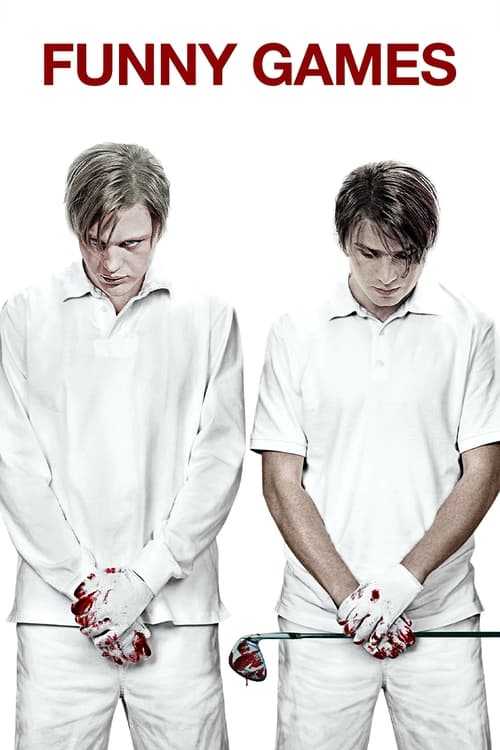
Funny Games
2008 · Michael Haneke
For when you want a film that dares you to keep watching — a challenge, an argument-starter, a test of why you watch violent movies at all. Emphatically not comfort viewing; know what you're signing up for.
What it's about
Ann, George, and their young son arrive at their lakeside vacation home for a quiet holiday. Two polite young men in white appear at the door with a small request, and their courtesy curdles into something else: a wager that the family won't survive until morning. What sounds like a home-invasion thriller is really a trap — one of the intruders keeps glancing at the camera, and the game he's playing includes you.
The experience
Grueling, icy, and deliberately confrontational — it denies you every satisfaction the genre trains you to expect and makes you feel the cost of wanting them. You don't enjoy it so much as endure it, and that's precisely the design.
Performances
Naomi Watts is astonishing in a physically and emotionally punishing role, much of it played in unbroken takes, while Michael Pitt makes soft-spoken politeness scarier than any snarl.
The craft
Haneke remade his own Austrian film nearly shot for shot in English, and the control is total: long static takes, violence kept off-screen or stripped of any thrill, silence where a score would soothe you, and direct address that turns the audience into an accomplice. It's formally immaculate and morally merciless.
Why it matters
A polarizing touchstone of confrontational cinema — the film everyone cites in arguments about screen violence and what audiences are complicit in when they watch it.
Snapshot
A near shot-for-shot American-language remake of Haneke's own 1997 Austrian film, Funny Games (2008) sends two soft-spoken young men — Paul (Michael Pitt) and Peter (Brady Corbet) — into the vacation home of a bourgeois family: Ann (Naomi Watts), George (Tim Roth), and their young son Georgie (Devon Gearhart). What follows is not quite a home-invasion thriller but a systematic dismantling of one. Haneke withholds spectacle, stages death off-screen or too fast to savor, and has Paul turn to the camera to solicit the audience's collusion. The film's most infamous single gesture — Paul retrieving a television remote and literally rewinding the film to undo Ann's act of lethal resistance — fuses content and form into an accusation: the viewer who continues watching has implicitly voted for the violence to continue. Polarizing, intellectually intractable, and impossible to watch passively, the film remains the most uncompromising entry in Haneke's sustained argument against the aestheticization of cruelty.
Industry & production
Haneke spent roughly a decade attempting to secure backing for an English-language version of his 1997 original, driven by the conviction that the Austrian film had been absorbed painlessly into the European art-cinema circuit — preached, as he put it, only to the already converted. He wanted to address the American mainstream audience that consumes Hollywood violence as entertainment without reflection. Warner Independent Pictures, the specialty arm of Warner Bros., eventually co-produced and distributed the film in the United States alongside Celluloid Dreams and Tartan Films; the production was filmed in the US, primarily on locations in and around Long Island, New York.
The casting of Naomi Watts and Tim Roth — both internationally recognized actors with credibility in prestige and genre work — was deliberate. Their presence encouraged the audience to expect the genre's standard grammar of survival and resistance. Watts, fresh from King Kong (2005) and 21 Grams (2003), carried particular resonance as a star whose suffering audiences were accustomed to eventually resolving into triumph. The film exploits and defeats that expectation. Warner Independent's closure in mid-2008, shortly after the film's release, meant that its theatrical support was limited; the film performed modestly at the box office, though precise figures are not publicly detailed in sources available to this writer.
Technology
The film was shot on 35 mm, consistent with Haneke's preference for photochemical acquisition throughout this period of his career. Darius Khondji, working with Haneke for the only time, used anamorphic lenses in combination with a cool, precisely controlled exposure regime that keeps interiors bright and uneventful rather than noir-shadowed. The wide-screen frame reinforces a quality of domestic normality: rooms look like rooms, not sets. There is no desaturated "horror palette," no rack-focus melodrama in the lighting. The technology is weaponized by its very restraint — the camera behaves as if nothing unusual is occurring, which is precisely the point. Post-production was kept conservative; the film's visual language resists the digital augmentation common in American genre films of the period.
Technique
Cinematography
Khondji's work here is the negative of his atmospheric contributions to Se7en (1995) or Midnight in Paris (2011). Where those films court expressionist texture, Funny Games pursues neutrality. Wide, stable compositions place characters inside an environment that refuses to encode danger in its geometry. The most analyzed single shot is the extended static take that follows Georgie's death: the camera holds on Ann in the living room for roughly ten minutes as she registers, with minimum performance and maximum duration, what has happened. The shot refuses the relief of a cut; its length becomes a kind of moral duration, forcing the audience to inhabit grief rather than move past it. Haneke and Khondji stage several scenes in deep focus with characters distributed across a depth plane in which the antagonists and victims share the frame without tension-building close-ups, denying the spectator the conventional cues for when to feel afraid.
Editing
Monika Willi, Haneke's long-standing editing collaborator (also credited on Caché, The White Ribbon, and Amour), brings her characteristic precision in managing scene duration against audience expectation. The most radical editorial act is the rewind. After Ann seizes a shotgun and shoots Peter dead — a moment that plays like a sudden rupture of the film's otherwise immovable determinism — Paul produces a TV remote and the image reverses: Peter reassembles, Ann is disarmed. The cut back to the "corrected" timeline is seamless. Haneke has discussed this device in interviews as a direct confrontation with the audience's desire to see the narrative resolve in the genre's conventional direction: to want the rewind undone is to want the violence to continue. Willi's cutting throughout otherwise follows long-take principles, resisting the fast-cut tempo of American thriller editing and refusing to metabolize tension through rhythm.
Mise-en-scène / staging
The vacation house is emphatically ordinary: bright kitchen, comfortable furniture, a boat at the dock. Haneke's staging insists on the pedestrian. The antagonists' politeness is sustained and inexhaustible — Paul and Peter speak in measured tones, apologize, make requests. The performance blocking keeps them close to their victims without the melodramatic invasion of personal space that genre convention would supply. The golf clubs, the film's primary instruments of menace, sit unremarkably in the corner. A key staging principle is the removal of violence from the visible frame: Georgie is shot out of shot; the climax takes place at a distance. The audience is left to construct the horror mentally, implicated in its imagining.
Sound
The sound design carries weight that the image deliberately refuses to bear. Impacts, screams, and shots arrive before or after the cut rather than in synchronized spectacle. Haneke uses diegetic sound — television, water, ambient house noise — with the same neutralizing flatness as the image. The opening sequence, however, is the film's most aggressive sonic gesture: as the family drives to their vacation house, listening to classical opera, Haneke cuts without warning to John Zorn's "Bonehead" from the Naked City album, a blast of thrash-jazz noise that obliterates the domestic tranquillity on the soundtrack. The title card arrives over this eruption. The device establishes the film's adversarial contract with the audience immediately and without diplomacy.
Performance
Pitt's Paul is the film's irreducible problem. He is charming in a way that registers as predatory only in retrospect, never in the moment: his performance supplies no tells, no signs of the conventional movie-villain. When he addresses the camera — winking, asking the audience which side they're on — Pitt holds the register of mild curiosity rather than theatrical menace, which is considerably more unsettling. Corbet's Peter operates as straight man to Paul's meta-narrator, deferring and occasionally confused, a performance of vacancy rather than evil. Watts sustains the film's emotional credibility through sheer physical endurance; her Ann is progressively stripped of dignity and volition in a performance that is, by design, not allowed to coalesce into conventional heroism or catharsis. Roth's George is incapacitated early, spending much of the film immobilised — a deliberate neutralization of the genre's male-protector function.
Narrative & dramatic mode
The film works through an anticlimactic mode: every narrative gesture that would normally initiate the genre's mechanisms of suspense or resolution is cut short or inverted. The family cannot escape; help does not arrive; the competent adult male is removed early; the attempt at reversal is literally undone. Haneke structures the narrative as a series of false promises delivered to an audience conditioned by the slasher and thriller genres to expect eventual agency for sympathetic protagonists. The film's dramatic mode is closer to tragedy in its classical sense — outcomes are fixed, resistance is formally impossible — than to the thriller's suspense grammar. Paul's direct addresses to the camera transform the film into something like a Brechtian demonstration: the audience is periodically reminded that they are watching a film, which makes their continued viewing a choice rather than an absorption.
Genre & cycle
Funny Games (2008) arrives in the middle of a distinct American cycle: the post-9/11 "torture porn" wave that included the Saw franchise (from 2004) and Hostel (2005), films that systematized graphic violence as entertainment product. Haneke has spoken directly about this cycle as the context his remake addresses, though he is careful not to name specific films in most documented interviews. The 2008 version sits in uneasy proximity to The Strangers (also 2008), a contemporaneous home-invasion thriller that operates within the conventions Haneke refuses. The film also participates in a longer genre-critique lineage that includes Wes Craven's Scream (1996), though it has no interest in Scream's knowing affection for its source material; Haneke's critique is accusatory rather than celebratory. It predates and arguably helps constitute the so-called "elevated horror" cycle that would gather critical mass after The Babadook (2014) and It Follows (2014).
Authorship & method
Haneke functions as his own source material here, a position with no precise equivalent in European art cinema. He has described the remake not as a reinterpretation but as a redeployment — the same film aimed at a different audience with greater precision. His method across his career involves writing his own screenplays and exercising tight editorial control; he is documented as rehearsing scenes extensively with actors to achieve the precise emotional calibration he requires, while often withholding information from performers to generate specific states of uncertainty. His collaborators on this film are, by design, mostly his own: Willi as editor and Khondji as the one significant departure, replacing the Austrian cinematographer Jürgen Jürges of the original. Haneke's stated poetics — making the audience "uncomfortable," refusing catharsis, treating cinema as a moral event rather than an entertainment contract — are consistent across his filmography from The Seventh Continent (1989) onward. Funny Games (2008) is unusual within that filmography precisely because it is the most explicit articulation of this poetics as content rather than method.
Movement / national cinema
The film occupies an anomalous position: it is an Austrian director's American film, produced in the United States, in English, with American stars, yet formally and intellectually it is continuous with the traditions of European art cinema. It has no meaningful relationship to the conventions of Hollywood genre cinema except as a critique of them. This hybridity is part of its provocation: it looks enough like an American studio film — in its cast, its English-language address, its genre trappings — to arrive within the viewing context it intends to interrogate. The film can be situated within a broader tradition of European filmmakers working critically against Hollywood grammar, including Michael Haneke's own repeated engagements with Americanised media culture (Benny's Video, 71 Fragments of a Chronology of Chance). It does not belong to any particular American national cinema movement; its European art-cinema DNA is structural.
Era / period
The film arrives at a transitional moment for the American specialty film market. Warner Independent Pictures, which co-distributed the film, closed operations in May 2008. The specialty-division model — through which studios like Miramax, Fox Searchlight, and Sony Pictures Classics had brought European and American art cinema to wider US audiences through the 1990s and early 2000s — was contracting. Funny Games (2008) is in some respects a product of the final phase of this infrastructure. The broader cultural context includes heightened debate, in the aftermath of the Iraq War and the period of enhanced-interrogation revelations, about the ethics of represented violence and its relationship to real cruelties — a context that gave Haneke's argument particular urgency, even if the film does not engage that political frame explicitly.
Themes
The film's central theme is audience complicity: the argument that the desire to watch violence is not innocent, that spectatorship is not passive, and that the pleasure taken in genre violence implicates the viewer in what they see. This is not a subtext but an explicit proposition delivered directly to the camera. Closely related is the theme of genre as conditioning: Paul and Peter operate by the rules of a film they appear to know they are in, manipulating genre conventions — the seemingly harmless visitor, the moment of apparent rescue — as tools of control. The film engages the vulnerability of bourgeois security: the vacation house, the boat, the golf clubs are the décor of class comfort, and the family's helplessness is partly a function of their unpreparedness for a world without social guardrails. Haneke refuses, however, to make this a social-critique film in any straightforward sense; the antagonists are never explained, motivated, or given a backstory, a refusal that prevents the audience from processing the violence as consequence.
Reception, canon & influence
Critical reception was polarized in ways that tracked the critic's position on Haneke's standing as a moral artist. Roger Ebert awarded the film four stars and defended it as a serious statement about the genre; J. Hoberman and other critics sympathetic to the European art-cinema tradition engaged it as a logical extension of Haneke's project. A substantial critical counter-position held that the film was self-congratulatory: that lecturing an audience about their own complicity from within a film they paid to see was a circular and somewhat arrogant gesture, and that the remake added nothing to the argument already made in 1997. This divide has not resolved; the film remains a contested text in discussions of meta-cinema and the ethics of screen violence.
Influences on the film (backward): The 1997 original is the immediate source, but Haneke's dramaturgy draws on Bertolt Brecht's Verfremdungseffekt — the interruption of identification to produce critical consciousness — as a structural principle. The off-screen violence has a documented precedent in Greek tragedy and was theorized in relation to Haneke's work by critics drawing on that tradition. The home-invasion premise connects to a lineage running from Pier Pasolini's Teorema (1968), in which a bourgeois household is penetrated and disintegrated by an alien presence, through to the American home-invasion cycle. Michael Powell's Peeping Tom (1960) is a relevant precursor in its implication of the viewer's gaze; Kubrick's A Clockwork Orange (1971) established the mode of stylized, unexplained violence that refuses psychological motivation.
Legacy and forward influence: Funny Games (2008) is difficult to separate from its 1997 source in mapping forward influence; the two films function together as a single canonical argument. The direct-address device — the antagonist recruiting the spectator — has become a more commonplace technique in horror and thriller films since 2008, though rarely with Haneke's theoretical rigor. The "elevated horror" cycle of the 2010s, characterized by horror as a vehicle for psychological or philosophical argument, operates in a critical landscape partially shaped by Haneke's demonstration that genre horror could be used against itself. The rewind scene is regularly cited in academic and critical writing on meta-cinema, editing theory, and the representation of violence; it has entered the small canon of film moments whose formal gesture and thematic argument are inseparable. Whether the film's argument is finally persuasive or self-defeating remains genuinely open — which may be, as Haneke would likely contend, precisely the point.
A Deleuzian reading
The most famous gesture in *Funny Games* is also the smallest.
The full Deleuzian reading of Funny Games →
Reception
In 2008 critics largely shrugged — 'why remake your own film, shot for shot?' — and it bombed. Since then it's been reappraised as the point itself: Haneke always said the story was aimed at American audiences, so the English version reads now less like a cash-in and more like the experiment finally completed.
How Funny Games was received, from release to now →
Influences: the films it descends from and the films it influenced
- Funny Games (1997) — The 2008 film is a near shot-for-shot translation of this Austrian original; every formal device — the rewind, Paul's fourth-wall wink, the ten-minute static grieving take, the off-screen death of the child — was originated here and transplanted with only cast and language changed to reach the American audience Haneke felt the 1997 version had missed by circulating only within European art cinema.
- Benny's Video (1992) — Introduced Haneke's strategy of using the video replay mechanism as medium-reflexive accusation: a teenager replays footage of a pig being stunned, then replays his own act of murder on videotape; Paul's remote-control rewind in the 2008 film is the logical formalization of this earlier device, which already argued that consumer playback technology structurally implicates the viewer in the violence being consumed.
- Psycho (1960) — Hitchcock's tactic of casting a bankable star (Janet Leigh) to generate audience investment in her survival, then killing her forty minutes in, is the direct structural ancestor of Haneke's casting of Naomi Watts to raise and defeat the expectation of genre-conventional rescue; both films also pioneer staging violence through editing rhythm and reaction performance rather than direct footage of the lethal act itself.
- Peeping Tom (1960) — Powell's central conceit — a killer who photographs his victims as they die, fusing camera, audience gaze, and homicidal act into a single apparatus — is the direct craft ancestor of Paul's fourth-wall address; both films use the viewing apparatus itself as the instrument of indictment, making the spectator's act of watching formally equivalent to participation in the violence.
- Straw Dogs (1971) — Peckinpah established the bourgeois-domestic-siege structure and pioneered the slow-motion aestheticization of violence that Haneke explicitly set out to invert; the 2008 film's absolute refusal of slow-motion, rack-focus, and any visual enhancement of the killings is a direct negative critique of Peckinpah's craft choices, using the same generic skeleton to reach the opposite formal and moral conclusion.
- Weekend (1967) — Godard established the Brechtian formal vocabulary — intertitles, direct-to-camera address, non-diegetic sonic intrusion that ruptures the fiction — which Haneke inherits for Paul's wink and the thrash-metal crash over the opening credits; both films also use a bourgeois couple's violence-saturated journey as a critique of the middle-class consumer subject, with form weaponized to prevent emotional absorption.
- Henry: Portrait of a Serial Killer (1986) — McNaughton's flat, affectless video aesthetic — violence filmed without expressive lighting, slow-motion, or atmospheric scoring as a deliberate moral refusal — established the neutral-camera mode as an ethical position against Hollywood's aestheticization of killing; Haneke and Khondji's decision to light the vacation house in unremarkable white daylight and hold the camera still regardless of what occurs is the 35 mm art-film formalization of McNaughton's stance.
- Hereditary (2018) — Aster inherits Haneke's formal device of the extended static take after violent death: the scene of Toni Collette discovering Charlie's decapitation holds on her face in the car for an uncomfortably sustained duration, refusing to cut or provide musical comfort; Aster also stages the child's death off-screen and reveals it through the mother's reaction performance alone — the exact staging principle Haneke uses for Georgie.
- The House That Jack Built (2018) — Von Trier's protagonist addresses his off-screen interlocutor — and by extension the audience — directly and at length to defend the aestheticization of murder as valid art, structurally mirroring and arguing back against Paul's wink; where Haneke uses direct address to accuse the viewer of complicity, von Trier uses the identical device to invert the accusation, making The House That Jack Built a formal rejoinder to Funny Games' indictment of the aestheticizing spectator.
- Speak No Evil (2022) — The most direct formal heir in the lineage: Tafdrup reproduces Haneke's staging of polite social compliance as the mechanism by which victims disable their own survival instincts, holds the camera on domestic normality as violence escalates, and ends without cathartic resistance or rescue — the anti-cathartic refusal of victim agency that defines Haneke's poetics is here the explicit structural template rather than an incidental resemblance.
- Caché (2005) — Editor Monika Willi applies the same long-take discipline in both films — sustained static holds that extend past comfort to prevent the viewer from metabolizing unease through the relief of a cut; both films also withhold the resolution genre convention promises and end with a final frame that explicitly refuses cathartic closure, punishing the viewer for expecting narrative satisfaction.
- Elephant (2003) — Van Sant deploys extended unbroken Steadicam takes following characters through a school at walking pace with no dramatic scoring to signal escalation; the Columbine-analog massacre arrives without audiovisual preparation, producing the same anticlimactic, anti-editorializing formal refusal that Haneke builds into every death in Funny Games — the camera continues moving as if nothing unusual has occurred.
- Irréversible (2002) — Noé's nine-minute single-take rape sequence uses duration itself as a moral instrument — the refusal to cut denies the viewer the relief of editing and makes endurance a form of spectatorship guilt — which is precisely the craft logic behind Haneke's ten-minute static take after the child's death; both directors weaponize the long take against the viewer's appetite for cinematic closure.
- Dogville (2003) — Von Trier uses explicit Brechtian theatrical devices — chapter title cards, visible chalk-drawn sets, direct address — to enforce analytical spectatorship that prevents emotional immersion, the same anti-absorption strategy Haneke pursues through Paul's wink and the rewind; both filmmakers deploy Brecht specifically against the Hollywood catharsis machine and both received polarized responses for the identical reason.
- Martyrs (2008) — Released the same year, Martyrs shares Funny Games' anti-cathartic endurance structure — sustained female suffering with no redemptive arc — and uses this structure to make a philosophical claim about spectatorship rather than deliver genre pleasure; where Haneke enforces Brechtian distance, Laugier uses maximalist immersion, but both films arrive at the same accusation directed at the viewer who remains in their seat.
Similar films
- Funny Games (1997) — influence & lineage
- The House That Jack Built (2018) — influence & lineage
- Caché (2005) — influence & lineage
- Martyrs (2008) — influence & lineage
- Hereditary (2018) — influence & lineage
- The White Ribbon (2009) — shared sensibility
- The Seventh Continent (1989) — shared sensibility
- Force Majeure (2014) — shared sensibility
All the films related to Funny Games →