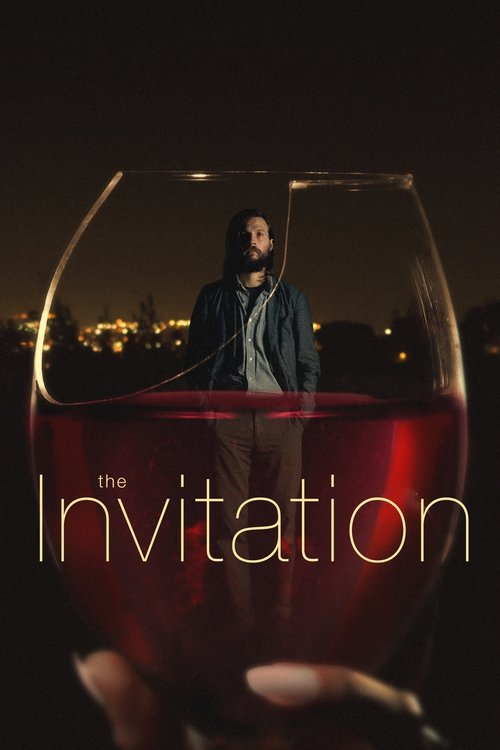
The Invitation
2016 · Karyn Kusama
For when you're craving creeping dread over jump scares — the kind of thriller you watch leaning forward, arguing with yourself about what's really happening. A challenge-night pick, perfect with someone to debate it with after.
What it's about
Will and his new girlfriend drive into the Hollywood Hills for a dinner party at the house he once shared with his ex-wife Eden — the house where their young son died. Eden has resurfaced after two years away with a new partner, a circle of old friends, and an unnervingly serene outlook. As the evening unfolds, Will can't decide whether his hosts are hiding something or whether his own grief is making him see danger everywhere.
The experience
A masterclass in slow-burn unease — long stretches of plausible, awkward dinner-party conversation shot through with wrongness you can't quite name. It keeps you second-guessing Will right up until it stops being ambiguous, and then it doesn't let up.
Performances
Logan Marshall-Green carries the film's ambiguity on his face — grief, suspicion, and self-doubt all legible at once. Tammy Blanchard's eerily becalmed Eden gives the evening its off-kilter center.
The craft
Karyn Kusama choreographs one house and one evening with total control, using the home's layout, candlelit warmth, and social choreography — toasts, party games, locked doors — to keep menace and hospitality indistinguishable. The pacing is patient by design, and the final image is one of the great gut-punch closers of recent horror.
Why it matters
It became a word-of-mouth hit that revived Kusama's career and stands as a defining film of the 2010s wave of grief-driven, slow-burn horror.
Snapshot
The Invitation is a chamber thriller that turns a dinner party in the Hollywood Hills into a slow study of grief, social pressure and doubting your own perception. Will (Logan Marshall-Green) and his girlfriend Kira (Emayatzy Corinealdi) are invited to the house Will once shared with his ex-wife Eden (Tammy Blanchard). The couple's young son died there, years earlier. Eden has come back from a stay in Mexico with a new partner, David (Michiel Huisman), and a calm that seems to have been bought. The film spends most of its running time not knowing whether Will is reading real signs of danger or projecting his own unresolved trauma onto a gathering of old friends. Its last movements settle that question violently, and its final image widens the horror from one house to a whole city.
The film premiered at South by Southwest in March 2015, won the top prize at the Sitges festival that autumn, and was released in the United States in 2016 by Drafthouse Films. It is widely seen as Kusama's critical comeback after the studio troubles of Aeon Flux (2005) and the delayed reappraisal of Jennifer's Body (2009). It also became one of the defining titles of the mid-2010s independent "elevated" or slow-burn horror moment.
Industry & production
The Invitation was a low-budget independent production, made far from the studio system that had burned Kusama on Aeon Flux. The screenplay is by Phil Hay and Matt Manfredi, a long-standing writing partnership whose credits include Crazy/Beautiful (2001), Aeon Flux, Clash of the Titans (2010) and R.I.P.D. (2013). Hay is Kusama's husband. The two writers had reportedly carried the script for years as a personal project rather than a commission. Hay and Manfredi are also among the producers.
Financing and producing partners included Gamechanger Films, a company set up in the mid-2010s specifically to finance narrative features directed by women, and XYZ Films, a company known for genre packaging and international sales. Gamechanger's involvement matters to the film's industrial history: The Invitation became one of the most visible early results of that company's model.
The production used essentially one location, a house in the hills above Los Angeles, with a contained ensemble cast. That fits a familiar economy of independent genre filmmaking, where a single location and a short schedule let the money go into actors and atmosphere. Detailed public figures for budget and shooting schedule are thin, and none are given here.
On distribution, Drafthouse Films (the label tied to the Alamo Drafthouse cinema chain and Fantastic Fest culture) released the film in a limited theatrical run alongside on-demand platforms in spring 2016. Netflix carried it in several territories. Its theatrical gross was modest. Its audience grew mostly through streaming and word of mouth, which is typical of the period's independent horror.
Technology
The film was shot digitally, in widescreen, with the low-light capability of contemporary digital cinema cameras. That capability shapes its look. Much of the evening is lit by practical sources (lamps, candles, firelight, the glow of the hills through glass) and the photography sits comfortably in deep amber shadow without the heavy supplementary lighting older film stocks would have needed. Nothing about the film's technology is experimental. Its significance lies in how modest digital tools let a contained production achieve an intimate, warm-toned image that slowly curdles. The final reveal of red lanterns across the night-time city relies on wide nocturnal exteriors, which digital capture made practical on an independent budget.
Technique
Cinematography
Cinematographer Bobby Shore lights the house as a warm, inviting space: honeyed wood, low lamps, candlelight. That warmth is the visual counterpart of the hosts' insistent hospitality. The camera often stays close to Will, framing him at the edges of group shots or in shallow focus while conversation goes on around him. This gives the viewer his isolation without confirming his suspicions.
Hallways, doorways and glimpsed rooms are used repeatedly, so the house feels both open-plan and full of withheld spaces: a locked door, a study, a bedroom where a child once slept. The palette stays restrained until the last act. There, violence breaks the composed frames, and the closing exterior turns the domestic warmth into a single image of signal lights repeating across the hills.
Editing
Editor Plummy Tucker shapes a deliberately slow first hour. Its rhythm comes from social awkwardness: pauses, interruptions, toasts and games. Brief, unannounced flashbacks to Will's memories of his son and his marriage cut into the present action. Because they are not marked off from Will's present perceptions, they blur the line between remembered trauma and current threat, and the viewer, like the other guests, cannot easily tell whether Will is reacting to the room or to the past.
The cutting stays measured even as tension builds, holding on reaction shots and silences. That restraint is what makes the sudden acceleration of the climax land.
Mise-en-scène / staging
The film is built on the chamber-drama form of a single evening in a single house. Kusama stages the guests in shifting groups around the living room, the dinner table and the kitchen, and the ensemble's social choreography carries much of the dread: who is seated where, who leaves the room, who is kept from leaving.
The house is both setting and character. It is the place where Will and Eden's son died, and Will's walks through it are as much mourning as investigation. Several props become charged as the evening goes on:
- the locked front door
- the barred windows, which David explains away as a security measure
- a laptop video of a cult recruitment and a death
- the red lantern placed outside
The staging keeps offering reasonable explanations for each sign, which keeps open the question of whether Will's distrust is justified or socially destructive.
Sound
Composer Theodore Shapiro, better known for comedy scores, writes a restrained, string-led score. It mostly hovers under scenes instead of underlining them, and adds unease without announcing threat. The sound design keeps the ambient life of the party in the foreground: overlapping talk, glasses, laughter, music played in the house. Will's growing deafness to that social noise comes through moments when the mix narrows around him. Coyotes heard and seen in the hills form a recurring sonic and visual motif, and they tie the outside darkness to the film's concern with mercy, killing and suffering.
Performance
Logan Marshall-Green carries the film as Will. His performance is guarded, watchful and visibly worn by grief, and it keeps the viewer close to a protagonist whose reliability is constantly in doubt. Tammy Blanchard's Eden is the film's most unsettling figure: her serenity looks both like healing and like a mask over unbearable pain. Michiel Huisman plays David with a smooth, charismatic courtesy that never fully tips into villainy until it has to.
John Carroll Lynch, as the gentle-mannered Pruitt, gives what is widely singled out as the film's most chilling turn. His monologue about the death of his wife is a set piece of controlled menace. Lindsay Burdge's Sadie, the eerily uninhibited cult member, adds a jarring, off-key note. The wider circle of friends, played by Mike Doyle, Jay Larson, Marieh Delfino, Michelle Krusiec, Jordi Vilasuso and others, sketches a believable group whose politeness and loyalty to one another make it hard for them to see danger. Emayatzy Corinealdi's Kira grounds Will and acts partly as a stand-in for the audience.
Narrative & dramatic mode
The narrative is a single-evening, near-real-time chamber drama that turns slowly into a thriller. Its dramatic engine is ambiguity. The film invites the viewer to share Will's suspicion while also building a strong case that he is a damaged man ruining a party. Each sign of danger has an explanation offered for it: the locked door, the video, the strange guest, Pruitt's confession, David's evasions. Will's outbursts make him look paranoid to his friends. So the suspense lies less in what will happen than in whether anything is happening at all, and the film treats the social cost of voicing suspicion as a real dramatic stake.
The structure leans heavily toward a late payoff. The poisoned wine at the toast resolves the ambiguity, and the film then compresses its violence into a short, chaotic last act. The coda, in which Will and Kira see red lanterns burning at house after house across the hills, recasts the whole evening as one instance of a wider, coordinated atrocity. That turns a private tragedy into an apocalyptic one.
Genre & cycle
The Invitation sits where several modes overlap: the dinner-party drama, the cult thriller, the home-invasion and "hostile hospitality" film, and the grief-horror that marked American independent genre cinema in the 2010s. It is usually grouped with the slow-burn, character-led horror that critics and marketers labelled "elevated" or "post-horror" in the mid-to-late 2010s. Neighbouring titles include The Babadook (2014), It Follows (2014), The Witch (2015) and, a little later, Get Out (2017) and Hereditary (2018).
Within that cycle it is notable for:
- having almost no supernatural element, and finding its horror in human belief and social coercion
- using grief as both theme and possible source of distorted perception, an approach close to The Babadook and anticipating Hereditary
- its contained, low-budget form, close to the single-location independent thriller tradition, with Coherence (2013) a frequently cited near-contemporary dinner-party genre piece
Authorship & method
Karyn Kusama came to prominence with Girlfight (2000), which won the Grand Jury Prize and shared the directing award at Sundance. Her studio feature Aeon Flux (2005) was a well-documented experience of losing creative control. Jennifer's Body (2009), written by Diablo Cody, was poorly marketed and reviewed on release but later strongly reappraised as a feminist horror text. The Invitation is generally read as a re-assertion of directorial control on independent terms. Its restraint, focus on actors and patience show a filmmaker working away from studio pressure.
Kusama's method here centres performance and atmosphere: long takes over spectacle, ensemble behaviour over plot mechanics, and a steady hold on ambiguity. The film's success set up her later genre and prestige work. That includes a segment of the anthology XX (2017), the crime drama Destroyer (2018), and television directing, notably the pilot of Yellowjackets (2021), whose blend of trauma, group dynamics and ritual violence echoes concerns visible in The Invitation.
Key collaborators:
- Phil Hay and Matt Manfredi (writers/producers): they supply the tightly built single-evening script, with its pattern of suspicion and explanation and its final widening of scope.
- Bobby Shore (cinematographer): warm, practical-lit images whose comfort becomes menacing.
- Theodore Shapiro (composer): an understated score that is unusual for a composer mostly associated with comedy.
- Plummy Tucker (editor): the slow-burn rhythm and the integrated flashbacks.
Movement / national cinema
The film belongs to American independent cinema of the 2010s, specifically the genre-festival network linking SXSW, Fantastic Fest, Sitges and similar venues to boutique distributors such as Drafthouse Films and to streaming platforms. That network let small horror and thriller films build critical reputations and cult audiences outside wide theatrical release.
The Invitation is also part of the decade's growing, and still contested, visibility of women directors in genre filmmaking. Gamechanger Films' backing explicitly tied it to efforts to finance features by women. Its setting puts it in a Los Angeles tradition of films about the city's affluent hillside enclaves and their spiritual movements, wellness culture and isolation.
Era / period
Made in 2014–15 and released in 2016, the film belongs to a period when American independent horror was being critically re-evaluated and commercially repositioned, and when streaming services were becoming a main route to audiences for mid-sized genre films. Its interest in grief-therapy groups, self-help language and charismatic spiritual movements draws on a long Californian history of new religious movements. Many viewers and critics have linked its premise to the 1997 Heaven's Gate mass suicide in the San Diego area. That echo is widely noted in commentary, though the film never names any real group. Its picture of an affluent, therapeutically fluent social class pressed into enforced positivity also fits the period's cultural mood.
Themes
- Grief and its management. The film's core is the death of Will and Eden's child. It sets two responses side by side: Will's raw, persistent mourning, and Eden's cult-given promise of release from pain. The film comes down firmly on the side of grief as something to be lived through, not abolished.
- Perception, paranoia and gaslighting. Will's suspicions are repeatedly labelled as symptoms. The film explores how social groups pathologise dissent, and how a traumatised person's perceptions are easily dismissed even when they are accurate.
- Hospitality as coercion. Toasts, games, locked doors and pressure to stay turn the conventions of a dinner party into instruments of control. Politeness becomes complicity.
- Cults and the language of healing. The group in the film speaks in therapeutic, accepting terms. Its menace lies in how attractive its offer is to people in pain.
- Mercy and violence. The coyote motif, Pruitt's account of his wife's death, and the cult's framing of murder as release together pose questions about the boundary between killing and compassion.
- Private tragedy, public apocalypse. The final lanterns turn one household's catastrophe into a sign of wider, coordinated disaster, suggesting that the despair the cult preys on is pervasive.
Reception, canon & influence
Critical reception. The film was well received from its SXSW premiere onward and won the Best Film award at the 2015 Sitges festival, one of the most prominent international genre-festival prizes. American reviews on its 2016 release were largely positive. Critics praised:
- the slow-burn tension
- the ensemble acting, especially Marshall-Green and John Carroll Lynch
- the long-sustained ambiguity
- the final image, which is frequently cited as one of the decade's most memorable horror endings
Some reviewers found the first two-thirds too drawn out, or the climax more conventional than what came before. Overall it was framed as a return to form for Kusama. Its theatrical grosses were small, and its standing rests mainly on critical esteem and later discovery through streaming.
Influences on the film (backward). Critics have placed it in several lineages:
- the paranoid domestic horror of Roman Polanski, especially Rosemary's Baby (1968), where a protagonist's accurate suspicions of a charming community are dismissed as hysteria
- the closed social trap of Luis Buñuel's The Exterminating Angel (1962)
- the reunion-of-friends ensemble drama typified by The Big Chill (1983), whose form the film darkly inverts
- cult-centred American thrillers and the wider cultural memory of Jonestown and Heaven's Gate
- in its own decade, the dinner-party genre puzzle Coherence (2013) and the grief-driven horror of The Babadook (2014)
These are comparative placements made in criticism, not sources Kusama is documented to have cited.
Legacy (forward). The Invitation has become a reference point for the contained, ambiguity-driven "social horror" that followed, in which party, family gathering or community ritual is the site of threat. Get Out (2017), Hereditary (2018) and Midsommar (2019) are frequently discussed alongside it for their shared interest in grief, cult-like groups and the dangers of hospitality, though direct influence is hard to establish. More concretely:
- it re-established Kusama as a leading genre director, leading to Destroyer and the Yellowjackets pilot
- it strengthened the reputations of Hay and Manfredi as writers of character-based genre material
- it became a frequently cited case study for financing initiatives aimed at women directors
Its final shot of lanterns across the Los Angeles hills is a recurring entry in critical lists of great horror endings and keeps circulating in online and critical discussion of 2010s horror.
Influences: the films it descends from and the films it influenced
- Rosemary's Baby (1968) — Builds paranoia out of hospitality: a smiling, overly attentive social circle and a protagonist whose correct suspicions are framed as grief-driven hysteria, staged through doorways and partial views inside a domestic interior.
- The Exterminating Angel (1962) — The dinner party as a closed trap: an evening of etiquette slowly turns into captivity, and the barrier is social obligation as much as any locked door.
- Rope (1948) — A single-apartment party where the hosts' hidden murderous plan sits underneath the small talk, with suspense built from the gap between what the hosts know and what the guests know.
- The Big Chill (1983) — The reunion-weekend ensemble form, with old friends, a shared death and confessions around the table, which Hay and Manfredi's script copies beat for beat and then turns into a trap.
- The Tenant (1976) — Keeps an unstable protagonist's point of view so tightly that the audience can't tell perception from persecution, the same doubt that drives Will's suspicion of the Eden household.
- Repulsion (1965) — Grief and trauma intrude on the present through abrupt, unmarked cuts inside a closed home, an early model for how Will's memories of his son break into the party.
- The Stepford Wives (1975) — Suburban California serenity hides an organized group plan, and the protagonist's growing alarm reads to everyone else as instability. Kusama's Hollywood Hills calm works the same way.
- Jennifer's Body (2009) — Extends Kusama's glossy-surface/unstable-underneath method into slow-burn dread, the controlled tonal concealment that retroactively clarified her authorship of Jennifer's Body.
- The Man from Earth (2007) — Builds dread from a houseful of guests listening to a testimony that may be delusion, blocking belief and disbelief physically across a living room so the audience reads conviction off body position.
- Magic Magic (2013) — It runs the same chamber-piece engine: one guest's growing alarm is dismissed by a friendly group as personal fragility, and it holds back for most of its length on whether the threat is real.
- Get Out (2017) — Hostile hospitality as social horror: a gracious host gathering, a guest whose unease is socially punished, and coercion dressed as welcome before the trap closes.
- Hereditary (2018) — A grief-management story that turns out to be a cult's long plan, ending with a widening reveal of a ritual network that had been hiding in the domestic background all along.
- Midsommar (2019) — A grieving protagonist is drawn into a commune whose warmth and ritual sharing are coercive, with the group's emotional 'support' itself turned into the method of capture.
- Destroyer (2018) — Kusama carries over the unmarked time-jumps between a traumatic past and a damaged present, and centres an unstable protagonist's point of view, with Hay and Manfredi again writing.
- Yellowjackets (pilot) (2021) — Kusama's pilot cuts between trauma timelines with unmarked transitions and frames group ritual violence and coerced belonging through a social gathering that slowly turns sinister.
- Martha Marcy May Marlene (2011) — Unmarked jumps between cult past and present, using matching gestures and spaces, make the edit itself carry trauma and leave the viewer unsure what is happening now.
- Sound of My Voice (2011) — A low-budget indie cult film that relies on a charismatic leader's intimate recruitment speeches in a closed room and never settles whether the group is a fraud or something worse.
- The Master (2012) — A movement's 'processing' session staged as a long, warm, closely framed interrogation, the same model behind the Invitation's confessional party game and the Pruitt monologue.
- Coherence (2013) — A dinner party as a sealed festival-genre puzzle: one house, an ensemble of friends with old tensions, and mistrust spreading through overlapping conversation before the scope widens at the end.
- The Babadook (2014) — Turns unprocessed grief for a family member into the horror engine, with a domestic space that grows more claustrophobic as the bereaved character's grip on reality is questioned.
- It Follows (2014) — Edge-of-frame, shallow-focus compositions and slow-burn pacing teach the viewer to scan the background for threat. It is the same festival-circuit 'elevated' style that Bobby Shore's framing uses.
- Heretic (2024) — Sustains single-location dread as a belief system is slowly disclosed to trapped guests inside a domestic space, dread built from politeness and doctrine rather than violence — Heretic's dinner-party-turned-doctrine sibling.
- The Gift (2015) — It was released the same year and generates suspense almost entirely from extended social awkwardness at a dinner party in a house of glass, where politeness stops guests from naming the threat, exactly the strategy behind The Gift's scenes with Gordo.
- Speak No Evil (2022) — A dinner party built on the protagonist's growing alarm and repeated failure to leave because leaving would be rude, timed as a slow burn of escalating small violations.
Similar films
- Hereditary (2018) — influence & lineage
- The Gift (2015) — shared sensibility
- Creepy (2016) — shared sensibility
- The Invite (2026) — shared sensibility
- Evil Dead Burn (2026) — shared sensibility
- A Tale of Two Sisters (2003) — shared sensibility
- Coherence (2014) — shared sensibility
- The Cabin in the Woods (2012) — shared sensibility