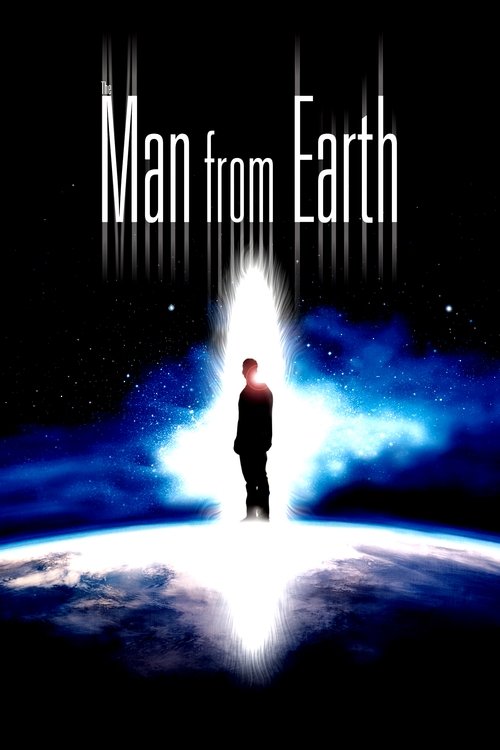
The Man from Earth
2007 · Richard Schenkman
For a quiet night when you want a film to argue with — something to pause, debate, and chew on for days. Zero spectacle, maximum conversation; bring a curious friend.
What it's about
A professor abruptly quits his job after ten years, and the colleagues who gather in his emptying house to say goodbye press him for a reason. He gives them one: he claims he has been alive for fourteen thousand years. The rest of the film is that single conversation, as a room full of academics — a biologist, an anthropologist, a psychiatrist, a devout Christian — use everything they know to test whether the claim can possibly be true.
The experience
Pure talk, and gripping anyway — the tension comes entirely from ideas colliding, belief straining, and the question of whether the calm man by the fireplace is a genius, a liar, or exactly what he says. It leaves your head buzzing.
Performances
David Lee Smith anchors it with an unnervingly serene turn as the man making the impossible claim, and the ensemble of skeptics gives every objection real weight.
The craft
Written by science-fiction legend Jerome Bixby — his final script, decades in the making — it's a masterclass in making a single room and eight chairs feel vast, with the screenplay itself as the special effect. Shot on a shoestring, it proves how far structure and dialogue alone can carry science fiction.
Why it matters
It became a word-of-mouth cult phenomenon after spreading online — famously embraced even by the people pirating it — and remains the go-to proof that a great sci-fi film needs only an idea and a room.
Snapshot
A university professor named John Oldman is packing a rented house in the woods when his colleagues arrive unannounced with a bottle and a farewell cake. He has taken a new post; he will not say where. Pressed for a reason he is leaving after ten years, he offers one: he is a Cro-Magnon hunter of the late Paleolithic who has not aged in roughly fourteen thousand years, and he moves every decade because people begin to notice. The remaining eighty minutes are the argument that follows, conducted almost entirely in one living room by seven or eight academics with the professional equipment to interrogate the claim — a biologist, an anthropologist, an archaeologist, an art historian, a psychiatrist summoned by telephone partway through, and a devout Christian literature teacher whose faith the conversation will eventually dismantle.
The Man from Earth is the last screenplay of Jerome Bixby, a science fiction writer of the pulp and anthology-television era whose byline sits on some of the most-watched hours of American genre TV. It is also one of the purest demonstrations available of what science fiction can do with no money at all: the film has no effects, no exteriors to speak of, no action, and a production reportedly costing in the low six figures, and it stages fourteen millennia of human history entirely through speech, faces, and objection. Its afterlife is stranger than its production — an unauthorized copy leaked onto file-sharing networks in 2007 and made the picture internationally known before most distributors had heard of it, and the producer's public response to that piracy became a small landmark in the argument about digital distribution.
Industry & production
The film's origin story is unusual and, by the accounts of those involved, essentially accurate: Bixby conceived the premise in the early 1960s and worked at it intermittently for decades, completing the screenplay in the final period of his life. He died in April 1998, and his son Emerson Bixby has consistently described the last portions of the script as having been dictated in Bixby's final days. The finished film carries a dedication to him. Whatever the precise chronology of those last pages — and it is the kind of family account that resists documentary verification — the script's texture supports the long gestation. It is a piece of writing built out of accumulated reading rather than a fast assignment.
Richard Schenkman, who had directed the low-budget features The Pompatus of Love (1995) and Went to Coney Island on a Mission from God… Be Back by Five (1998), brought it to production with Eric D. Wilkinson producing. The budget is very widely reported at around $200,000; I have not seen an audited figure and would treat it as an order-of-magnitude claim rather than a precise one. The shoot is likewise generally described as extremely short — on the order of a week — with a single practical location, a modest house in Southern California standing in for the cabin. The economics are visible in the finished picture in the honest way: this is a film that spends its resources on time with actors rather than on coverage, and the compression of the schedule is legible in a certain flatness of lighting and a reliance on performances that had to be right early.
Casting is where the production's intelligence shows most clearly. Rather than unknowns, Schenkman assembled working character actors with deep genre-television résumés — Tony Todd (Candyman) as the anthropologist Dan, John Billingsley (Dr. Phlox on Star Trek: Enterprise) as the biologist Harry, William Katt (The Greatest American Hero) as Art, Richard Riehle as the psychiatrist Will Gruber, Ellen Crawford as Edith, Annika Peterson as Sandy, Alexis Thorpe as the student Linda — around David Lee Smith's John. These are performers audiences recognize without being distracted by, and their familiarity from genre TV does quiet work: the film feels like an unusually good episode of an anthology series partly because several of its faces are drawn from that world.
Distribution was minimal. The picture had festival screenings and an extremely limited theatrical profile before an Anchor Bay DVD release in the United States. There is no meaningful box-office record to report, and I would rather say so than assemble a number from unreliable aggregators.
Technology
Two technological facts govern this film, and neither is on screen.
The first is digital acquisition. Shot on high-definition video rather than film, The Man from Earth belongs to the first generation of features for which the cost of running the camera was effectively zero. That is not incidental to a film whose method is long, uninterrupted talk: a director can let a six-minute exchange run, cover it again, and let actors find the rhythm of an argument in a way that a tight 35mm ratio would have made expensive. The specific camera package is not well documented in any source I would trust, but the image's characteristics — deep focus by default, limited highlight latitude, a slightly video-flat rendering of the daylight windows — are consistent with mid-2000s HD.
The second is BitTorrent. In 2007 an unauthorized rip of a screener copy circulated on file-sharing networks and the film spread rapidly and internationally, well beyond anything its distribution could have achieved. Wilkinson's response was to post an open message to a release-scene site acknowledging the exposure the leak had given the film and asking those who enjoyed it to buy a copy or contribute — an act that was widely reported at the time and that inverted the industry's standard posture. The film's reputation was, in a fairly literal sense, manufactured by peer-to-peer networks and by the word-of-mouth infrastructure of forums and early streaming. Ten years later Schenkman and his collaborators closed the loop deliberately: the sequel The Man from Earth: Holocene (2017) was placed on torrent sites by the filmmakers themselves, with a request for voluntary payment.
There is a third technological dimension, internal to the fiction. The film's science-fictional apparatus is entirely rhetorical. Where a studio treatment of this premise would render deep time — the cave, the mammoth, the Sea of Galilee — Schenkman refuses every flashback. The past exists only as testimony, which means the audience is placed in exactly the epistemic position of the characters: we have no evidence beyond a man's face and voice. That is a formal choice made possible by having no money, and it is better than the alternative would have been.
Technique
Cinematography
Afshin Shahidi's photography is functional rather than expressive, and deliberately so. The scheme is naturalistic interior light — practicals, firelight, and daylight from the windows — that tracks the passage of a single afternoon into night, so the room slowly darkens and contracts around the group as the claims escalate. The camera works largely in medium shots and singles, moving between speakers in the way a documentary crew covering a seminar would, and it holds on listeners about as often as on talkers. The most consistent visual decision is the refusal of grandeur: no low angles ennobling John, no expressionist shadow at the moment of revelation. When the film's biggest disclosure arrives, the framing does not change at all. The camera treats a claim to be the historical Jesus with exactly the same coverage as a claim about Paleolithic diet, which is the correct and rather brave choice.
Editing
The cutting has one job — to make an argument legible — and it does it by reaction. The film is edited less as a series of speeches than as a series of responses to speeches: John says something, and we watch the anthropologist test it, the biologist reject it, the believer flinch. Cuts land on faces receiving information. Pacing is managed by escalation rather than by rhythm; the film has essentially no montage, no cross-cutting, no parallel action, and its two brief exterior moments function as breathing spaces rather than as scenes. Credits for post-production on independent features of this scale are inconsistently reported, and I would not want to attribute the cutting confidently to a single hand.
Mise-en-scène / staging
This is the film's real craft. The set is a living room with a fireplace, a couch, chairs, and a staircase, and Schenkman treats it as a theatrical playing space in which physical position encodes belief. Characters who accept the story drift toward John; characters who are threatened by it retreat, stand, cross to the window, or leave the room. Edith's withdrawal to the edges of the frame as the theological material arrives is staged entirely through blocking. The packing boxes are doing quiet thematic work throughout — the room is being emptied even as it fills with history, and John's possessions are conspicuously few, which is what a life of ten-year cycles would produce. The one significant prop, a painting John claims to have received from Van Gogh, is the film's only piece of material evidence, and it is treated almost casually.
Sound
Mark Hinton Stewart's score is sparse and used mostly at transitions and at the two or three moments where the film permits itself an emotional swell. Otherwise the soundtrack is dialogue, room tone, fire, and weather. The film's most effective sonic device is silence: the pauses after John's largest assertions are long enough to be uncomfortable, and the absence of music at those points forces the audience to sit inside the group's disbelief rather than being told how to feel about it. The recording itself is unglamorous, with the slightly close, dry quality of a small-crew interior shoot.
Performance
David Lee Smith's John Oldman is built on withholding. He plays fourteen thousand years not as weariness or grandeur but as mildness — a man who has had every argument before and is politely enduring this one. It is a performance with almost no visible technique, and it has to be, because any actorly signal of "ancient" would collapse the ambiguity the film depends on.
The ensemble supplies the film's variety. Billingsley's Harry is the comic empiricist, deflecting with jokes because the alternative is to take it seriously. Todd's Dan is the film's most generous mind, an anthropologist temperamentally willing to entertain the impossible, and Todd gives him a stillness that anchors the room. Katt's Art is the archaeologist who takes the claim as a personal insult, and his hostility is the film's most credible reaction. Crawford's Edith carries the hardest arc — she is not written as a fool, and her devastation when John reframes the Gospels as a misreading of his own life is played without condescension. Riehle's late-arriving Gruber shifts the film's register entirely, converting a metaphysical debate into a clinical intervention and then, in the closing movement, into a personal catastrophe. Not all of the performances are equally calibrated; the film has patches where the theatricality of the writing outruns the acting, and its lower-budget seams show most in the younger cast members.
Narrative & dramatic mode
The film observes the classical unities more strictly than almost any modern genre film: one place, one continuous stretch of hours, one action. It is a bottle drama in the fullest sense, and its dramatic engine is Socratic — a proposition advanced, tested from multiple disciplinary angles, defended, and pushed further each time it survives.
Structurally it works by escalation through domains. John's claim begins as biology (why does he not age?), passes to archaeology and anthropology (can he describe the Paleolithic accurately?), to history and linguistics, and finally to religion, where it becomes intolerable. The film's genuine cleverness is that John never produces proof, and the script is careful to give the skeptics good arguments; every verifiable detail he offers could have been learned from books, a point the characters make themselves.
The final movement complicates this considerably. Under pressure — and with Gruber threatening committal — John recants and says the whole thing was a story. The film then undoes the recantation twice: once when the group realizes he is protecting them, and once in the closing exchange with Gruber, when a name from John's earlier life registers with the psychiatrist as his own father's, and the shock kills him. That ending has always struck me as the script's weakest move, a jolt of coincidence in a film that has otherwise refused every cheap effect, but it does perform a real function: it supplies the only evidence in the film that comes from outside John's own testimony, and it does so at a lethal cost. The coda, with Sandy leaving with him, ends the film on continuation rather than resolution.
Genre & cycle
The Man from Earth belongs to the small tradition of idea-driven, single-location genre cinema that treats conversation as the special effect. Its immediate ancestors are the anthology teleplay — The Twilight Zone, The Outer Limits — and the courtroom-and-jury-room chamber drama exemplified by 12 Angry Men (1957), from which it borrows the structure of a lone holdout persuading a room. It also sits, more surprisingly, alongside My Dinner with André (1981) in the very short list of features that ask an audience to watch people talk at a table for the entire running time.
Within science fiction proper it is an immortality narrative of the skeptical, unglamorous kind. Where Highlander (1986) gives the immortal a sword and where vampire fiction gives him predation, Bixby gives him tenure and a station wagon. The film's insistence that living forever would be primarily a logistical and bureaucratic problem — new documents, new towns, no attachments — is its most distinctive generic contribution.
It arrived at the front of a cycle of low-budget, high-concept, single-location genre features that the digital era made economically viable: Exam (2009), Circle (2015), Coherence (2013), The Invitation (2015). I would not claim direct causation for most of these, but The Man from Earth is routinely named as the reference point for that mode, and its commercial afterlife demonstrated that such a film could find a global audience without a distributor's help.
Authorship & method
The dominant author here is unambiguously the writer. Jerome Bixby's career spanned pulp magazines, low-budget 1950s science fiction, and network television, and two strands of it converge in this script. The first is his short story "It's a Good Life" (1953), adapted by Rod Serling for The Twilight Zone in 1961 — a story about an unassailable power hidden inside domestic ordinariness, which is structurally the same trick performed here in a gentler key. The second is his work for Star Trek, where he wrote "Mirror, Mirror," "Day of the Dove," "By Any Other Name," and — most relevantly — "Requiem for Methuselah" (1969), in which the crew encounters Flint, an immortal who has lived through history under a succession of famous identities. The Man from Earth is recognizably the same premise stripped of every prop and given a rigorous cross-examination instead of a plot. Bixby also supplied the story for Fantastic Voyage (1966) and wrote It! The Terror from Beyond Space (1958), the latter frequently cited as a template for Alien.
Schenkman's directorial method is best described as service. He makes no attempt at visual authorship, subordinating camera, cutting, and design to the delivery of the text, and the film is stronger for the restraint than it would have been for invention. His ongoing custodianship of the material is itself notable: he returned to it a decade later with The Man from Earth: Holocene (2017), co-written with Emerson Bixby, which relocates John to a new campus and shifts the mode toward thriller — a considerably less disciplined film that, by comparison, clarifies how tightly the original holds its single idea.
Among the key collaborators, cinematographer Afshin Shahidi — better known for still photography, including extensive work with Prince — provides an unfussy naturalism, and composer Mark Hinton Stewart supplies a score that stays deliberately out of the way. Producer Eric D. Wilkinson deserves mention as an author of the film's public life rather than its content; his handling of the 2007 leak shaped how the picture reached its audience.
Movement / national cinema
The film is American independent cinema of the digital era, but it sits outside the recognizable movements of its moment. It has nothing to do with mumblecore's improvisation or with the festival-circuit realism of the same years; its writing is formal, literate, and unfashionably explicit. If it has a national-cinematic identity, it is that of American genre television — the Serling lineage of the moral parable staged cheaply and argued out loud.
Its most interesting geography is one it acquired after the fact. The film became a substantial cult object outside the United States, most conspicuously in China, where it circulated online and accumulated a large and durable following on domestic film-rating platforms — a reputation considerably larger than anything it holds in its country of origin. Stage adaptations have followed in several countries. This is a film whose reception history is genuinely transnational in a way its production never was.
Era / period
2007 is the right year for it. The film sits at the exact hinge between physical media and networked distribution: DVD still the primary revenue channel, broadband widely enough deployed to make a feature-length download trivial, streaming not yet consolidated. A film with no stars, no effects, and no theatrical presence could not have found an audience five years earlier and would have been swallowed by algorithmic volume five years later.
The content is period-marked too, though less obviously. The theological material — the argument that a historical Jesus might have been a teacher of Buddhist-derived ethics whose life was subsequently mythologized — lands in the middle of the mid-2000s "New Atheism" moment and the popular vogue for revisionist religious history that The Da Vinci Code had made commercially enormous. Bixby wrote it far earlier, but it was released into a culture primed to argue about it.
Themes
The film's central subject is not immortality but evidence — what it would take to believe an extraordinary claim, and what happens to a person's worldview when belief becomes necessary or impossible. Each character is a discipline, and each discipline fails in a characteristic way: the biologist demands a mechanism, the archaeologist demands an artifact, the psychiatrist reclassifies the claim as pathology, and the believer experiences it as blasphemy. The film is a small essay on the sociology of knowledge, staged as an argument among friends.
Its second theme is the cost of continuity. John's fourteen thousand years are rendered almost entirely as loss: children he has outlived, wives buried, the ten-year cycle of abandonment that has made intimacy a scheduled amputation. There is no wisdom bonus. He is not particularly learned, has forgotten most of what he has seen, and describes history in the flattened, unreliable way any of us describe our childhoods.
Third, the manufacture of the sacred. The film's Jesus material is its most provocative and its most carefully written: John does not claim divinity but describes being misremembered into it, and the film's real interest is in how testimony hardens into scripture. Edith's crisis is treated with unusual seriousness for a genre film — the script grants that something real is being taken from her.
Finally, the name. "John Oldman" is a joke the film makes exactly once, and it points at the film's underlying proposal: that the oldest man alive would be indistinguishable from an ordinary one.
Reception, canon & influence
Contemporary critical coverage was thin. The film had almost no theatrical release, and the major American critical establishment largely did not engage with it at the time; what notices exist tend to divide along a predictable line, praising the ambition and intelligence of the premise while noting the visual plainness and the unevenness of the ensemble. Its reputation was built almost entirely by audiences, and audience scores across the major aggregators have remained conspicuously higher than critical ones ever since. It won recognition at genre and independent festivals, though I would not want to enumerate specific awards I cannot verify.
Backward. The film's ancestry is literary and televisual rather than cinematic. Bixby's own "Requiem for Methuselah" is the direct precursor; behind that lies the long tradition of the Wandering Jew and the deathless witness, and behind that the perennial-philosophy strand — the notion of a single ethical teaching recurring under different names — that the Jesus material draws on. Formally the debt is to 12 Angry Men and to the anthology teleplay. There is a distinct trace of the Socratic dialogue as a literary form: a proposition, an interlocutor per objection, and no scenery.
Forward. Three legacies are traceable. The first is generic: the film became the standard reference for the no-budget, one-room, high-concept science fiction feature, and the cycle that followed through the 2010s — Coherence, The Invitation, Circle, Exam — operates in the space it demonstrated was viable. The second is economic: the 2007 leak and Wilkinson's public response are still cited in discussions of piracy as discovery mechanism, and the deliberate torrent release of Holocene in 2017 stands as one of the earliest cases of a rights-holder using file-sharing as a primary distribution channel by design. The third is theatrical: the script's stage-like construction has made it unusually portable, and it has been produced as a play in multiple countries, an afterlife almost no independent science fiction film achieves.
The film is not canonical in the sense the institutions use that word. It has no restoration, no critical edition, no place on the standard lists. What it has instead is durability of a peculiarly contemporary kind — a picture that almost nobody's distribution system wanted, kept alive for two decades by people passing it to each other, which is, appropriately enough for its subject, a form of survival by testimony.
Reception
It skipped theaters almost entirely — a tiny 2007 release headed straight for DVD obscurity — until a BitTorrent leak turned it into a global word-of-mouth phenomenon; today it's a fixture on 'best low-budget sci-fi' lists with a rating far outpacing its production values.
How The Man from Earth was received, from release to now →
How to watch The Man from Earth: what to notice on a first viewing
- Watch the camera hold the same framing through John's biggest claims. Schenkman uses ordinary medium shots and singles for every disclosure, never a low angle or dramatic shadow, even at the moment of revelation. The steady, unglamorous coverage refuses to tell you whether to believe him, so you have to decide for yourself.
- Track who moves toward John and who backs toward the door. As the claim escalates, characters who accept it drift closer to him, while characters threatened by it retreat, stand, or cross to a window. Physical position becomes a visible readout of belief, without anyone having to say what they think.
- Notice how few boxes John actually has to pack. The room fills with argument even as it empties of possessions, and John's belongings stay conspicuously sparse throughout the conversation. A life lived in ten-year cycles would leave exactly this little behind, and the film shows you rather than states it.
- Listen for how long the room stays silent after John's largest claims. The score all but disappears at these moments, and the pauses run long enough to feel uncomfortable before anyone speaks again. The silence puts you inside the group's disbelief instead of cueing you how to feel about it.
- Watch the cuts land on the listener's face, not the speaker's. The film is edited as a chain of reactions: the anthropologist testing a claim, the biologist rejecting it, the believer flinching, each cut arriving on the response. Editing toward reaction turns the whole film into a study of how different disciplines fail to absorb one idea.
The whole guide to watching The Man from Earth, with the keys for a rewatch →
Influences: the films it descends from and the films it influenced
- It! The Terror from Beyond Space (1958) — Bixby's own script establishes his working economy — a fixed enclosure, an ensemble that advances the story by arguing about what it cannot see, and a threat kept offscreen so dialogue carries the load the budget cannot.
- Curse of the Faceless Man (1958) — Bixby's screenplay already stages a deathless survivor whose existence is litigated by skeptical scientists in expository scenes, the cross-examination-of-the-immortal scene that The Man from Earth expands into an entire feature.
- 12 Angry Men (1957) — The template for a feature whose only plot is a proposition tested by one objection per interlocutor, where progress is measured in reaction shots and shifting seating positions rather than incident, and the room's geography becomes the argument's scoreboard.
- Rope (1948) — A single-apartment party in which the confession is stated openly to the guests and all tension derives from whether the listeners credit it — the seed's exact device of putting the unbelievable claim on the table in scene one.
- My Night at Maud's (1969) — Rohmer proves a metaphysical argument (Pascal's wager, belief without proof) can be shot as domestic conversation in long takes with the camera resting on the listener's face, never illustrating the ideas being debated.
- My Dinner with André (1981) — An entire feature built from one conversation in which extraordinary anecdotes are strictly never dramatized — the refusal of flashback is the formal rule, and cutting is governed by the auditor's skepticism rather than by the speaker.
- Rashomon (1950) — Establishes testimony itself as narrative engine with truth a function of who narrates; the seed keeps Kurosawa's interrogation frame and deletes the illustrative flashbacks, leaving only the frame and the witnesses' faces.
- Vanya on 42nd Street (1994) — Malle's directorial self-effacement — street clothes, a bare room, coverage entirely subordinated to the delivery of a text — is precisely Schenkman's method of service, and explains the seed's easy portability back to the stage.
- Cube (1997) — Demonstrated that one built room plus a working genre-TV ensemble can sustain a high-concept science fiction feature with no effects, the production model the seed strips even further by using a real cabin.
- Exam (2009) — One room, one ensemble, one withheld piece of information interrogated for the full running time, with the camera confined to reaction coverage of candidates reasoning aloud.
- Coherence (2013) — A dinner party in one house where an impossible premise is established purely through overlapping improvised dialogue and available household light, the effect achieved by ensemble performance rather than by any visible effect.
- Locke (2013) — Pushes the bottle drama to its limit — one performer, one interior, a crisis that exists only as reported speech and is never once cut away to — the withholding lead carrying an entire feature.
- Circle (2015) — Reduces cinema to a fixed ensemble arguing in a single unadorned space, where the only editing rhythm available is the reaction shot and each character's death is decided by rhetoric.
- The Invitation (2015) — Builds dread from a houseful of guests listening to a testimony that may be delusion, blocking belief and disbelief physically across a living room so the audience reads conviction off body position.
- The Man from Earth: Holocene (2017) — Schenkman's own sequel continues the custodianship and formalizes the seed's accidental economics, releasing to torrent networks by design as the primary distribution channel rather than as leak recovery.
- The Vast of Night (2019) — Delivers its science fiction almost wholly through witness monologue, at points cutting to black rather than illustrate — sound and a held listening face substituting for the spectacle a flashback would provide.
- Primer (2004) — Carries a hard SF premise entirely on dense, unglamorous talk shot in available light in borrowed spaces, refusing the establishing spectacle shot that would normally sell the concept — the same conversion of poverty into method.
- The Sunset Limited (2011) — A two-hander theological cross-examination in a single apartment, shot as alternating reaction close-ups on a stage text with no exterior relief and no dramatization of the events discussed.
- Aattam (2024) — A low-budget, high-concept film staked entirely on one room of talk, the script-first digital-containment economics Aattam shares with the Malayalam new-wave model.
- Predestination (2014) — Speculative fiction executed as nothing but spoken testimony in one room to a circle of listeners, proving the genre's payload can travel on dialogue and reaction shots alone — the wager Predestination makes for its entire first hour.
Similar films
- Bugonia (2025) — often watched together
- Coherence (2014) — shared sensibility
- Waking Life (2001) — shared sensibility
- Last and First Men (2020) — shared sensibility
- Last Life in the Universe (2003) — shared sensibility
- Synecdoche, New York (2008) — shared sensibility
- Project Hail Mary (2026) — shared sensibility
- Grizzly Man (2005) — shared sensibility