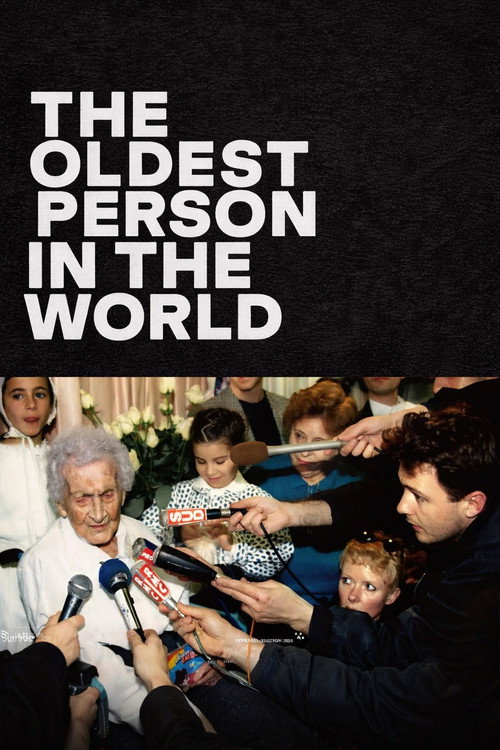
The Oldest Person in the World
2026 · Sam Green
For a reflective night when you want a film to chew on for days — something that makes you call your grandmother, or just sit still for a minute after the credits. Comforting and profound at once.
What it's about
For roughly a decade, documentarian Sam Green followed the people who have held one strange, unwanted title: the world's oldest living person — a distinction that passes, on average, about once a year, to a stranger who never applied for it. What begins as a global portrait gallery of extraordinarily long lives becomes a meditation on time, luck, and what it actually feels like to be alive.
The experience
Gentle, funny, and quietly devastating in the way films about time always are — it makes you sit with mortality without ever feeling morbid. The mood is warm curiosity shading into awe.
The craft
Green's method is guided attention rather than argument: a narrating voice, patient portraiture, and a structure the subject itself provides, since the title can only change hands one way. The decade-long shoot gives the film something money can't buy — real time passing on camera.
Why it matters
The culmination of Green's twenty-five years of essayistic, humane nonfiction, applying his signature approach to the most universal subject there is.
Snapshot
Sam Green has spent twenty-five years making documentaries that are less arguments than they are guided attentions — a narrator's voice, a stack of images, a live band, and a room full of people asked to notice something they had stopped noticing. The Oldest Person in the World applies that method to the most absolute subject available to it. Over roughly a decade, Green followed the succession of individuals who have held the Guinness World Records title of oldest living person: a title that can only be vacated by death, and that passes, on average, about once a year, to someone who did not apply for it and who frequently does not want it.
The premise is a machine for producing structure. A film about one very old person is a portrait; a film about the office of "oldest person," held serially by strangers on four continents, is a film about succession, about queues, about the statistical shape of a human life seen from its far edge. The TMDB synopsis frames the turn accurately — what begins as a portrait of longevity becomes a meditation on time, chance, and the strangeness of being alive at all — and that turn is the one Green's essay-documentaries have always made: the ostensible subject is a door, and the film walks through it.
A necessary caveat stated once and carried throughout: this is a 2026 release, and the verifiable public record on it — festival trajectory, crew credits, distribution, reviews, awards, which specific titleholders appear on screen — is thin or unavailable to me. What follows situates the film in Green's documented body of work and in the documentary traditions it draws on, and marks its speculations as speculations.
Industry & production
Green occupies an unusual economic position in American nonfiction. Since 2010 his primary features have been made not for broadcasters or streamers but for rooms — "live documentaries," performed with Green narrating from a lectern beside the screen and musicians playing the score in person. Utopia in Four Movements (2010), The Love Song of R. Buckminster Fuller (2012), The Measure of All Things (2014), A Thousand Thoughts (2018, co-directed with editor Joe Bini and performed with Kronos Quartet), and 32 Sounds (2022) were all built this way. The practical consequence is that Green's films are commissioned and sustained by performing-arts institutions, museums, and festivals as much as by film financing — a touring model, with fees per performance, closer to how a chamber ensemble or a theater piece earns out than to how a documentary recoups.
This matters for The Oldest Person in the World in a concrete way: a decade-long shoot, on multiple continents, in Japanese, Italian, Spanish, Portuguese, French, and English, is an expensive proposition that no single commission covers. Green's career has been supported by the customary scaffolding of American independent documentary — foundation grants, artist fellowships, festival labs, institutional commissions — accumulated in layers over years. A project of this shape is almost certainly the product of that layering rather than of a single green light, and its decade-long gestation is as much a funding fact as an aesthetic one.
Two production realities are worth naming because they are structural, not incidental. First, the subjects are extremely old and often in managed care, which means access runs through families, care-home administrators, national media minders, and the Guinness organization itself. Second, the shoot spans the COVID-19 pandemic, which closed long-term care facilities to visitors worldwide and killed a great many of the people this film exists to document. Any film following supercentenarians from the mid-2010s into the 2020s has a hole shaped like 2020–21 in it, and how the film handles that hole is one of the more interesting things to watch for. (I cannot confirm how it does.)
Technology
The film's technological condition is heterogeneity across time. A decade of digital capture spans multiple generations of camera bodies, codecs, and color pipelines; footage shot in 2015 and footage shot in 2025 do not match, and a filmmaker either conceals that or uses it. Green has historically used it — his films foreground the material difference between archival and contemporary images rather than smoothing them into a single gloss.
There is a second, deeper technological layer built into the subject. A person born in 1909 has a photographic record that begins in the era of glass plates and studio portraiture, passes through amateur snapshot film, home movies, video, and ends in the smartphone footage taken at their 116th birthday by a grandchild. The oldest person in the world is, among other things, a walking cross-section of the history of image technology — the only living subjects whose personal archives span the entire photochemical era. Any film built on their photographs inherits that span and the attendant problems of degradation, provenance, and rephotography.
Third: the performance apparatus, if this film follows Green's recent practice. A live documentary is a technical assembly — projection, live narration, cued playback, monitoring for musicians, and, in the case of 32 Sounds, headphones distributed to every audience member for binaural playback. 32 Sounds was a genuine technical proposition, not a gimmick: it made the auditorium's acoustics irrelevant and put the sound field inside each listener's skull. Whether The Oldest Person in the World carries any comparable apparatus is unconfirmed.
Technique
Cinematography
Green's visual practice is modest by disposition: small crews, available light, a camera that does not pretend to be invisible but also does not perform. The subject here imposes its own constraints. Supercentenarians tire quickly, are often bed- or chair-bound, have limited speech, and are frequently deaf or nearly so. The achievable shot list is narrow — a face, hands, a window, a room, a corridor, the visitors. This is a cinematography of the close-up and the static frame by necessity before it is one by choice.
The ethical charge of that closeness is unavoidable. Extreme old age reads on camera as spectacle whether or not the filmmaker intends it; the lens on a 117-year-old face is always in danger of becoming the lens of the record book, measuring. The counter-move available to a filmmaker is duration and stillness — holding a shot long enough that the audience stops cataloguing the face and starts being with the person. Given Green's temperament, I would expect the film to reach for that, though I cannot verify the result.
Editing
The premise supplies the cut. A succession of titleholders is a chain of segments, each terminated by a death, each death promoting the next person into the frame. That is an editorial engine of unusual cruelty and unusual clarity: the film's transitions are supplied by mortality. It also solves the essay film's hardest problem, which is why one thing follows another.
Green's assembly style, across his work, is associative rather than argumentative — an image, a fact, a digression, a return — with the narration doing the load-bearing while the images are allowed to be looser than the voice. His most significant editorial collaborator, Joe Bini (long the editor for Werner Herzog), co-directed A Thousand Thoughts, and Bini's influence is visible in Green's later willingness to let a sequence run on rhythm rather than information. The decade-long footage base here creates a distinct editorial opportunity: the same room, the same chair, five different occupants.
Mise-en-scène / staging
The film's recurring locations are institutional and domestic in roughly equal measure — care-home rooms, parlors, kitchens, day rooms with a television on — and its recurring ritual is public and absurd: the Guinness adjudicator arriving with a framed certificate, the local mayor, the cake, the press scrum, the photograph. This ceremony happens in reality, repeatedly, to people who are frequently unable to follow what is occurring. It is both genuinely tender and genuinely grotesque, and it is the richest staging the subject offers: the world arriving to congratulate someone on not having died.
Around that ritual stand the people the camera will find whether or not it looks for them — the care workers, overwhelmingly women, often migrants, whose labor is the actual mechanism by which a supercentenarian remains alive and presentable. Whether the film centers them is unknown to me; the material is there.
Sound
Green is, at this stage, a sound-first filmmaker. 32 Sounds was a full-length argument that listening is a mode of attention distinct from and in some ways more intimate than looking, and Green's long collaboration with sound designer, editor, and musician Dave Cerf runs through nearly the whole body of work. On this subject, sound carries specific weight: the voices of the very old are quiet, effortful, and slow; the rooms are full of clocks, oxygen concentrators, televisions, and the particular hum of institutions. A film that mics those rooms honestly will be a film substantially about waiting.
Music in Green's films is not underscore but co-presence — Yo La Tengo for The Love Song of R. Buckminster Fuller, Kronos Quartet for A Thousand Thoughts, JD Samson for 32 Sounds, performed live. The composer credit on this film is not something I can confirm.
Performance
Two performances run in parallel. The first belongs to the subjects, who are asked the same question by every journalist who reaches them — what is your secret? — and who have, most of them, developed an answer: olives, whiskey, never marrying, forgiveness, three eggs a day. These are performances of a role assigned from outside, and the gap between the person and the role is exactly where a documentary can live.
The second is Green's own. In his live work he is physically present, narrating in a deliberately unauthoritative first person — curious, digressive, willing to be moved. It is a performance of attention rather than expertise, and it descends directly from the essayistic, self-implicating documentary tradition he trained in.
Narrative & dramatic mode
This is an essay film organized as a catalogue — a form with a long lineage, from Chris Marker's Sans Soleil (1983) through Agnès Varda's The Gleaners and I (2000) and The Beaches of Agnès (2008), and, in its taxonomic strain, through Errol Morris's early grids of eccentrics in Gates of Heaven (1978) and Vernon, Florida (1981). It is also longitudinal, and therefore sits in the rare company of Michael Apted's Up series (1964–2019), the canonical demonstration that a camera returning over decades produces meaning no single visit can.
The dramatic mode is memento mori. There is no protagonist with an arc; there is a title that moves, and a narrator noticing what the movement means. The risk of the form is inventory — one more person, one more room, one more death — and the reward, if it lands, is cumulative rather than climactic: the audience arrives at a feeling about finitude it could not have been argued into.
Genre & cycle
The film belongs to the documentary of aging and mortality, a cycle that has thickened considerably since the mid-2010s: Albert Maysles's Iris (2014), Alan Berliner's First Cousin Once Removed (2012) on his relative's dementia, Kirsten Johnson's Dick Johnson Is Dead (2020), and the long shadow of Frederick Wiseman's Near Death (1989). Its record-book strain connects it to Green's own The Measure of All Things (2014), a live documentary drawn from Guinness titleholders and including among its subjects Besse Cooper (1896–2012), who held the oldest-living-person title until her death. The Oldest Person in the World is, on the evidence of its premise, that earlier film's single thread pulled until it became its own garment.
Authorship & method
Green (b. 1966) came to documentary through the UC Berkeley Graduate School of Journalism, where he studied with Marlon Riggs — a formation that matters, since Riggs's Tongues Untied (1989) and Black Is…Black Ain't (1994) are foundational works of first-person, performative, essayistic nonfiction. Green's breakthrough, The Weather Underground (2002, co-directed with Bill Siegel), was a conventional archival-and-interview film and an Academy Award nominee for Documentary Feature; everything since has moved steadily away from that mode toward performance, sound, and the first person.
His method is accretive and long-horizon: he collects for years, narrates himself, and treats collaborators as co-authors rather than crew. The durable names are Dave Cerf (sound, music, editing), Joe Bini (editing; co-director on A Thousand Thoughts), and the musical partners — Yo La Tengo, Kronos Quartet, JD Samson. I cannot verify the cinematographer, composer, editor, or writing credits on this particular film, and would rather say so than supply a plausible name. Given the practice, the likeliest configuration is Green himself as writer-narrator and a substantial part of the camera, with a composer or ensemble engaged as performing partner.
Movement / national cinema
Two lineages converge. The first is American independent documentary in its Bay Area inflection — the milieu of Riggs, of Rob Epstein and Jeffrey Friedman, of the ITVS/KQED public-media pipeline — which has long favored the personal voice, the political undertow, and modest means. The second is the tradition of live cinema: the illustrated travel lecture, the Japanese benshi, the magic-lantern narrator, and their contemporary revivals (Guy Maddin's Brand Upon the Brain! in 2006, with live orchestra, foley, and guest narrator, is the closest well-known analogue). Green is the most sustained practitioner of that revival in nonfiction, and his commitment to it is partly an argument: a film that exists only when people gather is a film that cannot be scrolled past.
Era / period
The decade the film covers, roughly 2015 to 2025, is the decade in which documentary's economics were remade by streaming acquisition and then broken by its retreat, and in which the pandemic made mass death and the vulnerability of the very old an ordinary fact of public life. It is also the decade of the "blue zones" longevity industry, of the search for lifespan-extension technologies funded by extremely wealthy men, and of a general cultural appetite for optimizing the end of life out of existence. A film that sits quietly with people who are simply, unimprovably old is legible against all of that — not as polemic, but as counterweight.
Themes
The record itself is the first theme, and its arbitrariness the point: the title is an artifact of documentation, awarded to whoever has the best-verified birth certificate, which biases it toward countries with early and durable civil registries. Longevity research carries its own scandals of verification — Japan's 2010 discovery that many registered centenarians were long dead or missing, and the long dispute over Jeanne Calment's claim to 122 years — and any serious treatment of the subject has to touch the bureaucracy of proof.
Beneath that: witness. The last people born in the nineteenth century died within this film's shooting window, and with them the last first-hand memory of that century. Then the ethics of care, largely invisible and largely borne by women. Then chance — nothing any of these people did earned this, and the film's synopsis flags "the randomness of fate" explicitly. And finally the thing Green's work returns to in every register, in Bucky Fuller and in 32 Sounds alike: that being alive is astonishing and that we are constitutionally unable to hold that thought for more than a few seconds at a time.
Reception, canon & influence
The reception record is not something I can report on. I have no verified reviews, festival results, awards, or box-office figures for this film, and will not manufacture them; a reader should treat any account of its critical standing as still forming.
What can be said with confidence concerns influence running backward. The film descends from Marker and Varda in its essayistic first person, from Riggs in its performative self-implication, from Apted in its longitudinal patience, from Morris and Wiseman in its attention to institutions and eccentrics, and most directly from Green's own The Measure of All Things, which established both the Guinness frame and the tonal register — wonder held just short of whimsy.
Forward influence is too early to assess. The likeliest contribution is formal rather than thematic: Green's live-documentary practice has, over fifteen years, demonstrated that nonfiction can be made as a touring performance sustained by arts institutions — a genuine alternative economy at a moment when the streaming market has stopped supporting the middle of the documentary field. If The Oldest Person in the World consolidates that model on a decade-scale, internationally shot project, its most lasting effect may be on how such films get paid for, and where they are seen.
A Deleuzian reading
An adjudicator arrives with a framed certificate.
The full Deleuzian reading of The Oldest Person in the World →
Influences: the films it descends from and the films it influenced
- Sans Soleil (1983) — Establishes the governing device: footage gathered over years across continents is held together not by chronology but by a first-person voice reading its own correspondence, so the cut is free to move by association while the narration supplies continuity — exactly the load-bearing structure Green uses to bind decades of interviews into one line.
- Chronicle of a Summer (1961) — Invents the repeated on-camera question ('are you happy?') as an organizing armature, where the interest lies in the variation of answers to an identical prompt rather than in any single subject — the direct formal precedent for 'what is your secret?' asked of each successive record-holder.
- Tongues Untied (1989) — Green's Berkeley teacher's model of performative nonfiction, in which the maker's speaking body and voice are the film's primary instrument rather than a neutral frame around the material — the license for a documentary whose narrator is physically present and implicated in the telling.
- Black Is…Black Ain't (1994) — Builds the director's own approaching death into the production schedule, shooting from the hospital bed and letting the film's incompleteness become its form; it is the precedent for an edit in which a subject's death is a structural transition the film was designed to absorb, not an accident that stops it.
- Silverlake Life: The View from Here (1993) — The camera runs across the boundary of the subject's death and the film cuts through it rather than away from it, establishing that the transition itself — not the deathbed image — is the editing problem, which is the operation Green repeats each time succession passes to the next holder.
- 28 Up (1984) — Makes the interval the technique: returning to the same faces at fixed spans so that the straight cut between two ages does all the expressive work, with the visible change in film stock and grain doing double duty as a time signature — Green's serial-succession cuts are the terminal case of this device.
- Vernon, Florida (1981) — Fixes the static frontal close-up on an eccentric talking past the question and holds the take long past the usable answer, treating oddity with an unmocking patience — the interview grammar Green's centenarian portraits inherit, including the refusal to cut on the punchline.
- Near Death (1989) — Lets institutional room tone — ventilators, corridor hum, nursing-station chatter — carry sequences without music or narration, so the building becomes an audible character; the acoustic template for the care-home interiors Green records rather than scores.
- The Gleaners and I (2000) — Turns the lightweight digital camera into a first-person prosthesis, the maker filming her own aging hand in close-up and folding the accident of the format into the essay; it licenses both Green's self-shot camera and the frank use of consumer-grade generations as evidence of elapsed time.
- Koyaanisqatsi (1982) — Established the touring live-score screening as a distribution model rather than a novelty, with the Philip Glass Ensemble performing the film city to city under arts-presenter economics — the exhibition infrastructure Green's live-documentary practice runs on.
- The Love Song of R. Buckminster Fuller (2012) — Green's first full working-out of the live form with Yo La Tengo performing onstage: narration timed to musicians who can stretch or compress a cue, and a single long-lived visionary whose archive forces the film to cross several photochemical and video generations in one reel.
- The Measure of All Things (2014) — The immediate parent — it sets the Guinness record-holder as the unit of construction, the certificate-presentation as a recurring staged beat, and the tonal register of wonder held just short of whimsy that the new film extends into a single serial line.
- 32 Sounds (2022) — Pushes the same live apparatus toward the ear — binaural headphone mix, a musician cueing beside the screen — and tests the memento-mori move of playing a dead person's recorded voice to a room, which is the affective mechanism the succession structure relies on.
- Decasia (2002) — Programs the decaying nitrate image against a score written to be performed live in the hall, so the physical age of the emulsion is the content and the event is part of the work — the same two commitments, photochemical span and performed score, arriving from the archival rather than the interview side.
- Dick Johnson Is Dead (2020) — Rehearses a subject's death with the subject's participation while the real decline advances through the shoot, solving the same production problem — how to shape a film around a death that will arrive on its own schedule — by staging rather than by waiting.
- Time (2020) — Cuts twenty years of the subject's own Hi8 home video against newly shot digital so the shift in format and resolution reads directly as elapsed years, the mixed-generation edit doing the arithmetic instead of titles or narration.
- Some Kind of Heaven (2020) — Composes elderly subjects in rigorously symmetrical static frames inside pastel institutional interiors, letting the architecture of managed late life supply the mise-en-scène — the contemporary working-out of the care-home frame Green shoots straight on and holds.
Similar films
- The Gleaners and I (2000) — influence & lineage
- Remarkably Bright Creatures (2026) — shared sensibility
- Silent Friend (2026) — shared sensibility
- After Life (1999) — shared sensibility
- So Long, My Son (2019) — shared sensibility
- Still Life (1974) — shared sensibility
- Blue Heron (2026) — shared sensibility
- Amour (2012) — shared sensibility