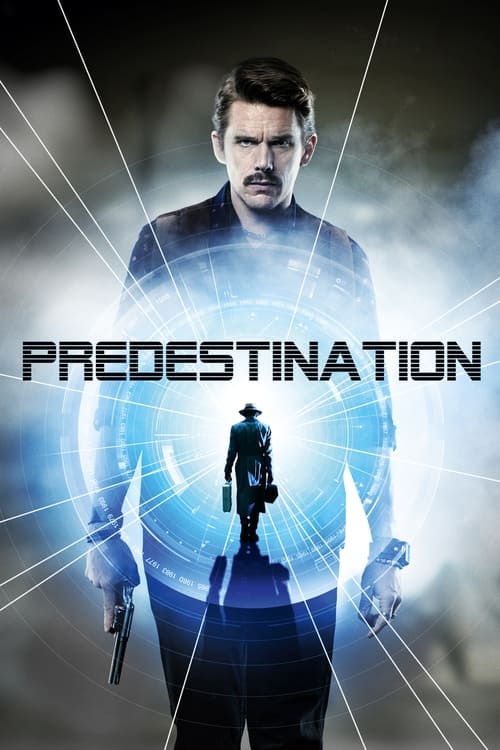
Predestination
2014 · Michael Spierig
When you want a film to chew on — the kind you finish and immediately want to rewatch or drag a friend into so you can talk it through. Best watched cold, with your phone in another room and no plot summaries beforehand.
What it's about
A time-traveling agent for a secret bureau hops between decades preventing atrocities before they happen, and is closing in on his last case: an elusive terrorist called the Fizzle Bomber, whose next attack will kill thousands. Working undercover as a bartender in 1970 New York, the agent meets a stranger with the most extraordinary life story he's ever heard — an orphan, a stolen future, a betrayal — and offers a deal that pulls them both into the mission. Adapted from a famously knotty Robert A. Heinlein short story.
The experience
Less an action movie than a slow-tightening puzzle box — long, riveting barroom storytelling that suddenly folds in on itself, leaving you turning the plot over in your head for days. It's intimate, melancholy, and genuinely mind-bending without ever feeling smug about it.
Performances
Sarah Snook is astonishing in a role that asks for a whole lifetime of hurt and reinvention, and she carries the film; Ethan Hawke matches her with a weathered, wounded steadiness. It's a two-hander at heart, and both halves are remarkable.
The craft
The Spierig brothers expand a five-page story into a feature with unusual discipline — the script is a piece of clockwork where every stray detail turns out to load-bearing. Handsome period design moves from 1940s hospitals to 1970s bars to a retro-futurist space program, all on a modest budget that never shows.
Why it matters
A small Australian production that became a word-of-mouth cult favorite and the definitive proof that Heinlein's most 'unfilmable' paradox story could be filmed — and it announced Sarah Snook, years before her television fame, as a major actor.
Snapshot
Predestination is an Australian science-fiction thriller adapted from Robert A. Heinlein's 1959 short story "'—All You Zombies—'," a five-page exercise in temporal paradox that the twin writer-directors Michael and Peter Spierig expanded into a feature without diluting its central conceit. The film follows an unnamed Temporal Agent (Ethan Hawke) working for a bureau that intervenes in the past to forestall atrocities, closing in on a serial bomber known as the Fizzle Bomber who has evaded capture across decades. Its true subject, however, is the person the Agent meets in a New York bar in 1970: a writer of confessional magazine filler who goes by "The Unmarried Mother" (Sarah Snook), whose life story — of an orphan named Jane, an aborted astronaut-corps career, a love affair, a pregnancy, a surgical revelation, and a stolen infant — occupies the film's long central act and eventually swallows every other character in it.
The film is unusual in the time-travel cycle for how little it cares about spectacle and how much about biography. Where most temporal thrillers stage their paradoxes as action, Predestination stages its central one as testimony: two people at a bar, one talking, the other listening, in a sustained conversational passage that runs closer to chamber drama than to genre cinema. It is also unusual in placing a transgender-adjacent narrative — Heinlein's original conceit involves an intersex protagonist surgically reassigned after childbirth — at the structural center of a mainstream genre film, decades after the source text and with markedly different cultural stakes. Snook's dual-register performance as both Jane and John is the film's engine and its most durable achievement; it won her the AACTA Award for Best Actress and effectively launched an international career that would culminate in Succession. Made modestly by an Australian production company with Screen Australia support, released in 2014 to broadly favorable notices and limited theatrical exposure, Predestination has settled into the position of a genre cult object: the film cited when the argument turns to whether a closed causal loop can carry emotional weight rather than merely puzzle-box satisfaction.
Industry & production
Predestination was produced by Blacklab Entertainment, the Australian company founded by producer Paddy McDonald with the Spierig brothers, and financed with support from Screen Australia and Screen Queensland — the same regional-agency scaffolding that had underwritten the brothers' earlier features. It was shot in Melbourne, Victoria, with Australian crew standing in for New York, Cleveland, and the various American mid-century locales the script requires. Sony Pictures Worldwide Acquisitions handled international distribution; in the United States the film went out through Sony's Stage 6 Films label in a limited theatrical release in January 2015, following a 2014 Australian release and a premiere at the SXSW Film Festival in March 2014.
The production is best understood as the third step in a career pattern. The Spierigs had made Undead (2003), a self-financed zombie comedy shot in Queensland on a shoestring with visual effects the brothers executed themselves, and Daybreakers (2009), a considerably larger vampire-dystopia picture with Ethan Hawke and Willem Dafoe backed by Lionsgate. Predestination reunited them with Hawke, and its budget sat between those two poles — modest by studio standards, substantial by Australian ones. Precise, well-sourced budget and gross figures for the film are not something I can state with confidence, and I would rather flag that gap than repeat a number of uncertain provenance; what is clear is that the film's commercial life has been overwhelmingly on video, streaming, and word-of-mouth rather than in theaters.
The economics shaped the film in visible ways. Its period America is built from a handful of controlled interiors — the bar, a diner, an apartment, an institutional corridor — rather than from streets and crowds. The single most expensive-looking sequence, an explosion in a Manhattan-coded street, is deployed sparingly and largely in fragments. This is a film that spends its money on faces, costume, and a small number of well-dressed rooms, and its aesthetic coherence owes a great deal to that discipline. The Australian-for-America substitution, a longstanding cost strategy in that national industry, is handled here through tight framing and period-specific set dressing rather than through establishing shots that would expose the seams.
Technology
Predestination was shot digitally, in the period when Australian mid-budget production had largely completed its migration away from film capture. The Spierigs came out of a visual-effects-literate, digitally native filmmaking practice — Undead had been made with the brothers building their own effects — and Predestination deploys that literacy quietly rather than showily. The visual effects work is concentrated in three places: the period cityscape extensions that let a Melbourne stage read as mid-century America, the bombing sequence, and the film's most technically delicate task, the facial and physical continuity work required to make Snook's two presentations legible as one person.
That last problem is the film's real technological centerpiece, and it is solved mostly by non-digital means — prosthetic and makeup work, hair, costume, and posture — with digital assistance held in reserve. The decision matters aesthetically. A more effects-forward approach (heavy digital de-aging, extensive facial reconstruction) would have pushed the character toward uncanniness and away from the credibility the story requires. The Spierigs instead trust the makeup department and the performer, using the camera's discretion — angle, lighting, duration of hold — as the primary tool. The time-travel apparatus itself is likewise resolutely analog in design: a violin-case-sized device with mechanical dials, more spy-thriller prop than science-fiction machine, deliberately withholding the digital sublime that the genre's contemporary blockbusters had made standard.
The film also belongs to the moment when specialty science fiction found a viable distribution technology in on-demand and streaming platforms. Its theatrical footprint was small; its audience was assembled largely through post-theatrical channels, and the reputation it now enjoys was built there.
Technique
Cinematography
Ben Nott, who had shot Daybreakers for the Spierigs, photographs Predestination in a controlled, low-key register that leans on practical-seeming sources: the amber pool over a bar, the hard institutional wash of a corridor, the sodium spill of a street at night. The palette runs to desaturated blues and browns punctuated by warm interior light, a scheme that lets the film's several decades read as tonally continuous — a useful economy when the narrative shuttles between 1945, 1963, 1970, 1975, and 1985 without wanting to announce each jump with a change of visual grammar.
The most consequential cinematographic decision concerns the bar. The long central conversation is covered in a way that privileges sustained holds on Snook, frequently in close or medium-close framings, with the camera drifting slightly rather than cutting for emphasis. This is a film in which the camera's job, for a substantial stretch, is simply to stay with a face while it tells a story — and Nott's lighting of that face, which must register as both Jane's and John's without either reading as costume, is the film's quietest technical achievement. Elsewhere, in the flashback material, the camera is more mobile and the compositions more classically pretty, particularly in the 1960s romance passages, which are shot with a warmth the framing narrative withholds.
Editing
Matt Villa's cutting carries an unusual structural burden: the film's plot is not chronological, is not even primarily sequential, and depends on the audience holding several temporal positions simultaneously without being told which one is causally prior. The editing solves this by front-loading a brief, deliberately confusing prologue — an explosion, a burned face, surgery — and then withholding its meaning while the bar conversation runs at a length that would be unthinkable in a more conventional thriller.
The film's most-discussed formal gesture is the way that conversation is edited: John's narration is illustrated by flashbacks that gradually assume the film's dominant duration, so that the "frame" narrative is functionally the interruption and the "flashback" is the main text. When the film returns to the bar, the return registers as a jolt. Villa also handles the reveals with an economy worth noting — the film's several turns are not staged as stinger cuts with musical accents but arrive within scenes already in progress, which is why the picture can execute three or four major disclosures without feeling like a machine for delivering twists.
Mise-en-scène / staging
The film's production design (by Matthew Putland) and costume work build a mid-century America out of surfaces rather than vistas: Formica, tin ceilings, glass ashtrays, the specific tailoring of a 1960s dress and a 1970s work shirt. Period is established by the density of small correct things in tight frames — a strategy both economical and thematically apt, since the film is about a life reduced to its objects and documents.
The staging of the bar scenes deserves particular attention. The two figures are positioned across a bar top, one behind and one in front, an arrangement that formalizes their relation as interrogator and confessant while concealing — through blocking as much as through writing — how much each already knows. The Spierigs shoot this space with a consistency that lets the audience map it, which pays off when the film later returns to it under different terms. The institutional spaces of the space-corps training facility and the hospital are staged with a chilly symmetry that reads as period-appropriate futurism, a 1960s idea of tomorrow rather than our own.
Sound
Peter Spierig composed the score himself, as he had for the brothers' earlier features — an unusual and underdiscussed instance of a director doubling as composer. The music is restrained, built on sustained strings and a recurring melodic figure that attaches to Jane's story rather than to the thriller plot, and it is conspicuously absent from long stretches of the bar conversation, where the soundscape is barroom ambience, glass, and voice. That withholding is a deliberate strategy: the film reserves its score for the flashbacks, so that emotion is coded as belonging to the past and the present is left dry.
The sound design elsewhere leans on the mechanical: the clicks and whirs of the temporal device, the specific report of the explosion in the prologue, the muffled acoustic of hospital corridors. The film's use of a recurring song cue in the bar — diegetic, period, and thematically pointed — is the sort of choice that rewards a second viewing.
Performance
Sarah Snook's performance is the film's reason for existing, and it is a genuinely difficult piece of work: she plays the same person across roughly forty years and two social presentations, and the performance's credibility depends on the audience recognizing continuity of self through discontinuity of body and voice. Snook builds that continuity out of small persistent behaviors — a defensive tilt of the head, a way of holding a glass, a flat affect that reads as guardedness in the young Jane and as exhaustion in the older John. The vocal work is the most obvious technical element and the least interesting one; the achievement is in the eyes and the stillness.
Ethan Hawke, in what is structurally the listener's role for much of the film, does something equally difficult in a different key: he must be interesting while receiving, and must plant information he cannot yet be seen to possess. Hawke plays the Agent as tired, warm, and slightly wrong — a man whose kindness has an agenda he does not entirely control. Noah Taylor, as the bureau's Mr. Robertson, supplies the film's institutional voice in a handful of scenes, playing the bureaucrat as neither villain nor mentor but as something more unsettling: an administrator of fates who is entirely comfortable with the arrangement.
Narrative & dramatic mode
Predestination is a puzzle film, but it belongs to a specific and relatively rare subspecies: the puzzle whose solution is a person rather than an event. The dominant mode is confessional monologue embedded in a procedural frame. A significant majority of the film's dramatic weight sits in a single conversation, and the "action" plot — the pursuit of the Fizzle Bomber — functions less as narrative drive than as the pretext that keeps two people in a room.
Structurally, the film is a closed causal loop, the tightest form of the ontological or "bootstrap" paradox, in which effects have no origin outside the loop itself. Heinlein's story is the canonical literary example of the form, and the Spierigs' adaptation preserves its logic exactly while adding a second-order loop — the Fizzle Bomber plot — that Heinlein's original does not contain. This addition is the adaptation's principal creative intervention and the most debated one: it gives the feature the antagonist and third act that a five-page story lacks, and it also converts a story about identity into a story about determinism and the ethics of an agency that manufactures its own agents.
The dramatic mode is closer to tragedy than to thriller in the strict sense. The film's revelations do not open possibilities; they close them. Each disclosure narrows the field of who the characters might be until only one configuration remains, and the final movement's affect is not triumph or horror but a kind of exhausted recognition. The film's last image is a statement about loneliness rather than about time.
Genre & cycle
The film sits inside the time-travel paradox cycle that ran through the 2000s and 2010s — Primer (2004), Timecrimes (2007), Triangle (2009), Looper (2012), Coherence (2013), Edge of Tomorrow (2014) — a body of work characterized by tight budgets, rigorous internal logic, and an appeal to audiences who treat plot mechanics as a form of pleasure. Predestination is among the most formally severe entries in that cycle, in the sense that it commits fully to a closed loop and declines the escape hatch of alternate timelines that most of its contemporaries reserve.
It also draws on the noir tradition, and consciously: the bar confession, the period voice-over inflection, the world-weary agent, the femme-fatale structure inverted so that the dangerous stranger and the investigating hero are the same person. The 1970s New York setting and the confessional-magazine milieu evoke a pulp-print culture that is itself a noir signifier.
Within Australian genre cinema, the film belongs to a mid-2010s wave — alongside The Babadook (2014), Wyrmwood (2014), and the ongoing Mad Max revival — in which local production companies and screen agencies backed distinctive genre work aimed at international markets rather than at the domestic social-realist tradition. The Spierigs are among the clearest exemplars of that turn.
Authorship & method
Michael and Peter Spierig, German-born and Australian-raised, work as an inseparable writing-directing unit, and their method has been consistent across a career: genre premises executed with craft-forward economy, developed from their own scripts, with the brothers taking on technical roles (effects on Undead, score on Predestination) that a comparably budgeted production would outsource. Their filmography — Undead, Daybreakers, Predestination, Jigsaw (2017), Winchester (2018) — is uneven, and Predestination is by consensus the peak. What distinguishes it from the rest is its willingness to subordinate genre machinery to a performance and a conversation.
The adaptation itself is the key authorial act. Heinlein's story is a compressed puzzle with almost no interior life; the Spierigs' screenplay grants Jane a childhood, an institution, a rejection, a romance, and a grief, and it is these additions — not the paradox, which was already there — that make the film work. The choice to have one actor carry both presentations, rather than casting two performers, is likewise a screenplay-level decision with enormous downstream consequences.
Ben Nott (cinematography) and Matt Villa (editing) are the technical collaborators most responsible for the film's coherence — Nott for the tonal continuity that lets four decades share a look, Villa for the structure that lets a monologue function as a second act. Peter Spierig's score, restrained and thematically targeted, completes an unusually self-contained production. Sarah Snook, though a performer rather than an author in the traditional sense, has as strong a claim on the film's authorship as anyone: the picture's central argument — that a self persists through radical bodily and social discontinuity — is made by her acting, not by its dialogue.
Movement / national cinema
Predestination is an artifact of a particular configuration in Australian cinema: state and federal screen-agency funding (Screen Australia, Screen Queensland) directed toward genre features designed for export, at a moment when the Australian industry was actively diversifying beyond the naturalist dramas and outback fables that had defined its international profile since the 1970s New Wave. The film is set entirely in America, features an American star, and betrays almost no Australian surface content — which is itself characteristic of the strategy.
There is a longer Australian lineage of genre filmmaking that runs from the Ozploitation output of the 1970s and 1980s through Mad Max (1979) and its sequels to the contemporary wave, and the Spierigs belong to it more than they belong to the art-cinema tradition. What they share with the Ozploitation generation is a resourcefulness about making expensive-seeming pictures cheaply; what separates them is a literary sensibility about source material and a comparative restraint about violence and spectacle.
Era / period
Released in 2014, Predestination arrives at the crest of the "smart genre" moment — a period in which mid-budget science fiction with intellectual pretensions found both critical hospitality and, increasingly, a streaming-driven audience. It shares its year with Interstellar, Edge of Tomorrow, Under the Skin, and Ex Machina (premiered 2014), a cluster that suggests how much appetite there was for science fiction operating as idea-delivery rather than as franchise.
The film's internal periods matter as much as its release year. Its span runs from a 1945 orphanage through a 1963 space-corps program, a 1970 bar, and into a near-future 1985 and 1992, and each is rendered with specificity. The 1963 material engages, obliquely, with the era's gendered exclusions from the space program — a fictionalized corps that recruits women for purposes the film reveals to be exploitative, in a way that reads as commentary on the actual history of women's marginalization in mid-century aerospace. The 1970 bar sequence is embedded in the confessional-magazine economy of that decade, a print culture in which anonymous personal disclosure was a commodity — an apt setting for a film about a life told as a story.
The film's treatment of intersex embodiment and gender transition, inherited from a 1959 text, sits awkwardly in a 2014 frame and has drawn commentary on both counts: some readings value the film's insistence on continuous personhood across transition, others note that the narrative treats surgical reassignment as a plot mechanism imposed on the character rather than as a matter of self-determination. Both readings are available in the text, and the film's reputation now includes that debate.
Themes
The film's governing theme is the self-generated self: a person who is their own parent, lover, and pursuer, and who therefore has no origin outside their own biography. This is the closed loop rendered as an existential condition rather than a logic puzzle. The paradox is the point, but the film's interest is in what it feels like to be the paradox — to be, as the closing movement makes explicit, entirely alone in the universe in a sense no other person can be.
Determinism and agency run alongside it. The Temporal Bureau exists to change the past, but the film systematically demonstrates that every intervention was always already part of the sequence it was meant to alter. The Fizzle Bomber subplot exists largely to make this argument: the pursuit produces the pursued. The bureaucracy that presents itself as an instrument of prevention is revealed as a mechanism of reproduction.
Identity and embodiment form the third axis. The film asks whether the self is continuous through radical bodily change, and answers — through Snook's performance more than through its dialogue — that it is, while refusing to make that continuity comfortable. Jane and John are the same person and are also estranged from each other; the film's cruelest sequences involve one failing to recognize the other.
Finally, loneliness as structure. The picture ends with an image of total isolation, and the loneliness is not circumstantial but topological: a closed loop has no outside, and a person who is the entire loop has no one else in it.
Reception, canon & influence
Critical reception in 2014–15 was broadly positive, with reviewers converging on two points: that Snook's performance was exceptional, and that the film's central conceit was executed with unusual rigor for a genre picture. The most common reservation concerned the Fizzle Bomber material — that the added antagonist plot was the weakest strand, more mechanically necessary than dramatically alive, and that the film's final act resolves into inevitability a little too neatly. The film's institutional recognition came primarily in Australia: Snook won the AACTA Award for Best Actress, and the film received several other AACTA nominations. It premiered at SXSW in March 2014 and played the festival circuit before a limited theatrical run.
Its backward influences are clear and largely literary. Heinlein's "'—All You Zombies—'" (1959) is the direct source, and behind it sits Heinlein's own "By His Bootstraps" (1941), the earlier and less baroque bootstrap-paradox story. The cinematic antecedents are Chris Marker's La Jetée (1962) and Terry Gilliam's 12 Monkeys (1995), both of which established the tragic closed loop as a film form; Shane Carruth's Primer (2004), which legitimated rigorous low-budget time-travel filmmaking; and Nacho Vigalondo's Timecrimes (2007). The noir inheritance runs through the confessional structure, and the film's bar-set testimony has an obvious debt to the flashback architecture of 1940s crime cinema.
Its forward influence is harder to measure and, honestly, more a matter of reputation than of demonstrable lineage. Predestination is now a standard reference in discussions of the bootstrap paradox on film — frequently the example offered when the claim is that a closed loop can be emotionally rather than merely intellectually satisfying. It has a durable cult standing built through streaming and repeat viewing, and it functions as a touchstone for a certain kind of low-budget, high-concept science fiction that prioritizes performance over spectacle.
Its clearest verifiable legacy is a career. Sarah Snook's work here brought her international attention and stands as the performance most often cited as her breakthrough before Succession (2018–2023) made her a major figure. The Spierigs, by contrast, moved into work-for-hire horror sequels and did not repeat the film's achievement. The film's other legacy is discursive: it is regularly invoked in writing about trans and intersex representation in genre cinema, both as an unusual instance of a mainstream film structuring itself around a transition narrative and as a case study in the complications of adapting a 1959 text's assumptions about bodies and gender into a contemporary frame. Any claim that specific later films were directly shaped by Predestination would be speculation; what can be said is that it consolidated a set of possibilities — the paradox as character study, the single performer as the whole puzzle — that the cycle had circled without quite landing.
Reception
A small-release 2014 sci-fi that made modest box office noise but earned strong reviews, it's since become a word-of-mouth staple — retroactively boosted by Succession fans discovering Sarah Snook was doing career-best work years before anyone was watching.
How Predestination was received, from release to now →
How to watch Predestination: what to notice on a first viewing
- Watch who stands behind the bar and who sits in front. The Spierigs hold two figures across a countertop, one serving and one talking, for most of the film's middle. The blocking makes it an interrogation without either party calling it one. The geometry decides who has the power in the room, and it keeps hiding how much each of them already knows.
- Listen for the music dropping out during the bar talk. Peter Spierig wrote the score himself and keeps it off the bar entirely. What you get there is ambience, glass and voice. The strings are saved for the scenes being described. Feeling is coded as belonging to the past. The present is left dry, so you have to supply your own reaction.
- Count how long the camera stays on one face. Ben Nott shoots the conversation in close and medium-close holds and lets the camera drift instead of cutting for emphasis. For long stretches its only job is to stay with someone telling a story. A genre film hands its second act to a face and a voice. That is the whole bet the picture makes.
- Look at the Formica, tin ceilings and glass ashtrays. Matthew Putland builds four decades of America out of small correct objects in tight frames rather than streets and skylines. Tailoring, signage and bar fittings carry the year. The period is made of things you could pick up. Fitting for a film about a life reduced to its documents.
- Watch Hawke's face while the other person is talking. For most of the film he is the listener. Hawke plays the Agent tired, warm and slightly wrong, a man whose kindness runs on an agenda he does not entirely control. He has to be interesting while receiving, and has to know things he cannot yet be seen to know.
The whole guide to watching Predestination, with the keys for a rewatch →
Influences: the films it descends from and the films it influenced
- La Jetée (1962) — Established the closed causal loop as a film form in which the protagonist's earliest remembered image turns out to be his own death, so the climax is a recognition of identity rather than a plot reversal — exactly the terminal move Predestination borrows for its final bar scene.
- 12 Monkeys (1995) — Expanded La Jetée to feature length by wrapping the loop in an institutional apparatus — the traveler's testimony is heard by clinicians who read it as delusion — which is the same interrogation-and-record frame the Spierigs use for Jane's file at the Space Corps and the Temporal Bureau.
- Double Indemnity (1944) — Codified the confession-to-a-single-listener structure in which a man narrates his life into a recording device and the flashback progressively supplants the present tense, leaving the frame only to close the trap — the exact architecture of the Pop's Place monologue.
- Out of the Past (1947) — Model for the roadside-confession noir: a long unbroken past-tense account delivered to one auditor, lit from low practical sources within the scene, with the listener's silence carrying the dramatic charge — Predestination's bartender is that auditor role weaponized.
- Vertigo (1958) — Gave the tragic-loop film its key structural gamble — release the reveal to the audience well before the protagonist reaches it, so the last act plays as dread rather than surprise — which is why Predestination can drop the Jane/John identity without a music sting or cutting flourish.
- Somewhere in Time (1980) — The pocket watch with no point of origin is the canonical bootstrap object played for romance rather than puzzle-logic; Predestination inherits the device wholesale and multiplies it, making the traveler himself the object with no origin.
- The Terminator (1984) — Made the predestination loop the emotional engine of a genre thriller — the soldier sent back fathers the man who sends him — and anchored it in a hand-carried photograph, the physical prop-as-paradox strategy Predestination repeats with the violin case and the fiddle-case time machine.
- Primer (2004) — Legitimated rigorous micro-budget time travel by building the machine as a mundane analog object shot without a single explanatory VFX grammar — no portal, no vortex — the same refusal that lets Predestination's device be a violin case with dials and a countdown.
- Timecrimes (2007) — Proved a loop can be staged with three actors and two locations by making the protagonist occupy every role in his own catastrophe, which is the economy Predestination scales to one performer occupying every role in her own biography.
- Orlando (1992) — Sustained a single performer as one continuous character across a change of sex and centuries of period, signaling era entirely through costume, wig and surface rather than exposition — the same period-by-surfaces method and single-body continuity Snook's performance depends on.
- Boys Don't Cry (1999) — Built its performance on sustained close holds of a face negotiating gender presentation and on practical, in-camera physical alteration — binding, hair, prosthesis — rather than any optical trick, the precedent for the makeup-over-CGI continuity that keeps Snook legible as one person before and after.
- Halloween (1978) — The canonical instance of the director scoring his own picture out of budgetary necessity and turning it into authorial signature, with long stretches deliberately left unscored so silence does the work — the model for Michael Spierig composing Predestination and withholding cue from its reveals.
- Arrival (2016) — Runs the same editing sleight-of-hand at feature scale: material cut with the grammar of flashback that resolves as flash-forward, so the closed loop lands as grief rather than as trivia — the emotional-bootstrap payoff Predestination is now routinely cited as having proven possible.
- Daybreakers (2009) — The brothers' own rehearsal for building a speculative world out of production-design surfaces and practical effects on a genre budget, and their first collaboration with Ethan Hawke, whose weathered-listener register is repurposed here as the barkeep who mostly absorbs.
- Triangle (2009) — Contemporary case for the emotionally closed loop: a single confined set repeated until the protagonist confronts her own earlier and later selves, with reveals delivered by staging and eyeline rather than by score or montage stinger.
- The Man from Earth (2007) — Speculative fiction executed as nothing but spoken testimony in one room to a circle of listeners, proving the genre's payload can travel on dialogue and reaction shots alone — the wager Predestination makes for its entire first hour.
- Coherence (2013) — Micro-budget high-concept built from performance and one location, with the speculative mechanism established through practical light sources and props on hand — the contemporaneous proof that the puzzle can be carried by actors rather than by effects budget.
Similar films
- The Terminator (1984) — influence & lineage · same viewing thread
- Looper (2012) — influence & lineage · same viewing thread
- Double Indemnity (1944) — influence & lineage · often watched together
- Black Bag (2025) — often watched together
- A Most Wanted Man (2014) — shared sensibility
- Interstellar (2014) — shared sensibility
- Furiosa: A Mad Max Saga (2024) — shared sensibility
- Phoenix (2014) — shared sensibility
All the films related to Predestination →
Watch it with: curated runs of related films
- Tampering With the Timeline — A run of films that all reach for the undo button — meddling with the past, outrunning the future, and living with the paradoxes that snap back.