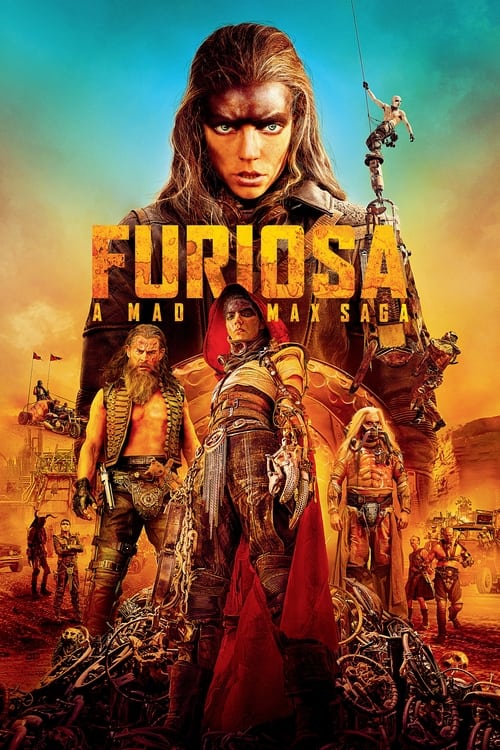
Furiosa: A Mad Max Saga
2024 · George Miller
For when you want a huge, loud, world-swallowing action saga — a full-meal epic rather than a quick hit, best when you can give it your whole evening and your best screen.
What it's about
Before she was the war-rig commander of Fury Road, Furiosa was a child stolen from a hidden green paradise by a roaring biker horde. Her captor is Dementus, a grandiose wasteland warlord waging a power struggle against the tyrant Immortan Joe — and across fifteen years of captivity, apprenticeship, and patience, she forges herself into someone capable of getting home, and of revenge.
The experience
A sweeping, brutal wasteland epic — slower-burning and more novelistic than its predecessor, told in chapters, but when the chases ignite they're staggering. It trades relentless momentum for scale, myth, and a long-simmering rage that pays off.
Performances
Anya Taylor-Joy burns through the role with barely a page of dialogue, doing it all with her eyes; Chris Hemsworth is the surprise — funny, pathetic, and menacing as the self-mythologizing Dementus, the loosest and strangest work of his career.
The craft
George Miller's action filmmaking remains the genre's gold standard: colossal practical vehicle warfare, immaculate geography in every chase, and a scorched-orange visual world built out over decades. The centerpiece assault sequences demand the biggest screen and loudest sound you can find.
Why it matters
It deepened the Mad Max saga into genuine mythology and stood as proof that a director in his ninth decade could still out-stage every action filmmaker working.
Snapshot
Furiosa: A Mad Max Saga is George Miller's prequel to Mad Max: Fury Road (2015), tracing the origin of the character Charlize Theron originated as Imperator Furiosa. Where Fury Road compressed its story into a single unbroken pursuit across roughly three days, Furiosa expands outward into an epic chronicle organized as five titled chapters and spanning something like fifteen to eighteen years of wasteland history. It follows a girl abducted from the Green Place of Many Mothers by the marauding warlord Dementus, passed into the orbit of Immortan Joe's Citadel, and slowly forged, through captivity and revenge, into the one-armed war captain of the earlier film. Anya Taylor-Joy plays the adult Furiosa, Alyla Browne the child; Chris Hemsworth, in prosthetic nose and self-mythologizing bombast, plays Dementus. The film premiered out of competition at the 2024 Cannes Film Festival and was released theatrically by Warner Bros. It is at once a continuation of Miller's forty-five-year Mad Max project and a formal departure from it — a saga where its predecessor was a chase, and a partly digital construction where its predecessor was famous for the practical.
Industry & production
The film was a large-scale Australian-American co-production, developed by Miller and producer Doug Mitchell through Kennedy Miller Mitchell, the company Miller has anchored in Sydney for decades. Miller has spoken publicly about having written extensive backstory for Furiosa during the making of Fury Road — material originally conceived to give Theron's performance interior grounding — and the prequel grew out of that pre-existing "bible." Crucially, and in contrast to Fury Road, which was shot largely in Namibia after floods turned the Australian outback unexpectedly green, Furiosa was filmed in Australia, principally in New South Wales around Broken Hill and Hay, returning the saga to its native landscape.
The production was among the most expensive ever mounted in Australia, its budget widely reported in the vicinity of the mid-hundred-millions of US dollars; I'll avoid asserting a precise figure, as reported numbers vary. Commercially, the film is generally regarded as an underperformer relative to that outlay — it did not replicate Fury Road's eventual cultural and awards momentum at the box office — and its release amid a crowded 2024 summer is often cited as a factor. The disappointing gross has been noted as a complicating factor for Miller's long-discussed further Mad Max projects. I won't attach specific revenue figures here, as I can't verify exact totals.
Technology
Furiosa marks a notable technological shift within the Mad Max series. Fury Road built its reputation on physically real vehicular stunt work with digital augmentation used sparingly and invisibly; Furiosa, by contrast, leans more heavily and more openly on computer-generated environments, digital vehicle work, and virtual extension of its landscapes and crowds. This was partly a function of the saga's expanded geography — the film must portray the Citadel, Gastown, and the Bullet Farm as a connected economy of settlements, and stage battles at a scale beyond a single road. De-aging and digital-youth techniques bridge Alyla Browne's child Furiosa and Anya Taylor-Joy's adult, with reports that Browne's features were digitally blended into Taylor-Joy's in transitional passages. Weta and other effects houses contributed heavily. The film's reception included a strand of debate about whether this greater digital visibility diminished the tactile authenticity that made Fury Road feel singular — a genuine critical fault line rather than a settled verdict.
Technique
Cinematography
The director of photography is Simon Duggan (Hacksaw Ridge, The Great Gatsby), replacing John Seale, who had come out of retirement for Fury Road and did not return. Duggan sustains the saga's saturated palette — scorched oranges by day, deep cyanotic blues by night — and its signature strategy of centering the principal action for legibility at speed. But the visual grammar is adjusted to the longer form: where Fury Road was relentlessly propulsive, Furiosa admits more scale-establishing vistas, more sustained landscape, and a wider tonal range across its chapters. The film retains Miller's insistence on eyeline clarity and readable spatial geography, but the increased reliance on digital environments changes the texture of the image relative to Seale's largely in-camera desert.
Editing
Margaret Sixel returns as editor. Sixel, who is married to Miller, won the Academy Award for editing Fury Road, and her approach there — an extraordinarily dense cut prioritizing frame-to-frame clarity and centered motion — is foundational to the saga's style. Furiosa poses a different editorial problem: not one continuous chase but an episodic biography that must manage ellipses across years and modulate rhythm across five distinct movements. The film's set-piece centerpiece, an extended assault on a war rig sometimes referred to as the "Stowaway to Nowhere" sequence, is the clearest inheritor of Fury Road's kinetic method — a sustained, multi-vehicle action passage cut for continuous spatial coherence. (I believe Sixel worked with a co-editor on the film but will not name one I can't confirm.)
Mise-en-scène / staging
Production designer Colin Gibson and costume designer Jenny Beavan, both Oscar winners for Fury Road, return, and their continuity is central to the film's worldbuilding. Furiosa is in large part an act of cartography: it makes explicit the political-economic triangle only glimpsed in Fury Road — the Citadel (water and the Vuvalini captive breeders), Gastown (fuel), the Bullet Farm (munitions) — and stages Dementus's biker horde as a rival, mobile power. The vehicles remain baroque assemblages of scavenged industrial parts; the costuming continues to encode caste and scarcity through prosthetic bodies, war paint, and salvaged materials. Miller stages action for clarity and for iconographic weight, composing tableaux — the wheel of Dementus's chariot, the Citadel's vertiginous heights — that function as much as emblems as events.
Sound
Composer Junkie XL (Tom Holkenborg) returns from Fury Road, and the score again fuses percussion, distorted electric guitar, and orchestral mass into a driving propulsive engine, extended here to accommodate the film's more varied emotional register and its longer, more elegiac stretches. Miller's sound design continues to treat engine noise, metal, and the human voice as an aggressive sonic palette; the mix privileges impact and presence. The saga's operatic musicality — its treatment of vehicular combat as a kind of scored spectacle — remains intact.
Performance
Anya Taylor-Joy's Furiosa is a study in withheld interiority: for long passages she is nearly silent, the performance carried in the eyes and in physical stillness, building toward the hardened figure Theron would later inhabit. Alyla Browne, as the child, establishes the character's founding trauma and resolve. Chris Hemsworth's Dementus is the film's rhetorical engine and its most divisive performance — a garrulous, wounded, theatrical tyrant, deliberately pitched as a lesser and more human villain than the mythic Immortan Joe, and read by some critics as a career-stretching turn and by others as tonally loud. Tom Burke, as Praetorian Jack, supplies the film's brief current of alliance and tenderness.
Narrative & dramatic mode
Furiosa is structured as an origin epic and a revenge tragedy, its five-chapter architecture consciously invoking the shape of a saga rather than a single mission. This is its most significant formal break from Fury Road, which is often taught as an exemplar of pure kinetic cinema — story told almost entirely through motion and image with minimal exposition. Furiosa instead accepts the burdens of biography: causation across years, the psychological accretion of grief and vengeance, the slow assembly of a self. The dramatic mode is mythic and tragic — a stolen child, a lost mother, a paradise (the Green Place) that becomes a fixed point of longing. The film's ending deliberately circles back to the threshold of Fury Road, so that the whole functions as a preface, its meaning completed by the film that preceded it in production.
Genre & cycle
The film sits at the confluence of post-apocalyptic science fiction, the action epic, and the Western — the last a persistent substrate of the Mad Max films, with their frontier lawlessness, water-and-fuel economies standing in for gold, and lone-rider morality. Within the post-apocalyptic cycle, Miller's series is foundational: Mad Max (1979) and especially The Road Warrior (1981) codified the wasteland iconography — the scavenged vehicle, the punk-tribal marauder, the precious commodity — that countless films and games have since drawn upon. Furiosa extends that cycle inward, treating its own established world as a mythology to be historicized rather than a landscape to be introduced.
Authorship & method
George Miller, at nearly eighty at the time of release, is the saga's sole authorial constant across forty-five years; the Mad Max films constitute one of the most sustained director-driven world-building projects in commercial cinema, and Miller's larger filmography (the Babe and Happy Feet films, The Witches of Eastwick, Three Thousand Years of Longing) reveals a fabulist as much as an action director. He co-wrote Furiosa with Nico Lathouris, his co-writer on Fury Road, and the screenplay draws on the backstory the pair had developed for the earlier film. Miller's method is famously exhaustive: extensive storyboarding, a conception of action as visual music, and an insistence on spatial and eyeline clarity. His key collaborators here — cinematographer Simon Duggan (new to the series), editor Margaret Sixel, composer Junkie XL, designer Colin Gibson, and costumer Jenny Beavan — represent a mix of continuity and substitution that gives Furiosa a recognizable house style inflected by fresh camera sensibility.
Movement / national cinema
Miller is a central figure of the Australian New Wave, and specifically of the exploitation-genre strand often called "Ozploitation," from which the original Mad Max emerged in 1979 as a low-budget outback thriller that became a global phenomenon. Furiosa's return to Australian shooting locations is meaningful in this light: after the accident of Fury Road's Namibian production, the prequel reclaims the series' native terrain and reasserts its identity as, at root, an Australian cinema of landscape, machinery, and frontier menace, even as it operates at the scale of a Hollywood studio tentpole.
Era / period
Released in 2024, Furiosa arrives in an industry increasingly organized around legacy intellectual property, and it is inevitably read as both a franchise expansion and an authorial passion project — a nine-year-later prequel to a film that had itself become a modern canonical text. Its heavier reliance on digital effects reflects the technological norms and economics of 2020s blockbuster production, and the discourse around it — practical versus digital, saga versus chase, the commercial risk of an adult-skewing, expensive, non-superhero action epic — is characteristic of the anxieties of its moment in theatrical exhibition.
Themes
The film's governing themes are survival, memory, and the corrosive logic of revenge. The Green Place functions as a lost Eden — a matriarchal sanctuary of abundance against the patriarchal scarcity-economies of the wasteland — and Furiosa's entire arc is a movement of exile and the impossible wish to return home. Vengeance is treated with ambivalence: the film asks what a life organized entirely around retribution costs, and whether hope can survive it. Tyranny is anatomized through the contrast of its two warlords — Immortan Joe's theocratic control of water and bodies against Dementus's charismatic, improvisational, ultimately hollow demagoguery. And, continuing a thread central to Fury Road, the series' feminism is here given a full origin: the making of a woman warrior out of a world built to consume women.
Reception, canon & influence
Critical reception was broadly positive though more divided than Fury Road's near-unanimous acclaim. Admirers praised Miller's undiminished command of action, the film's mythic ambition, the performances of Taylor-Joy and Hemsworth, and the enrichment of the saga's world; skeptics questioned the more visible digital effects, argued that an origin-story structure could not match the propulsive purity of its predecessor, and noted the near-necessity of Fury Road to complete its meaning. The film's soft commercial performance became part of its story, prompting industry commentary about the viability of expensive original-feeling action epics.
Its influences run backward through Miller's own corpus — above all Fury Road, whose style, characters, and world it inherits wholesale, but also The Road Warrior's foundational wasteland grammar — and, more distantly, through the Western, the revenge tragedy, and the epic-mythic mode of storytelling Miller has cited across his career. Its forward legacy is still forming: as a prequel it primarily consolidates and historicizes an already-influential world rather than opening a new stylistic vein, and its place in the canon will likely be measured against Fury Road as the discursive event — practical versus digital, chase versus saga — that clarified, by contrast, what made the 2015 film feel unrepeatable. Whether Furiosa enables or forecloses further Mad Max films remains, as of this writing, unresolved.
A Deleuzian reading
Somewhere in the first hour of *Furiosa*, a child's face turns into a woman's.
The full Deleuzian reading of Furiosa: A Mad Max Saga →
Reception
Rapturous Cannes reception in May 2024 gave way to a shockingly soft Memorial Day box office — one of the worst holiday-weekend frames in decades — and instant 'is the theatrical blockbuster dead?' discourse. Two years on it's the classic vindicated-flop: year-end lists, fervent defenders, and a growing consensus that audiences blew it.
How Furiosa: A Mad Max Saga was received, from release to now →
How to watch Furiosa: A Mad Max Saga: what to notice on a first viewing
- Watch the orange days and the blue nights. Simon Duggan keeps the saga's grading: scorched orange sand by day, deep cyan by night, the color pushed far past anything natural. The wasteland is painted, not just photographed. The palette tells you this is legend, not a documentary about a desert. Miller is building a myth to look at.
- Watch where the important thing sits in the frame. Miller locks the object of interest to the center across cut after cut. At speed, your eye never has to hunt for the subject again. Eyelines and geography stay readable even in chaos. This is why you can follow the action. The centering is the single biggest craft idea in these films.
- Look at what each settlement actually produces. The Citadel has water and captive women. Gastown has fuel. The Bullet Farm has munitions. Dementus's horde owns nothing and only moves. Colin Gibson builds every place around the one thing it controls. These are not cities with economies. They are economies that grew a city, and the film finally draws the map.
- Count how many lines Taylor-Joy actually speaks. She goes long stretches without dialogue. The performance runs on eyes, stillness and a jaw that does not move. Everything is being stored rather than spent, across years of screen time. A face can hold power without discharging it. Watch how much she keeps back and for how long.
- Listen to how much Dementus talks. Hemsworth plays him garrulous, wounded and theatrical, forever performing for a crowd. Immortan Joe never needs to argue. Dementus governs by voice, remaking himself every morning for whoever is listening. Loudness is his method of government. The film puts a talker against a myth and lets you hear the difference.
The whole guide to watching Furiosa: A Mad Max Saga, with the keys for a rewatch →
Influences: the films it descends from and the films it influenced
- Mad Max: Fury Road (2015) — Inherits wholesale the center-framed 'crosshair' editing grammar in which the object of interest is locked to the middle of frame across every cut so the eye never re-hunts the subject at chaos-speed.
- Mad Max 2: The Road Warrior (1981) — Establishes the saga's convoy-chase-as-climax architecture and the undercranked, real-vehicle stunt language — the war-rig/tanker set-piece — that Furiosa's road-war sequences directly reprise.
- Mad Max (1979) — Originates the revenge-tragedy engine of the series — personal loss converted into vehicular pursuit — plus the scavenged leather-and-scrap production-design vernacular Furiosa historicizes.
- Once Upon a Time in the West (1968) — Models the operatic multi-movement revenge structure and the extreme-close-up faces that withhold interiority while a childhood-witness trauma silently powers the vendetta.
- The Searchers (1956) — Supplies the Western grammar of an obsessive, years-long abduction-and-pursuit quest with human figures dwarfed against monumental hostile terrain.
- Lawrence of Arabia (1962) — Treats the desert as an epic mythic canvas in saturated widescreen, the scale-and-landscape template for staging small figures against vast waste.
- The General (1926) — Provides the silent-era model of vehicle action as precise, fully legible physical choreography readable without dialogue — Miller's cited 'action as visual language' lineage.
- Battleship Potemkin (1925) — The rhythmic-montage 'visual music' theory Miller and editor Margaret Sixel cut to, building set-pieces as metric percussion rather than coverage.
- Aguirre, the Wrath of God (1972) — Prefigures the charismatic-tyrant-leading-a-doomed-expedition figure (Dementus) and the deranging descent of a ragged convoy into wilderness.
- Gladiator (2000) — Codifies the modern revenge-origin epic arc — the wronged protagonist stripped, enslaved, and remade into an avenger across chaptered years toward a single killing.
- John Wick (2014) — Carries forward the ethos of wide, clearly-staged action geography and spatial legibility over cut-frenzy, keeping the viewer always oriented in the fight space.
- Kill Bill: Vol. 1 (2003) — Extends the chaptered female-avenger revenge saga staged in an operatic, mythologized register with named-chapter title cards structuring the vendetta.
- The Northman (2022) — Shares the fate-driven, chaptered revenge-origin saga told with brutal physical grandeur and a mythic-oath framing of vengeance.
- Dune (2021) — Parallels Furiosa's fusion of photoreal digital desert environments with practical foreground elements to sustain a mythic, worldbuilt scale.
- The Irishman (2019) — Deploys de-aging CGI as the same enabling technology — letting a performance span decades within one continuous character arc rather than recasting.
- Three Thousand Years of Longing (2022) — Confirms the same authorial fabulist grammar — nested chaptered myth-telling and a fairy-tale voiceover framing — that shapes Furiosa's storybook-epic structure.
Similar films
- Mad Max: Fury Road (2015) — influence & lineage
- Dune (2021) — influence & lineage
- F1 (2025) — same viewing thread
- Twisters (2024) — same viewing thread
- John Wick: Chapter 4 (2023) — same viewing thread
- Mad Max 2 (1981) — shared sensibility
- Jurassic World Rebirth (2025) — shared sensibility
- Dune: Part Two (2024) — shared sensibility
All the films related to Furiosa: A Mad Max Saga →
Watch it with: curated runs of related films
- Real Machines, Real Stunts — A run of blockbusters that strap the camera to actual jets, cars, rigs and bodies — watch them together for the vertigo of action done for real.