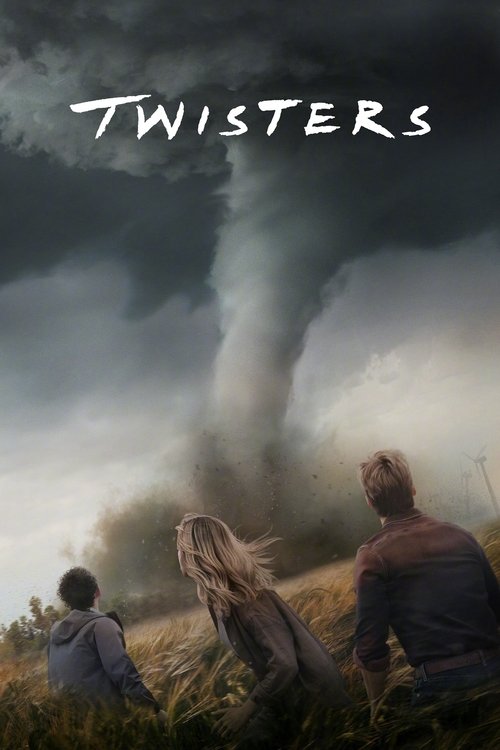
Twisters
2024 · Lee Isaac Chung
For when you want a proper popcorn night: spectacle, banter, a little flirtation, and zero homework. Comfort viewing at maximum volume.
What it's about
Storm season in Oklahoma, and the tornadoes are getting stranger and meaner. Kate Carter, a gifted meteorologist who walked away from chasing after a tragedy, gets pulled back into the field just as Tyler Owens — a swaggering YouTube 'tornado wrangler' with a huge following — rolls into town with his crew. Their rival teams keep crossing paths as multiple storm systems converge, and what starts as a science-versus-showmanship feud turns into a shared fight for survival.
The experience
Big, loud, and sincere — it alternates white-knuckle chase sequences with easygoing small-town charm, and the storms have real menace without the film ever turning grim. You come out buzzing rather than shaken.
Performances
Glen Powell is the engine here — his cowboy charm does a lot of the film's heavy lifting — while Daisy Edgar-Jones grounds it, playing Kate's fear and competence as two sides of the same instinct.
The craft
Lee Isaac Chung, previously known for intimate rural drama, brings an unusual feel for landscape and community to a disaster movie: the Oklahoma flatlands look genuinely lived-in between the set pieces. The tornado sequences are built for scale — roaring sound design and wind-torn debris that absolutely reward the biggest screen and loudest speakers you can find.
Why it matters
One of the defining hits of Hollywood's mid-2020s bet on big-screen spectacle, it proved a decades-old title could be revived without serialized franchise machinery — and showed an indie director could scale up without losing his signature.
Snapshot
Twisters is a legacy sequel to Jan de Bont's Twister (1996), arriving twenty-eight years after the original at the intersection of two Hollywood tendencies: the studio appetite for recognizable but non-serialized IP, and the mid-2020s reinvestment in large-format spectacle designed to draw audiences back to theaters. Directed by Lee Isaac Chung, whose previous feature Minari (2020) was an intimate, semi-autobiographical drama, the film represents a deliberate pairing of an auteur associated with regional realism and a maximalist disaster-action premise. It follows Kate Carter (Daisy Edgar-Jones), a traumatized former storm chaser drawn back to the field, and Tyler Owens (Glen Powell), a charismatic "tornado wrangler" and YouTube showman whose bravado masks genuine competence. Set across the tornado alley of central Oklahoma, the film is at once a large-scale meteorological spectacle and a character piece about grief, showmanship, and vocation. It was among the summer of 2024's most commercially successful original-branded releases and functioned as a significant star-making vehicle for Powell.
Industry & production
Twisters emerged from a co-financing and distribution arrangement uniting Universal Pictures, Warner Bros., and Amblin Entertainment — a structure that reflects the tangled rights inheritance of the original Twister, which itself was a Universal/Warner Bros./Amblin production. Frank Marshall and Patrick Crowley served as producers, with Steven Spielberg's Amblin lineage providing continuity to the 1996 film, which Kathleen Kennedy and Marshall had produced. Joseph Kosinski — director of Top Gun: Maverick (2022) — devised the story and was at one stage attached in a creative capacity; the screenplay is credited to Mark L. Smith, whose prior work includes The Revenant (2015). The choice of Chung as director was widely read within the industry as part of a pattern of handing large studio properties to filmmakers with independent, character-driven pedigrees (comparable to Chloé Zhao on Eternals or Destin Daniel Cretton on Shang-Chi).
Production centered on location shooting in Oklahoma, a decision emphasized in the film's publicity as a return to the geographic and atmospheric authenticity of the original, which had also shot in the region. The film was released theatrically in July 2024 and became one of the season's strongest performers commercially; precise grosses are best confirmed against box-office trackers rather than asserted here, but its success was substantial enough to prompt public discussion of a further installment. The production notably foregrounded partnership with meteorological and storm-chasing communities as consultants, extending a tradition the 1996 film had established.
Technology
The technological gap between Twister (1996) and Twisters (2024) is itself a chapter of film history. The original was a landmark for Industrial Light & Magic's early digital effects, among the first films to render convincing photoreal tornadoes and airborne debris via computer graphics, and its success helped normalize CG-driven natural-disaster spectacle in the late 1990s. Twisters inherits a mature digital-effects pipeline in which photoreal atmospheric simulation, volumetric rendering, and fluid dynamics are routine, allowing tornadoes of varied scale, texture, and behavior — rain-wrapped, multi-vortex, fire-laced — that would have been impractical decades earlier.
Chung and his team emphasized, in interviews accompanying the release, a hybrid methodology that combined this digital capacity with extensive practical elements: wind machines, physical debris, water, and on-location shooting under real Oklahoma skies, so that performers reacted to tangible forces. The film was formatted for large-format and IMAX presentation, consistent with the mid-2020s studio strategy of differentiating theatrical spectacle through image scale and immersive sound. The precise vendor breakdown of visual-effects houses is a matter for the film's technical credits rather than something to be asserted from memory.
Technique
Cinematography
Director of photography Dan Mindel — a veteran of large-scale action photography through his collaborations with J.J. Abrams (Star Trek, Star Wars: The Force Awakens) and on Mission: Impossible III — brings an anamorphic, widescreen sensibility suited to the horizontal vastness of the plains. The photographic strategy exploits the flatness of the Oklahoma landscape, where the horizon and the towering supercell above it become the primary compositional axis; the tornado is repeatedly framed as a vertical intrusion into an emphatically wide, low horizon. Mindel's work leans on natural light and the dramatic, fast-changing quality of real prairie weather, lending the storms a documentary tactility. The camera is frequently mobile and embedded within vehicles and running figures, privileging kinetic proximity over detached spectacle.
Editing
Terilyn A. Shropshire, an editor closely associated with Gina Prince-Bythewood's films (Love & Basketball, The Woman King), cuts the film with attention to both action legibility and character rhythm. The editorial challenge of a storm-chase picture is sustaining spatial clarity amid chaos — keeping the audience oriented to who is where relative to a moving, formless threat — while modulating tension across set pieces of escalating scale. Shropshire's background in relationship-driven drama is discernible in the film's willingness to hold on performance and to pace the quieter interstitial scenes between storms, so that the action sequences are anchored to stakes rather than presented as continuous sensory assault.
Mise-en-scène / staging
The film's staging repeatedly organizes bodies against the open field: characters dwarfed by the storm, sprinting toward or away from shelter, taking cover in motel bathrooms, under overpasses, in cellars. Production design draws on the iconography of American tornado alley — diners, rodeos, gas stations, motels, wind farms — grounding the spectacle in a recognizably lived-in regional Americana. Tyler's convoy of modified trucks, festooned with cameras and social-media branding, is staged as spectacle-within-spectacle, visually contrasting with Kate's more austere scientific instrumentation, so that the mise-en-scène itself dramatizes the film's tension between showmanship and science.
Sound
Sound is central to the film's design; the tornado is as much a sonic as a visual presence, its characteristic roar built into a dense, low-frequency mix intended to exploit large-format theatrical systems. The interplay of wind, debris impact, rain, radio chatter, and country-inflected music creates an enveloping field. The sound design's task is partly the inverse of the picture's: where the image can render a tornado at a distance, sound conveys the physical pressure and disorientation of proximity.
Performance
Daisy Edgar-Jones plays Kate as internalized and guarded, her arc governed by guilt over a prologue catastrophe; the performance is restrained, foregrounding recovered nerve over demonstrative heroics. Glen Powell's Tyler is the film's charismatic engine — a swaggering, self-aware performer whose likability is calibrated to reveal underlying decency and skill. The pairing generates the film's central chemistry, which Chung notably chose to keep unconsummated, declining a climactic romantic kiss — a decision widely reported and discussed as a departure from genre convention. Anthony Ramos, Brandon Perea, Sasha Lane, Maura Tierney, David Corenswet, and Kiernan Shipka fill out the competing teams, though the ensemble is subordinate to the two leads.
Narrative & dramatic mode
The film operates in the classical Hollywood mode of the disaster-adventure, structured around escalating set pieces punctuated by character beats. Its dramatic spine is a redemption arc: Kate's return to a vocation she abandoned after trauma, and her reconciliation of scientific idealism (a scheme to disrupt or "tame" tornadoes using moisture-absorbing polymers) with lived risk. Tyler's arc inverts the audience's initial reading, converting an apparent reckless opportunist into a competent and ethical partner. The rivalry-to-alliance structure between competing chase teams — one motivated by data and disaster mitigation, one by spectacle and, ultimately, exploitative disaster capitalism — supplies the moral scaffolding. The mode is fundamentally optimistic and populist, resolving individual trauma through collective action against nature.
Genre & cycle
Twisters sits within the natural-disaster subgenre of the action-adventure film, a cycle with roots in the 1970s Irwin Allen productions (The Poseidon Adventure, The Towering Inferno) that surged again in the mid-1990s alongside Twister, Independence Day, Dante's Peak, Volcano, and Deep Impact. Within that lineage it is specifically a legacy sequel — part of the 2010s–2020s cycle of long-delayed continuations that revive a dormant brand without direct narrative serialization (comparable in strategy to Top Gun: Maverick, Blade Runner 2049, or Jurassic World). It also participates in the contemporary storm-chaser mode that Twister essentially founded as a screen genre, blending procedural meteorology with spectacle.
Authorship & method
The film's central authorial question is the meeting of Chung's sensibility with a studio tentpole. Chung's Minari is a quiet, observational, deeply humanist portrait of a Korean-American family farming in Arkansas — its concerns are land, labor, family, and the texture of rural American life. Reviewers frequently framed Twisters through this lens: Chung imports an attentiveness to regional community, to the dignity of ordinary Oklahomans, and to landscape-as-character, grounding the spectacle in a felt sense of place. His decision to withhold the conventional romantic payoff signals an authorial willingness to subordinate genre formula to character logic.
His key collaborators shape the result: Dan Mindel supplies large-format action-photography experience; editor Terilyn A. Shropshire brings a character-drama rhythm; screenwriter Mark L. Smith contributes a lean, survival-oriented dramatic structure consistent with his prior work; and Joseph Kosinski's story credit connects the film to the Top Gun: Maverick model of legacy-property revival. Composer Benjamin Wallfisch — known for Blade Runner 2049 (with Hans Zimmer), It, and Hidden Figures — provides the score, integrated with a prominent soundtrack of contemporary country music that anchors the film culturally to the American heartland. The confluence of these hands makes Twisters less a single-author statement than a well-integrated studio collaboration inflected by a distinctive directorial sensibility.
Movement / national cinema
Twisters is unambiguously a product of the American studio system and belongs to no art-cinema movement; its interest for this axis lies in its regionalism. It is a Hollywood film consciously invested in a specific American vernacular landscape — the Great Plains, tornado alley, the culture of storm chasing and rural Oklahoma. In this it extends a documentary-inflected regionalism that Chung had explored in Minari, and it participates in a broader current of American commercial cinema that treats the heartland with earnest, non-ironic attention. Its integration of contemporary country music further situates it within a specifically American popular-cultural register.
Era / period
The film is a characteristic artifact of the immediate post-pandemic theatrical moment (2022–2024), when studios sought spectacle-driven, large-format, communally experienced films to rebuild the theatrical habit. Its legacy-sequel form, its IMAX orientation, and its reliance on a rising star (Powell, whose ascent through Top Gun: Maverick, Anyone But You, and Hit Man culminated here) all mark it as of its exact industrial moment. It also arrives amid heightened cultural awareness of extreme weather and climate volatility, which lends its subject a contemporary charge — though, as critics observed, the film largely declines to name climate change explicitly, a reticence that itself became a talking point.
Themes
Several themes organize the film. First, grief and recovered vocation: Kate's arc traces the return to a calling after loss, framing courage as the reclamation of purpose. Second, spectacle versus substance: the contrast between Tyler's social-media showmanship and Kate's scientific mission interrogates a culture in which disaster is content, and the film ultimately reconciles the two by revealing showmanship and competence as compatible. Third, disaster capitalism and community: a subplot involving predatory real-estate exploitation of storm-ravaged towns supplies an ethical antagonist more concrete than the weather itself, valorizing communal solidarity against extraction. Fourth, humanity against nature: the recurring, quietly hubristic dream of controlling or disrupting the tornado dramatizes the tension between scientific mastery and natural forces indifferent to human will. Underlying all is a rootedness in place — the land and its people as the true stakes of the spectacle.
Reception, canon & influence
Critical reception was broadly favorable, with reviewers frequently praising Chung's grounding of spectacle in character and place, Powell's star charisma, and the visceral quality of the storm sequences; a common line of appreciation noted that a filmmaker of Chung's sensibility elevated what could have been a generic tentpole. Recurrent critical reservations concerned the film's political reticence — its reluctance to address climate change directly — and, for some, a familiar or formulaic plot architecture. The withheld romance was widely discussed, dividing viewers between those who admired the restraint and those who wanted the conventional payoff. Commercially, the film was a notable summer-2024 success and reinvigorated interest in the property.
Its influences (backward) are clear and self-conscious: above all Twister (1996), whose iconography — the flying cow, the "Dorothy" sensor deployment, the diner-and-motel geography, the science-versus-spectacle rivalry — it echoes and updates; the 1970s disaster cycle; and the Top Gun: Maverick template of the reverent, star-driven legacy sequel. Chung's own Minari is the crucial authorial antecedent, supplying the film's regional humanism.
Its legacy (forward) is still emerging at the time of writing. Its commercial performance reinforced the studio thesis that original-branded (non-franchise-serialized) spectacle can still succeed theatrically, and it consolidated Glen Powell's standing as a leading man. Public discussion of a potential sequel followed its release. Whether Twisters proves a durable influence on the disaster genre or an accomplished one-off is a judgment the historical record cannot yet support, and it would be premature to claim more.
A Deleuzian reading
The image that stays with you is a flat line with one thing standing on it.
The full Deleuzian reading of Twisters →
Reception
Landed in summer 2024 as the legacy sequel that actually worked — a $370M+ crowd-pleaser nobody expected from the Minari director — and it's since settled into fond memory as the moment Glen Powell's movie-star coronation felt official.
How Twisters was received, from release to now →
How to watch Twisters: what to notice on a first viewing
- Notice how low Mindel keeps the horizon under a huge sky. The frame stays mostly sky throughout; when a tornado appears, it is the one vertical thing standing in a flat world. The composition shows you where the pressure in this world comes from before the plot does.
- Listen for the tornado's low-frequency roar before you can see it clearly. Sound design builds pressure through bass and debris noise well before or beyond what the image shows. The scariest thing in this movie is a sound decision, not a visual one.
- Look at Tyler's camera-covered trucks next to Kate's plain instruments. Chung stages the two teams' vehicles as visual opposites: branded spectacle versus austere science, the whole film long. The gear tells you which character trusts showmanship and which trusts data.
- Track how shots alternate between open plains and cramped truck cabs. Shropshire cuts between vast wide shots of the storm and tight embedded shots inside vehicles or among running bodies. That alternation is the film breathing, giving the close, tense shots something huge to push against.
- Watch how guarded and internal Edgar-Jones plays Kate's early scenes. Her stillness recurs before every storm, contrasted against Powell's loose, swaggering energy. Her restraint signals what has broken in her is not nerve, but the link between seeing and acting.
The whole guide to watching Twisters, with the keys for a rewatch →
Influences: the films it descends from and the films it influenced
- Twister (1996) — The direct progenitor: Twisters reprises its "Dorothy" sensor-deployment climax, diner-and-motel roadside geography, and science-crew-chases-storm staging, updating the ILM digital-tornado-composited-against-real-plains template with modern hybrid VFX.
- Minari (2020) — Chung's own authorial antecedent, supplying the observational natural-light attentiveness to rural American labor and community that grounds the tentpole's spectacle in a felt, dignified sense of Oklahoma place.
- Days of Heaven (1978) — The urtext for treating the American plains as protagonist — magic-hour, natural-light widescreen photography of wheat and sky where landscape and weather carry as much dramatic weight as the human figures crossing it.
- The Towering Inferno (1974) — Anchors the 1970s disaster-cycle architecture Twisters inherits: an ensemble of ordinary and expert characters organized around escalating set-piece survival, with catastrophe as the machine that sorts moral worth.
- Jaws (1975) — Models the grounding-spectacle-in-character-and-place method critics praised in Chung — withholding and rationing the natural threat while a low-frequency sonic dread and small-town texture do the emotional work between attacks.
- War of the Worlds (2005) — Precedent for the embedded, ground-level POV of overwhelming destruction — keeping the camera down among fleeing people so cataclysm is experienced as chaotic sensory assault rather than surveyed from above.
- Top Gun: Maverick (2022) — The template for the reverent star-driven legacy sequel (Kosinski holds a story credit here): reviving a dormant property through a charismatic leading man and in-vehicle embedded cameras that put the audience physically inside the rig.
- Star Wars: The Force Awakens (2015) — Cinematographer Dan Mindel's large-format anamorphic action-photography method — flare-laden widescreen practical shooting integrated with digital — carries directly into his lensing of Twisters' storm sequences.
- The Revenant (2015) — Screenwriter Mark L. Smith's lean, survival-oriented dramatic structure with the natural environment itself as antagonist, shot in unforgiving natural light — the same skeleton he brings to Twisters.
- Blade Runner 2049 (2017) — Composer Benjamin Wallfisch's Zimmer-adjacent sub-bass, low-frequency sound-design-as-score approach — physically felt tectonic rumble — is the sonic method he ports into the storm mix here.
- Take Shelter (2011) — Sibling in regional-American storm dread: renders the Midwestern tornado as looming existential threat rooted in working-class rural life, staging the sky and horizon as sources of mounting psychological pressure.
- Interstellar (2014) — Sibling in anamorphic dust-bowl Americana — practical, in-camera dust and windstorms shot large-format across corn-field heartland, wedding regional agrarian imagery to spectacle.
Similar films
- Top Gun: Maverick (2022) — influence & lineage · same viewing thread
- Furiosa: A Mad Max Saga (2024) — same viewing thread
- The Fall Guy (2024) — same viewing thread
- F1 (2025) — same viewing thread
- The End of Oak Street (2026) — shared sensibility
- Hunt for the Wilderpeople (2016) — shared sensibility
- The Lost Bus (2025) — shared sensibility
- 2012 (2009) — shared sensibility
All the films related to Twisters →
Watch it with: curated runs of related films
- Real Machines, Real Stunts — A run of blockbusters that strap the camera to actual jets, cars, rigs and bodies — watch them together for the vertigo of action done for real.