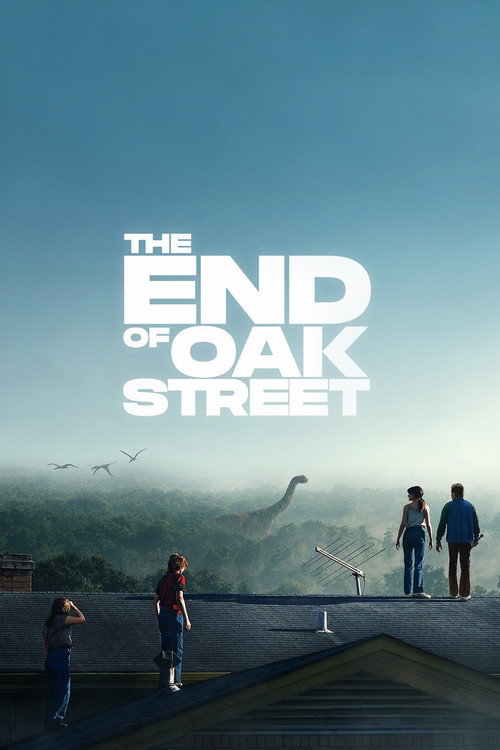
The End of Oak Street
2026 · David Robert Mitchell
For when you want big-swing adventure with teeth — the kind of night where you'd like to be amazed and a little scared in the same breath. Great with family or friends who grew up on suburban-kids-versus-the-impossible stories.
What it's about
One ordinary suburban block — Oak Street — is torn loose from the world by a cosmic event and set down somewhere no map covers. The Platt family wakes to find their cul-de-sac intact but everything beyond it unrecognizable, and staying alive means staying together as they venture into terrain stalked by things that shouldn't exist, from giant serpents to creatures out of deep time. It's a survival story wrapped in a family story: the lawns and driveways of the 1980s pressed up against the genuinely unknown.
The experience
Wonder and dread trade places constantly — one minute it plays like a joyous backyard adventure, the next like survival horror closing in. The familiar comforts of the neighborhood make the strangeness beyond it hit harder, and the tension of a family holding itself together gives the spectacle real stakes.
The craft
David Robert Mitchell shoots suburbia like nobody else working in American genre film — the cul-de-sac becomes a precise, closed geometry, every sightline down the block loaded with meaning. That formal control makes the collision with an alien wilderness genuinely disorienting, and the creature spectacle earns a big screen and loud speakers.
Why it matters
It carries a classic anxiety — the neighborhood suddenly cut off from the world — into modern effects-driven spectacle, and marks Mitchell's boldest scale yet after building his name on intimate suburban dread.
Snapshot
A cosmic event detaches one suburban block — Oak Street — from the world it belonged to and deposits it, and the Platt family with it, somewhere unaccounted for. That premise is old and deep: it is the logic of Rod Serling's "The Monsters Are Due on Maple Street" and, more literally, of The Twilight Zone's "Stopover in a Quiet Town," in which a couple wakes in a town that is not a town. What makes the film worth an entry in this atlas is not the premise but the hand on it. David Robert Mitchell is the most formally disciplined suburbanist working in American genre film, a director whose three previous features treat the cul-de-sac as a closed geometry to be photographed rather than a backdrop to be decorated.
A necessary caveat, stated once and not repeated at every turn: the documentary record on this production is thin and partly contradictory. The project circulated in trade reporting for years under a different title and a different description — an Eighties-set picture involving time and a monster — before surfacing with the present title and the present logline about a displaced neighborhood. Those two descriptions are not obviously the same film. Either the project changed substantially in development, or its public framing did. Nothing below should be read as a description of finished shots, cuts, or performances I have seen. Where this dossier is specific, it is specific about Mitchell's established grammar and the traditions the film enters; where it concerns this film's execution, it marks itself as provisional.
Industry & production
The salient industrial fact is the gap. Mitchell's last released feature, Under the Silver Lake, premiered in Competition at Cannes in 2018 and was then delayed more than once by A24 before arriving in 2019 in a minimal theatrical footprint alongside video-on-demand — a commercial burial for a film that had been acquired on the strength of It Follows. A director coming off a widely admired micro-budget horror hit and a costly, orphaned second film occupies a peculiar industrial position: bankable as a signature, unproven as a scaler. The years between then and now are the direct consequence.
The film is a studio production — Warner Bros. per trade reporting — with a cast that departs sharply from Mitchell's earlier practice of building ensembles from unknowns and near-unknowns. Reporting has attached established stars to the Platt family; readers should treat specific casting, budget figures and final credits as unconfirmed here rather than take an unsourced list on trust. No reliable budget or box-office figures are available to this account, and none are invented.
Two structural forces shaped the release. First, the 2023 Writers Guild and SAG-AFTRA strikes, which halted production and post-production publicity across the American industry and forced a wholesale reshuffling of the 2024–2026 theatrical calendar; effects-heavy studio pictures were the most frequently moved. This film's date slid more than once within that window. Second, the narrowing of the theatrical mid-budget. An original science-fiction film with no pre-existing IP, made at a studio scale by a director with one cult hit, is precisely the category that streaming absorbed after 2019 and that the post-pandemic theatrical market has only intermittently sustained. That the film exists as a theatrical release at all is the interesting industrial datum.
Technology
The image problem the premise sets is specific: you must show a street that has been removed from the earth, and the removal must read at both the scale of a lawn and the scale of a horizon. The contemporary toolkit for that shot is well established even if this production's particular choices are not public. The standard 2020s solution is a hybrid — a practical exterior build or a dressed real block for the ground-level work, digital sky replacement and horizon extension above the rooflines, and an LED volume for any sustained shooting against an environment that cannot exist. Warner Bros. has access to all three pipelines. Which were used, and in what proportion, is not on the public record.
Mitchell's prior practice pulls against the volume. Under the Silver Lake was photographed on 35mm, and both of the Gioulakis-shot features depend on deep, legible depth of field — figures held sharp at the far end of a lawn or a corridor — which is exactly the register that LED-wall backgrounds handle worst, since parallax and focus falloff betray the wall. If the film preserves Mitchell's habit of putting the meaningful information in the distant third of a widescreen frame, it will have needed real distance or very good environment work to do it.
The other technology worth naming is temporal rather than photographic. Mitchell's films are set in a deliberately unplaceable now: It Follows mixes mid-century sedans, cathode-ray televisions, and a clamshell e-reader that belongs to no year at all. Production design there functions as a device for suspending period. A film reported at various points as Eighties-set from this director is unlikely to be doing straightforward nostalgia reconstruction, because he has already demonstrated a more interesting use for the same props.
Technique
Cinematography
Mitchell's visual signature across three features is unusually consistent and unusually describable. He shoots in scope. He composes symmetrically and centrally, frequently placing the camera at a slight, almost anthropological remove from the actors. He favors the slow lateral track and, most famously, the sustained rotation: the 360-degree pan across a school lawn in It Follows that makes the audience, not the cutting, do the work of searching the frame. The threat in a Mitchell shot is usually already in the shot — a figure at the back of the image, walking, in focus, unremarked by the score or the cut. This is a horror grammar built on scanning rather than startling, and it is the opposite of the shallow-focus, fast-cut default of studio genre filmmaking.
Mike Gioulakis is the collaborator most responsible for executing it, and his intervening career — Split, Glass, Us, Old — has been a decade-long extension of the same idea: bounded spaces, uncanny depth, faces held too long at the wrong distance. Whether he shot this film has been reported but is not confirmed here.
Editing
Julio C. Perez IV cut both It Follows and Under the Silver Lake, and their cutting patterns are nearly inverse. It Follows withholds: it refuses reverse shots, holds after the moment a conventional thriller would cut, and uses the cut to skip time rather than to build tension. Under the Silver Lake digresses: it is episodic, associative, and deliberately overlong, its structure mimicking the conspiracy-reader's inability to stop. A family-survival film sits between those poles, and the editorial question — whether the film paces to studio thriller rhythm or to Mitchell's slower, more exposed one — is the single most likely site of compromise between director and distributor.
Mise-en-scène / staging
The lawn, the porch, the above-ground pool, the sidewalk seen from a child's eye level: Mitchell stages in the horizontal, public shallows of the American subdivision, where the drama of who is approaching down the street is the primary available drama. The suburb in his films is never decorative and never fully safe; it is a designed enclosure whose boundaries the characters have been taught not to cross. It Follows names its boundary explicitly — the kids were not allowed south of 8 Mile — and the film's Detroit-area geography carries the ruin of the city in its periphery. A premise that severs a single street from everything around it is, in this light, less a rupture of suburban life than its completion.
Sound
Rich Vreeland, working as Disasterpeace, gave It Follows one of the most consequential horror scores of the 2010s: aggressively synthetic, square-wave-derived, distorted to the point of physical discomfort, and placed forward in the mix rather than under it. He came to film from game scoring — Fez (2012) — and the crossing matters, because game audio is built for spaces the player scans rather than scenes the editor controls, which is exactly what Mitchell's camera asks for. The acknowledged ancestry is John Carpenter, Goblin, and Tangerine Dream; the achievement was making that vocabulary feel current rather than retro, a distinction the subsequent Stranger-Things-era wave of synth pastiche largely collapsed. Vreeland also scored Under the Silver Lake, there in a lush orchestral-Hollywood register — evidence he is not a one-mode collaborator.
Performance
The change of register here is real. Mitchell's first two features are built on low-affect, naturalistic ensembles of young unknowns — Maika Monroe's watchful stillness in It Follows is the model — and his third gave Andrew Garfield a deliberately unpleasant, drifting non-hero. Casting established stars as parents inverts the arrangement: the audience arrives already knowing the faces, which is useful for a survival premise that needs quick investment and corrosive for a director whose held wide shots depend on the audience not knowing where to look. How Mitchell stages recognizable faces in unrecognizable space is the performance question this film poses.
Narrative & dramatic mode
Mitchell writes premises as rule-systems. It Follows is famously legible: the thing walks, it is transmissible, it is visible only to the cursed, and it never stops. What the film refuses is origin — there is no explanation, no institute, no third-act mythology. Under the Silver Lake pushes the refusal into the open by building an entire film out of interpretation and then declining to make the answers satisfying.
A neighborhood displaced by an unexplained cosmic event asks that question directly, and the two available answers point in opposite directions. Mitchell's authorial record predicts non-resolution: the event stays unnamed, the film ends inside the mystery, the survival is provisional. Studio genre economics predict the opposite: a revelation, a mechanism, a door out. The dramatic mode named in the logline — survival contingent on the family staying together — is also the most ideologically freighted frame available in American genre film, the Spielbergian consolation in which the nuclear family is both the thing at risk and the instrument of rescue. Whether Mitchell endorses that frame, or treats it the way It Follows treats teenage intimacy — as a structure that transmits the danger as readily as it resists it — is the film's central interpretive stake.
Genre & cycle
The film sits at the intersection of three live cycles. The first is suburban Amblin science fiction, established in a concentrated burst around 1982 — E.T., Poltergeist — and continuously revived since, most consequentially by Stranger Things from 2016 onward, which made the mode a commercial default and thereby raised the cost of entering it without irony. The second is the family-survival horror cycle of the late 2010s: A Quiet Place, It Comes at Night, films in which the apocalypse is staged at household scale and the moral question is how much of the world outside the door you are willing to abandon. The third is the post-Get Out, post-Nope wager that an auteur-branded original genre film can carry a studio release — a wager the industry has made less often each year since.
Within science fiction proper, the lineage is the bounded-community picture: Village of the Damned, Dark City, The Truman Show, Cube, The Mist, King's Under the Dome, and Shyamalan's Old, a film whose beach behaves wrongly in ways closely analogous to a street that has gone somewhere else. Shyamalan's Signs is the closest structural precedent for keeping a global event at one family's property line.
Authorship & method
Mitchell's method is recognizable and small-c conservative in the best sense: he writes his own scripts, works repeatedly with the same department heads, shoots in wide compositions with long takes, and trusts the audience to search the frame. The core collaborators across his genre work are Gioulakis (camera), Perez (cutting), and Vreeland (score); the continuity of that unit across a studio production is the best available proxy for how much of the film is his. His subject, from The Myth of the American Sleepover (2010) forward, has been the threshold — the last summer, the night that ends an adolescence, the neighborhood you are about to be too old for. The apocalypse in this film's premise is a literalization of a figure he has used three times already.
Movement / national cinema
Mitchell belongs to the American independent-to-studio pipeline that runs from Spielberg through Raimi to Gareth Edwards, Jordan Peele, and Jeff Nichols — directors whose festival calling cards became studio assignments, with wildly variable results. He also belongs to a smaller regional strand: Michigan filmmaking. It Follows was shot in and around Detroit during the window opened by Michigan's film incentive program, introduced in 2008 and effectively ended in 2015, and the specificity of that geography — the decayed grandeur at the edge of the intact subdivision — is inseparable from the film's meaning. Whether this production returned to that landscape or built a generic American street on a studio backlot is a question about what kind of film it is.
The larger national tradition is the critique of the suburb, which American cinema has conducted continuously from Rebel Without a Cause through Blue Velvet, Safe, The 'Burbs, and American Beauty. Mitchell's contribution has been to make that critique formal rather than satirical: the suburb is indicted by how it is framed, not by what anyone says about it.
Era / period
Two periods are in play. The reported diegetic one is the American 1980s, now so thoroughly reconstructed by film and television that it functions as a stylized past on the order of the Western frontier — a set of signs (station wagon, ranch house, synthesizer) that signify pastness rather than a particular decade. Mitchell has already shown, in It Follows, that he treats such signs as unmoored from chronology.
The production period is the mid-2020s: a post-strike calendar, a theatrical market in which mid-budget originals are the endangered category, a visual-effects labor market under strain, and audiences four decades deep into Amblin nostalgia. A film about a neighborhood detached from everything around it arrives into an exhibition landscape describable in almost the same terms.
Themes
Enclosure. The subdivision is already a machine for separation — by design, by covenant, by the history of American housing policy. The premise makes the separation physical, which is the classic science-fictional move: take the social arrangement and build it out of matter.
The family as the last unit of politics. "Survival depends on them sticking together" is a premise with a politics. The Amblin reading makes the family the site of repair; the bunker reading, sharpened by the 2010s survival cycle, makes it the site of everyone else's exclusion. The best films in this line hold both.
Unknowability. Mitchell consistently declines explanation, and his films locate their dread in the gap between a rule you can verify and a cause you cannot. This is a theological structure more than a scientific one.
The threshold. Adolescence and apocalypse are the same shape in his work: a world that ends while the people inside it are still standing in it.
Reception, canon & influence
The reception record for this film is not yet established, and this dossier will not manufacture one — no review consensus, no grosses, no festival verdict is asserted here.
What can be stated is the reception history Mitchell brings to it. It Follows premiered at Cannes' Critics' Week in 2014 and became one of the decade's genuine word-of-mouth successes, expanding theatrically after a planned quick move to on-demand was reversed; its critical standing as a canonical 2010s horror film, and its score's influence on a subsequent wave of synth-driven genre scoring, are both secure. Under the Silver Lake divided Cannes in 2018, was delayed by its distributor, and reached audiences in a truncated release; it has since accumulated a durable cult, which is a different thing from vindication.
The backward influences are traceable and were named above: Serling's Twilight Zone, particularly the two episodes that put an ordinary street under experimental conditions; the 1982 Amblin cluster; Carpenter's framing and Carpenter's synthesizers; Shyamalan's household-scale apocalypse; Nichols' Americana genre films; and Mitchell's own two suburban pictures, which this one appears to be scaling up rather than departing from.
The forward legacy cannot be assessed and should not be predicted. What can be identified is what the film is positioned to test. If an original, auteur-authored, effects-scale science-fiction film built on a fifty-year-old anthology premise finds a theatrical audience in 2026, that is an argument about the viability of a whole category. If it does not, the more likely lesson the industry draws is the narrower one it drew from Under the Silver Lake: that this particular sensibility travels better at two million dollars than at a hundred. Either way, the formal question stands independent of the commercial one — whether the patient, scanning, deep-focus horror grammar Mitchell built on a micro-budget survives contact with a studio's schedule, a studio's stars, and a sky that has to be rendered.
A Deleuzian reading
The camera sits on a school lawn in *It Follows* and turns.
The full Deleuzian reading of The End of Oak Street →
Reception
Barely a month out, it already has a split verdict: critics embraced it (86% on Rotten Tomatoes) as pulpy Amblin-throwback fun, but audiences gave it a B CinemaScore and a soft $21M opening — making it instant Exhibit A in the 'why won't people show up for original blockbusters' discourse.
How The End of Oak Street was received, from release to now →
Influences: the films it descends from and the films it influenced
- The Twilight Zone: "The Monsters Are Due on Maple Street" (1960) — The template for the rule-system premise: a single named residential street is placed under an announced experimental condition and the teleplay refuses to cut away from that block until the final exterior vantage, so the enclosure itself — not the explanation — generates the dread.
- The Twilight Zone: "The Shelter" (1961) — Serling's second street-under-conditions experiment, which stages a civilizational countdown entirely at door-and-driveway scale with the catastrophe kept off-screen and audible only as radio voice-over — the exact ratio of household staging to apocalyptic scale this film adopts.
- The Birds (1963) — The unexplained rule-set that is never given a cause, plus the jungle-gym sequence's method of letting the threat accumulate in the unemphasized deep background of a locked-off composition while the foreground plays dialogue — the audience finds it before the cut confirms it.
- Halloween (1978) — The anamorphic frame as a search field: Carpenter parks a still figure at the edge or rear of a 2.35 composition and declines the reverse shot that would confirm him, and scores the withholding with a repeating synth ostinato rather than orchestral stings — the grammar Mitchell rebuilt with Gioulakis and Vreeland.
- Assault on Precinct 13 (1976) — Siege geography drawn as a legible perimeter — every shot establishes where the boundary line is and which side of it a body stands on — under a minimal analog-synth cue that runs beneath scenes instead of punctuating them.
- E.T. the Extra-Terrestrial (1982) — The 1982 Amblin contract that a cul-de-sac can contain a complete world, executed through camera height locked to the children and a systematically withheld adult reverse shot (faces kept out of frame for the first act) so authority exists only as legs, keys and noise.
- Poltergeist (1982) — Effects-scale spectacle held inside one property line: the tract house is pressurized as a sealed container and the budget goes into what happens within its rooms and back yard rather than into any wider view of the phenomenon.
- Signs (2002) — Household-scale apocalypse: a planetary event is transmitted entirely through one family's sightlines and a television set, and the definitive reveal arrives as a figure crossing the background of a home-video frame — scale delivered by restriction of vantage, not by coverage.
- Take Shelter (2011) — Americana genre filmmaking that keeps the sky as antagonist inside sober anamorphic compositions and gives the family's economics the same frame-weight as the catastrophe, so the genre premise never dislodges the regional realism.
- The Myth of the American Sleepover (2010) — Origin of the associative-digression cutting Perez later formalizes: scenes are chained by lateral drift among adolescents across one night rather than by causal consequence, and the film's engine is the threshold — the last summer — that this film's premise literalizes.
- It Follows (2014) — The immediate parent: the announced rule-system, Gioulakis's slow 360-degree pans that scan a full horizon and dare the viewer to spot the walker, 35mm origination, and 8 Mile deployed as a hard class boundary the characters narrate as they cross it.
- Under the Silver Lake (2018) — Where Mitchell scales associative digression to feature architecture and tests star-casting inversion — a recognizable lead (Garfield) played at drifting, unaffected register inside an ensemble of unknowns, with Vreeland's score carrying the tonal continuity the plot deliberately drops.
- A Quiet Place (2018) — Post-It Follows proof that a studio will finance an apocalypse expressed as an enforceable rule stated in the first reel, with sound design promoted to the rule itself and the entire global event kept at farmhouse-and-property-line scale.
- It Comes at Night (2017) — Inherits the withheld reverse shot as a structural principle — the camera repeatedly refuses the answering angle at the red door — and runs a posted household rule-set whose violation, not any creature, supplies the mechanism.
- Stranger Things (2016) — The clearest downstream instance of the scoring wave It Follows opened: analog-synth arpeggios and low drones displacing orchestral cues in suburban genre work, layered over Amblin cul-de-sac staging and bicycle-height blocking.
- Us (2019) — Gioulakis's other studio-scale showcase for the same toolkit: 35mm anamorphic, mirror-symmetrical staging, and the driveway shot that holds four silhouettes in unlit deep focus for an unbroken beat rather than cutting in to identify them.
- Split (2016) — Gioulakis's wide-lens close-up held past comfort while the scene's other party is denied a reverse shot — the actor plays the absent interlocutor into the lens, which is the same withheld-reverse economy Perez cuts around.
- Old (2021) — Gioulakis's roving lateral and 360-degree pans used to keep transformations at the frame edge or just outside it, married to a hard rule-system premise with a bounded location — the nearest formal cousin to this film's enclosure logic.
Similar films
- A Quiet Place (2018) — influence & lineage
- Us (2019) — influence & lineage
- A Quiet Place Part II (2021) — shared sensibility
- The Mitchells vs. the Machines (2021) — shared sensibility
- Nope (2022) — shared sensibility
- Remarkably Bright Creatures (2026) — shared sensibility
- Hunt for the Wilderpeople (2016) — shared sensibility
- Bacurau (2019) — shared sensibility