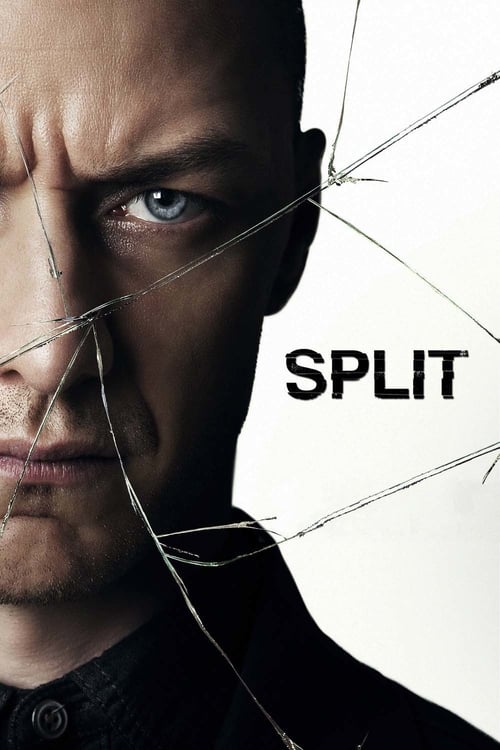
Split
2017 · M. Night Shyamalan
For when you're craving a real thriller night — tense, twisty, a little disturbing, best with the lights down and no interruptions. A challenge dressed as a crowd-pleaser.
What it's about
Three teenage girls are abducted from a mall parking lot and wake in a windowless basement, held by a captor who is not one man but many: Kevin, whose twenty-three distinct identities take turns in the light, some kind, some terrifying, all warning of a further one still to come. The film moves between the girls' captivity, the psychiatrist trying to keep Kevin's fragile inner order from collapsing, and the guarded, observant Casey, whose own hard past makes her the only captive who understands how to survive.
The experience
Tight, claustrophobic, and queasily fun — a contained thriller that ratchets steadily while giving you the uncanny pleasure of watching one actor become a roomful of people. It's scary without leaning on gore, and it keeps pulling the floor out from under what kind of movie you think you're watching.
Performances
James McAvoy delivers a genuine tour de force, switching identities — voice, posture, gaze — mid-scene without cuts or effects; Anya Taylor-Joy gives Casey a wary stillness that makes her the film's real center, and Betty Buckley brings warmth and gravity as the psychiatrist.
The craft
Shyamalan shoots the confinement with patient, precise framing that makes a few rooms feel like a maze, and stages the identity shifts as pure performance rather than trickery. The controlled camerawork and creeping sound design reward close attention on a good screen.
Why it matters
A low-budget January release that grossed hundreds of millions and roared Shyamalan back to the center of the conversation, proving the mid-budget original thriller was still alive and reshaping what a modern studio horror hit could be.
Snapshot
Split is a contained abduction thriller that turns out to be a superhero origin story told from the wrong end. Three teenage girls are taken from a shopping-mall parking lot by a man who is not, in any stable sense, one man; over roughly two hours in a windowless basement, the film alternates between their captivity, the therapy sessions in which Dr. Karen Fletcher tries to keep her patient's twenty-three identities in negotiated peace, and flashbacks to a childhood hunting trip that explains why Casey Cooke is the only one of the three who knows how to be prey. Made for a reported budget in the neighborhood of $9 million and released by Universal in the January dead zone of 2017, it grossed several hundred million dollars worldwide and did two things at once: it restored M. Night Shyamalan's commercial standing after a decade of critical collapse, and — in a final diner scene that no marketing had prepared audiences for — it retroactively annexed itself to Unbreakable (2000), converting a self-contained horror film into the middle panel of a trilogy. It is a film built almost entirely out of James McAvoy's body and Mike Gioulakis's camera, and it is inseparable from the argument, still unresolved, about what it does with dissociative identity disorder.
Industry & production
Split is a product of the specific economic arrangement Shyamalan arrived at after The Last Airbender (2010) and After Earth (2013) ended his run as a studio-scale director. He retrenched deliberately: The Visit (2015) was made small, self-financed, and handed to Universal for distribution through a partnership with Jason Blum's Blumhouse Productions, whose model — hard budget ceilings, backend participation in place of front-end fees, final cut for the filmmaker in exchange for financial discipline — had already produced Paranormal Activity, Insidious, and The Purge. Split was made the same way, again through Shyamalan's Blinding Edge Pictures with Blumhouse, again released by Universal. Shyamalan wrote, directed, and produced.
The consequences are visible in every frame. A single principal location (a basement suite of rooms), a cast of five that matters, and a Philadelphia-area shoot with the climax staged in the service tunnels and back-of-house spaces of the Philadelphia Zoo — where Kevin works as a maintenance man, a piece of production economy that doubles as characterization. The zoo is also, of course, thematically loaded: a place where beasts are kept behind glass.
The film premiered at Fantastic Fest in September 2016 and opened wide in the US on January 20, 2017, a release slot conventionally reserved for dumped product. Its performance against that slot and that budget made it one of the most profitable studio releases of its year, and it is one of the clearest single proofs of the Blumhouse thesis: that a horror film with one star giving one extraordinary performance can out-earn films costing twenty times as much.
The Unbreakable connection was the industry story. Shyamalan has said publicly that the Kevin Wendell Crumb character originated in an early draft of Unbreakable and was cut; Split reactivates him. Keeping the link out of the trailers, the press notes, and — remarkably — out of the discourse until opening weekend, was a genuine act of marketing discipline in an era structurally hostile to secrets, and it converted the film's last ninety seconds into a news event rather than a coda.
Technology
Split is not a technically adventurous film, and that is the point: it is an argument that the constraint of a small budget can be met with staging rather than apparatus. Public documentation of its capture format is inconsistent enough that I will not assert one; what is legible on screen is a widescreen scope frame, wide-to-normal focal lengths used close to faces in cramped rooms, and a controlled, desaturated digital grade in cold greens and industrial blues.
More interesting is how technology functions inside the fiction. The girls' phones are removed in the first minutes — the standard modern horror problem, dispatched efficiently — and the film's remaining communications are pointedly obsolete or mediated: a scavenged walkie-talkie, a door with no handle, a window that turns out to be a drawing. Dr. Fletcher's relationship to her patient runs through email and video conferencing; she is a clinician who has partially outsourced her attention to a screen, and the film's most quietly frightening idea is that the identity writing to her is not the one she thinks. Shyamalan himself appears in a cameo as Jai, a security-camera technician, which places the director inside the film's small economy of surveillance-adjacent labor.
Technique
Cinematography
Mike Gioulakis, who had shot It Follows (2014) and would go on to Us (2019) and Glass (2019), is the film's most important collaborator after McAvoy. His work here inverts the usual grammar of the captivity thriller. Rather than the handheld, fragmentary coverage the genre defaults to, Split is composed of static or slowly gliding wide frames in which people are pushed to the extreme edge of the scope image, leaving large volumes of empty room where a threat might arrive. Doorways, corridors, and thresholds organize nearly every setup; we are constantly looking through something at someone. Close-ups are held long past comfort, often slightly off-axis, so that faces are studied rather than merely covered.
The signature Shyamalan/Gioulakis device is withheld information at the frame boundary: a shot that shows us a character's reaction while denying us the thing reacted to, or that reveals an identity's arrival by a change in posture at the edge of the image before any dialogue confirms it. Mirrors recur — the identities' habit of examining themselves is both plot mechanism and formal motif — and the camera's willingness to rotate or track laterally within a locked scene creates the sense of a space being inventoried by something patient.
Editing
Luke Ciarrocchi, who had cut The Visit, structures the film in three interleaved strands: captivity, therapy, memory. The therapy sessions are the film's expository engine and its greatest structural risk — long, static two-handers that halt the basement suspense to deliver a theory of the body. Ciarrocchi's solution is rhythmic contrast: the Fletcher scenes are cut slowly, in sustained takes, so that the basement material reads as comparatively kinetic even when it isn't. The hunting-trip flashbacks are seeded in short, unexplained fragments and only resolve near the end, a withholding pattern that mirrors the film's larger reveal architecture. The film runs long for a contained thriller, and the talkiness of the middle act is the most common formal complaint against it.
Mise-en-scène / staging
The basement is a paradox: filthy industrial infrastructure containing an obsessively clean domestic suite. Dennis's compulsive tidiness produces a bedroom of hospital neatness, a tiled bathroom, folded clothes — the horror of order rather than squalor. Costume does the identity work that special effects would do in a larger film: Patricia's high-necked cardigan and skirt, Hedwig's tracksuit and sneakers, Dennis's shaved head and work shirt. There are no prosthetics, no morphing, no digital assistance. An identity change is a change of garment, spine, and gaze.
Sound
West Dylan Thordson's score — strings that scrape and bow rather than swell, low sustained drones, percussive metallic textures — refuses the stinger-driven convention of studio horror. It functions as pressure rather than punctuation. The Beast is announced sonically before visually, by rumble and by the sound of a body moving with the wrong weight. The sound design foregrounds breath, footfall, and the acoustic behavior of tiled and concrete rooms; McAvoy's vocal transitions are given space rather than being underscored. In the final scene, the return of James Newton Howard's Unbreakable theme does the reveal's emotional work almost single-handedly.
Performance
McAvoy's performance is the film's technology. He plays Dennis, Patricia, Hedwig, Barry, and others, plus — crucially — identities impersonating other identities, a nested performance problem that the film exploits for suspense: we are asked to read whether the man in the room is who he claims to be. The distinctions are built from voice placement, gait, and the direction and duration of a look, not from mimicry-as-showmanship, though the performance is undeniably a display piece and was received as one.
Anya Taylor-Joy, arriving off The Witch (2015), plays Casey almost entirely in stillness and watchfulness — a study in the survival competence of a child who has already been prey. Betty Buckley's Dr. Fletcher supplies the film's warmth and its dubious science; her casting carries a genre lineage of its own, as she played the sympathetic teacher in De Palma's Carrie (1976).
Narrative & dramatic mode
The film runs a classic three-act captivity structure while smuggling in two other modes. The first is the clinical procedural: Fletcher's sessions and her conference lecture argue that dissociation can produce measurable physiological difference — one identity diabetic, another with different visual acuity — and therefore that belief can reshape the body. This is presented as fringe but plausible science, and it is the load-bearing beam of the film's fantastic turn. The second is the trauma flashback, structured so that Casey's past is revealed at the exact rate needed to convert her from passive victim to the one person the Beast recognizes.
The reveal architecture is Shyamalan's habitual signature, but doubled. The internal twist — that the Beast is real, not delusion — lands with the shotgun blast that fails to kill him. The external twist arrives after the story ends: a diner, a news broadcast, a customer reaching for the name "Mr. Glass," and David Dunn turning to camera. The second twist does not recontextualize the story; it recontextualizes the genre the story was in.
Genre & cycle
Split sits at the intersection of two mid-2010s cycles. One is the contained-abduction thriller — Room (2015), 10 Cloverfield Lane (2016), released within a year of it — descended from Wyler's The Collector (1965) and from the basement of The Silence of the Lambs (1991). The other is the low-budget, formally serious American horror wave of the period (The Babadook, It Follows, The Witch, and, months after Split, Get Out), which restored critical attention to the genre and made Gioulakis's kind of patient framing commercially viable.
Behind both stands the split-personality thriller as a durable genre object: The Three Faces of Eve (1957), Psycho (1960), the Sybil phenomenon of the 1970s, De Palma's Sisters (1972), Dressed to Kill (1980), and Raising Cain (1992), and the Jekyll-and-Hyde tradition beneath all of them. Split's innovation is to route that tradition through comic-book logic: it is a supervillain origin story in which the supervillain's power is his diagnosis.
Authorship & method
Shyamalan is sole writer, director, and producer, and Split is a compendium of his method: Philadelphia as a permanent setting; a genre premise treated with unembarrassed sincerity; children and damaged adults as the film's moral center; a structure built backward from a revelation; a director's cameo. His weaknesses are present too — dialogue that explains its own themes, a psychiatrist who exists to lecture, a sentimentality that sits uneasily beside the subject matter.
The collaborations matter more than usual here. Gioulakis supplies a visual patience that Shyamalan's mid-period studio films had lost. Thordson, whose earlier feature work included David Gordon Green's Joe (2013), replaced the orchestral scoring of Shyamalan's James Newton Howard years with something rawer. Ciarrocchi, carried over from The Visit, holds shots long enough for McAvoy's transitions to register. Blum supplied the discipline of the budget cap, which is arguably the most consequential creative intervention of all.
Movement / national cinema
This is regional American commercial filmmaking: a Philadelphia auteur shooting Philadelphia, financed largely outside the traditional studio development system and distributed by one. It belongs to no movement in the manifesto sense, but it is a clear artifact of the post-2010 American independent-studio hybrid, in which the low-budget genre film became the primary venue for directorial control.
Era / period
2017 is the year American horror became prestige-adjacent and franchise-capable simultaneously. Split answers the Marvel-era logic of the shared universe with a deliberately impoverished version of it: a cinematic universe assembled for a fraction of one blockbuster's marketing budget, its continuity revealed in a single dialogue scene rather than a post-credits VFX sequence. It also arrives at a moment of intensifying public literacy about trauma and mental illness, which is why its central conceit provoked the response it did.
Themes
The film's explicit thesis, spoken aloud, is that "the broken are the more evolved" — that suffering does not merely damage but transfigures. It is applied to both protagonist and antagonist: the Beast spares Casey because her scars mark her as one of the pure, and Kevin's fractured mind is presented as an evolutionary frontier rather than an affliction. This is the film's most provocative idea and its most criticized one, since it aestheticizes abuse into a qualification.
Around that sit the film's more conventional and more successful concerns: captivity and gendered predation; the body as an unreliable container for the self; the failure of institutions (a therapist who is outmaneuvered, an uncle who is a guardian and an abuser); and class invisibility — Kevin is a maintenance worker in a place where the animals are the attraction. The final held shot of Casey in the police car, being told her uncle is waiting, refuses to grant her rescue, and is the strongest thing in the film.
Reception, canon & influence
Critical reception was broadly positive and unusually bifurcated: near-unanimous praise for McAvoy's performance and Gioulakis's images, alongside skepticism about the therapy scenes' expository burden and about the ethics of the premise. Mental-health clinicians and advocacy organizations objected substantively — dissociative identity disorder is a trauma disorder whose sufferers are far likelier to be victims than perpetrators, and Split revives the equation of the diagnosis with monstrosity that Psycho installed and that decades of clinical writing have worked against. The film's defenders point to its fantastical frame; the objection is that the frame is precisely what makes the association durable. That argument was not settled by the film's release and has not been settled since.
Looking backward, the film's debts are explicit: Psycho for the diagnosis-as-monster and the explaining psychiatrist; The Silence of the Lambs for the pit, the resourceful young woman, and the childhood memory braided into her survival; The Collector for the acquisitive captor; the multiple-personality media wave of the 1970s and the real case histories that fed it; the Universal monster tradition for the Beast; and Unbreakable for everything else.
Looking forward, its legacy is threefold. It completed the rehabilitation of Shyamalan, enabling Glass (2019) — which closed the trilogy to markedly cooler reviews — and then Old (2021), Knock at the Cabin (2023), Trap (2024), and the Apple TV+ series Servant. It confirmed the Blumhouse economic model at a scale that reshaped studio horror budgeting for the rest of the decade. And it launched Anya Taylor-Joy from genre discovery to leading actor. Its shared-universe stunt has proved harder to imitate than its economics: the secret sequel requires a secret, and Split may have been the last major studio film able to keep one.
A Deleuzian reading
One of the rooms in that basement has a window.
The full Deleuzian reading of Split →
Reception
A shock hit in 2017 — $278M on a $9M Blumhouse budget — it was hailed as the peak of the 'Shyamalaissance' comeback that The Visit started; the lukewarm reception of its follow-up Glass (2019) has since made Split look even more like the high-water mark of that run.
How Split was received, from release to now →
How to watch Split: what to notice on a first viewing
- Watch how often people sit at the extreme edge of the frame. Gioulakis builds static or slowly gliding wide scope shots with large volumes of empty room left sitting beside the actors. Nothing fills that space. It stays open, waiting. You end up watching the empty part of the picture, because that is where the film keeps its threat.
- Look at how many shots put a doorway between you and Kevin. Doorways, corridors, and thresholds organize nearly every setup. You are constantly looking through something at someone rather than standing in the room with them. The architecture keeps you on the wrong side of the threshold, so you always see a little less than the people inside.
- Watch which clothes he is wearing each time he enters the room. There are no prosthetics, no morphing, no digital assistance. Patricia has a high-necked cardigan, Hedwig a tracksuit and sneakers, Dennis a work shirt and a shaved head. The garment announces who has the body. A nine-million-dollar film does its transformations with a wardrobe rack, so you learn to read fabric before anyone speaks.
- Listen for where McAvoy places his voice in his throat. Voice placement, gait, and the direction and length of a look do all the identity work. McAvoy shifts register before any dialogue confirms who has arrived. You learn to identify who is in the room by sound alone, which is the film's main suspense engine.
- Look at how clean the basement bedroom and bathroom are. The location is filthy industrial infrastructure holding an obsessively tidy domestic suite. Folded clothes, scrubbed tile, everything squared. Dennis's compulsion built it and maintains it. The horror here is order rather than squalor. Somebody went down there and made it nice for you.
The whole guide to watching Split, with the keys for a rewatch →
Influences: the films it descends from and the films it influenced
- Dr. Jekyll and Mr. Hyde (1931) — Mamoulian stages the split as an actor's job inside a continuous subjective-camera take — Fredric March shifts register before the makeup does — the same bet Shyamalan makes by letting McAvoy change personae in-shot with no cut, dissolve, or optical effect.
- The Three Faces of Eve (1957) — Established the clinical-session two-shot in which alters are summoned on cue and differentiated only by posture, vocal placement, and eyeline — the exact grammar of Dr. Fletcher's laptop interviews with Barry, Dennis, and Patricia.
- Psycho (1960) — Supplies the explaining-psychiatrist device wholesale; Split keeps the lecturing clinician but distributes her across the runtime as Fletcher's therapy scenes instead of parking the explanation in a coda.
- The Collector (1965) — The captor who curates rather than merely imprisons — cellar as vitrine, meals and gifts as courtship ritual — restaged in the boiler-room 'keeping' of the three girls and Hedwig's negotiated visits.
- The Silence of the Lambs (1991) — The pit-and-basement geography plus Demme's near-axial lens-address close-ups; Split braids Casey's hunting-trip flashbacks into her captivity exactly as Demme braids Clarice's lamb memory into hers.
- Primal Fear (1996) — Norton's holding-cell switch set the modern benchmark for the persona change performed in one unbroken take with the camera refusing to cut away — precisely the shot length Shyamalan and editor Luke Ciarrocchi hold McAvoy inside.
- Unbreakable (2000) — The film Split is secretly a sequel to: its comic-origin structure, character-coded color scheme, and long-lens framings through doorways and reflections are the template, down to the James Newton Howard theme quoted as leitmotif callback in the diner tag.
- Joe (2013) — West Dylan Thordson's scraped-string and processed-acoustic scoring here is the sound Shyamalan hired away from his James Newton Howard orchestral era, giving Split its rasping, non-symphonic persona motifs.
- It Follows (2014) — Mike Gioulakis's signature is imported wholesale — wide scope compositions parking the threat in dead negative space or just past the frame line, with slow lateral pans that withhold rather than reveal.
- The Visit (2015) — Proved out the Blumhouse capped-budget contained-house model and Ciarrocchi's habit of holding a shot past the comfortable cut point so a performer's turn registers in one continuous piece.
- The Witch (2015) — Taught Anya Taylor-Joy's held, unblinking stillness against a locked-off frame — the register Shyamalan casts for, where Casey's watchfulness is played in eyelines and withheld reaction rather than dialogue.
- Glass (2019) — Pushes the in-take switch to its limit, cycling McAvoy through personae inside single unbroken takes using rack focus and Gioulakis's body-mounted POV close-ups instead of cuts.
- Us (2019) — Gioulakis again, now serving a doubled lead performance and a subterranean lair — the Beast's withheld-in-shadow reveal and posture-coded second self are Split's basement grammar scaled up.
- The Invisible Man (2020) — Blumhouse Universal-monster reboot built on the same withholding device — the camera pans off the actor to an empty corner and simply holds, making negative space itself the monster.
- Old (2021) — Turns Gioulakis's frame-edge withholding into the entire engine: bodies transform off-frame, whip pans arrive late, and blocked foregrounds deny the reveal the audience is straining for.
- Trap (2024) — Another single-venue contained thriller keyed to one performer sustaining two registers in the same shot, but with the reveal front-loaded — the Split structure inverted rather than repeated.
- 10 Cloverfield Lane (2016) — Same-year proof that a single-location captivity two-hander could conceal a franchise reveal until the final reel — the structural and marketing trick Split repeats in its diner coda.
- Get Out (2017) — Blumhouse's cap-the-budget/keep-final-cut arrangement applied to the therapy session staged as a horror set piece; Missy's hypnosis chair and Fletcher's video sessions both convert clinical dialogue into suspense architecture.
- The End of Oak Street (2026) — Gioulakis's wide-lens close-up held past comfort while the scene's other party is denied a reverse shot — the actor plays the absent interlocutor into the lens, which is the same withheld-reverse economy Perez cuts around.
Similar films
- Unbreakable (2000) — influence & lineage · same viewing thread
- Trap (2024) — influence & lineage
- The Invisible Man (2020) — influence & lineage
- Get Out (2017) — influence & lineage
- Us (2019) — influence & lineage
- The Sixth Sense (1999) — same viewing thread
- The Conjuring (2013) — shared sensibility
- Talk to Me (2023) — shared sensibility
All the films related to Split →
Watch it with: curated runs of related films
- Shyamalan's Wounded Believers — A run of Shyamalan's ordinary-people-meet-the-extraordinary parables — grief, faith, and hidden gifts surfacing in quiet Pennsylvania lives — that reward being watched in sequence as the twist-craft and the belief questions deepen from one to the next.