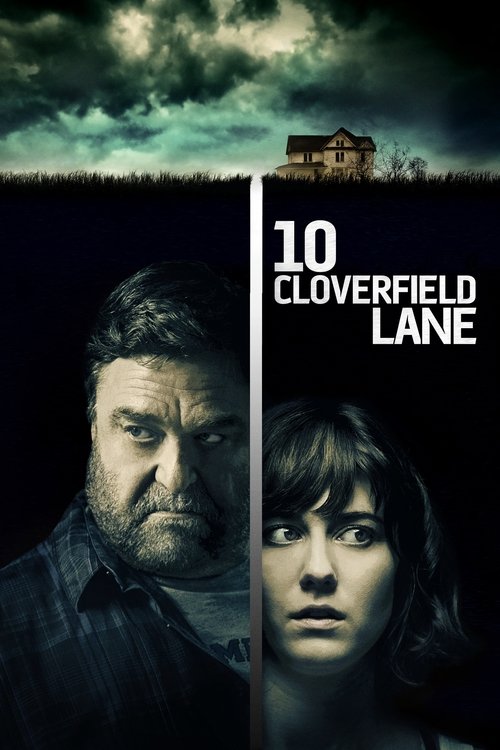
10 Cloverfield Lane
2016 · Dan Trachtenberg
When you want smart, gripping suspense that respects your intelligence — the kind of thriller you watch leaning forward and immediately want to discuss. Tense but accessible; a great pick for viewers who don't do gore.
What it's about
Michelle walks out on her fiancé, crashes her car on a rural Louisiana road, and wakes up chained in an underground bunker. Her host, a conspiracy-minded survivalist named Howard, insists he saved her life: the air outside, he says, has been poisoned by an attack. With a third occupant who half-confirms the story, Michelle has to work out whether the real danger is outside the bunker door or sitting across the dinner table.
The experience
A pressure-cooker chamber piece where every meal and board game hums with menace — it keeps you guessing, then guessing again, right up to a finale that swings big. Tight, twisty and genuinely nerve-shredding without being gory.
Performances
John Goodman gives one of the great late-career performances of its era: by turns pitiable, paternal and terrifying, often within a single scene. Mary Elizabeth Winstead matches him as a resourceful heroine whose thinking you can watch happen on her face.
The craft
Dan Trachtenberg, in a remarkably assured debut, wrings maximum suspense from three actors and a few rooms, with precise editing and a nervy score doing the work explosions usually do. The bunker is designed so you learn its every corner — and the film makes that knowledge pay off.
Why it matters
Made and marketed almost entirely in secret, it became a case study in surprise-release strategy and launched Trachtenberg's directing career, while proving a famous title could house an intimate, original story.
Snapshot
10 Cloverfield Lane is a single-location psychological thriller with a science-fiction coda. It was made almost entirely in secret and announced to the public only about two months before its March 2016 release. Michelle (Mary Elizabeth Winstead) leaves her fiancé, crashes her car on a rural Louisiana road and wakes up chained in a concrete room. She is inside the underground shelter of Howard Stambler (John Goodman), a conspiracy-minded former Navy man. He tells her the air outside has been poisoned by an attack of unknown origin. A third occupant, Emmett (John Gallagher Jr.), a local man who helped build the bunker, confirms that he saw something happen. For most of its running time the film asks one question: is Howard a saviour, a captor, or both? It then answers a second question, what is actually happening outside, in a final act that turns the drama into open alien-invasion spectacle.
The film is Dan Trachtenberg's first feature. It was produced by J.J. Abrams's Bad Robot for Paramount, and it is the second title to carry the Cloverfield name after Matt Reeves's found-footage monster film of 2008. It shares almost nothing with that film narratively or stylistically. Its importance in film history comes from three things: its tightly controlled chamber-piece construction, Goodman's frightening central performance, and its role in turning "Cloverfield" from a single film into a loose anthology brand. That brand became a model, and later a cautionary example, for how studios repurposed original scripts under franchise names.
Industry & production
The film began as an original spec script called The Cellar, written by Josh Campbell and Matthew Stuecken. It came to Bad Robot and Paramount as a standalone thriller with no connection to Cloverfield. Damien Chazelle was brought in to rewrite it and was at one point attached to direct. He left to make Whiplash (2014), and the project passed to Trachtenberg. The final screenplay is credited to Campbell, Stuecken and Chazelle, with story credit to Campbell and Stuecken.
Trachtenberg was known mainly for Portal: No Escape (2011), a widely shared short film based on Valve's video game, and for his online film-commentary work. Choosing him fitted Bad Robot's habit of giving genre properties to directors with strong visual-effects and short-form credentials.
The film was shot in and around New Orleans in late 2014 under the working title Valencia. The secrecy was deliberate. Cast and crew have said in interviews that the Cloverfield connection took shape during production and post-production, and that the ending was developed to bring the story into a shared thematic world with the 2008 film. How much of the final act was rewritten or reshot for this purpose is described differently in different accounts, and the public record is not detailed enough to settle it.
Paramount revealed the film with a trailer in January 2016, released with Michael Bay's 13 Hours. The film opened on 11 March 2016. This "surprise" rollout, with no long pre-release publicity cycle, was presented as a counter-programming experiment. It turned the film's existence into the marketing hook. The reported production budget was modest, about $15 million, and the film made roughly $110 million worldwide. That was a clear commercial success and confirmed that the anthology approach could work. Paramount and Bad Robot later attached the brand to The Cloverfield Paradox (2018), which grew out of an unrelated script called God Particle.
Technology
The film uses no special new technology. Its technical interest lies in how it uses mid-2010s digital production to support an old-fashioned set-based thriller. The bunker was built as a practical set, which let the filmmakers control space, light and sightlines exactly. Digital visual effects are kept mostly for the final act: the bird-like gas, the hovering bio-mechanical craft and the creature that emerges. Withholding effects for so long gives them more force when they finally appear. The contrast between an analogue, lived-in interior and a computer-generated exterior is built into the film's design. Detailed public information about camera package, capture format and the effects houses involved is not well documented in the critical literature, and this dossier does not claim specifics there.
Technique
Cinematography
Jeff Cutter, Trachtenberg's director of photography, lights the bunker as a set of separate zones:
- the stark, institutional concrete of Michelle's first cell;
- the warm, amber, falsely domestic living room with its jukebox, board games and VHS tapes;
- the cramped utility spaces: the air-filtration room, the vent ducts and the decontamination airlock.
The camera mostly stays with Michelle and holds to her point of view. The audience learns about the bunker only as she does. Tight framing and low ceilings keep the space pressing in. In key scenes, when the camera pulls back to show all three characters in one frame, the arrangement of bodies around the dinner table becomes a map of shifting alliances.
The opening sequence is wordless. Michelle packs, leaves, drives and crashes, with credits laid over the images. It is shot with a classical clarity that critics often called Hitchcockian. It establishes her ability to act without anyone telling us her story.
Editing
Stefan Grube's editing paces information release carefully. The film plants objects and then pays them off much later:
- the earring;
- the word "HELP" scratched into the hatch glass;
- the photograph of a girl Howard says is his daughter;
- the barrel of acid;
- the shower curtain.
Each one later becomes evidence or a tool. Scenes run long enough for social tension to build, as in the dinner-table outburst and the word-guessing game, and then are cut sharply at moments of reversal. The crash itself is cut into the credit sequence with abrupt percussive impacts. That sets up a rhythm of long quiet stretches broken by sudden violence, which the film keeps to the end.
Mise-en-scène / staging
Production designer Ramsey Avery's bunker carries much of the storytelling. Howard's shelter is a re-creation of an idealised mid-century American home: Americana décor, a jukebox, puzzles, stockpiled tins, a kitchen set up for family meals. The staging shows how this domestic order is enforced. Howard decides who sits where, who speaks and what counts as polite behaviour. Thresholds, especially the airlock door and its window, are the central visual motif. Michelle is repeatedly framed at doors, vents and hatches, and the drama is built around the limits of the space.
The final act moves to open farmland at night. The staging turns horizontal and expansive, and Michelle is now alone against a huge threat.
Sound
Bear McCreary's orchestral score is restrained for long stretches. It leans on low strings and nervous ostinatos, then grows to full symphonic scale in the climax. The opening sequence is effectively scored as a short silent film. In the bunker, the sound design relies on the constant hum of air filtration, the creaks of the structure, and muffled noises from above that may or may not be what Howard says they are.
Diegetic music matters a great deal. Songs on Howard's jukebox, including Tommy James and the Shondells' "I Think We're Alone Now," play over a domestic montage. The music turns the uneasy household into dark comedy and hints at Howard's fantasy of a closed family.
Performance
Goodman's Howard is the film's main achievement. He draws on his long-established screen persona: genial, heavy, capable of sudden menace, as in the Coens' Barton Fink (1991). He plays Howard as never wholly readable. Howard is pitiable, rigidly polite, petty, paranoid and, as the film confirms, dangerous. Critics widely singled the performance out as one of the best of his later career.
Winstead's Michelle is watchful and quick to adapt. The performance is largely physical and reactive, carried by faces and decisions rather than speeches. The script gives her a backstory (a habit of running from conflict) that the final act resolves. Gallagher's Emmett is gentle and self-deprecating, a counterweight to both of them, and his fate marks the moment the film's comedy is over. Bradley Cooper provides the uncredited voice of Ben, Michelle's fiancé, heard only on the phone.
Narrative & dramatic mode
The film is built as a three-hander of mounting suspicion in a confined space, a recognisable chamber-drama form, with a fourth movement attached in a different register. Its main engine is unreliable information. The audience and Michelle have to keep reassessing two separate claims:
1. that the outside world is poisoned; 2. that Howard is benevolent.
The film's sharpest structural idea is that these turn out to be independent of each other. Howard is right about the catastrophe and still a predator, which the evidence shows: the earring, the scratched "HELP," and the strong implication that an earlier captive was killed.
The suspense is mostly Hitchcockian. The audience often knows or suspects more than Howard, and the tension comes from waiting for discovery. The ending moves from claustrophobia to open action. Michelle escapes, fights an alien craft with a home-made Molotov cocktail and, given the choice between fleeing to safety in Baton Rouge and joining a resistance in Houston, turns towards the fight. Thematically this completes her change from someone who runs away to someone who acts. Tonally it splits audiences, as discussed below.
Genre & cycle
The film combines at least three genre traditions:
- the captivity/abduction thriller, with clear family resemblance to Misery (1990);
- the post-apocalyptic shelter drama, rooted in Cold War fallout-shelter fiction and Twilight Zone-style moral fables;
- the alien-invasion film, which takes over openly in the last act.
It belongs to a mid-2010s cycle of modestly budgeted, contained genre films that relied on limited locations and few characters, alongside contemporaries such as Green Room (2015) and The Invitation (2015). Critics also noted a coincidental thematic overlap with Room (2015), released a few months earlier: a woman held underground by a man who controls her account of the outside world.
It also belongs to a franchise cycle. It was the first "Cloverfield" film to treat the name as an anthology label, closer to The Twilight Zone than to a continuing story. Abrams himself described the films as "blood relatives" rather than direct sequels.
Authorship & method
Dan Trachtenberg (director). Trachtenberg brought precise visual storytelling and an interest in physical problem-solving from his short-film work, where heroes improvise under pressure. Both traits run through this film and his later features. Prey (2022) and his Predator films of 2025 share its taste for lean, mostly wordless action and heroines who win through resourcefulness. Before Prey he also directed the Black Mirror episode "Playtest" (2016), another story of a protagonist trapped in a space whose reality is uncertain.
Josh Campbell & Matthew Stuecken (writers). They wrote the original Cellar script and supplied the core premise and three-hander structure.
Damien Chazelle (co-writer). He tightened the script before his breakthrough with Whiplash. Critics have sometimes linked the film's attention to obsessive, controlling men to his later work, but the exact division of writing contributions is not publicly documented in detail.
J.J. Abrams (producer, Bad Robot). Abrams's well-known "mystery box" philosophy, set out in his 2007 TED talk, shapes both the secret release and the film's structure of withheld information.
Jeff Cutter (cinematography), Stefan Grube (editing), Bear McCreary (music), Ramsey Avery (production design). Together they produced a classical, controlled style, notably unlike the shaky handheld style of the original Cloverfield. McCreary, known for television scores including Battlestar Galactica, gives the film an orchestral grandeur that its small budget would not otherwise suggest.
Movement / national cinema
The film is an American studio genre picture, made through a producer-led company inside a major studio (Paramount). It is not tied to any national new-wave or movement. It does represent a trend in 2010s Hollywood: studios using producer brands (Bad Robot, and in a different model Blumhouse) to make mid-budget genre films with first-time or early-career directors. This kept costs low while drawing on recognisable labels.
Its Louisiana setting and New Orleans production reflect the state's film-tax-incentive boom of that period, which drew a large share of American genre production to the region.
Era / period
The film appeared in the mid-2010s, when American prepper and survivalist subcultures had high media visibility, and conspiracy thinking was moving from the margins into mainstream political talk. Howard is a recognisable type of that moment: a doomsday prepper whose paranoia happens to be justified.
The film was shot in 2014 and released in early 2016. That timing has led later commentators to read it as anticipating the politics of grievance and distrust that shaped that year. Such readings are interpretations after the fact rather than stated intentions. The film's interest in men who build closed worlds and demand gratitude from the women inside them was also read alongside growing public discussion of coercive control in the mid-2010s.
Themes
- Captivity and protection. The film's central idea is that protection can be a form of imprisonment. Howard's shelter really does save lives and is also a prison. The film refuses to let the first fact excuse the second.
- Patriarchy and domestic fantasy. Howard's bunker re-enacts an imagined American family: meals, games, rules and a "daughter." Michelle and the implied earlier captive are made to play roles in it.
- Truth and evidence. Michelle has to reason from fragments and test claims against physical evidence. The film turns her epistemic labour into suspense.
- Flight versus agency. The opening establishes Michelle as someone who runs away. A remembered moment when she failed to step in to protect a child links her backstory to the climax. Her final choice to drive towards Houston closes that thread.
- Inside versus outside. The film proposes that the monstrous may be equally present inside and outside, and that surviving one does not prepare you for the other.
- Resourcefulness. Michelle's improvised hazmat suit, made from a shower curtain, and her Molotov cocktail celebrate practical intelligence. The motif continues in Trachtenberg's later work.
Reception, canon & influence
Critical reception. The film was well reviewed on release, with strongly positive aggregate scores and particular praise for Goodman, Winstead and Trachtenberg's control of suspense. The main point of disagreement was the final act. Some critics found the switch to alien-invasion spectacle exhilarating and earned, completing Michelle's arc. Others saw it as an obvious franchise graft that weakened the chamber drama's ambiguity. That disagreement has become the standard way the film is discussed. Goodman's performance appeared on several year-end lists, though not with major awards recognition.
Influences on the film (backward).
- Misery (1990) and the Stephen King captivity tradition.
- Alfred Hitchcock's suspense mechanics, especially his use of planted objects and confined settings. Critics most often cited Rope (1948), Rear Window (1954) and Psycho (1960).
- The Twilight Zone's Cold War fallout-shelter episodes, especially "The Shelter" (1961), which dramatises the moral collapse of neighbours fighting over a bomb shelter.
- Alien-invasion cinema from War of the Worlds (1953, 2005) to Signs (2002), the latter for its domestic-siege staging.
- The 2008 Cloverfield, as a brand rather than a style.
Legacy (forward).
- Franchise strategy. The film's success proved that an unrelated original genre script could be given a franchise name and marketed through surprise. The Cloverfield Paradox (2018) took the idea further, released on Netflix straight after a Super Bowl advertisement. Its poor critical reception is often compared with this film's success and is used to argue that the strategy works only when the underlying film can stand on its own. The episode is regularly cited in industry writing on intellectual-property creep.
- Directorial career. The film established Trachtenberg as a director who could revive franchises. That led to Prey (2022), widely credited with reviving the Predator series, and his further Predator films.
- Contained-thriller vocabulary. Its bunker became a reference point for later confined-space thrillers. Its structure, with ambiguous captor, justified paranoia and evidence gathered in fragments, is frequently invoked in criticism of later films of that kind. Direct lines of influence on specific titles are harder to document than general resemblances.
- Performance canon. Howard Stambler is commonly counted among Goodman's signature roles, alongside his work for the Coen brothers.
It is now generally regarded as the most critically secure of the Cloverfield films. It is a small, precise thriller whose standing has, if anything, grown as the franchise it helped define has stalled.
Influences: the films it descends from and the films it influenced
- The Collector (1965) — Sets up the captivity thriller as a cellar domestic space that a polite, controlling man has furnished for a woman he has taken. The film runs on her escape attempts against his courtesy, and the Stambler bunker and Michelle's failed breakouts repeat that mechanism.
- Rope (1948) — Builds a dinner-party chamber piece around one planted object (the chest) that the audience knows about and the guests don't. The bunker's board-game and dinner scenes play the same tension against the hidden 'Megan' evidence.
- Rear Window (1954) — A confined protagonist pieces together a crime from fragments seen through a frame. Michelle's reading of the scratched 'HELP' on the skylight, through a window she can't open, uses the same method of restricted point of view.
- Psycho (1960) — The model for a structural switch partway through that changes what the audience thought it was watching. The film's swing from domestic thriller to invasion is a late, genre-level version of Hitchcock's switch.
- Wait Until Dark (1967) — A single-apartment siege in which control of light and the layout of the domestic space decide the final fight. Trachtenberg's zoned bunker lighting and the improvised weapons in the climax come from the same craft.
- Night of the Living Dead (1968) — Survivors in a boarded house fight over authority while the threat outside stays mostly unseen and is reported by broadcast. That makes the people inside, not the monsters, the immediate danger, which is the bunker's premise.
- Misery (1990) — A caregiver-captor whose friendliness and rage switch from one beat to the next, with the menace carried in close-ups of a big character actor. Goodman's Howard is built directly on Kathy Bates's Annie Wilkes.
- Panic Room (2002) — Treats a fortified residential shelter as a set to be mapped, with its vents, monitors, airlock-like doors and air supply turned into plot devices. The bunker's air-filtration room and vent crawl echo it closely.
- Signs (2002) — Shows an alien invasion only through what a single family can see and hear in their boarded-up farmhouse, paying off details planted early on (the water glasses, 'swing away'). The film's plant-and-payoff design and its domestic siege come straight from it.
- Bug (2006) — A paranoid conspiracy is acted out in one sealed room, and the audience can't tell whether the man insisting on unseen threats is mad or right. That unreliable information is the uncertainty Howard's prepper speeches rely on.
- The Mist (2007) — Trapped survivors face a human authority figure, an apocalyptic believer, who becomes more dangerous than the creatures outside. Like this film, it moves from a social chamber drama to creature spectacle at the edges of the story.
- Cloverfield (2008) — Gives this film the Bad Robot mystery-box release method (untitled trailers and viral withholding) and the brand name. As the dossier says, the debt is marketing, not style.
- The Cloverfield Paradox (2018) — Pushes the franchise-anthology approach this film proved: an unrelated original script (God Particle) retrofitted with Cloverfield links and released as a surprise. It shows the method fails when the source film doesn't hold up by itself.
- A Quiet Place (2018) — A family survival thriller in a contained farmhouse-and-basement set, built on Hitchcockian plant-and-payoff (the exposed nail, the fireworks, the soundproofed cellar). It shows that this film's lean, resourceful creature-siege approach could be sold to a mass audience.
- Prey (2022) — Trachtenberg's next feature. It carries over Michelle's wordless physical problem-solving: a resourceful heroine tests objects in her surroundings and turns them into tools, and the action is told through planted clues and payoffs instead of dialogue.
- Barbarian (2022) — Combines an ambiguous male host, a hidden underground captivity space with a 'mother' substitute, and sharp tonal switches between sections. The film's mix of uncertain menace and genre change is broken here into a multi-part structure.
- Knock at the Cabin (2023) — Captives are held by people who insist an unseen apocalypse is going on outside. The film runs on whether their information can be trusted and settles it with outside evidence, a direct reworking of Howard's 'the air is poisoned' setup.
- Leave the World Behind (2023) — A tense standoff between strangers sheltering in one house while news of the catastrophe outside arrives in partial, unreliable pieces. A prepper's bunker appears only in the final scene, where the disaster beyond the walls is confirmed.
- Fresh (2022) — The domestic-bunker captivity two-hander built on a host who oscillates between hospitable and lethal, forcing the captive into performed docility — Fresh's confinement dynamic in miniature.
- Take Shelter (2011) — Builds a prepper's backyard storm shelter into a test of whether one man's apocalyptic certainty is madness or foresight. It settles the question with a final coda that confirms the threat, the same structure as this film's justified paranoia.
- Don't Breathe (2016) — Released the same year. A home thriller in which a damaged, grieving older man is revealed to be keeping a woman in his basement as a replacement daughter, which is very close to Howard's 'Megan' twist.
- Split (2016) — Released the same year. A captivity thriller in a bunker-like underground space that ends with a coda tying it to an earlier franchise. Like this film, it makes a single-location thriller into a 'stealth sequel'.
- War of the Worlds (2005) — Descendant that distills the Ogilvy-cellar idea into a feature-length underground-bunker chamber piece where the off-screen invasion is filtered through claustrophobic, restricted knowledge.
Similar films
- Cloverfield (2008) — influence & lineage
- A Quiet Place (2018) — influence & lineage
- Don't Breathe (2016) — influence & lineage
- Barbarian (2022) — influence & lineage
- Coherence (2014) — shared sensibility
- The Invitation (2016) — shared sensibility
- Companion (2025) — shared sensibility
- Trap (2024) — shared sensibility