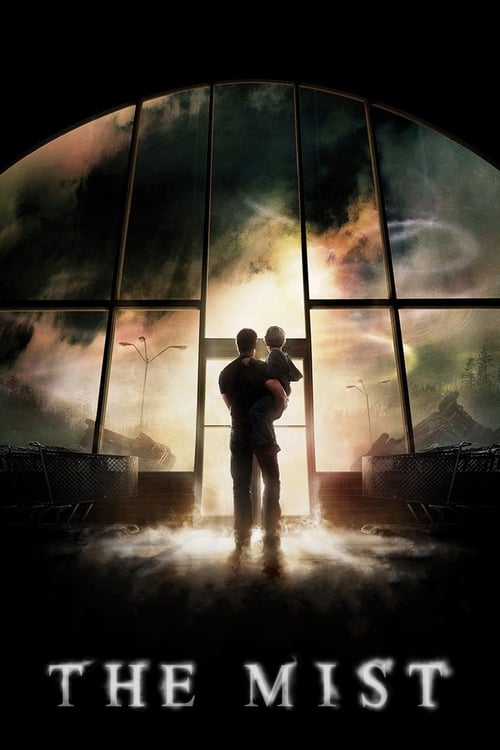
The Mist
2007 · Frank Darabont
For when you're craving real horror with teeth — not a party movie, but a gut-punch you'll be arguing about afterward. Choose it when you want to be disturbed, not comforted.
What it's about
After a violent storm, an unnatural mist rolls over a small Maine town, and David Drayton and his young son end up trapped in the local supermarket with a few dozen neighbors. Something in the mist kills anyone who steps outside — but the real story is inside the store, where fear curdles into faction, a doomsaying zealot finds her congregation, and ordinary people have to decide what they'll do to survive each other.
The experience
A slow tightening of the screws — dread over jump scares, with bursts of genuinely nasty creature horror. It's less fun than it is corrosive: the film keeps asking how thin the veneer of civilization really is, and its answer will leave you rattled.
Performances
Marcia Gay Harden is terrifying as Mrs. Carmody, the store's self-appointed prophet — a portrait of fanaticism finding its moment that's scarier than anything in the mist.
The craft
Frank Darabont shoots it rough and handheld, like news footage of a disaster, which makes the monster-movie premise feel unnervingly plausible. The sound design does heavy lifting — things heard in the white-out before they're seen — and the siege staging inside one supermarket is a masterclass in escalating claustrophobia.
Why it matters
Its ending — changed from Stephen King's novella, with King's blessing — is one of the most infamous in modern horror, and the film has grown from divisive theatrical release into a touchstone of bleak American genre cinema.
Horror · Creature feature · Cosmic horror · Suspense & terror. Neighbors trapped in a supermarket by a monster-filled mist turn on each other — claustrophobic, bleak creature horror.
Snapshot
The Mist is Frank Darabont's third feature adapted from Stephen King, following The Shawshank Redemption (1994) and The Green Mile (1999) — but where those were stately, humane prison dramas, The Mist is a lean, corrosive siege-horror film that turns its gaze on the people trapped inside rather than the monsters outside. Adapted from King's 1980 novella (first published in the anthology Dark Forces and later collected in Skeleton Crew), it strands a group of small-town Mainers in a supermarket after an unnatural mist — spilling from a torn seam between dimensions — brings tentacled and insectoid horrors to the parking lot. The film is best known today for two things: a deliberately drab, handheld, documentary-style visual approach at odds with prestige-King filmmaking, and one of the bleakest endings in modern American horror, invented by Darabont and grafted onto King's more ambiguous original. It is a modestly budgeted creature feature that functions, without much disguise, as an allegory about fear, faith, and how quickly a frightened community turns on itself.
Industry & production
The film was produced through Darabont's own Darkwoods Productions in partnership with Dimension Films, then under the Weinstein Company umbrella, and distributed by MGM. It carried a modest budget by the standards of a creature-effects picture — reported in the high-teens of millions — which materially shaped its aesthetic: the single principal location, the restraint in monster reveals, and the mix of practical and digital effects were all economies as much as choices. Production took place largely in Louisiana (Shreveport and surrounding areas), part of the wave of runaway production drawn to the state's film incentives in the mid-2000s.
Darabont wrote the screenplay himself and had, by his own account in interviews, wanted to make the film for years — long before Shawshank — making it a passion project rather than a studio assignment. The picture opened in the United States in November 2007. Precise box-office figures are outside what I can reliably state here, but the consensus record describes it as a modest theatrical performer that found a much larger and more durable audience on home video, where its reputation steadily grew. Central to that afterlife was a two-disc special edition featuring Darabont's preferred black-and-white version of the film (see Technology).
Technology
The Mist sits at an interesting technical hinge point in creature filmmaking. Its monsters were realized through a combination of practical effects — the KNB EFX Group, the makeup and creature house co-founded by Greg Nicotero and Howard Berger, contributed — and digital work handled by the visual-effects studio CafeFX. The modest budget meant the film could not lean on wall-to-wall photorealistic CGI; instead it rations its creatures, favoring silhouette, partial glimpses through fog, and staging that hides the seams. The mist itself is both a horror device and a budgetary friend, dissolving backgrounds and limiting how much needed to be built or rendered.
The single most discussed technical decision is the black-and-white alternate version. Darabont has consistently described monochrome as his preferred presentation, conceived to evoke the 1950s science-fiction and creature features the story descends from. Because the studio wanted color for the theatrical release, the black-and-white cut was preserved for home video, where it circulates as the "director's" version. It is not merely a desaturation gimmick: the grayscale flattens the creatures further into their B-movie lineage and pushes the film toward the stark, high-contrast look of period atomic-age horror. On the exact camera and capture format I would be guessing; the reliable point is the intended aesthetic — grainy, handheld, and deglamorized — rather than a specific stock or sensor.
Technique
Cinematography
Shot by Rohn Schmidt, the film's look is its most deliberate formal gesture. Darabont and Schmidt modeled the camerawork on the handheld, verité style of the television series The Shield, on which Schmidt had worked — restless framing, snap-focus, and a willingness to let the operator hunt for the action rather than compose it in advance. The intent was to strip away the polish audiences might expect from a Darabont-King production and replace it with immediacy and grubby realism, so that the fantastical creatures land against a mundane, believable backdrop of fluorescent supermarket light and frightened faces. The fog is photographed as a wall of nothing — a negative space that the camera cannot penetrate — which does as much dramatic work as any monster, because the horror is largely what cannot be seen.
Editing
Cut by Hunter M. Via, the film's editing serves the siege structure: long stretches of confinement and argument punctuated by sharp, violent incursions. The tension architecture depends on withholding — extended dread inside the store, then bursts of chaotic action when a creature breaches the glass or a supply run goes wrong. The most consequential editorial passage is the ending, whose devastating impact rests on timing: the beat between the final gunshots and the arrival of rescue is calibrated so the irony lands like a physical blow rather than a twist to be admired.
Mise-en-scène / staging
The supermarket is the film's entire world, and Darabont exploits it as a pressure cooker and a social diagram. The aisles, stockroom, loading dock, and plate-glass front become a map of the group's fracturing: factions form by geography, the pharmacy corner becomes Mrs. Carmody's pulpit, the front windows are the fragile membrane between order and the mist. Ordinary retail objects — mop handles, insecticide, a bag of dog food, shopping carts — are repurposed as weapons and barricades, grounding the fantastic in the banal. The staging steadily concentrates people around Carmody as fear metastasizes, using blocking to show a democracy of the terrified curdling into a cult.
Sound
Sound design carries much of the horror, precisely because the mist limits sight. Scuttling, chittering, and the wet slither of unseen things do the work of imagination; the film trusts noise off-screen more than spectacle on it. Notably, The Mist largely forgoes a conventional wall-to-wall orchestral score, keeping long passages tense and near-silent. The most memorable musical choice arrives at the finale, where Dead Can Dance's "The Host of Seraphim" — a mournful, wordless dirge — scores the film's closing movement, its funereal quality amplifying the ending's despair. I would not want to overstate the presence of an original composed score; the film's sonic identity is built more from design and that pre-existing piece than from a traditional soundtrack.
Performance
The ensemble is the film's engine. Thomas Jane anchors it as David Drayton, a father whose rationality is steadily ground down. Marcia Gay Harden gives the film's defining performance as Mrs. Carmody, the religious zealot who reads the mist as apocalyptic judgment and gathers a following — a portrayal pitched at the edge of caricature but disciplined enough to be genuinely frightening precisely because she is persuasive to the desperate. Strong supporting turns come from Toby Jones as the unassuming, quietly heroic store clerk Ollie, Andre Braugher as an out-of-town neighbor whose skepticism proves fatal, Laurie Holden, Frances Sternhagen, and Jeffrey DeMunn. The performances are keyed to the naturalistic camera style — raw, overlapping, unglamorous.
Narrative & dramatic mode
Structurally, The Mist is a chamber piece and a siege narrative: a fixed location, a closed group, an external threat, and the slow revelation that the real danger is internal. Its dramatic mode is closer to social tragedy than to the roller-coaster of much studio horror. The monsters are catalysts; the plot is really the sociology of a trapped population — the formation of factions, the rise of a demagogue, the failure of reason and decency under sustained terror. The film withholds explanation (the "Arrowhead Project," a military experiment, is gestured at but never diagrammed), keeping the cosmic cause vague so the human drama stays foregrounded. The ending inverts the survival-narrative contract: the characters who "do everything right" are punished by cruel timing, converting the genre's usual catharsis into an indictment of despair and premature surrender of hope.
Genre & cycle
The film belongs to several overlapping traditions at once. It is a creature feature in the 1950s atomic-age mold (its black-and-white version makes the homage explicit), a Lovecraftian tale of indifferent horrors from beyond human comprehension, and — most importantly — a Romero-descended siege film in which the living threat rivals the monstrous one. The DNA of Night of the Living Dead is everywhere: the barricaded interior, the disintegrating group, the argument as the real drama, the nihilistic ending. Within King's own body of adaptations it sits in the "ordinary people, extraordinary breakdown" strain rather than the supernatural-child or haunted-place strain, closer in spirit to the mob dynamics King repeatedly returns to.
Authorship & method
The Mist is a strong auteur statement precisely because it breaks with Darabont's established brand. Where his King prison films are warm, classically composed, and finally consoling, this is cold, handheld, and pitiless — evidence that his signature is thematic (institutions, faith, human decency under pressure) as much as tonal, and that he could invert his own style deliberately. As writer-director he controlled the adaptation end to end, and the decisive authorial act was replacing King's open ending with a closed, annihilating one. By multiple accounts King himself endorsed the change, reportedly saying he wished he had thought of it — a notable blessing given how radically it alters the story's meaning.
His key collaborators reflect the method: cinematographer Rohn Schmidt, imported for a TV-verité sensibility rather than feature gloss; editor Hunter M. Via, shaping the siege rhythm and the fatal timing of the finale; creature and effects work split between KNB EFX Group (Nicotero/Berger) practical craft and CafeFX digital work. On scoring the record is comparatively thin — the film's identity leans on sound design and the borrowed Dead Can Dance piece rather than a marquee composer — and I'd rather flag that than overstate a musical authorship the film doesn't really have.
Movement / national cinema
This is mainstream American genre cinema, produced within the Hollywood studio-specialty system (Dimension/Weinstein/MGM) and shot under U.S. regional tax-incentive conditions in Louisiana. It participates in no formal movement, but it is legibly part of a mid-2000s American horror sensibility that prized bleakness, moral discomfort, and social critique over reassurance. Its lineage is thoroughly domestic: American 1950s SF, American independent horror of the Romero school, and the ongoing American cottage industry of Stephen King adaptation.
Era / period
Released in 2007, the film reads as a post-9/11, mid-Iraq-War artifact, and most critics have read it that way — a study of a frightened populace that trades reason and pluralism for a strongman's apocalyptic certainty, scapegoats outsiders, and sanctions violence in the name of protection. Mrs. Carmody's rapid ascent from crank to authority figure resonates with anxieties of the period about fear-driven politics and religious absolutism. Technologically it belongs to the transitional moment when digital creature effects were maturing but budgets still forced hybridity with practical craft, and when the handheld television aesthetic of shows like The Shield was migrating into feature horror.
Themes
The governing theme is the fragility of the social contract: strip away safety and information, and civilization dissolves into tribalism within days. Faith is treated ambivalently and pointedly — Carmody's brand of apocalyptic religion is depicted as a predatory response to fear, offering certainty and a sacrificial logic to people who can no longer bear ambiguity. Around this cluster related concerns: fatherhood and the impossible burden of protecting a child (David's arc is entirely defined by his son); the failure of rationality and expertise to hold authority against terror; and the corrosive effect of the unknown, embodied in a mist that is horrifying largely because it refuses to explain itself. The ending crystallizes the film's darkest thesis — that despair, acted on too soon, is its own catastrophe, and that the universe offers no guarantee that endurance will be rewarded.
Reception, canon & influence
Critical reception was broadly favorable, with particular praise directed at Marcia Gay Harden's Carmody, the film's unfashionable seriousness, and above all its ending, which became an instant talking point and remains its calling card — routinely cited in discussions of the bleakest conclusions in horror history. Some reviewers found the human characters schematic and Carmody's zealotry overdrawn, but even skeptics tended to concede the finale's force. The film's stature has risen over time, aided by the black-and-white version's cult reputation, making it one of the more critically respected King adaptations of its era.
Influences on the film (backward): King's 1980 novella is the direct source; beyond it, the film draws on 1950s atomic-age creature features (openly, via the monochrome cut), on H.P. Lovecraft's tradition of vast, uncaring cosmic horror, and structurally on George Romero's Night of the Living Dead and the siege-horror template of internal conflict under external threat. The camera language is borrowed from contemporaneous verité television, chiefly The Shield.
Legacy (forward): Its most tangible institutional legacy runs through Darabont himself: he went on to develop and showrun the television adaptation of The Walking Dead (2010), carrying with him collaborators and cast from The Mist's orbit — effects artist Greg Nicotero became a defining creative force on that series, and several Mist performers (including Laurie Holden, Jeffrey DeMunn, and Melissa McBride) crossed over. The novella and film were later readapted as a Spike TV series, The Mist (2017), which was poorly received and short-lived, indirectly underscoring how much the 2007 film's power depended on Darabont's specific ending and tone. More diffusely, the film became a reference point for bleak, socially critical genre horror and a fixture in the ongoing critical rehabilitation of Stephen King adaptations — remembered less as a monster movie than as a parable about what people do to one another in the dark.
A Deleuzian reading
The best shot in *The Mist* is a window with nothing behind it.
The full Deleuzian reading of The Mist →
Reception
A modest performer with mixed-to-positive reviews in 2007, it has since climbed into the modern-horror canon — the ending that split audiences then is now the thing everyone insists you experience unspoiled, and Darabont's preferred black-and-white cut has fed the reappraisal.
How The Mist was received, from release to now →
How to watch The Mist: what to notice on a first viewing
- Watch the flat white nothing behind the store's front windows. Schmidt photographs the fog as a wall the lens cannot enter. It sits dead center in the frame, thirty feet away, lit by the store's own fluorescents, and gives back nothing. The blank does more work than any creature. What is outside cannot be located, so it cannot be measured or planned against.
- Notice the camera hunting for focus during arguments. Darabont and Schmidt borrowed the handheld grammar of The Shield: restless reframing, snap focus, an operator who finds the speaker a beat late rather than waiting for them. The style promises a camera that arrived without knowing what would happen, and that borrowed credibility is spent on tentacles.
- Listen to how long the film runs with no music. There is almost no orchestral score. Dread is carried by scuttling, chittering, and wet movement heard through walls and glass, none of it locatable. Unseen and unplaced noise keeps the threat from becoming a thing with dimensions, which is the only way it stays frightening.
- Watch which corner of the store people drift toward. Darabont marks factions by geography: the loading dock, the checkout lanes, and the pharmacy aisle where Mrs. Carmody sets up. The blocking shifts a few bodies at a time. The crowd is being consolidated in front of you. You can count the congregation growing without a single line of dialogue announcing it.
- Count the store items repurposed as weapons or barricades. Mop handles, insecticide, shopping carts, a bag of dog food. The most thoroughly organized room in American life gets converted into a larder and an armory. The fantastic stays grounded because everything the survivors use is something you could buy on aisle four.
The whole guide to watching The Mist, with the keys for a rewatch →
Influences: the films it descends from and the films it influenced
- Night of the Living Dead (1968) — Supplies the core siege-horror template Darabont builds on — a heterogeneous group barricaded in one building where the fatal threat becomes internal argument, capped by the same nihilist gut-punch of a protagonist who endures the whole ordeal only to be destroyed at the very end.
- Them! (1954) — The atomic-age, black-and-white creature feature whose monochrome newsreel gravity Darabont explicitly channels in the film's alternate B&W cut, treating the monster movie with documentary seriousness rather than camp.
- The Birds (1963) — Model for the enclosed-space siege by an unexplained natural force scored with no orchestral music at all — only designed/electronic sound — and ending on withheld resolution rather than victory, the same sound-design-over-score and no-catharsis strategy The Mist adopts.
- Invasion of the Body Snatchers (1956) — Establishes the creature film as social-contract allegory in which the real horror is neighbors turning on each other under pressure — the Cold War paranoia structure Darabont repurposes into Carmody's supermarket mob.
- The Thing (1982) — The trapped-group paranoia film whose Rob Bottin practical-effects craft is the direct lineage KNB/Nicotero descend from, and whose annihilating, hope-less ending licenses The Mist's closed finale.
- Alien (1979) — Stages its creatures as unknowable Lovecraftian biology glimpsed in fragments and built practically in-camera, the withholding, half-seen monster strategy Darabont uses to keep the mist's horrors cosmic rather than legible.
- Dawn of the Dead (1978) — Turns a consumer-retail space into the siege arena so the setting itself carries the social critique — the mall-as-battleground logic that The Mist compresses into a small-town supermarket.
- The Green Mile (1999) — The warm, classically composed, redemptive King adaptation whose feature-gloss aesthetic The Mist consciously repudiates with handheld TV-verité coldness, the negative image of the same auteur's method.
- Signs (2002) — Carries forward the boarded-enclosure siege plus explicit faith-versus-fear thematizing, weaponizing the threshold between safe interior and unseen exterior threat.
- The Blob (1988) — Darabont reworks his own Blob script: townspeople trapped by monsters released through a military experiment, a religious fanatic who gains power as the crisis grows, and Jeffrey DeMunn in the cast.
- The Walking Dead (2010) — The film's most tangible legacy: Darabont carried its deglamorized verité horror grammar, KNB/Nicotero practical gore craft, and cast (Holden, DeMunn, McBride) directly into the series, extending the same 'what people do to each other' siege ethic to television.
- 10 Cloverfield Lane (2016) — Extends the supermarket-pressure-cooker device — a confined survivor group menaced by an outside catastrophe in which the zealous authoritarian human inside proves the deadlier threat, Carmody rewritten as bunker patriarch.
- A Quiet Place (2018) — Builds its creature feature on sound design as the primary authorial voice rather than a marquee score, pairing practical-and-digital hybrid monsters kept mostly off-screen, the same technical priorities The Mist chose over a composer.
- Bird Box (2018) — Withholds its Lovecraftian force entirely — an unseen cosmic presence whose mere perception destroys people — extending The Mist's editing-of-withheld-tension and never-show-the-god approach to unknowable horror.
- Assault on Precinct 13 (1976) — A secular, Romero-derived single-location siege in which strangers must cooperate under relentless external assault, the same pressure-cooker staging of an ad-hoc community fracturing under attack.
- The Shawshank Redemption (1994) — Darabont's own King adaptation carrying his thematic signature — institutions, faith, and human decency under pressure — that The Mist deliberately inverts, proving his authorship is thematic rather than tonal by swapping consolation for annihilation.
- Cloverfield (2008) — Applies the same handheld, deglamorized-verité camera language to a creature feature and reads the monster attack as a post-9/11 allegory of ordinary people amid an incomprehensible catastrophe.
- The Descent (2005) — A deglamorized, claustrophobic creature feature committed to an uncompromising bleak ending, sharing The Mist's refusal to grant its trapped protagonists survival or comfort.
Similar films
- A Quiet Place (2018) — influence & lineage · same viewing thread
- Night of the Living Dead (1968) — influence & lineage · same viewing thread
- Cloverfield (2008) — influence & lineage
- Dawn of the Dead (1978) — influence & lineage
- The Thing (1982) — influence & lineage
- The Descent (2005) — influence & lineage
- 10 Cloverfield Lane (2016) — influence & lineage · same viewing thread
- [REC] (2007) — same viewing thread
All the films related to The Mist →
Watch it with: curated runs of related films
- Nowhere Left to Hide — Watch these when you want pure primal terror — ordinary people cornered by something relentless, from open water to a silent farmhouse to a stairwell in Barcelona.
- Something Is Out There: Sieges from Above — A run of films about ordinary people (a family on a farm, neighbours stuck in a supermarket, a frozen government) besieged by something unknowable from the sky or the fog, where how they hold together matters as much as the monster.
- Doorways Into Cosmic Dread — A run of films where someone opens a door they shouldn't (a star map, a shimmer, a mist, a machine, a basement wall), and what's on the other side doesn't care about human sense or human bodies; watched together, they map how horror tries to picture the unknowable.