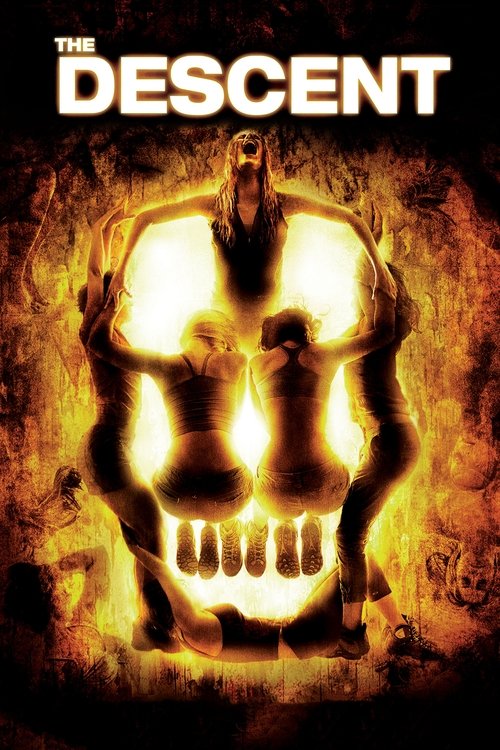
The Descent
2005 · Neil Marshall
When you're craving a real scare and want to be pinned to the couch — this is the hard stuff, for horror fans who mean it. Absolutely not the pick for the faint of heart or the claustrophobic.
What it's about
A year after a devastating personal tragedy, Sarah reunites with five friends for a caving expedition in the Appalachians — an adrenaline trip meant to put her back together. Then a rockfall seals the way they came in, and the descent through an unmapped cave system becomes a fight to get out. In the dark, they discover the caves are not empty, and the trust between the women starts to crack along old fault lines.
The experience
Punishingly tense — the crawl-space claustrophobia is so effective that many viewers find the first hour, before anything supernatural happens, the scariest part. When the film turns, it turns savage: relentless, gory, and pitch-dark in every sense. Not a casual watch.
Performances
Shauna Macdonald and Natalie Mendoza give the ensemble its spine — Macdonald's Sarah makes a raw, feral arc believable, and the largely unknown all-female cast plays real friendship and real betrayal rather than horror-movie types.
The craft
Neil Marshall wrings maximum dread from light itself — flares, headlamps and glow sticks are often the only illumination, so the darkness feels physical. The structure is a masterclass: nearly an hour of pure survival tension before the creatures appear, so the terror is already at full boil. Watch it in a dark room with the sound up; it's built for it.
Why it matters
A defining film of the mid-2000s British horror revival, regularly ranked among the best horror films of its decade and a benchmark for female-led ensemble horror.
Horror · Creature feature · Backwoods & survival. Six women trapped in an unmapped cave, lit only by flares: an hour of crushing claustrophobia, then something savage in the dark.
Snapshot
The Descent is a British subterranean horror film that fuses a survival-adventure premise with a monster-siege structure, and in doing so became one of the defining genre works of the mid-2000s British horror revival. Written and directed by Neil Marshall as his second feature, it follows six women — bound by friendship and, in one case, by betrayal — who become trapped in an uncharted cave system and are hunted by pale, blind, cave-adapted humanoids the production dubbed "crawlers." Its lasting reputation rests on three achievements: a genuinely oppressive evocation of claustrophobia and lightlessness; an almost entirely female principal cast whose relationships carry the drama rather than decorating it; and a structural gambit whereby the film functions as pure survival tension for nearly an hour before its creatures arrive, so that the horror feels earned rather than imposed. The result is frequently ranked among the strongest horror films of its decade.
Industry & production
The film was produced through Celador Films, the production arm associated with the British company best known for the Who Wants to Be a Millionaire? format, with Christian Colson producing. It was a modestly budgeted independent production — figures commonly reported place it in the low single-digit millions of pounds, though I would treat any precise budget number cautiously rather than assert one. Crucially, the film was made in Britain by a British team but set in the Appalachian Mountains of the United States, a displacement that let Marshall stage his caving expedition in an ostensibly vast, under-explored American wilderness while shooting the practical work at home.
Almost none of the film was shot in real caves. The cave interiors were built as sets — the studio work is associated with Pinewood — allowing the production to control lighting, rigging, camera placement, and the safety of prolonged shooting in confined spaces that no real cave would permit. This is central to understanding the film: its overwhelming sense of being underground is a constructed illusion, achieved through set design, restricted light, and sound rather than location authenticity.
Its release pattern is itself a piece of industry history. The Descent opened in the United Kingdom in 2005 to strong reviews and became a genre success. Its United States release, handled by Lionsgate, came the following year, in 2006, and — famously — with a different, truncated ending imposed for that market (discussed below). Its commercial performance was healthy enough relative to its cost to make it a recognized success and to license a sequel, The Descent Part 2 (2009).
Technology
The Descent is, in large part, a film about light — its scarcity and its sources — and this drives its technical identity. The photography (see below) worked within near-total darkness, motivating the production to build its imagery around diegetic light: head torches, handheld flashlights, chemical glow sticks, road flares, a video camera's night-vision mode, and thermal-style imaging. These are not merely atmospheric flourishes; they are the film's lighting instruments, folded into the story world so that the audience only sees what the characters can illuminate. The green night-vision look, in particular, became one of the film's signature images and the vehicle for its most celebrated shock.
I would flag the exact capture format as a point I cannot verify with confidence; the film has the grain and texture consistent with 35mm origination typical of the period and budget, but I will not assert a specific stock or camera without certainty. Whatever the format, the achievement is one of controlled underexposure and practical light design rather than any novel imaging technology.
Technique
Cinematography
The cinematography is credited to Sam McCurdy, a frequent Marshall collaborator, and it is the film's most discussed craft element. The governing principle is restriction: the frame shows only what a character's light source reveals, so darkness is not a backdrop but an active, encroaching presence that swallows the edges of every shot. Pools of torchlight, the flat spectral wash of night vision, and the sudden red of a flare each carry different emotional registers. The camera favours tight, enclosing compositions that press the actors against rock, and it withholds establishing geography, so the audience shares the characters' disorientation. The film's most famous shot — a crawler revealed in the background of a night-vision frame, unnoticed by the character in the foreground — is a masterclass in using the limits of an image against the viewer.
Editing
The editing is credited to Jon Harris, whose contribution is significant enough that he would go on to direct the sequel. The cutting manages two distinct tempos. In the long first movement, the film builds dread through patient, tension-accruing rhythm — the caving, the crawl through the "Crawl" passage, the rockfall that seals the group in. Once the creatures appear, the editing shifts to fast, fragmented, often deliberately confusing cutting that mirrors the chaos of combat in the dark, where neither characters nor audience can fully parse what is happening. The film is also structured around a slow-burn reveal: the withholding of the monsters for roughly the first half is fundamentally an editorial and structural strategy, converting audience impatience into unease.
Mise-en-scène / staging
The production design is the drama. The cave sets are staged as a descending series of increasingly hostile spaces — from recognizable cavern chambers to the notorious tight squeeze that traps a character mid-crawl, to blood-slicked pits. Marshall stages the human bodies within the rock so that the environment is always a co-antagonist: characters wedge, climb, dangle, and squeeze, and the physical difficulty is legible in every setup. Blood and red imagery recur pointedly — the red of flares, the crawlers' feeding pit — against the gray-black of stone. Water, gorges, and vertical drops extend the sense that the cave is not a single space but a whole hostile world with its own treacherous geography.
Sound
Sound is arguably as important as image, precisely because so much of the film happens at the edge of visibility. The soundscape trades on the acoustic character of caves — dripping, distant echo, the scrape of rock, the amplification of breath and heartbeat in enclosed silence. The crawlers announce themselves through screeches and clicking cries, and much of their menace is auditory before it is visual, since they are blind and hunt by sound (a trait the film weaponizes in scenes where the women must stay silent). David Julyan's score works largely in tension-building and dread registers rather than melody, reinforcing the film's oppressive interiority.
Performance
The performances are anchored by an ensemble of women, led by Shauna Macdonald as Sarah, the grieving protagonist whose arc runs from trauma to feral survival, and Natalie Mendoza as Juno, the reckless, guilt-carrying leader whose choices detonate the group's trust. Alex Reid, Saskia Mulder, MyAnna Buring, and Nora-Jane Noone complete the party. The acting is notably physical — crawling, climbing, fighting in mud and blood — and the emotional work is real: the film asks its cast to carry grief, resentment, and buried betrayal alongside terror. Macdonald's transformation across the film, culminating in her blood-drenched final state, is the performance the whole structure is built to deliver.
Narrative & dramatic mode
Structurally, the film is a study in the withheld monster. It opens with personal tragedy — a prologue that kills Sarah's husband and daughter in an accident — and then reunites the friends a year later for a reunion caving trip meant as healing. The first act is adventure and interpersonal drama: the descent, the collapse that seals their exit, the revelation that Juno has led them not into a known cave but into an unmapped system to claim a "discovery." Only after this human crisis is fully established do the crawlers arrive, at which point the film pivots into siege-and-survival horror. Layered beneath the monster plot is a second, human betrayal — the revelation of an affair between Juno and Sarah's late husband — so that the film's climax turns on human vengeance as much as creature survival. The dramatic mode is thus twofold: an external monster movie and an internal drama about grief, guilt, and shattered trust, with the cave functioning as the pressure vessel that forces both to the surface.
Genre & cycle
The Descent sits at the intersection of the "survival adventure gone wrong" film and the creature-siege horror film. Its lineage is easy to trace: the group-picked-off-one-by-one structure of Alien, the paranoid distrust-in-isolation of The Thing, the wilderness-turns-hostile dread of Deliverance, and the primal cave-monster tradition. It also belongs squarely to a specific cycle: the mid-2000s revival of British genre filmmaking, alongside 28 Days Later (2002), Dog Soldiers (Marshall's own 2002 debut), Shaun of the Dead (2004), and the later Eden Lake (2008) and Severance (2006). Within horror specifically, it arrived during a global wave of harder, more visceral horror in the 2000s and was often grouped with that intensity while distinguishing itself through characterization and craft rather than gore alone.
Authorship & method
The film is fundamentally a Neil Marshall work: he wrote and directed it, and it confirmed the promise of Dog Soldiers while demonstrating a marked leap in control and seriousness. Marshall's authorial signatures — genre literacy, ensemble under siege, physical peril, an affection for classic horror and action reference — are all present, but The Descent is his most emotionally disciplined film, subordinating fan-service instincts to sustained dread.
His key collaborators form a recognizable unit. Cinematographer Sam McCurdy translated Marshall's darkness-first concept into a coherent visual language of practical, diegetic light. Editor Jon Harris shaped both the slow-burn structure and the chaotic combat, and his creative investment was substantial enough that he directed the 2009 sequel. Composer David Julyan supplied a dread-forward score. The screenplay is Marshall's own, and its strongest structural decision — grounding the horror in a specific, human story of grief and betrayal before any monster appears — is what critics most consistently credit for the film's superiority over its imitators.
Movement / national cinema
As British cinema, The Descent is a flagship of the 2000s British horror resurgence, a period in which UK filmmakers reclaimed genre territory with international ambition on limited budgets. Its transposition of an all-British cast into an American setting reflects a common strategy of the era: making internationally legible genre films while working within a domestic industry. It stands as evidence that British horror in this period could compete on craft and intensity with larger American productions, and it is frequently cited in surveys of modern British genre cinema as a high-water mark.
Era / period
The film is a product of the mid-2000s, a moment of pronounced global appetite for intense, uncompromising horror. Its two-endings history is inseparable from this context: the original UK version closes on a bleak note — Sarah's apparent escape revealed as a dying hallucination, leaving her still trapped underground with the crawlers closing in — while the version prepared for the 2006 US release cut the ending earlier, to a more conventional escape-and-shock beat. That divergence is itself a period artifact, illustrating how differently horror bleakness was calibrated for UK and US audiences in the mid-2000s, and it remains one of the film's most debated features.
Themes
The film's dominant theme is grief and its aftermath: Sarah's descent into the cave is a literalised descent into mourning, and her emergence — feral, blood-covered, having killed to survive — reads as a passage through and out of trauma rather than a clean rescue. Female friendship and its fracture is the second pillar: the betrayal between Sarah and Juno turns the film's climax human, so that the most decisive act of violence is between two women, not between woman and monster. Critics have long read the cave through the imagery of the body — as womb and birth canal, with the blood, tight passages, and the final "rebirth" that isn't — supporting feminist interpretations of the film as being about women navigating a hostile interior world without men. Trust, guilt, and the thin membrane between civilization and savagery run throughout, with the crawlers functioning as a mirror of what the humans themselves become in the dark.
Reception, canon & influence
Critically, The Descent was strongly received, praised for its atmosphere, its refusal to treat its women as disposable, and its rare achievement of being genuinely frightening rather than merely gory. It quickly entered discussions of the best horror films of the 2000s and the best British horror films of its generation, a standing it has largely retained.
Its influences reaching backward are well documented in the film's own DNA: the ensemble-siege architecture of Alien, the isolation-paranoia of The Thing, the wilderness-hostility of Deliverance, and the broader tradition of cave and underground horror. Marshall's own genre steeping — evident across his work — is the connective tissue.
Reaching forward, its legacy is substantial. It is credited with reinvigorating claustrophobic, confined-space horror and with modeling how to center women in a survival-horror ensemble without either exploitation or tokenism, a template later horror repeatedly drew on. Its night-vision reveal became a widely referenced example of the buried-in-the-frame scare. It generated a direct sequel, The Descent Part 2 (2009), directed by its editor Jon Harris, and it cemented Neil Marshall as a significant genre voice, feeding into his subsequent film and prominent television work. Within the canon of modern horror, it endures as a benchmark for how much dread can be wrung from darkness, restraint, and character — and as one of the enduring achievements of 2000s British cinema.
A Deleuzian reading
Somebody switches the camcorder to night vision because there is nothing else left to see by.
The full Deleuzian reading of The Descent →
Reception
Hailed on its 2005 UK release as the scariest film in years, it hit the US in 2006 with its bleaker ending lopped off by Lionsgate — and as the uncut version spread, it climbed from 'great genre entry' to consensus pick for the best horror film of the 2000s.
How The Descent was received, from release to now →
How to watch The Descent: what to notice on a first viewing
- Watch which light source is on screen: torch, flare, glow stick, camcorder. The frame only ever shows what a character's own light touches, and the instrument changes as the women move deeper. Darkness stops being a backdrop and becomes an active force pressing in from the edges of every shot.
- Notice you're never shown how one chamber connects to the next. McCurdy withholds establishing shots throughout, so each lit room appears as an island with no visible map between them. Deleuze calls this an any-space-whatever, a space stripped of coordinates until it becomes pure potential rather than a mapped place.
- Track how each chamber grows tighter and more hostile. Marshall stages the cave as a downward sequence: cavern, the narrow Crawl passage, then blood-slicked pits. This is what the reading calls the line of slope, a descent that only runs downhill and never back.
- Listen for dripping, echo, and the sound of the women's own breathing. Julyan's score works in dread rather than melody, laid against the cave's own acoustic texture of drips and rock. Menace arrives through sound first, since so much of the film happens at the edge of what you can see.
- Watch how the women position themselves around each other. The group's blocking shifts from a unified cluster to isolated pairs as trust erodes, scene by scene. The relationships carry the drama; the physical distance between the women tells you who still trusts whom.
The whole guide to watching The Descent, with the keys for a rewatch →
Influences: the films it descends from and the films it influenced
- Alien (1979) — Supplies the ensemble-under-siege architecture in which a working crew is picked off one by one, the creature withheld and revealed only in fragments swallowed by darkness.
- The Thing (1982) — Models the isolation-paranoia dual-antagonist structure where trust between the trapped group collapses, making the humans as lethal as the monster — the template for Juno's betrayal subplot.
- Deliverance (1972) — Establishes the leisure-adventure-into-wilderness-nightmare arc, a group's recreational descent into a hostile landscape that punishes their hubris and strips them to survival instinct.
- Jaws (1975) — Codifies the withheld-monster suspense economy — delaying and rationing the full creature reveal so dread accrues in absence rather than display.
- Predator (1987) — Pioneers the thermal/night-vision POV as a monster's-eye reveal device, the direct forebear of the camcorder night-vision shot that finds a crawler buried in the frame.
- The Blair Witch Project (1999) — Weaponizes low-light, night-vision handheld imagery so that darkness itself becomes the frame and the source of terror — a diegetic-light discipline Marshall inherits.
- Southern Comfort (1981) — A Deliverance sibling that traps outsiders in an enclosed hostile terrain hunted by a barely-seen local predator, refining the lost-in-a-labyrinth attrition Marshall stages underground.
- Dog Soldiers (2002) — Marshall's own prior ensemble-siege creature film — practical monsters, a small unit besieged in a confined structure — the immediate template he strips of fan-service and disciplines into sustained dread.
- My Bloody Valentine (1981) — Lights its underground horror almost entirely with helmet lamps, flares and glow sticks carried by the cast, building on the cap-lamp lighting MBV pioneered in its real mine.
- The Descent Part 2 (2009) — Directed by the original's editor, it re-enters the same constructed cave sets and crawler mythology, extending the dual-tempo cutting rhythm Harris designed for the first film.
- The Ruins (2008) — Traps a small group in a single confined hostile site and runs the same survival-attrition mechanics, watching the ensemble physically and psychologically disintegrate under siege.
- Sanctum (2011) — Transposes the descending-hostile-spaces structure into cave-diving, using constructed subterranean sets and diegetic light to render the depths as an inescapable tightening trap.
- As Above, So Below (2014) — Literalizes the grief-as-descent and womb/underworld imagery in the Paris catacombs, its journey downward doubling as a psychological reckoning exactly as Sarah's cave descent does.
- Crawl (2019) — Confines a creature siege to a flooding crawlspace anchored by a family-grief core, extending Marshall's fusion of practical-monster claustrophobia with an emotional throughline.
- The Ritual (2017) — A British wilderness ensemble horror in which a grief-driven group descends into a hostile natural space and a withheld creature, carrying forward the British-horror-revival lineage Marshall helped ignite.
- Barbarian (2022) — Blueprint for the vertical-buried horror: descent into black subterranean crawlspaces lit only by limited practical sources, with a humanoid dweller emerging from the dark of the tunnels.
- Manjummel Boys (2024) — Precedent for built cave-interior sets lit and framed to constrict the image, using reverberant enclosure sound to convert rock geometry into dread.
- Don't Breathe (2016) — Blind cave dwellers hunt by sound and the characters must freeze in silence inches from them. The film alternates long held quiet with bursts of fast cutting, and Don't Breathe stages its encounters with Lang the same way.
- Eden Lake (2008) — It shares editor Jon Harris and composer David Julyan with Eden Lake. Harris's tightly controlled cutting of panic and Julyan's sparse ambient drone carry over directly into Eden Lake's nocturnal claustrophobia.
- Bone Tomahawk (2015) — Marshall's blind, cave-dwelling crawlers, and his structure of a long character-driven descent before the monsters show up, give Zahler the subterranean humanoid predators and the delayed turn into horror.
- The Cave (2005) — A near-simultaneous caving-expedition-versus-subterranean-predator film working the same descending-hostile-spaces premise and constructed-set claustrophobia.
- [REC] (2007) — Its climactic night-vision reveal — a threat emerging from total darkness only through the camera's infrared — extends the same buried-in-the-frame scare grammar into found-footage.
- Green Room (2015) — Runs the same confined-space siege with escalating ensemble attrition and a human dual-antagonist, wringing dread from a locked, shrinking geography rather than gore.
- The Mist (2007) — A deglamorized, claustrophobic creature feature committed to an uncompromising bleak ending, sharing The Mist's refusal to grant its trapped protagonists survival or comfort.
- Evil Dead (2013) — Female-survivor ordeal built on claustrophobic enclosure and practical creature-gore, plus a grief/trauma frame motivating descent into a literal pit.
- The Maze Runner (2014) — Enclosed-space creature horror where the geography is the trap and predators emerge from darkness — the pastoral-safe-zone versus lethal-labyrinth spatial binary rendered as survival horror.
- Evil Dead Rise (2023) — Shares the female-ensemble-under-siege claustrophobia driven by fractured sisterhood, executed through tight, dark spatial confinement and tactile practical creature and gore effects.
- Them (2006) — Made a year earlier, it lit claustrophobic underground passages with only the light sources the characters carry, the method *Them* uses for its climax in the sewers and tunnels.
Similar films
- The Ritual (2017) — influence & lineage · same viewing thread
- As Above, So Below (2014) — influence & lineage
- [REC] (2007) — influence & lineage
- The Blair Witch Project (1999) — influence & lineage
- The Thing (1982) — influence & lineage
- Alien (1979) — influence & lineage
- 28 Years Later: The Bone Temple (2026) — same viewing thread
- Bone Tomahawk (2015) — same viewing thread
All the films related to The Descent →
Watch it with: curated runs of related films
- Trapped in the Dark — Watch these as a run of survival horror where the place itself — a chained-shut bathroom, a cabin cellar, a lightless cave, an endless fluorescent nowhere, an emptied city — turns into the thing hunting you.
- Out Past the Last Gas Station — A run of films about people who go somewhere remote (woods, caves, a quarry lake, a backwoods club, an island, the frontier) and find that the usual rules stop applying out there. Watched near each other, they show the 'city folk take a wrong turn' story played as dread, as Western, as revenge and as a joke on itself.