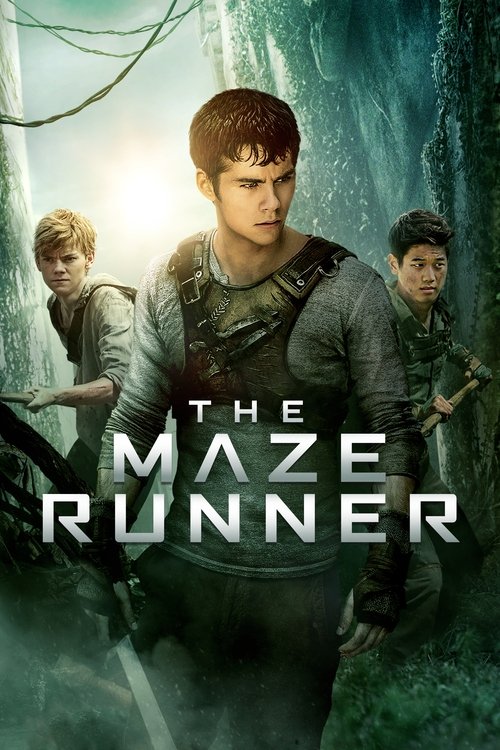
The Maze Runner
2014 · Wes Ball
For when you want a fast, gripping puzzle-box adventure that pulls you along without asking much of you — a great pick when you're in the mood to yell 'don't go in there' at the screen and keep watching anyway.
What it's about
A teenager wakes up in a grassy clearing with no memory of who he is, surrounded by a society of boys who've built their own rules, jobs, and pecking order inside towering stone walls. Beyond those walls lies a colossal maze that rearranges itself every night and hides mechanical monsters. The newcomer's arrival starts breaking the fragile order, and the question that drives everything — who put them here, and is there a way out — suddenly seems answerable.
The experience
Lean and propulsive, built on withheld information: you're dropped in as disoriented as the hero and learn the rules alongside him. It plays more like a survival thriller crossed with a monster movie than a teen drama, and the maze runs have real white-knuckle momentum.
The craft
Director Wes Ball came up through visual effects, and it shows in the maze itself — massive shifting walls and biomechanical creatures rendered with a physical, looming weight that rewards a big screen and loud speakers. The storytelling is disciplined about exposition, letting geography and dread do the work a lesser film would hand to speeches.
Why it matters
Arriving at the peak of the young-adult dystopia boom, it stood out from its cycle by trading romance for mystery and creature-thriller mechanics, launched a trilogy, and made Wes Ball's name as a director in a single debut.
Snapshot
The Maze Runner is a lean, propulsive survival thriller adapted from James Dashner's 2009 young-adult novel of the same name, and the feature directing debut of visual-effects artist Wes Ball. It arrived at the crest of the post-Hunger Games wave of YA dystopian adaptations, but distinguished itself through a genre posture closer to the closed-room mystery and the creature-thriller than to the romance-driven ballots of its cycle. Its premise is a machine for withholding information: a boy wakes with no memory in a bucolic clearing called the Glade, walled in by a colossal stone labyrinth that reconfigures itself nightly and is patrolled by biomechanical horrors. The film's engine is epistemological — who put them here, why, and how to get out — and its dramatic economy comes from refusing exposition almost entirely until its final reel. Modestly budgeted and shot largely in Louisiana, it became a commercially durable property that anchored a three-film series and helped certify Ball as a studio-scale director, a trajectory that later carried him to the Planet of the Apes franchise.
Industry & production
The film was produced by Gotham Group (Ellen Goldsmith-Vein), Temple Hill Entertainment (Wyck Godfrey and Marty Bowen — the producing team behind the Twilight saga), TSG Entertainment, and Twentieth Century Fox, which distributed. Its lineage in the Temple Hill camp is significant: this was a producing outfit fluent in monetizing YA literary properties for a teen and crossover audience, and the machinery of the Maze Runner rollout — casting rising television-adjacent talent, courting the book's existing readership, positioning for a franchise — reflects that expertise.
The defining industrial fact is its budget discipline. The Maze Runner was made for a reported figure in the mid-thirty-millions, a fraction of the outlays typical of studio science-fiction tentpoles of its moment. That constraint is legible in the film's design logic: a single principal location (the Glade), a limited ensemble, and creature and maze effects deployed strategically rather than continuously. The commercial return substantially outstripped the outlay — the film was a clear financial success on a global basis and greenlit its sequels quickly — though I will not attach specific gross figures here, as I cannot verify exact numbers from memory. The takeaway is structural rather than numerical: it modeled a profitable version of the YA-dystopia film, one whose economics did not depend on saturation spectacle.
Production was based in Louisiana, principally around Baton Rouge, taking advantage of the state's film incentives — an industrial commonplace of American mid-budget filmmaking in the early 2010s. The Glade set was built practically, an approach that pays real dividends in the film's sense of place. A sequel, Maze Runner: The Scorch Trials, followed in 2015, with The Death Cure delayed into 2018 after star Dylan O'Brien was injured during filming — an interruption that is well documented and that reshaped the franchise's release cadence.
Technology
Ball's own background is the film's most important technological fact. He came to features from motion graphics and visual effects, and his calling card was the short film Ruin, a photoreal post-apocalyptic chase piece that circulated widely and helped secure him the Maze Runner assignment. That pedigree informs a hybrid effects methodology: the Glade is a practical, built environment, while the maze corridors and the Grievers — the maze's spider-like mechanical predators — are realized through digital effects integrated with physical set pieces. The Grievers are a notable design achievement for a mid-budget film, combining organic and machine anatomy in a way that reads as genuinely threatening without over-exposure.
The production sits at a transitional moment in exhibition and capture technology, using digital cinematography and a conventional 2D release (this was not a film that leaned on 3D as a selling point). Its technological interest lies less in any single innovation than in its efficient marshalling of VFX talent by a director who understood the pipeline from the inside — a case study in how a visual-effects sensibility, applied with restraint, can make a limited budget read as larger than it is.
Technique
Cinematography
Enrique Chediak served as director of photography. Chediak, whose credits include 28 Weeks Later, 127 Hours, and other kinetic, physically immersive work, brings a naturalistic yet muscular sensibility. The Glade sequences favor available-feeling, sun-dappled light that lends the clearing an almost pastoral quality — a deliberate contrast to the maze, which is rendered in cold grays, hard verticals, and oppressive scale. The camera is frequently handheld or mobile during the running sequences, privileging bodily urgency and disorientation over geographic legibility; we are meant to feel lost in the maze, not to map it. Chediak's compositions repeatedly stress the walls' height relative to the human figure, converting production design into a recurring visual argument about confinement.
Editing
Dan Zimmerman edited the film. The cutting is central to the picture's mystery structure: information is metered out, and the editing withholds the reverse angle or the explanatory cut that a more conventional adaptation might supply. The maze-running set pieces are constructed for velocity and threat, using rapid, spatially compressed cutting during Griever encounters and the closing of the great stone doors. Zimmerman would remain associated with the franchise, an editorial continuity that gives the series a consistent rhythmic signature.
Mise-en-scène / staging
The film's design is organized around a stark binary — the enclosed pastoral of the Glade versus the monumental hostility of the maze. Within the Glade, the staging emphasizes an improvised social order: assigned roles, a governing council, a memorial to the dead, physical labor. The boys have built a functioning micro-society, and the production design makes that legible through props, structures, and the geography of daily life. The maze itself is staged as an antagonist — a shifting architecture whose scale dwarfs the characters and whose reconfigurations are a source of dread. This spatial dialectic does much of the film's thematic work before a word of explanation is spoken.
Sound
John Paesano composed the score, a driving, percussive, largely orchestral-electronic hybrid that supports the film's chase mechanics and its atmosphere of unease. The Griever sequences depend heavily on sound design — mechanical clicking, shrieks, the grinding of the moving walls — to sell threats that are only partially shown, an economical horror strategy. Paesano's music, like Zimmerman's editing, carried across the trilogy, contributing to the series' sonic identity. Beyond these general observations the granular sound-design record is thin in the readily available literature, and I will not embellish it.
Performance
Dylan O'Brien anchors the film as Thomas, translating the audience's disorientation into a watchful, physically committed lead performance; his television work on Teen Wolf had built a young audience that the film could address directly. The ensemble is the picture's real strength: Thomas Brodie-Sangster brings a wounded gravity to Newt; Will Poulter gives Gally a genuinely conflicted antagonism rather than cartoon villainy, grounding the Glade's political fractures; Ki Hong Lee's Minho supplies competence and momentum; Aml Ameen's Alby embodies the fragile authority of the established order; and Blake Cooper's Chuck provides the emotional stakes that the mystery plot otherwise keeps at arm's length. Kaya Scodelario arrives late as Teresa, the lone girl, a structurally loaded role the film uses more as a disruption to the Glade's equilibrium than as a fully developed character. Patricia Clarkson lends institutional menace to Ava Paige in the film's framing revelation.
Narrative & dramatic mode
The film's dominant mode is mystery-survival: it is built as a withholding machine. Where much of its YA cohort front-loaded worldbuilding, The Maze Runner commits to radical restriction of knowledge, aligning the audience entirely with an amnesiac protagonist who knows nothing. This is closer to the closed-room puzzle or the survival-horror scenario than to the epic dystopias around it. The dramatic tension is generated by the tension between two imperatives — the Glade's survivalist conservatism ("we have rules that keep us alive") and Thomas's destabilizing curiosity ("the rules are the trap"). The third-act reveal, delivered by the organization WCKD (World Catastrophe Killzone Department) and the figure of Ava Paige, converts the puzzle-box into franchise setup, opening outward onto a ruined world and a larger experiment. This pivot — from claustrophobic mystery to expansive dystopia — is the film's most consequential structural decision, and the one most bound to its identity as the first installment of a planned series.
Genre & cycle
The Maze Runner belongs unmistakably to the early-2010s YA dystopian adaptation cycle catalyzed by The Hunger Games (2012) and paralleled by the Divergent series (2014– ). These films share a template: a young protagonist, a controlling institution, a society organized by arbitrary categories, and a coming-of-age arc fused to rebellion. Yet The Maze Runner inflects the formula toward science-fiction survival and creature-horror, trading the romance and factional-identity emphasis of its peers for a masculine-coded ensemble and a puzzle structure. Its ancestry reaches past its cycle to the tradition of the enclosed-experiment narrative — stories of subjects trapped in an engineered environment and observed — and to survival-adventure lineages about boys building order (and disorder) outside adult authority. The film is thus both fully of its cycle and slightly athwart it, which is part of why it read as distinctive at release.
Authorship & method
The credited screenplay is attributed to Noah Oppenheim, Grant Pierce Myers, and T.S. Nowlin, adapting Dashner's novel; Nowlin in particular continued with the franchise, lending screenwriting continuity across the trilogy. The presiding authorial intelligence, however, is Wes Ball's. As a first-time feature director drawn from the VFX and motion-graphics world, Ball approached the material with a designer's eye — prioritizing spatial dread, kinetic set pieces, and the disciplined deployment of effects — and a genre-fan's instinct for withholding and threat. His key collaborators form a coherent creative unit that largely persisted across the series: cinematographer Enrique Chediak, editor Dan Zimmerman, and composer John Paesano. The consistency of this team is itself an authorial fact, giving the Maze Runner films a uniform craft signature. Ball's success here launched a mainstream directing career that culminated in his stewardship of Kingdom of the Planet of the Apes (2024), a lineage that retrospectively frames The Maze Runner as the proving ground for a VFX-native filmmaker's ascent to franchise stewardship.
Movement / national cinema
This is a work of the American studio system — a Twentieth Century Fox production, financed and released within Hollywood's franchise economy, and shot domestically in Louisiana under state incentive programs. It does not belong to any art-cinema movement; its "movement," if the term applies, is industrial: the incentive-driven regionalization of American production in the 2010s and the studios' systematic mining of YA literary properties. Its cast is transatlantic — several principals are British — but its idiom, financing, and distribution are thoroughly Hollywood.
Era / period
The Maze Runner is a characteristic film of the 2012–2016 franchise moment, when studios sought the next self-renewing property and looked to YA fiction to supply it. It reflects that era's assumptions: build for a young, book-aware audience; design the first film as the opening of a series; balance a moderate budget against outsized upside. It also reflects a period sensibility about surveillance, institutional betrayal, and engineered adolescence — anxieties that suffuse the dystopian cycle broadly. Watched now, it reads as a well-made late entry in a wave that would crest and recede within a few years, as audience appetite for YA dystopia cooled and several rival franchises stalled. The Maze Runner is notable for having completed its trilogy where others did not.
Themes
The film's central preoccupation is the tension between security and truth — the Glade's survivalist order depends on not asking the forbidden questions, and Thomas is the destabilizing force who insists that survival without understanding is merely a nicer cage. Related themes include: manufactured society and the arbitrariness of imposed rules; memory and identity, dramatized through amnesia as both narrative device and metaphor for adolescence; authority and rebellion, staged in the Gally–Thomas conflict over how a community should govern its fear; sacrifice and solidarity, carried by Chuck; and, in its closing turn, the ethics of experimentation on the young — the reveal that the maze is an engineered trial run by adults observing children weaponizes the coming-of-age story into an indictment of institutions that instrumentalize youth. That last theme is the connective tissue linking The Maze Runner to the anxieties of its entire cycle.
Reception, canon & influence
Critical reception was mixed-to-favorable, and notably warmer than the tepid response many rival YA adaptations drew. Reviewers tended to credit the film's atmosphere, pace, and disciplined mystery structure, and to single out its refusal of the romance-heavy conventions of its peers, while some faulted the third-act exposition and the familiar franchise-setup machinery. It was widely regarded as one of the more competently made and genuinely tense entries in the dystopian wave. (I am characterizing the consensus rather than citing specific scores, which I cannot verify precisely.)
Its influences run backward to several strains: the Hunger Games–led YA cycle that made the film financeable; the enclosed-experiment and survival-horror traditions that shape its structure and its creature threat; and the running-and-labyrinth adventure lineage that its set pieces evoke. Ball's own short Ruin is a direct antecedent for his post-apocalyptic, chase-driven sensibility.
Forward, its legacy is threefold. It sustained a completed trilogy — a rarity in a cycle littered with abandoned franchises — demonstrating that a puzzle-box, creature-inflected variant of the formula had staying power. It served as the launch platform for Wes Ball, whose subsequent elevation to major-franchise directing gives the film retrospective significance as a career origin point. And it consolidated the careers of an ensemble — most prominently Dylan O'Brien — that carried forward into other work. Within the longer history of the YA-dystopia moment, The Maze Runner stands as its most genre-committed entry: the film that proved the wave could accommodate mystery and monster-movie mechanics, not just revolution and romance.
Reception
A solid mid-tier hit in the post-Hunger Games YA gold rush — critics shrugged, teens showed up. Now it's less 'reappraised' than fondly held: Gen Z's nostalgic comfort dystopia, remembered as one of the better entries in a wave that fizzled.
How The Maze Runner was received, from release to now →
How to watch The Maze Runner: what to notice on a first viewing
- Compare the sunlight in the Glade to the gray inside the walls. Enrique Chediak shoots the clearing warm and sun-dappled, almost pastoral, with grass and daylight. The corridors beyond the doors get cold grays and hard verticals. The two looks never bleed into each other. The film sets up its whole situation with light before anyone explains anything. One space is a home, the other is a machine.
- Notice you cannot tell which corridor leads where. During the running sequences the camera goes handheld and stays with the bodies. Ball and Chediak refuse the overhead shot that would let you map the layout, and the walls keep dwarfing the figures. You are meant to be lost, not oriented. Confusion is the effect the staging is built to produce.
- Listen for the clicking and grinding before you see anything. The Grievers are sold mostly through mechanical clicks, shrieks and the noise of moving stone. John Paesano's percussive score drives the chases. The creatures are shown partially and late. Withheld sight and supplied sound is the cheapest and oldest horror trade, and it keeps the threat bigger than any effect could be.
- Look at what the boys have built in the Glade. Assigned jobs, a council, a graveyard, farmed ground, huts. The design makes a working micro-society legible in props and layout, with its own slang and its own rules about who goes where. The order they built is what Thomas's questions put at risk, so the production design is also the political argument.
- Notice which explanatory shot Dan Zimmerman refuses to cut to. Information arrives late and in pieces. The reverse angle that would settle a question is withheld, and the chase sequences compress space rather than clarify it. You learn what Thomas learns, when he learns it. The editing binds you to an amnesiac lead. The mystery works because the cutting will not let you get ahead of him.
The whole guide to watching The Maze Runner, with the keys for a rewatch →
Influences: the films it descends from and the films it influenced
- The Hunger Games (2012) — Established the financeable template of youths dropped into a lethal engineered arena monitored by unseen controllers, shot with jittery handheld survival camera — Maze Runner adopts the mechanism wholesale while stripping out the romance-forward register.
- Cube (1997) — The maze-as-antagonist itself: amnesiac strangers trapped in a reconfiguring lethal geometric labyrinth whose walls move on a schedule — Maze Runner's Griever-patrolled corridors that reshape nightly are Cube scaled to blockbuster VFX.
- Alien (1979) — Off-screen creature design as suspense engine — the Griever, like the xenomorph, is withheld and defined by sound and partial glimpses long before any full reveal, weaponizing the audience's imagination.
- Battle Royale (2000) — The enclosed lethal experiment run on adolescents by an unseen adult authority — the observed-subjects, security-versus-truth premise that governs WCKD's control of the Glade.
- Lord of the Flies (1963) — The ensemble self-governance of stranded boys building a fragile ruled society (the Glade's Keepers, jobs, and hierarchy) and its erosion under external threat.
- 28 Days Later (2002) — Kinetic handheld chase grammar and compressed cutting for running-from-threat set pieces, paired with a percussive electronic-orchestral score of mounting dread — the exact texture of the maze runs.
- Jurassic Park (1993) — The enclosed engineered park plus a raptor-like predator built through off-screen sound cues and pattern-learning intelligence — Grievers hunt, herd, and 'learn' the runners much as the velociraptors work the kitchen.
- Aliens (1986) — Compressed ensemble-under-siege chase cutting and the motion-tracker 'it's coming' tension architecture that structures the withholding build to each maze incursion.
- Ruin (2011) — Ball's own proof-of-concept short: post-apocalyptic, first-person chase-driven kineticism and VFX-native worldbuilding that became the feature's spatial-dread signature and got him the job.
- The Hunger Games: Catching Fire (2013) — Extends the YA-dystopia survival template — adolescents trapped in an engineered, shifting lethal environment run by unseen overseers — that Catching Fire's success greenlit.
- Maze Runner: The Scorch Trials (2015) — Direct continuation carrying the persistent craft unit (Chediak, Zimmerman, Paesano) intact, extending the withholding-mystery-to-franchise pivot from the enclosed maze into open-world chase.
- A Quiet Place (2018) — Sound-first creature suspense taken mainstream — threat defined by what you don't see and by silence, the withholding cut and off-screen creature grammar as the film's whole method.
- Escape Room (2019) — The Cube-via-Maze-Runner puzzle-box crystallized as its own subgenre: strangers solving a lethal, reconfiguring environment engineered and watched by hidden observers.
- Kingdom of the Planet of the Apes (2024) — The payoff of Maze Runner as proving ground — Ball's VFX-native spatial dread and kinetic chase staging scaled to major-franchise stewardship with performance-capture creatures.
- Maze Runner: The Death Cure (2018) — The trilogy opener installed the repertory team (Ball/Nowlin/Paesano/Zimmerman) and the literal wall-as-barrier motif that Death Cure inherits and inverts, moving the ensemble from being walled-in to breaking-in.
- Lost (2004) — The puzzle-box withholding-mystery engine — an ensemble stranded in an unexplained space stalked by an unseen mechanical monster, metering out answers to sustain a serialized franchise pivot.
- The Descent (2005) — Enclosed-space creature horror where the geography is the trap and predators emerge from darkness — the pastoral-safe-zone versus lethal-labyrinth spatial binary rendered as survival horror.
- Divergent (2014) — The parallel YA-dystopian adaptation released the same year — faction-sorted youths tested by an engineered system — sharing the financing moment while making the romance-forward tonal choice Maze Runner pointedly refuses.
Similar films
- Divergent (2014) — influence & lineage
- The Hunger Games (2012) — influence & lineage
- Kingdom of the Planet of the Apes (2024) — influence & lineage
- The Long Walk (2025) — same viewing thread
- The Hunger Games: The Ballad of Songbirds & Snakes (2023) — same viewing thread
- Harry Potter and the Prisoner of Azkaban (2004) — same viewing thread
- Harry Potter and the Goblet of Fire (2005) — same viewing thread
- Maze Runner: The Death Cure (2018) — shared sensibility
All the films related to The Maze Runner →
Watch it with: curated runs of related films
- Young Under a Darkening Sky — Watch these in a run as the frame darkens — the institutions built to shelter the young (a school, a walled glade, a nation, a highway) curdle into deadly contests and regimes they have to outlast.