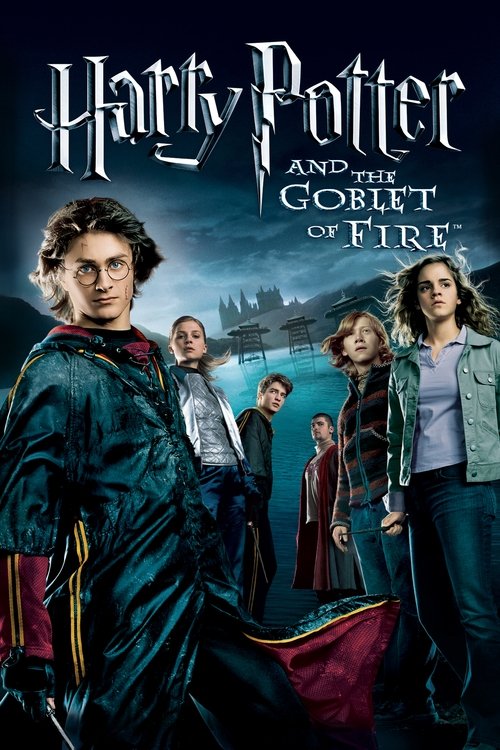
Harry Potter and the Goblet of Fire
2005 · Mike Newell
For a big blockbuster evening — whether you're marathoning the saga or want one movie with tournament thrills, teen comedy, and a real chill at the end. Comfort viewing with teeth.
What it's about
Harry Potter's fourth year at Hogwarts goes wrong before it starts: his name comes out of the Goblet of Fire, entering him — underage and against his will — into the Triwizard Tournament, a legendarily dangerous contest between three wizarding schools. Between dragons, a lake full of merpeople, and a living maze, he also has to survive something more ordinary and more terrifying: a school dance. And behind it all, the signs are mounting that Lord Voldemort is coming back.
The experience
This is where the series stops feeling like a bedtime story — bigger spectacle, real dread, and the first time the danger draws actual blood, leavened by some of the franchise's funniest awkward-teenager comedy. It builds to an ending that genuinely rattles.
The craft
Mike Newell, the first British director to helm a Potter film, plays it as a boarding-school story that curdles into a thriller — the Yule Ball staged with real romance, the tournament tasks as full-scale set pieces. The dragon chase and underwater sequence are built for a big screen, and the tonal turn in the final act is handled with real nerve.
Why it matters
The first Potter film rated PG-13 — the moment the biggest family franchise in the world officially grew up with its audience, and the template for how a long series can darken installment by installment.
Snapshot
The fourth installment of the Warner Bros. Harry Potter franchise, Goblet of Fire marks the point at which the series decisively crossed from children's fantasy into adolescent thriller. Adapting J.K. Rowling's fourth and, to that date, longest novel, it introduces the Triwizard Tournament, the return of Lord Voldemort in corporeal form, and the death of a Hogwarts student — the first killing of a sympathetic character in the saga. It was the first film in the series to receive a PG-13 rating in the United States (and a 12A in the UK), a formal acknowledgment that the material had darkened. Directed by Mike Newell, the first British filmmaker to helm a Potter picture, it is transitional in every sense: tonally poised between Chris Columbus's storybook warmth and Alfonso Cuarón's expressive gloom in Prisoner of Azkaban, and structurally strained by the challenge of compressing a very large book into a single feature.
Industry & production
By 2005 the Potter films were among the most valuable properties in Hollywood, and Goblet of Fire was produced by Warner Bros. with Heyday Films' David Heyman as the throughline producer across the series. The central creative problem was one of scale: Rowling's novel runs to several hundred pages, and Newell and screenwriter Steve Kloves openly weighed splitting it into two films — a strategy the franchise would eventually adopt for Deathly Hallows — before deciding to render it as one. That decision governed the production: entire subplots were excised, most conspicuously the house-elf storyline (S.P.E.W., Dobby's return) and much of the Quidditch World Cup, which is reduced to an arrival and a Death Eater raid rather than a match.
Production was based, as with the whole series, at Leavesden Studios outside London, with exteriors drawn from established Potter locations and new British sites. The film continued the series' practice of casting from the deep bench of British stage and screen talent. Michael Gambon returned as Dumbledore for the second time, having replaced the late Richard Harris. Notable additions included Brendan Gleeson as the volatile Alastor "Mad-Eye" Moody, Miranda Richardson as the tabloid journalist Rita Skeeter, David Tennant in a brief but vivid turn as Barty Crouch Jr., and — as the tournament's foreign champions — Robert Pattinson as Cedric Diggory, Stanislav Yanevski as Viktor Krum, and Clémence Poésy as Fleur Delacour. The single most consequential piece of casting was Ralph Fiennes as the reborn Voldemort, whose full physical debut anchors the film's climax. Commercially it was among the year's top performers worldwide, extending the franchise's run of blockbuster returns; precise gross figures are widely reported but I'll refrain from citing an exact number here.
Technology
Goblet of Fire was shot photochemically on 35mm, consistent with the series' house style in this period, and its ambition lay less in acquisition technology than in visual effects and physical staging. The film leaned on a coalition of major effects houses — the franchise routinely distributed work across facilities including ILM, MPC, Double Negative, Cinesite and Rising Sun — to deliver its three tournament set pieces. The first task's Hungarian Horntail dragon is a fully computer-generated creature integrated with a rooftop chase across Hogwarts; the sequence is among the film's technical showcases. The second task, submerged in the Black Lake, required extensive underwater cinematography, with the young actors performing in a large tank at Leavesden and the merpeople and grindylows added digitally. The third task's living hedge maze combined built set, atmospheric effects and CG extension. The reconstitution of Voldemort in the graveyard — flesh forming from a cauldron, the actor's nose digitally erased to produce the serpentine face — is the effects work most bound to performance, using Fiennes's live playing as the armature for a partly synthetic visage.
Technique
Cinematography
Roger Pratt, who had shot Chamber of Secrets, returned as director of photography. His work here pushes the desaturated, cooler palette the series had begun to adopt after Columbus, favoring overcast British light, low-key interiors, and a texture closer to gothic thriller than to fairy tale. The graveyard climax is lit for menace — flame, fog and hard shadow — while the Yule Ball offers a rare passage of warmth and saturated color. The underwater sequence, by contrast, trades in filtered blue murk and shafts of light, using visibility itself as a suspense device.
Editing
Mick Audsley cut the film, and his work is inseparable from the picture's defining constraint. With so much narrative to move, the editing is brisk and elliptical, hurrying through exposition to clear room for the three tournament tasks and the finale. Critics at the time noted both the momentum this produces and the occasional sense of compression — connective tissue clipped, secondary characters glimpsed rather than developed. The cross-cutting during the graveyard confrontation, intercutting Harry's duel with the gathering of Death Eaters, is the film's most sustained editorial set piece.
Mise-en-scène / staging
Production designer Stuart Craig, the series' constant architect, again governed the physical world, and Goblet of Fire gave him fresh spaces to design: the Durmstrang ship and Beauxbatons carriage, the tournament arena and champions' tent, the Riddle graveyard. Newell's staging repeatedly emphasizes the school as a social ecosystem — corridors of gossip, the awkward choreography of adolescence — and the Yule Ball is staged as much as a comedy of teenage manners as a spectacle. Costume design (Jany Temime) marks the tonal registers, from dress robes to the darker uniforms of the visiting schools.
Sound
The most significant sonic change is the score (discussed under Authorship below). Sound design foregrounds the elemental threats of the tasks — the dragon's roar and wingbeat, the pressure and muffle of the underwater world, the whispering hedges of the maze — and the graveyard sequence uses near-silence and sudden noise to sharpen dread. The rendering of Voldemort's voice, sibilant and unhurried, is central to Fiennes's characterization.
Performance
The film is a hinge for its three leads: Daniel Radcliffe, Emma Watson and Rupert Grint are played less as plucky children than as anxious teenagers, and Newell — drawing on his roots in British comedy and social realism — foregrounds their embarrassment, jealousy and grief. Radcliffe carries the tournament's terror and the loss of Cedric; Grint supplies the film's most naturalistic comedy in Ron's wounded rivalry. Among the adults, Gleeson's Moody is a study in unstable menace, Richardson's Skeeter a sly caricature of press intrusion, and Fiennes's Voldemort, in limited screen time, establishes the antagonist for the remainder of the series with cold, theatrical relish. Pattinson's Cedric registers strongly precisely because the film asks the audience to mourn him.
Narrative & dramatic mode
Structurally the film is organized around the tournament as a three-act trial, a competition frame that imposes episodic momentum. Layered over it is a mystery — how Harry's name entered the Goblet, and who at Hogwarts intends him harm — that resolves into the film's true purpose: a machine for delivering Voldemort back into the world. The dramatic mode shifts accordingly across the runtime, from school comedy and coming-of-age awkwardness in the middle stretch to gothic horror in the graveyard. The tournament's spectacle, in retrospect, is revealed as an elaborate trap, and the film's tonal whiplash — from the Yule Ball to Cedric's murder — is the point rather than a flaw: it enacts the series' loss of innocence.
Genre & cycle
The film sits within the early-2000s cycle of literary-fantasy franchises that reshaped the industry alongside Peter Jackson's Lord of the Rings and the ongoing Potter series itself. Within that cycle Goblet of Fire is the entry where the Potter films begin to hybridize most openly with the thriller and horror registers, borrowing the iconography of the tournament epic (the dragon, the arena, the champion) and the boarding-school story while grafting on a supernatural-horror climax. Its PG-13/12A rating formalized a genre migration the whole franchise would follow.
Authorship & method
Mike Newell brought an unusual profile to the material. Best known internationally for Four Weddings and a Funeral (1994) and the crime drama Donnie Brasco (1997), and rooted in British television and social-realist filmmaking, he approached Hogwarts as a recognizable British institution — a boarding school with its cliques, romances and cruelties — rather than a purely fantastical construct. He has spoken of wanting the film to feel like a "paranoid thriller," and that emphasis on institutional texture and adolescent anxiety is his signature on the series.
His key collaborators bridge continuity and change. Screenwriter Steve Kloves, who adapted every Potter film except the fifth, again performed the aggressive triage the novel demanded. Cinematographer Roger Pratt returned from Chamber of Secrets. Production designer Stuart Craig provided the series' unbroken architectural through-line. Editor Mick Audsley shaped the film's brisk rhythm. The most audible authorial change is in music: with John Williams departed after the first three films, Patrick Doyle — a longtime collaborator of Kenneth Branagh — composed the score, retaining Williams's established "Hedwig's Theme" as a motif while introducing a more romantic, at times folk-inflected voice, including diegetic music for the Yule Ball. Doyle's score is the first in the series to fully reimagine the franchise's sound.
Movement / national cinema
Goblet of Fire is a paradigmatic example of the transatlantic production model that defined the era: American studio financing and distribution (Warner Bros.) married to an almost entirely British creative and performing workforce, shot in British studios and locations. Newell's appointment as the first British director consolidated the series' identity as a showcase of British acting and craft traditions — the deep pool of stage-trained character actors, the boarding-school milieu, the national landscape. In this sense the Potter films function as a major engine of the British film industry in the 2000s even as they are, financially, Hollywood tentpoles.
Era / period
Released in November 2005, the film belongs to the mid-decade high-water mark of the franchise-fantasy blockbuster, a moment when studios had learned to sustain multi-film sagas as annualized events. It arrived after The Lord of the Rings had proven the audience for serialized epic fantasy and while the Potter films were maturing their audience in real time — the child actors and their original readers aging in tandem. Its darker rating reflected a broader early-2000s willingness to let family franchises grow up rather than freeze their tone.
Themes
The film's governing theme is the end of childhood — the intrusion of death, romance, jealousy and political menace into a world that had been, in the earlier films, largely safe. The tournament dramatizes the pressure of forced achievement and public scrutiny; Rita Skeeter's tabloid distortions extend that into a critique of a hostile press. The Yule Ball subplot treats adolescent desire and social humiliation with unusual tenderness for a fantasy blockbuster. Beneath these runs the series' larger arc — the return of a fascistic evil, the failure of institutions (the Ministry) to recognize it, and the burden placed on the young to see clearly what adults deny. Cedric's death gives the theme its weight: glory and cruelty are shown to be neighbors.
Reception, canon & influence
Critically, Goblet of Fire was generally well received, with reviewers praising its darker tone, its set pieces, and the maturing performances of the young cast, while a recurring reservation concerned the breathless compression the source material forced upon it — the sense that a very full book had been pruned to fit. It was a substantial commercial success, sustaining the franchise's blockbuster standing.
Looking backward, the film's influences are legible: Rowling's novel is the primary text; Cuarón's Prisoner of Azkaban established the darker visual and tonal register Newell inherited and pushed further; the tournament-epic and gothic-horror traditions inform its iconography; and Newell's own background in British comedy and realist drama shapes the school-life texture. The retention of Williams's musical motifs within Doyle's new score is itself an act of franchise continuity.
Looking forward, Goblet of Fire is the pivot on which the remaining films turn. By killing Cedric and embodying Voldemort, it set the stakes and the tone for the increasingly grave Order of the Phoenix, Half-Blood Prince and the two-part Deathly Hallows — and its writers' abandoned idea of splitting the book prefigured the studio's eventual decision to divide the finale. Its casting had consequences beyond the series: Robert Pattinson's visibility here immediately preceded his career-defining role in the Twilight films. And its formal lesson — that a beloved, sprawling literary property could be aged up, darkened, and still command a mass family audience — helped normalize the tonal maturation that later franchise cinema would treat as routine. Within the Potter canon, it is remembered as the film where the series lost its innocence on purpose.
A Deleuzian reading
A cup that was supposed to produce three names produces a fourth.
The full Deleuzian reading of Harry Potter and the Goblet of Fire →
Reception
A big hit in 2005 — the highest-grossing film worldwide that year — and praised for going darker, it's since settled into mid-table in most fan rankings, remembered as much for its haircuts and one meme as for the film itself.
How Harry Potter and the Goblet of Fire was received, from release to now →
How to watch Harry Potter and the Goblet of Fire: what to notice on a first viewing
- Watch where the boys stand at the Yule Ball. Newell stages the dance as a comedy of teenage manners. Boys line the walls, invitations are botched, Grint's dress robes do half the work of the scene without a word of explanation. Posture tells you the social pecking order of the school faster than any line of dialogue.
- Notice the gray overcast light in almost every Hogwarts scene. Roger Pratt keeps the palette cool and desaturated, with low-key interiors and British weather. The Yule Ball is the one warm, saturated passage in the film. The one warm sequence stands out because everything around it has been drained, so its loss registers.
- Count how quickly scenes end before their conversations finish. Mick Audsley clips connective tissue and hurries exposition. Secondary characters get a glance rather than a scene, and the cutting keeps clearing space for the three tasks. The rhythm tells you what the film considers urgent, and what it is willing to skip.
- Listen for the old familiar Hedwig melody, and how rarely it returns. Patrick Doyle takes over from John Williams and writes a more romantic, folk-inflected score, plus live band music at the Ball. Williams's motif survives only as an occasional visitor. The music keeps the earlier films in earshot while sounding like a different series has begun.
The whole guide to watching Harry Potter and the Goblet of Fire, with the keys for a rewatch →
Influences: the films it descends from and the films it influenced
- Harry Potter and the Prisoner of Azkaban (2004) — Established the desaturated, weather-driven naturalism and muggle-clothed adolescent realism — teens in hoodies on wet grounds rather than robed mascots — that Newell inherited wholesale and pushed toward outright horror.
- Harry Potter and the Chamber of Secrets (2002) — Returning DP Roger Pratt and production designer Stuart Craig carry over the lived-in Hogwarts architecture and lensing, giving Goblet its unbroken institutional continuity beneath the tonal shift.
- Four Weddings and a Funeral (1994) — Newell's ensemble comedy-of-manners built on courtship and social embarrassment supplies the Yule Ball's exact register — awkward invitations, dress-robe humiliation, dance-floor cruelty staged as adolescent romantic farce.
- Donnie Brasco (1997) — The infiltration-paranoia thriller method Newell explicitly imported ('a paranoid thriller') — a hidden enemy operating inside a trusted institution, dread built from who-can-be-believed rather than spectacle.
- Henry V (1989) — Patrick Doyle's folk-inflected, choral-romantic orchestral idiom, forged in his long Branagh partnership, reimagines the franchise's sound while grafting itself onto Williams's retained 'Hedwig's Theme.'
- If.... (1968) — The British boarding-school-as-cruel-institution realism — cliques, hierarchies, sanctioned violence — through which Newell reframes Hogwarts as a recognizable school rather than a fantastical construct.
- Bram Stoker's Dracula (1992) — Graveyard-gothic theatricality and bodily-resurrection iconography — the ritual regeneration of a monstrous body from viscera and blood — behind Voldemort's cauldron rebirth in the churchyard climax.
- Jurassic Park (1993) — The benchmark for photoreal CG creatures composited into live-action peril with real physical stakes, the template for the Hungarian Horntail's rooftop dragon chase.
- The Empire Strikes Back (1980) — The model of the darker middle installment that raises the stakes, admits real death, and deliberately spends the franchise's innocence — the structural precedent for killing Cedric.
- Harry Potter and the Order of the Phoenix (2007) — Inherits Goblet's paranoid-institutional register directly, translating Newell's 'enemy within a trusted institution' into Umbridge's authoritarian Ministry takeover of the school.
- Harry Potter and the Deathly Hallows: Part 1 (2010) — Realizes the book-split that Goblet's own writers had floated and abandoned, converting the compression problem Newell fought into the studio's two-film solution.
- Fantastic Beasts and Where to Find Them (2016) — Extends Stuart Craig's design language and the wizarding-world's institutional texture into a still grimmer, thriller-inflected register that Goblet first established for the series.
- The Hunger Games (2012) — Builds a mass-audience aged-up YA blockbuster on a lethal tournament-trial frame with adolescent competitors and a desaturated palette — Goblet's Triwizard structure scaled up as a whole franchise's engine.
- Twilight (2008) — Robert Pattinson's Cedric visibility fed directly into his casting, and the film extends the same desaturated teen-gothic romance mode into a rival family-audience franchise.
- The Chronicles of Narnia: Prince Caspian (2008) — A family-fantasy franchise deliberately darkened and aged-up in its sequel — grimmer palette, battlefield death, adolescent leads — following Goblet's demonstrated lesson that a beloved property could mature without losing its audience.
- Percy Jackson & the Olympians: The Lightning Thief (2010) — Part of the wave of YA mythic-quest franchises chasing Potter's aged-up template — with Columbus himself returning — structured around escalating adolescent trials and tournament-style set pieces.
Similar films
- Harry Potter and the Prisoner of Azkaban (2004) — influence & lineage · same viewing thread
- Harry Potter and the Deathly Hallows: Part 1 (2010) — influence & lineage
- The Hunger Games (2012) — influence & lineage
- Twilight (2008) — influence & lineage
- Harry Potter and the Half-Blood Prince (2009) — same viewing thread
- The Maze Runner (2014) — same viewing thread
- Harry Potter and the Deathly Hallows: Part 2 (2011) — shared sensibility
- The Lord of the Rings: The Fellowship of the Ring (2001) — shared sensibility
All the films related to Harry Potter and the Goblet of Fire →
Watch it with: curated runs of related films
- Young Under a Darkening Sky — Watch these in a run as the frame darkens — the institutions built to shelter the young (a school, a walled glade, a nation, a highway) curdle into deadly contests and regimes they have to outlast.