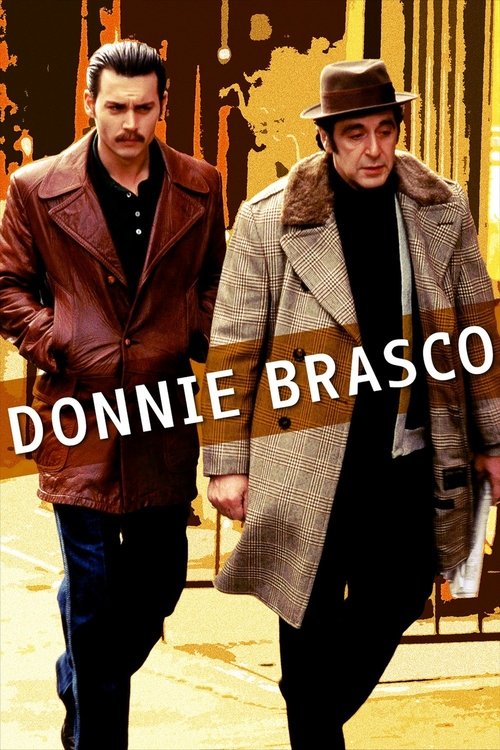
Donnie Brasco
1997 · Mike Newell
For when you want a mob movie with a broken heart — something closer to a tragedy than a shoot-'em-up. Reach for it when you're in the mood to feel conflicted about everyone on screen.
What it's about
An FBI agent goes undercover inside a New York crime family in the 1970s under the name Donnie Brasco, and stays under for years. His way in is Lefty, an aging, perpetually passed-over mob soldier who vouches for him, mentors him, and comes to love him like a son — not knowing the friendship is a weapon that will eventually be used against him. Meanwhile the agent's real life, his marriage and his own sense of who he is, quietly falls apart.
The experience
A slow-burn character piece wearing a gangster movie's clothes — tense whenever the cover threatens to slip, but the real ache is watching a genuine friendship grow inside a lie. It leaves you heavy rather than thrilled.
Performances
Al Pacino, as Lefty, gives one of his most touching performances — a small-timer whose loyalty is his whole dignity — and Johnny Depp matches him with coiled, watchful restraint as a man disappearing into his own alias.
The craft
The writing trusts small talk: whole relationships are built out of diner conversations, card games, and the mob's coded vocabulary ('forget about it' gets its own seminar). Mike Newell directs it as an intimate two-hander rather than an epic, keeping the violence blunt and unglamorous so the emotional betrayals hit hardest.
Why it matters
It arrived late in the great gangster-movie cycle and quietly deflated the genre's romance, becoming the definitive film about undercover work as identity loss — the story every later mole drama gets measured against.
Snapshot
A crime drama of exceptional psychological density, Donnie Brasco adapts the true case of FBI Special Agent Joseph D. Pistone, who spent six years infiltrating the Bonanno crime family under the alias Donnie Brasco. Where most gangster films romanticize entry into the mob, this one traces the costs of that entry from the inside out: what happens to a man when his cover story becomes, in every meaningful sense, his life. The film is structured less as a procedural than as a study in the slow erosion of identity — professional, marital, moral — and its emotional fulcrum is the friendship between Pistone and the aging, never-gonna-make-it soldier Benjamin "Lefty Guns" Ruggiero, whom Pistone will eventually destroy. That the audience is made to feel the weight of this destruction is the film's central moral achievement.
Industry & production
Donnie Brasco was produced by Baltimore Pictures (Barry Levinson's company) in association with Mark Johnson and Gail Mutrux, and released by TriStar Pictures in February 1997. The project had been in development for some years; the underlying material was Joseph Pistone's 1988 memoir Donnie Brasco: My Undercover Life in the Mafia, co-written with Richard Woodley. Pistone himself remained an active consultant throughout production and has lived under an assumed identity since completing his undercover operation in 1981. His testimony and cooperation with authorities led to over 200 indictments and more than 100 convictions of Bonanno family members — one of the most consequential undercover operations in FBI history.
Paul Attanasio's adaptation compresses and restructures the memoir's episodic account into a dramatically tight character study, wisely choosing the Lefty-Donnie axis as its emotional spine rather than attempting to dramatize the full scope of Pistone's infiltration. Attanasio was at the height of his critical standing following Quiz Show (1994) and his work on Homicide: Life on the Street, and his screenplay is notably clean: no voiceover narration (an extraordinary restraint for the genre post-Goodfellas), no score-driven editorializing, a refusal to sentimentalize the mob while equally refusing to sentimentalize Pistone's institutional loyalty.
The casting of Johnny Depp and Al Pacino was central to the film's commercial viability and, ultimately, its artistic success. Depp had not yet undertaken the blockbuster franchises that would define the next phase of his career, and he brought an unusual interiority to a role that required him to perform concealment throughout. Pacino, coming off a period that included several more operatic performances, found in Lefty Ruggiero one of his finest opportunities for understatement. The film's budget and scale were relatively modest by studio standards — it is very much a film of interiors and of faces.
Technology
Donnie Brasco was shot on 35mm and adheres to period-appropriate photochemical production practices. No significant digital post-processing techniques distinguished its production; the emphasis fell instead on lens choice and practical lighting to achieve texture. Steadicam and handheld work were used selectively rather than as a governing aesthetic, giving the film a more classically composed look than the kinetic approach of contemporaneous crime dramas. The location-heavy shoot in New York and New Jersey made practical lighting conditions central to the visual strategy. Nothing in the technical record suggests a film pushing at the edges of available technology; the craft here is deployed in service of restraint.
Technique
Cinematography
Peter Sova served as director of photography, and his work on Donnie Brasco is among the more under-discussed achievements in 1990s American crime cinema. Sova worked with Newell to establish a palette of grays, browns, and washed-out amber — the world of the film is lit like a city in late autumn, perpetually on the edge of dark. The cinematography refuses the glossy uplighting associated with Coppola's Corleone trilogy or even the expressionistic tracking shots of Goodfellas. Instead, Sova gravitates toward the unglamorous: fluorescent-lit strip clubs, the dim back rooms of social clubs, dingy Queens apartments. The mise-en-scène is deliberately de-aestheticized, and the cinematography supports that choice. Close-ups are used judiciously, held long enough that both Depp and Pacino have room to let micro-expressions register. The camera rarely performs; it watches.
Editing
Jon Gregory edited the film, working again with Newell following Four Weddings and a Funeral. The editing rhythms are measured and observational, built more on accumulation than on montage energy. Gregory resists cutting away from difficult emotional confrontations — the scenes between Pistone and his wife Maggie (Anne Heche), and the late scenes between Pistone and Lefty, are held at length rather than fragmented. This willingness to let scenes breathe distinguishes the film from the cut-driven energy of much crime cinema and places considerable trust in the performances. The film's pacing has sometimes been criticized as languid, but this seems a misreading of a deliberate structural choice: the slow rhythms enact the incremental drift of Pistone's identity.
Mise-en-scène / staging
Newell and production designer Donald Graham Burt populate the film's world with granular, unglamorous specificity: the social clubs look genuinely lived-in, the strip clubs look genuinely depressing, the suburban houses where Pistone stashes his real family look genuinely stranded. Costume designer Aude Bronson-Howard dressed the Bonanno-connected characters in the slightly-out-of-fashion, slightly-too-flashy wardrobe of working-class aspirational New York, while Pistone's FBI context is rendered in nondescript, institutional beige. The staging of ensemble scenes in cramped interiors — the classic mob staging of men around a table, around a bar — emphasizes the claustrophobia of the world Pistone has entered. There is no visual analog for freedom or openness in this film; even the exterior shots tend toward the constricted.
Sound
Patrick Doyle's score is notably restrained by the standards of the genre and of Doyle's own work. It does not editorialize violence or sentimentalize the friendship at the film's center, arriving mostly in transitions and at moments of private reflection rather than underscoring dramatic confrontations. The film makes considerable use of diegetic sound — the ambient noise of bars and clubs, the particular audio texture of payphone conversations, television in the background of domestic scenes. The sound design contributes to the film's documentary quality. The decision not to employ a period-pop soundtrack, so common in crime films of the era, keeps the film from feeling nostalgic or curated.
Performance
The performances are the film's dominant artistic achievement. Al Pacino's Lefty Ruggiero is a career-defining piece of work: a man in perpetual grievance, perpetually talking himself into his own relevance, yet unmistakably decent in his way — loyal to codes that have returned nothing but disappointment, capable of genuine affection even as he remains capable of ordered violence. Pacino keeps the performance small, specific, and earned. His is not the Pacino of Scarface or Heat but of The Godfather, Part II — internal, controlled, devastatingly specific.
Johnny Depp's task is in some ways harder: he must play a man playing a man, and the double layer of performance must remain legible without being melodramatically visible. Depp solves this largely through what he withholds — Pistone/Donnie is always slightly behind his eyes, watching rather than fully occupying any given moment. The performance is a sustained study in behavioral bifurcation. Michael Madsen brings genuine menace and unpredictability to Sonny Black; Bruno Kirby's Nicky Santora is sharp comic relief that never deflates the drama. Anne Heche, working with a sharply written role, makes Maggie's accumulated resentment and love feel entirely real.
Narrative & dramatic mode
The film's narrative mode is that of the tragedy of complicity. Pistone does not "go native" in the melodramatic sense of losing his rational agency; rather, he discovers that the moral categories he entered the assignment with have become genuinely scrambled. The FBI is presented not as a heroic institution but as a bureaucratic one, its handlers more concerned with the evidentiary value of Pistone's work than with its cost to him. The mob, conversely, is shown as offering something genuine: loyalty, belonging, a comprehensible code of masculine conduct. The film refuses to resolve this as irony or as corruption; it treats the moral ambiguity as real and uncomfortable.
Structurally, the film is almost a two-hander — the Pistone/Lefty relationship generates the emotional through-line, and everything else (the Bureau, Maggie, the Bonanno family hierarchy) orbits that center. The climax is not a shootout or an arrest but the moment when Pistone hands over his evidence and the audience understands, along with him, what he has caused. The final title card — informing us of Lefty Ruggiero's imprisonment and the open contract on Pistone's life — converts the ending into something close to Greek tragedy.
Genre & cycle
Donnie Brasco belongs to the American crime film's post-Goodfellas reformation, a cycle of works in the 1990s that subjected the gangster genre's conventions to demythologizing pressure. But where Goodfellas (1990) accomplished this through irony and formal virtuosity, and where Casino (1995) did so through excess, Donnie Brasco works through intimacy and reduction. It is less interested in the machinery of organized crime as a system than in two men and what they mean to each other.
The film also belongs to a distinct undercover-cop subgenre with roots in Serpico (1973) and Prince of the City (1981) — films about law enforcement agents whose immersion in transgressive worlds becomes a form of moral contamination. In this lineage, Donnie Brasco is notable for placing the emotional weight on the criminal figure rather than the institutional one: Lefty, not Pistone's handlers or his domestic life, is the moral center.
Authorship & method
Mike Newell is a British filmmaker whose career has moved between intimate character study and larger commercial assignments. His facility with ensemble dynamics and emotional texture, demonstrated in Four Weddings and a Funeral (1994), served Donnie Brasco well; his outsider's perspective on American organized crime may, paradoxically, have enabled the film's resistance to genre sentimentality. Newell approached the material as social drama rather than genre exercise, and the film's distinctive register — cooler, more observational than American directors of the period tended toward — may owe something to that distance.
Paul Attanasio's screenplay is models of genre adaptation: it finds the essential dramatic relationships in a discursive memoir and sharpens them without simplifying them. His decision to eliminate voiceover — to refuse the narratorial distance that Goodfellas employs so brilliantly — forces the film to earn its emotional effects through scene construction alone.
Peter Sova's cinematography, though less celebrated than that of contemporaneous crime films, is a quietly essential contribution. His palette desaturates without going to monochrome, creating a visual world that feels real without feeling shabby.
Patrick Doyle, primarily known for his work with Kenneth Branagh, brought an almost classical restraint to the score that suits the film's tonal register.
Jon Gregory's editorial choices privilege duration and accumulation over kinetic energy.
Movement / national cinema
The film is broadly situated within the American studio crime film of the 1990s, inflected by the independent cinema emphasis on behavioral realism and character-driven storytelling that characterized the decade. It does not belong to the Tarantino-adjacent wave of stylized, intertextual crime films, nor to the more expansive, operatic tradition of Coppola and De Palma. Its closest formal relatives are Sidney Lumet's New York crime dramas — films oriented toward institutional critique and psychological interiority. The British director's sensibility reinforces this: Newell makes the film feel less indebted to Hollywood mythology about organized crime than most American-directed entries in the genre.
Era / period
The film arrives at a moment when the American crime drama is at peak cultural visibility and critical engagement, in the years between Goodfellas and The Sopranos (1999). It participates in a sustained cultural renegotiation of what the gangster narrative means — who it is for, what it reveals about American life rather than American fantasy. The mid-1990s also mark a shift in studio willingness to finance adult-oriented character studies with A-list casts at mid-range budgets, a model that has since contracted significantly.
Themes
Identity dissolution and performance: The film's central concern is the cost of sustained performance — the question of whether there is a stable self beneath the role, and what happens when the answer is uncertain. Pistone is a method actor in a mortal context, and the film tracks the psychological toll of that position with unusual seriousness.
Loyalty, codes, and the problem of belonging: The Mafia's codes of loyalty and conduct are presented as genuinely compelling, not merely as false consciousness. The film takes seriously the idea that Pistone comes from a background similar to the men he is infiltrating, and that the mob offers something — solidarity, recognition, a comprehensible masculine world — that his institutional employer does not.
The banality of criminal life: Against the glamorized gangster tradition, Donnie Brasco insists on the grinding, often tedious, economically precarious reality of low-level organized crime. Lefty is not a figure of romantic transgression; he is a man who has given his life to an organization that has given him nothing in return.
Domestic cost: The Pistone marriage subplot, which might in a lesser film be relegated to periodic check-ins with an anxious wife, here carries real weight. Maggie's experience — married to an absence, unable to know the truth of her husband's life — is rendered sympathetically without reducing her to victimhood.
Institutional indifference: The FBI functions in the film less as a heroic organization than as a bureaucracy that processes Pistone's sacrifice into evidentiary currency. This critique of the institution nominally on the side of the law is among the film's most quietly radical moves.
Reception, canon & influence
Influences on the film (backward): The primary antecedents are formal and generic. Francis Ford Coppola's Godfather films established the mythological framework that Donnie Brasco works to demythologize. Martin Scorsese's Goodfellas is the immediate and unavoidable predecessor — its insider perspective, its demythologizing impulse, its focus on low-level mob life rather than the Corleone summit. Sidney Lumet's New York crime dramas — Serpico, Prince of the City, Dog Day Afternoon — provide the film's institutional critique and its commitment to unglamorous realism. Joseph Pistone's own memoir grounds the film in documented history.
Critical reception: The film received a warm, if not ecstatic, critical reception on release. Pacino's performance was widely identified as a return to the restrained mode that characterized his finest early work, and the film was praised for its psychological seriousness. Some critics noted the pacing as a weakness; others identified it as a virtue. The film did not dominate awards season, though Pacino and Depp both received recognition for their performances.
Legacy and forward influence: Donnie Brasco's most significant legacy may be the template it established for the undercover-agent-as-identity-crisis drama. The Departed (2006) — Scorsese's greatest engagement with the undercover subgenre — deepens and radicalizes concerns about the costs of infiltration that Donnie Brasco introduced to mainstream Hollywood crime cinema. David Chase has acknowledged the cultural milieu of films like Donnie Brasco as part of the context in which The Sopranos developed its own demythologizing project. The film's interest in the emotional texture of criminal friendship — rather than in criminal spectacle — anticipates the serial television drama's sustained engagement with those same questions.
The film's reputation has grown steadily in the years since its release, and it is now generally regarded as one of the more accomplished American crime films of the decade, distinguished by its restraint, its performances, and its moral seriousness. Its lack of bravura stylistic gestures has perhaps kept it from the canonical foreground occupied by Goodfellas and Pulp Fiction, but it is increasingly recognized as working in a different register rather than a lesser one — prioritizing psychological truth over formal excitement, and finding in that priority its own form of mastery.
A Deleuzian reading
Watch Johnny Depp's face in any of the long-held close-ups and you notice something kept back.
The full Deleuzian reading of Donnie Brasco →
Reception
Well reviewed in 1997 — it even landed an Oscar nomination for its screenplay — but only a modest hit, it's since climbed to 'quietly one of the great 90s mob movies,' with Pacino's Lefty increasingly reappraised as one of his finest late-career performances.
How Donnie Brasco was received, from release to now →
Influences: the films it descends from and the films it influenced
- Prince of the City (1981) — Lumet's durational scene construction and the exact narrative template of an undercover informant whose operation destroys those who trusted him, executed without voiceover or score-driven editorializing — the primary structural model Newell inherits.
- The Friends of Eddie Coyle (1973) — Establishes the demythologized low-level mob soldier as tragic protagonist: unglamorous practical location photography, Mitchum's behavioral naturalism as the 'never-gonna-make-it' archetype, and betrayal-to-death complicity without genre resolution — the direct template for Lefty Ruggiero.
- Serpico (1973) — Lumet and Ornitz's desaturated unglamorous NYC cinematography, institutional realism in production design, sustained undercover identity erosion, and diegetic ambience over composed score as governing aesthetic — the Lumet-influenced tag points here specifically.
- Dog Day Afternoon (1975) — Claustrophobic interior staging generating sustained psychological pressure, Pacino in his pre-operatic behavioral mode that Donnie Brasco directly recalls, and Lumet's durational scene construction that refuses to cut away from emotional confrontation.
- The Conversation (1974) — Walter Murch's layered diegetic sound design over composed score as both formal device and thematic register; surveillance-as-observation collapsing into the observer's identity dissolution — the craft precedent for Donnie Brasco's sound restraint and complicity theme.
- Mean Streets (1973) — Establishes the observational closeup and behavioral performance mode (De Niro, Keitel) as genre foundation; unglamorous Little Italy interiors and the psychology of loyalty and codes among criminal figures shot without glamour.
- GoodFellas (1990) — The voiceover-driven structure and romanticized gangster aesthetics that Attanasio's screenplay explicitly refuses — Donnie Brasco defines its demythologized approach by systematic negation of GoodFellas' formal choices.
- Quiz Show (1994) — Paul Attanasio's shared screenplay architecture: no voiceover, complicity tragedy in which the protagonist destroys a trusting relationship for institutional loyalty, behavioral restraint in performance, and institutional realism in production design.
- City on Fire (1987) — Extends the undercover-cop-bonding-with-his-target tragedy, where the agent's fabricated loyalty becomes emotionally real and the betrayal he must commit destroys him — Lam's 'loyalty as trap' rendered as procedural drama.
- White Heat (1949) — Reworks White Heat's undercover-informant structure and its agonizing dramatic irony — the planted agent earning the trust of the criminal he must betray.
- A Bronx Tale (1993) — Carries forward the mentor–protégé wiseguy morality tale played in a low-key, performance-first register that prizes actorly restraint over stylistic display, the De Niro directorial value.
- Mafioso (1962) — Centers on Mafioso's archetype of the ordinary, sympathetic man drawn incrementally into performing violence he cannot refuse, dramatizing conscription-by-loyalty rather than criminal glamour.
- Narc (2002) — Desaturated palette pushed toward near-monochrome grain, observational closeup, durational accumulation, undercover cop identity dissolution and complicity tragedy — the most direct visual heir of Donnie Brasco's cinematographic restraint, extended into a harder register.
- Eastern Promises (2007) — Undercover Russian mob infiltration with behavioral bifurcation (Mortensen's Nikolai performing criminal identity as cover), unglamorous milieu, restrained score, observational closeup — the most structurally direct descendant of Donnie Brasco's undercover-in-the-mob formal grammar.
- The Departed (2006) — Elaborates Donnie Brasco's behavioral bifurcation into a mirrored parallel structure with two simultaneous infiltrators, amplifying identity dissolution through kinetic editing — the formal machinery Donnie Brasco withheld, restored and doubled.
- Zodiac (2007) — Durational accumulation as governing formal principle — Fincher refuses thriller resolution in favor of accreting evidence and eroding investigators; observational closeup, diegetic ambience, restrained score; the tragedy of institutional obsession destroying the protagonist's domestic life.
- A Most Violent Year (2014) — Demythologized crime-adjacent world, desaturated winter palette, durational accumulation, behavioral restraint across performance, slow erosion of ethical identity without voiceover editorializing — extends Donnie Brasco's formal grammar into a corporate crime register.
- Harry Potter and the Goblet of Fire (2005) — The infiltration-paranoia thriller method Newell explicitly imported ('a paranoid thriller') — a hidden enemy operating inside a trusted institution, dread built from who-can-be-believed rather than spectacle.
- Dhurandhar (2025) — Supplies the vouching-chain structure Dhurandhar runs on — every rung the operative climbs is underwritten by the mentor who sponsored him, so advancement and betrayal are the same act, and the handler debriefs are cut in as intrusions that feel like the disloyalty rather than the cover.
- Heat (1995) — Behavioral bifurcation as structural principle — De Niro's McCauley compartmentalizing professional and domestic identity mirrors Pistone's directly — paired with desaturated urban palette, diegetic ambience, and a score used as punctuation rather than underlining.
- Homicide (1991) — Attanasio's work on Homicide: Life on the Street derives from Mamet's procedural method here — terse behavioral dialogue, identity bifurcation (Jewish detective confronting his own loyalty), and institutional betrayal without melodrama; the tonal register Attanasio brings to Donnie Brasco.
- Blow (2001) — Both films pair Johnny Depp with an older criminal surrogate father — Pacino, then Liotta — and use that father-surrogate dynamic as the performance architecture through which the audience sustains sympathy for criminal immersion; the emotional register of betrayal-within-the-surrogate-family is the same structural mechanism in both.
- Judas and the Black Messiah (2021) — Undercover-informant drama tracking the psychic dissolution of an agent whose assumed loyalty curdles into real love and unbearable guilt.
- Land of Fear (2000) — A near-contemporary of the deep-cover craft: the undercover agent whose fabricated persona overtakes the real one until loyalty, name, and self become indistinguishable — dramatized through slow behavioral saturation rather than plot mechanics.
Similar films
- GoodFellas (1990) — influence & lineage · same viewing thread · often watched together
- The Departed (2006) — influence & lineage · often watched together
- Heat (1995) — influence & lineage · often watched together
- The Conversation (1974) — influence & lineage · often watched together
- Serpico (1973) — influence & lineage
- Mean Streets (1973) — influence & lineage
- Dog Day Afternoon (1975) — influence & lineage
- The Friends of Eddie Coyle (1973) — influence & lineage
All the films related to Donnie Brasco →
Watch it with: curated runs of related films
- The Great American Crime Film — A run through the seductions and wreckage of American crime — mob epics that span a whole life beside capers that unravel over a weekend, all told with the same eye for how ordinary greed curdles into violence.