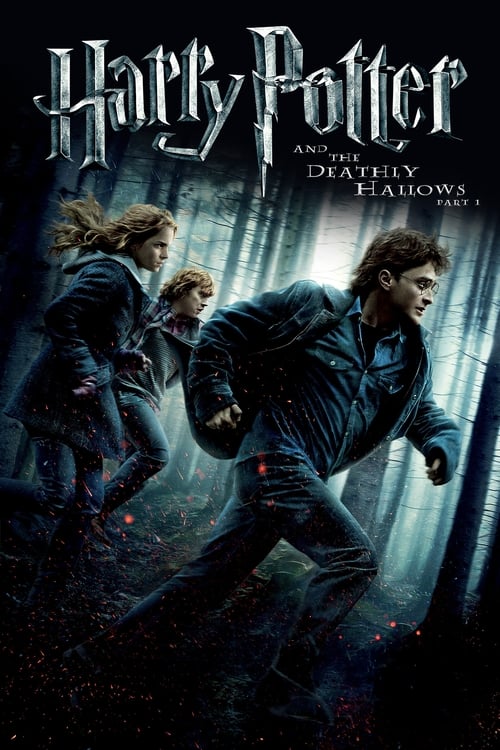
Harry Potter and the Deathly Hallows: Part 1
2010 · David Yates
For when you want your comfort franchise with real weight — a moody, immersive sit rather than a cozy one. Best watched when you're ready to feel the dread of a story approaching its end.
What it's about
Harry, Ron and Hermione abandon their final year at Hogwarts to hunt down the Horcruxes keeping Voldemort alive, with no teachers, no map, and a wizarding government collapsing into tyranny behind them. What follows is a fugitive road movie through a wintry Britain — safe houses, forests, and long stretches of hiding — as the three friends carry a mission too big for them and the strain starts to show.
The experience
Slower, darker and lonelier than any film before it in the series, trading castle spectacle for tension, grief and quiet character moments. It's the installment that feels most like a war story — anxious, melancholy, occasionally warmed by flashes of friendship.
Performances
Daniel Radcliffe, Rupert Grint and Emma Watson, having grown up in these roles, do their most grounded work here — the tent-bound stretches rest entirely on the three of them, and they carry it.
The craft
David Yates shoots the British countryside as both refuge and threat — bleak moors, gray coastlines, frost-bitten forests that give the fantasy an unusual realist texture. A striking animated sequence telling a wizarding fable is a highlight, and the muted palette and sound design reward a dark room and a big screen.
Why it matters
Splitting the final book in two became the template every big franchise finale followed for a decade. It also proved a blockbuster series could go quiet and grim in its penultimate chapter and trust the audience to stay.
Snapshot
Harry Potter and the Deathly Hallows: Part 1 is the seventh entry in the eight-film Warner Bros. adaptation of J.K. Rowling's novels, and the first of two films drawn from her final book (2007). Directed by David Yates from a screenplay by Steve Kloves, it marks the franchise's decisive break from the boarding-school template that had structured the previous six installments. Hogwarts is effectively abandoned; the film follows Harry (Daniel Radcliffe), Ron (Rupert Grint) and Hermione (Emma Watson) as fugitives in the British countryside, hunting the Horcruxes that anchor Lord Voldemort to life while the wizarding state collapses into authoritarian rule behind them. It is, in genre terms, a fantasy film operating in the register of a fugitive road movie and a wartime resistance drama — slower, sparser and more adult than its predecessors. Its commercial success was substantial, and its decision to split a single book into two theatrical films proved one of the most consequential structural gambits in twenty-first-century franchise filmmaking.
Industry & production
The film was produced by Heyday Films for Warner Bros., with David Heyman and David Barron producing alongside Rowling, whose creative oversight of the franchise had become a defining feature of its development. The most significant industrial decision preceded shooting: in 2008 Warner Bros. announced that the final novel would be adapted as two films. The studio's stated rationale was fidelity — that the book's density could not be compressed into a single feature without gutting it — but the financial logic was equally plain, doubling the box-office yield of the franchise's most anticipated conclusion. The choice drew skepticism as a potential cash-grab, yet it established a template the industry rapidly adopted: subsequent franchises split their finales in the same manner (the Twilight, Hunger Games and later young-adult adaptations among them), making Deathly Hallows an inflection point in how studios monetized concluding chapters.
Principal photography ran across an extended schedule, with both parts shot largely back-to-back — an efficiency that pooled crew, sets and budget across what was effectively one long production. Filming centered on Leavesden Studios outside London, the franchise's longstanding home, but Part 1 broke from precedent with extensive location work across Britain, including the Forest of Dean, Welsh and Scottish landscapes, and coastal and moorland exteriors that stood in for the trio's wanderings. This relocation from soundstage to weather-beaten exterior was both a logistical undertaking and an aesthetic statement, and it distinguishes the film visually from the franchise's earlier, more enclosed installments.
Technology
The Potter films were photographed on celluloid, and Deathly Hallows: Part 1 continued that practice under cinematographer Eduardo Serra, preserving the photochemical texture that the franchise had cultivated. The most discussed technological episode around the film concerns 3D. Part 1 had been slated for a post-production stereoscopic conversion in line with the post-Avatar (2009) industry rush toward 3D exhibition, but Warner Bros. abandoned the conversion late in the process, citing an inability to complete it to an acceptable standard in time, and released the film in 2D. (Part 2 the following year was released in 3D.) The reversal is a notable data point in the broader story of the early-2010s 3D bubble, in which hasty conversions of films shot flat frequently disappointed and helped sour audiences on the format.
Visual effects, supervised across multiple vendors with longtime franchise contributors involved, carried much of the film's spectacle. Key sequences include the "Seven Potters" — in which Polyjuice Potion turns six allies into duplicates of Harry, requiring Radcliffe to be multiplied and composited across a single frame — and the fully digital house-elf Dobby, whose performance-driven animation anchors the film's emotional climax. The animated "Tale of the Three Brothers" interlude, executed in a stylized silhouette-and-shadow puppet aesthetic distinct from the rest of the film, was produced as a self-contained set piece and stands as one of the series' most formally adventurous passages.
Technique
Cinematography
Eduardo Serra, a Portuguese cinematographer whose earlier credits include The Wings of the Dove and Girl with a Pearl Earring, shot both Deathly Hallows films and gave Part 1 a markedly desaturated, naturalistic palette. Where the location work dominates, Serra favors overcast skies, muted greens and grays, and available-light naturalism that reads almost as social realism transplanted into fantasy. The framing isolates the three leads against vast, indifferent landscapes — wide shots of tiny figures in open country — visually dramatizing their abandonment and the absence of institutional shelter. Interiors, by contrast, are often cramped and underlit, the tent that serves as the trio's mobile refuge becoming a claustrophobic counterpoint to the exteriors. This oscillation between exposure and enclosure is the film's defining visual rhythm.
Editing
Cut by Mark Day, Yates's regular editor across his Potter films, Part 1 is paced more patiently than any prior entry. The split-book structure freed the film from the compression that had forced earlier installments to sprint through plot, and the editing leans into longueurs: the middle stretch of the trio's directionless flight is deliberately becalmed, accumulating fatigue and friction rather than incident. This is a structural risk — the film has been criticized as the franchise's most plotless — but the slower cutting is purposeful, mirroring the characters' aimlessness and dread.
Mise-en-scène / staging
Production designer Stuart Craig, who designed all eight films and shaped the franchise's coherent visual world, here pivots from the gothic grandeur of Hogwarts toward bleaker registers: the brutalist, totalitarian Ministry of Magic, transformed under Voldemort's regime into an apparatus of bureaucratic terror; the genteel decay of the Black family house at Grimmauld Place; the windblown emptiness of the wilderness camps. The staging frequently strips the wizarding world of its enchantment, presenting magic as something furtive and embattled rather than wondrous.
Sound
Alexandre Desplat composed the score, his first contribution to the franchise after John Williams, Patrick Doyle and Nicholas Hooper had scored earlier films. Desplat's writing here is restrained and elegiac, foregrounding loss and isolation over heroic theatrics, and his "Obliviate" cue — accompanying the film's opening, in which Hermione erases herself from her parents' memories — sets the elegiac tone. The film also makes a striking diegetic use of a pre-existing pop recording in the scene where Harry and Hermione dance in the tent, a tonal departure widely noted for grounding the fantasy in raw, awkward intimacy. (Specific licensing and clearance details are not something I will assert beyond the scene's well-documented existence.)
Performance
With the supporting ensemble largely sidelined for long stretches, the film rests on its three leads, by now grown into the roles after a decade of playing them. Radcliffe, Grint and Watson carry extended two- and three-handers that demand a naturalism the earlier films rarely required of them; the strain of the trio's relationships — Ron's jealousy and desertion, Hermione's grief, Harry's guilt — is played with a maturity that the franchise had been building toward. Ralph Fiennes's Voldemort presides over the film's bookending menace, and the supporting cast is studded with the British character actors who had populated the series throughout, though several appear only briefly.
Narrative & dramatic mode
Part 1 abandons the episodic school-year structure that had given the franchise its reliable shape and replaces it with an open-ended quest narrative that withholds resolution by design. As the first half of a bisected story, it has no third act in the conventional sense; it builds toward Dobby's death and the recovery of a wand rather than toward triumph, ending on suspension rather than catharsis. The dramatic mode is one of attrition: the engine is not a series of escalating set pieces but the slow erosion of the protagonists' resolve, trust and direction. This makes it the franchise's most introspective and least plot-driven entry, a deliberate tonal trough engineered to make Part 2's release feel like a payoff.
Genre & cycle
Nominally an adventure-fantasy, the film is more accurately understood as a hybrid: a fugitive road movie crossed with an occupation-and-resistance drama. The wizarding world has been seized by a fascistic regime that persecutes "Mudbloods" through pseudo-legal machinery — a register that pulls the film toward political allegory and away from the wonder of the earlier installments. Within the franchise's own cycle, Part 1 represents the endpoint of a tonal darkening that began with Prisoner of Azkaban (2004) and deepened under Yates: each successive film had grown grimmer, and this one fully commits to the bleakness the series had been approaching.
Authorship & method
David Yates directed four consecutive Potter films — Order of the Phoenix (2007), Half-Blood Prince (2009) and both Deathly Hallows parts — making him the franchise's principal late author and its longest-serving director. A veteran of British television before joining the series, Yates brought a sensibility attuned to character realism and political texture, and his tenure coincided with the films' shift toward darker, more adult material; he would go on to steer the spin-off Fantastic Beasts films, extending his stewardship of Rowling's screen world.
His key collaborators on Part 1 form a continuity of franchise craftspeople: screenwriter Steve Kloves, who adapted every Potter film except Order of the Phoenix and whose distillation of Rowling's prose shaped the series' voice; production designer Stuart Craig, the visual architect of all eight films; and editor Mark Day, Yates's regular cutter. The notable new arrivals were cinematographer Eduardo Serra and composer Alexandre Desplat, both of whom would carry through to Part 2. Rowling's authorial presence as producer and source novelist remained the franchise's organizing principle, ensuring fidelity to a narrative whose ending was fixed before the film was made.
Movement / national cinema
The Potter films are a landmark of British studio production, and Part 1 is among the most thoroughly "British" of them — not only in its Leavesden base and almost entirely British cast and crew, but in its location shooting across recognizable British landscapes. The franchise functioned as an engine of the UK film industry, sustaining studio infrastructure, technical talent and facilities (the Leavesden site would later become a permanent studio and visitor attraction). Within this, Serra's naturalistic landscape photography and Yates's social-realist instincts give Part 1 an affinity with British realist traditions, unusual texture for a Hollywood-financed blockbuster.
Era / period
Released in 2010, the film arrived at the height of the franchise era of Hollywood, when studios reorganized around pre-sold intellectual property and serialized storytelling. Its two-part split both reflected and accelerated that logic. It also landed during the post-Avatar 3D boom, and its abandoned 3D conversion is a small but telling artifact of that moment's instability. As the penultimate chapter of a decade-spanning series — the films had run continuously since 2001, their cast aging on screen in near-real time — it carried the weight of an ending long deferred, and its release was framed as the beginning of a cultural farewell completed by Part 2 in 2011.
Themes
The film's dominant themes are loss, exile and the disintegration of trust under pressure. Its opening movement — Hermione erasing her own existence from her parents' memories, the trio fleeing their homes — establishes displacement as the governing condition, and the narrative sustains it through the long wilderness exile. Political themes are unusually explicit: the Voldemort-controlled state persecutes those of "impure" blood through registration, propaganda and disappearance, a dramatization of how institutions are captured and turned to terror. Mortality runs throughout, from the embedded fable of the Three Brothers — a meditation on death as inevitability rather than enemy to be conquered — to Dobby's sacrificial death. Against these, the film sets friendship as fragile and effortful rather than given, with Ron's desertion and return forming its moral center.
Reception, canon & influence
Critical reception was generally favorable, with frequent praise for the film's mature tone, its naturalistic landscapes and its emotional weight, balanced against a recurring criticism that its first-half structure left it slow, episodic and incomplete as a standalone work — a near-inevitable consequence of releasing half a story. The film earned Academy Award nominations in technical categories — Art Direction and Visual Effects — recognizing Craig's design and the effects work, though it won neither. (Precise box-office figures and awards tallies beyond these I will not assert from memory; the film was unambiguously among the year's major commercial releases.)
The influences on the film are clear: Rowling's source novel above all, but also the franchise's own accumulated visual grammar built across the prior six films, and a broader lineage of wartime-occupation and fugitive narratives that Yates and Kloves drew the material toward. The desaturated landscape realism connects it to British realist filmmaking traditions more than to the maximalist fantasy of its genre peers.
Its forward legacy is most concrete in industrial terms. The two-part split of a single concluding book became standard studio practice, replicated across the major young-adult franchises that followed and normalizing the bifurcated finale as a release strategy. Within Rowling's screen world, the film's success cemented Yates as the franchise's authorial steward and helped pave the way for the Fantastic Beasts prequels. As a chapter in one of the highest-grossing film series in history, Deathly Hallows: Part 1 occupies a secure place in the canon of franchise filmmaking — less as a self-sufficient film than as the deliberately withholding first half of an ending, valued for the maturity and gloom it was willing to sustain on the way there.
A Deleuzian reading
Three figures stand on a clifftop the size of nothing, gray country swelling enormous behind them, and for once the camera is in no hurry to tell them what to do.
The full Deleuzian reading of Harry Potter and the Deathly Hallows: Part 1 →
Reception
Dismissed by some in 2010 as 'half a movie' — all setup, endless camping — it's since become the fandom's reappraisal darling, praised as the series' most atmospheric and melancholy entry, the one that plays like a bleak indie road movie wearing a blockbuster's budget.
How Harry Potter and the Deathly Hallows: Part 1 was received, from release to now →
Influences: the films it descends from and the films it influenced
- Harry Potter and the Prisoner of Azkaban (2004) — Cuarón rebuilt the franchise's visual grammar around handheld naturalism, weathered Scottish landscapes and overcast available light — the desaturated realist register Yates inherited and pushed to its bleakest in Part 1.
- Children of Men (2006) — Documentary-handheld, color-drained dystopian realism that stages a totalitarian state and a fugitive flight through gray landscape as if shot newsreel-style — the same anti-spectacle treatment of genre material.
- Pan's Labyrinth (2006) — Establishes the template of fantasy as political allegory under a fascist regime, with magic shadowed by mortality and the threat of the authoritarian state rather than used for wonder.
- Defiance (2008) — Cinematographer Eduardo Serra (carried into Part 1) shot partisans hiding in forest refuges under available light — the exact resistance-in-the-wilderness fugitive idiom and naturalist lensing he brought to the tent sequences.
- Days of Heaven (1978) — Néstor Almendros's magic-hour, available-light landscape isolation is the foundational source for Serra's naturalist exteriors where figures are dwarfed by open country.
- Badlands (1973) — The elegiac young-fugitives-on-the-run road movie through vast indifferent landscape, scored against the violence with mournful restraint — the structural and tonal model for the trio's wandering.
- Stalker (1979) — Slow, wandering trek through depopulated wasteland where dread accumulates through duration and stillness — the patience-as-form approach behind the film's withheld, episodic middle.
- Brazil (1985) — Production design of a vast bureaucratic-totalitarian ministry as oppressive architecture — the direct precedent for Stuart Craig's Stalinist-styled Ministry of Magic interiors.
- Kes (1969) — The British social-realist tradition of available-light, location-shot naturalism the dossier names — character truth and dour weather over polish, the movement Part 1 leans toward.
- Come and See (1985) — Wartime-occupation horror rendered as sensory attrition across scorched countryside, dramatizing exile and dread through a youth's collapsing innocence.
- The Queen (2006) — Showcases Alexandre Desplat's restrained, melancholic scoring method — sparse, mournful motifs over swells — that he carried into Part 1's elegiac, grief-forward score.
- Harry Potter and the Goblet of Fire (2005) — Realizes the book-split that Goblet's own writers had floated and abandoned, converting the compression problem Newell fought into the studio's two-film solution.
- The Twilight Saga: Breaking Dawn – Part 1 (2011) — Directly adopted the bifurcated-finale release strategy Part 1 normalized — splitting a single concluding book into two films as standard studio practice.
- The Hobbit: An Unexpected Journey (2012) — Extended the split-the-book economics further, stretching one volume into a multi-part fantasy event in the wake of Deathly Hallows' commercial proof.
- The Hunger Games: Mockingjay – Part 1 (2014) — Inherited both the two-part finale split and the deliberately withholding, attrition-mode resistance-drama first half — a somber YA chapter built around a totalitarian regime and slow-building revolt.
- Fantastic Beasts and Where to Find Them (2016) — Yates's direct authorial continuation of Rowling's screen world, carrying forward his character-realist, politically-textured stewardship cemented by the Deathly Hallows films.
- Logan (2017) — A franchise capstone that matures into an elegiac, desaturated road movie about mortality and exhaustion — extending the same craft of letting a blockbuster series end in gloom and attrition.
- The Road (2009) — A near-monochrome attrition-mode road movie across a dead landscape, prioritizing endurance and dwindling hope over event — the same deliberate longueurs and elegiac exhaustion.
- Harry Potter and the Deathly Hallows: Part 2 (2011) — The other half of Serra's photochemical 35mm bisection of the novel, deliberately the quiet, wandering movement whose stillness makes Part 2's siege pay off as release.
Similar films
- Harry Potter and the Prisoner of Azkaban (2004) — influence & lineage
- The Hobbit: An Unexpected Journey (2012) — influence & lineage
- Logan (2017) — influence & lineage
- Pan's Labyrinth (2006) — influence & lineage
- Harry Potter and the Deathly Hallows: Part 2 (2011) — shared sensibility
- Harry Potter and the Half-Blood Prince (2009) — shared sensibility
- Harry Potter and the Goblet of Fire (2005) — shared sensibility
- The Lord of the Rings: The Fellowship of the Ring (2001) — shared sensibility
All the films related to Harry Potter and the Deathly Hallows: Part 1 →