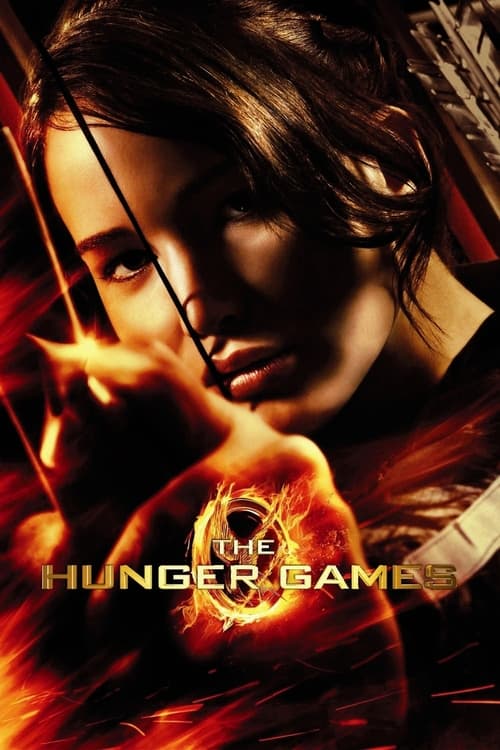
The Hunger Games
2012 · Gary Ross
For when you want an accessible, edge-of-your-seat survival thriller — a great pick for a group night or a franchise binge starter. Exciting rather than heavy, but with enough bite to spark an argument afterward.
What it's about
In a future nation where the gleaming Capitol punishes its impoverished districts by forcing their children to fight to the death on live television, sixteen-year-old Katniss Everdeen volunteers to take her little sister's place. What follows is part survival story, part twisted celebrity makeover: to live, she has to hunt, hide, and — hardest of all — perform for the cameras of an audience that's betting on her death.
The experience
Urgent and unnerving — the handheld camera keeps you pressed close to Katniss, and the quiet dread before the Games hits harder than the fighting itself. It's a fast, gripping watch with a genuinely uncomfortable idea at its core: you're watching the show too.
Performances
Jennifer Lawrence is the whole ballgame — grounded, watchful, and fierce, she makes a pulp premise feel like it's happening to a real person, and the role made her a star.
The craft
Gary Ross shoots the districts like Depression-era documentary and the Capitol like a garish fashion broadcast, and the collision of the two styles is the film's sharpest statement. The handheld, close-quarters camerawork keeps the violence felt rather than glamorized within a PG-13 frame.
Why it matters
It reset the economics of the studio blockbuster by proving a teenage heroine could carry a global franchise, launching a wave of young-adult dystopias and making Jennifer Lawrence one of the defining stars of her generation.
Snapshot
The Hunger Games is the film that proved young-adult dystopia could anchor a four-quadrant franchise built around a teenage girl. Adapted from Suzanne Collins's 2008 novel — itself the first of a bestselling trilogy — the picture translated a first-person interior narration into a propulsive, handheld survival thriller, and in doing so reset the commercial logic of the post-Twilight, post-Harry Potter studio landscape. Directed by Gary Ross and built around Jennifer Lawrence's performance as Katniss Everdeen, it fused arena-spectacle action with a satire of televised cruelty and class stratification. It is at once a star vehicle, a franchise launch, and a Reagan-to-reality-TV commentary dressed in genre clothing. Its lasting significance lies less in formal innovation than in its demonstration that a female-led, PG-13 dystopia could open enormously and sustain a multi-film arc — a lesson the industry absorbed with conspicuous speed.
Industry & production
The film was produced by Lionsgate, then a mid-major studio that staked an unusually large bet on the property, with Color Force (Nina Jacobson, the former Disney executive who acquired the book) and Jacobson partnering on production. Suzanne Collins was credited as a co-screenwriter alongside Gary Ross and Billy Ray, an arrangement that gave the adaptation rare authorial proximity to the source. The decision to mount the film as a relatively contained production — for a studio of Lionsgate's scale — rather than a blank-check tentpole shaped much of its texture: practical Appalachian and North Carolina locations stand in for District 12 and the arena, lending a grounded, naturalistic surface that contrasts with the Capitol's artifice.
The casting of Katniss was the production's central gamble. Jennifer Lawrence, then known chiefly for her Oscar-nominated work in the independent film Winter's Bone (2010) — a role with clear thematic rhymes: a young woman in Ozark poverty hunting and providing for a fractured family — was a deliberate choice that prioritized dramatic credibility over established box-office bankability. The supporting ensemble paired rising performers (Josh Hutcherson, Liam Hemsworth) with veteran character actors (Woody Harrelson as Haymitch, Stanley Tucci as the talk-show host Caesar Flickerman, Donald Sutherland as President Snow, Elizabeth Banks, Lenny Kravitz), a structure that let star presence do worldbuilding work.
The film opened in March 2012 to a very large debut and became one of the year's defining commercial events, establishing a franchise that would run through Mockingjay – Part 2 (2015) and later prequel material. Ross did not return to direct the sequels; Francis Lawrence took over from Catching Fire onward, a handoff often attributed in trade reporting to the compressed sequel schedule, though I would not overstate the specifics of that decision beyond what is firmly on the record.
Technology
The Hunger Games was made at the hinge of the industry's transition to digital capture, and it sits deliberately on the film side of that line for its "real world" material. Cinematographer Tom Stern shot substantially on 35mm photochemical film, a choice consonant with the grain, latitude, and organic motion that suited the documentary-inflected handheld approach to District 12 and the arena. The visual-effects work — the Capitol's gleaming architecture, the engineered "muttation" creatures, the holographic control room from which Gamemakers manipulate the arena — is extensive but generally deployed to extend a physically shot world rather than to replace it. The Cornucopia bloodbath and the forest fire sequences combine practical stunt work and pyrotechnics with digital augmentation.
A notable production-context detail concerns exhibition rather than capture: the film arrived as multiplex projection had largely converted to digital, but its aesthetic decisions — shallow focus, available-light naturalism, restless camera — were authored independent of any 3D or large-format mandate, distinguishing it from many contemporaneous tentpoles built around stereoscopic spectacle.
Technique
Cinematography
Tom Stern — a longtime Clint Eastwood collaborator — gives the film a bifurcated visual grammar. District 12 is rendered in desaturated, ash-and-slate naturalism, frequently handheld, with available-light interiors and a near-documentary roughness that recalls social realism more than science fiction. The Capitol, by contrast, is saturated, high-key, ornamented, its compositions more stable and frontal — the look of a world that has the luxury of artifice. Within the arena, the camera reverts to the jittery, close, often whip-panned handheld style. This restlessness was a divisive choice: it preserves the novel's claustrophobic first-person limitation (we rarely see more than Katniss can) and tempers the violence of children killing children to a PG-13 register by fracturing legibility, but a number of critics found the shaky-cam disorienting to the point of obscuring the action's geography.
Editing
Cut by Stephen Mirrione and Juliette Welfling, the film runs on a sustained tension between two editorial modes. The pre-arena passages — the reaping, the tribute train, the Capitol training and interviews — are paced with relative patience, letting performance and worldbuilding breathe. Once inside the Games, the cutting accelerates and the average shot length contracts sharply, especially in the opening Cornucopia melee, where rapid, fragmented cutting works in concert with the handheld camera to imply brutality without depicting it explicitly. The editing also carries the film's satirical layer through cutaways to the Capitol broadcast apparatus — the control room, Caesar Flickerman's commentary, the watching crowds — which reframe the survival drama as spectacle and implicate the viewer.
Mise-en-scène / staging
The production design (Philip Messina) and costume design (Judianna Makovsky) do the heavy lifting of the film's class allegory. District 12 evokes Depression-era and Appalachian poverty — muted homespun textiles, coal-country grays. The Capitol is a riot of Baroque excess, candy-colored couture, powdered and surgically altered faces, a visual vocabulary that draws on fashion-runway grotesque and totalitarian-kitsch grandeur. Katniss's "girl on fire" costuming and the flame motif function as both spectacle within the diegesis (a stylist's branding strategy) and as the film's central image of incipient rebellion. The staging consistently contrasts bodies as commodities — tributes paraded, made over, displayed — against the intimacy of Katniss's relationships with Prim, Rue, and Peeta.
Sound
James Newton Howard's score blends an orchestral idiom with folk and Appalachian textures, foregrounding strings, woodwinds, and a sparing use of voice that ties the music to District 12's agrarian roots. The film is also marked by strategic silence: the score withdraws at key moments — notably around Rue's death and its aftermath — letting diegetic sound and quiet carry emotional weight. The soundtrack album, curated with contemporary artists, extended the property's cultural footprint; the original song associated with the film became a prominent tie-in, though I'd treat specific chart claims as outside what I can verify here. Sound design draws a sharp line between the arena's natural ambience and the Capitol's mediated, broadcast-processed sonic world.
Performance
Jennifer Lawrence's Katniss is the film's center of gravity: guarded, physically capable, emotionally withholding in a way that externalizes the novel's interiority through stillness rather than voiceover. The performance balances competence (the archery, the hunting, the strategic calculation) against flashes of fear and grief, and Lawrence's grounded naturalism anchors the surrounding stylization. Around her, the ensemble is calibrated to register: Stanley Tucci's Caesar Flickerman embodies the obscene cheer of the spectacle; Donald Sutherland's Snow plays menace as soft-spoken cultivation; Woody Harrelson's Haymitch supplies dissolute, wary mentorship; Elizabeth Banks's Effie Trinket is mannered Capitol etiquette made flesh. Amandla Stenberg's Rue and her brief alliance with Katniss provide the film's emotional fulcrum.
Narrative & dramatic mode
The film operates as a survival thriller nested inside a media satire. Its structure is a three-act funnel: the world of scarcity and the reaping; the Capitol's grooming-and-display machinery; and the arena ordeal. The dominant dramatic mode is suspense built on resource constraint and shifting alliances, but the film repeatedly steps outside the survival action to show the Games as a produced television event — a reflexive device that lets it comment on its own spectacle. A central narrative engine is performance-within-performance: Katniss and Peeta must enact a romance for the cameras to win sponsors, so that genuine feeling and strategic performance become indistinguishable, a sophisticated ambiguity the film sustains better than most YA adaptations. The film softens the novel's first-person limitation by adding scenes the book's narration cannot access — the Gamemakers' control room, Snow's private deliberations — trading some of Katniss's claustrophobic subjectivity for dramatic irony and a clearer view of the system she is trapped within.
Genre & cycle
The Hunger Games belongs to several overlapping cycles. Most immediately, it is the keystone of the early-2010s YA dystopia boom, and its success directly accelerated the greenlighting and release of comparable franchises (Divergent, The Maze Runner, and others), most of which failed to match its cultural traction. It also descends from the death-game / blood-sport subgenre — a lineage that runs through The Most Dangerous Game, The Running Man, and Battle Royale, with which it has frequently been compared (Collins has cited Greco-Roman gladiatorial sources and the Theseus myth as touchstones, and the resemblance to Battle Royale has been the subject of much discussion, which I note as critical debate rather than established influence). As science fiction it sits in the soft, allegorical-dystopian tradition, more concerned with social critique than technological extrapolation. And structurally it is a star-driven studio tentpole, participating in the post-Twilight economics of the multi-film YA adaptation.
Authorship & method
Gary Ross came to the project from a background more associated with literate, Americana-inflected dramas — he wrote Big and Dave and directed Pleasantville and Seabiscuit — and his sensibility shows in the film's emphasis on character, social texture, and the Pleasantville-adjacent device of a controlled, color-coded artificial world contrasted with a drabber "real" one. His method here favored handheld immediacy and performance over spectacle, and he co-wrote the screenplay with Collins and Billy Ray, keeping the adaptation tethered to its author. His key collaborators shaped the film decisively: cinematographer Tom Stern brought the photochemical naturalism and Eastwood-school restraint; composer James Newton Howard supplied the folk-orchestral score and its expressive silences; editors Stephen Mirrione and Juliette Welfling governed the film's tonal modulation between patience and frenzy; production designer Philip Messina and costume designer Judianna Makovsky built the District-versus-Capitol visual argument. That Ross did not return for the sequels means his authorial imprint is most legible as a founding template that Francis Lawrence subsequently refined.
Movement / national cinema
The film is a product of mainstream American studio cinema and does not belong to a formal movement, but its aesthetic borrows pointedly from outside the tentpole norm. The District 12 material draws on the American independent tradition of regional social realism — the same vein as Winter's Bone, shot in actual Appalachian and Carolina locations — while the handheld camera and available-light naturalism import a documentary grammar more associated with art-house and indie filmmaking than with effects-driven blockbusters. The Capitol sequences, conversely, gesture toward a European-inflected grotesque in their fashion and design. The result is a Hollywood franchise film that wears the surface of American indie realism in its most affecting passages.
Era / period
Released in 2012, the film is legible as a post-financial-crisis text. Its imagery of extreme wealth concentration, a pampered metropolitan elite extracting from impoverished resource-producing peripheries, and a precarious underclass resonated with the contemporaneous Occupy moment and broader anxieties about inequality. It also belongs to the reality-television era's late self-awareness: the conceit of a populace watching engineered suffering as entertainment reads as a sharpened critique of a media culture the audience was thoroughly steeped in. Industrially, it arrived at the close of the Harry Potter and Twilight franchise cycles, positioned precisely to inherit and redirect their YA-adaptation audience.
Themes
The film's governing themes are spectacle and complicity — the way televised violence pacifies and entertains, and the way the audience (both diegetic and actual) is implicated in consuming it. Closely bound to this is class and exploitation: the Capitol's extraction from the districts, hunger as a tool of control, and the body as commodity. The romance plot foregrounds authenticity versus performance — whether feeling can survive when survival depends on performing it. Surveillance and control run throughout, with the arena as a totally administered space. And the film traces the birth of resistance: Katniss's small acts of refusal — volunteering for Prim, honoring Rue, the berry gambit — accumulate into a symbolic threat to the system, framing rebellion as something that begins in personal loyalty rather than ideology.
Reception, canon & influence
Critically, the film was received as a strong, intelligent adaptation — praised above all for Jennifer Lawrence's performance and for taking its dark premise seriously, with the most common reservation being the disorienting handheld camerawork in the action sequences. It was widely regarded as a cut above the YA-adaptation norm, and it elevated Lawrence to top-tier stardom within a period during which her independent and prestige work (Winter's Bone, and shortly after, Silver Linings Playbook) gave her unusual critical credibility for a franchise lead.
Looking backward, the film draws on the gladiatorial and blood-sport tradition (gladiatorial Rome, the Theseus myth, The Most Dangerous Game, The Running Man), on reality-television and media-spectacle satire (the lineage of Network and The Truman Show hovers behind it), and on American social-realist regional drama for its District 12 texture; the much-debated kinship with Battle Royale belongs to critical conversation rather than acknowledged influence.
Looking forward, its impact is primarily industrial and cultural. It validated the female-led action-franchise lead at blockbuster scale, contributing to a broader shift in who could anchor a tentpole, and it triggered a wave of YA-dystopia adaptations, most of which underperformed and whose collective fade arguably marked the cycle's exhaustion by the late 2010s. Katniss became a durable cultural figure, and the film's "three-finger salute" and "girl on fire" iconography entered popular vocabulary, even appearing in real-world protest contexts. Within the franchise itself, it established the visual and tonal template — naturalist districts, grotesque Capitol, performance-as-survival — that the sequels deepened as the series pivoted from arena thriller to revolutionary war film. Its canonical standing rests less on formal achievement than on its pivotal role in reshaping what a major studio believed a young-woman-led genre franchise could be.
A Deleuzian reading
A girl runs through a forest and a wall of fire rises to cut off her retreat.
The full Deleuzian reading of The Hunger Games →
Reception
A record-breaking phenomenon in 2012 that some cinephiles wrote off as YA-boom product; a decade on it's been reappraised as the rare franchise-starter whose political satire aged into relevance, riding a full-blown Gen Z nostalgia renaissance.
How The Hunger Games was received, from release to now →
Influences: the films it descends from and the films it influenced
- The Most Dangerous Game (1932) — Supplies the core arena blueprint — a leisured aristocrat hunts unwilling humans as sport across an enclosed, controlled terrain — that Katniss's Game literalizes as state spectacle.
- Spartacus (1960) — Models the gladiatorial-combat-as-elite-entertainment staging: tributes, like the ludus pairs, are groomed, costumed, and paraded before a watching ruling class before being made to kill each other.
- The Running Man (1987) — Provides the televised-death-game-show apparatus — a glib studio host, costumed contestants, and a home audience voting on lethal entertainment — that Caesar Flickerman's broadcasts directly echo.
- Network (1976) — Establishes the ratings-driven media-satire engine, where corporate broadcasters escalate spectacle to feed an audience, the logic that governs the Gamemakers' control-room manipulations.
- The Truman Show (1998) — Pioneers the performance-within-performance dramaturgy of a constructed world watched en masse, with an unseen director-controller engineering reveals — the template for the arena's surveilled, authored reality.
- Pleasantville (1998) — Ross's own color-coded design argument — a saturated artificial world set against a drabber 'real' one — recurs as the grotesque Capitol versus desaturated District 12 visual contrast.
- Battle Royale (2000) — Anchors the youth-death-game structure — adolescents forced by the state to kill one another in a sealed, monitored zone — that frames the tribute premise (acknowledged as critical kinship).
- Winter's Bone (2010) — Source of Lawrence's stoic, resource-scarce survivor persona and the available-light Appalachian social-realist texture that District 12's regional-poverty look borrows wholesale.
- Million Dollar Baby (2004) — Tom Stern's photochemical, low-key 'available-light' naturalism and Eastwood-school restraint, carried directly into the film's 35mm District photography.
- The Bourne Ultimatum (2007) — Defines the handheld, accelerated-cutting action grammar — disorienting proximity and rapid fragmentation — that Ross adopts for the bloodbath sequences (the film's most-debated technique).
- They Shoot Horses, Don't They? (1969) — Reanimates the core conceit — ordinary people placed in a televised endurance contest, their suffering packaged as profitable spectacle for a mass audience — the dance marathon scaled to a national broadcast.
- Twilight (2008) — Greenlit in Twilight's wake as proof of the female-driven YA franchise, extending its desaturated handheld regional look and subjective first-person adolescent framing to dystopia.
- The Hunger Games: Catching Fire (2013) — Inherits and refines Ross's founding template — naturalist districts, grotesque Capitol, performance-as-survival — while smoothing the handheld toward steadier widescreen coverage.
- Divergent (2014) — Direct product of the YA-dystopia adaptation wave the film triggered: a faction-coded society and a young-woman-led franchise built on the same blockbuster-with-a-genre-heroine bet.
- The Maze Runner (2014) — Extends the arena-survival cycle — adolescents trapped in an engineered, lethal enclosure under unseen overseers — as a sibling entry in the same studio gold rush.
- Squid Game (2021) — Carries forward the death-game-as-class-critique with the same contrast of a candy-bright artificial arena against a grim outside world, performed for a hidden audience of wealthy patrons.
- Maze Runner: The Death Cure (2018) — Established the YA-dystopia-trilogy-as-studio-tentpole format and the handheld, close-in shooting of a young ensemble under duress that Death Cure adopts wholesale.
- Snowpiercer (2013) — Renders the same class-exploitation allegory through literal production design — train cars escalating from squalor to decadence — that the film stages as Districts versus Capitol.
- The Purge (2013) — Shares the state-sanctioned-violence-as-spectacle conceit fused to class critique, contemporaneously mining the same post-crisis anxiety about institutionalized brutality against the poor.
- Harry Potter and the Goblet of Fire (2005) — Builds a mass-audience aged-up YA blockbuster on a lethal tournament-trial frame with adolescent competitors and a desaturated palette — Goblet's Triwizard structure scaled up as a whole franchise's engine.
- The Long Walk (2025) — The other screen incarnation of a state-run youth death-contest, using shaky mobile capture rigs following contestants — the spectacle mode the Walk deliberately refuses.
- The Hunger Games: The Ballad of Songbirds & Snakes (2023) — Established the franchise's desaturated Capitol-versus-District palette and the vérité handheld coverage of the arena that Songbirds & Snakes deliberately restages, in cruder period-appropriate form, for the 10th Games.
- The Running Man (2025) — Cross-cuts the arena against a visible control room authoring hazards in real time, so the producers' edit becomes a second narrative layer running alongside the event — the same event-versus-broadcast division worked at studio scale.
Similar films
- The Hunger Games: Catching Fire (2013) — influence & lineage
- Divergent (2014) — influence & lineage
- Battle Royale (2000) — influence & lineage
- The Maze Runner (2014) — influence & lineage
- Snowpiercer (2013) — influence & lineage
- The Hunger Games: The Ballad of Songbirds & Snakes (2023) — shared sensibility
- The Long Walk (2025) — shared sensibility
- The Running Man (2025) — shared sensibility