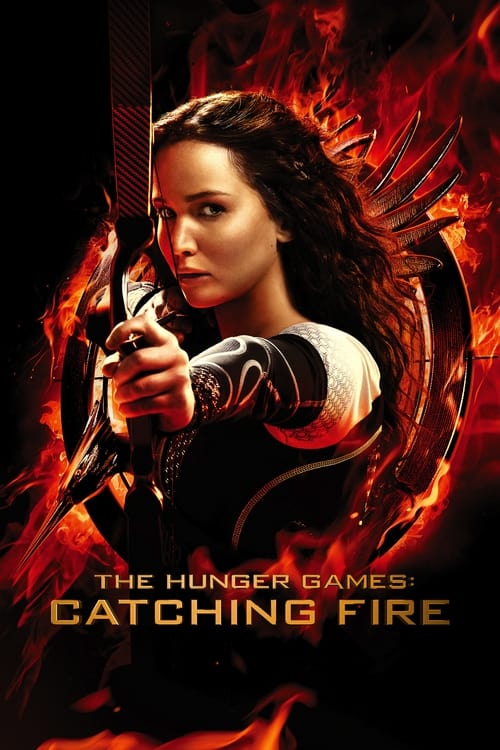
The Hunger Games: Catching Fire
2013 · Francis Lawrence
For when you want a big, gripping blockbuster night that still has something on its mind — thrilling first, thoughtful underneath. Comfort-food spectacle with a rebellious streak.
What it's about
Katniss and Peeta survived the arena, but victory made them famous in the most dangerous way possible: as symbols. As unrest ripples through the districts of Panem, President Snow forces them onto a victory tour meant to smother the spark they lit — and when that fails, the Capitol changes the rules of the Games themselves. Katniss must play celebrity, survivor, and unwilling revolutionary all at once.
The experience
Tense and propulsive, with a colder, angrier edge than a typical blockbuster — the dread builds through the pageantry long before anyone reaches the arena, and once there it barely lets up. It's a crowd-pleaser that leaves a bruise.
Performances
Jennifer Lawrence carries the film with a performance of barely contained fury and fear, and Donald Sutherland's soft-spoken President Snow is quietly chilling — menace delivered in a purr.
The craft
Francis Lawrence trades the shaky-cam of the first film for a steadier, grander canvas, and the arena — a hostile environment with its own lethal clockwork — is a genuinely inventive piece of design. The Capitol's costumes and pageantry are gaudy in exactly the right, sinister way. This one earns the biggest screen you can find.
Why it matters
Widely regarded as the franchise's high point and the rare sequel that outdoes its original, it proved a female-led dystopia could be both a global box-office event and a pointed story about propaganda and power.
Snapshot
The Hunger Games: Catching Fire is the rare middle chapter of a studio franchise that is widely held to surpass its origin — the film in which the Hunger Games series deepened from a survival spectacle into a study of how authoritarian power manages dissent and how a reluctant figurehead is conscripted into revolution. Adapted from the second novel in Suzanne Collins's trilogy, it picks up Katniss Everdeen and Peeta Mellark after their joint victory in the 74th Hunger Games, a defiance that has made them living symbols of resistance across the districts of Panem. The Capitol, embodied by Donald Sutherland's silken President Snow, responds by tightening the screws — a coerced "Victory Tour," escalating repression — and then by engineering a special edition of the Games, the Quarter Quell, whose rules return previous victors to the arena, a maneuver designed to destroy Katniss as a rallying point. The film's central tension is the gap between performance and sincerity: Katniss must keep playing the staged romance the Capitol demands even as the country reads her every gesture as a call to arms. Where the first film introduced the world, Catching Fire anatomizes its machinery of spectacle, surveillance, and propaganda — and ends, pointedly, not with a victory but with the revelation that the heroine has been a piece in a larger game she did not design.
Industry & production
Catching Fire was Lionsgate's consolidation of what had become, almost overnight, the most important franchise in the studio's history. The first film's enormous commercial success in 2012 transformed Lionsgate from a scrappy mid-major into a tentpole operation, and the sequel was greenlit and fast-tracked accordingly. It was produced by Nina Jacobson's Color Force alongside Jon Kilik, the team that shepherded the whole quartet, with Suzanne Collins closely involved as author and producer.
The production's defining behind-the-scenes story is the change of director. Gary Ross, who directed the first film, did not return; in public statements he indicated that the compressed production schedule did not leave him the time he felt the project required, and the parting was reported as amicable rather than acrimonious. Lionsgate replaced him with Francis Lawrence, a director who had come up through music videos before features such as Constantine (2005), I Am Legend (2007), and Water for Elephants (2011). Lawrence's hiring proved consequential: he would go on to direct the remaining three films, giving the back half of the franchise a continuity of vision the handoff might have threatened. The screenplay passed through prestige hands — Simon Beaufoy, the Oscar-winning writer of Slumdog Millionaire, and Michael Arndt, the Oscar-winning writer of Little Miss Sunshine, the latter credited under the pseudonym Michael deBruyn.
The film also arrived at the precise moment of Jennifer Lawrence's ascent to the top tier of stardom: she won the Academy Award for Best Actress for Silver Linings Playbook in early 2013, months before Catching Fire opened, so the sequel reached audiences with its lead newly anointed as one of the most bankable and acclaimed actors of her generation. The returning ensemble (Josh Hutcherson, Liam Hemsworth, Woody Harrelson, Elizabeth Banks, Stanley Tucci, Lenny Kravitz, Donald Sutherland) was expanded with a roster of new victors and Capitol figures: Sam Claflin as Finnick Odair, Jena Malone as Johanna Mason, Jeffrey Wright as Beetee, Amanda Plummer as Wiress, Lynn Cohen as Mags, and — a notable prestige addition — Philip Seymour Hoffman as the gamemaker Plutarch Heavensbee. Hoffman died in early 2014, during the production of the subsequent Mockingjay films; Catching Fire stands as one of his last completed major studio roles.
The film was a commercial phenomenon, ranking among the very top earners of its year worldwide and as the highest-grossing release in North America for 2013; I'll avoid attaching precise figures, which vary by source and accounting, but the order of magnitude — a franchise-defining blockbuster — is not in dispute.
Technology
The most significant technological decision on Catching Fire was its partial use of IMAX cameras. The arena sequences of the Quarter Quell were shot with IMAX film cameras, and the film expands to a taller aspect ratio at the moment Katniss enters the arena — a formal device that uses the technology itself to mark the threshold between the controlled, claustrophobic world of the Capitol and districts and the engineered "wild" of the Games. The shift in frame is a piece of storytelling, widening the image precisely as the stakes and the physical space open up. Otherwise the film was a large-scale digital-and-photochemical hybrid production typical of an early-2010s studio tentpole, combining extensive practical sets and location work with substantial visual-effects extension of the Capitol's architecture and the arena's hazards (the poison fog, the simian mutts, the lightning-tree clock mechanism). Production was based principally in Atlanta, with the lush arena jungle shot in Hawaii, whose tropical density gave the Quarter Quell a humid, organic menace distinct from the first film's forested arena.
Technique
Cinematography
The film was shot by Jo Willems, Francis Lawrence's regular cinematographer, and the change of director and DP produced a visibly different look from the first installment. Where Gary Ross's film leaned heavily on jittery handheld camerawork — a style some viewers found disorienting in its action scenes — Willems and Lawrence adopted a steadier, more classically composed approach, with cleaner blocking and more legible geography in the action. The Capitol is rendered with cold, polished symmetry and saturated artificial color, a visual language of decadent control, while the districts are kept muted and gray. The IMAX-shot arena, by contrast, is sweeping and immersive. The deliberate orderliness of the imagery is itself thematic: this is a society obsessed with stagecraft and surface, and the camera's poised, presentational quality mirrors a world in which everything is being watched, framed, and broadcast.
Editing
Edited by Alan Edward Bell, Catching Fire is structured as a long, patient first act followed by an accelerating arena sequence — a shape that gives the film unusual room, by blockbuster standards, to dwell on dread, ceremony, and political maneuvering before any combat begins. Roughly half the running time elapses before the Quarter Quell starts, and the editing sustains tension through surveillance, public ritual, and the slow tightening of Snow's grip rather than through action. Once inside the arena, the cutting organizes a series of timed, zone-based threats into comprehensible set pieces, a marked improvement in spatial clarity over the franchise's first outing. The assembly's confidence in withholding the action — trusting that the political and emotional stakes will hold an audience — is part of why the film reads as more mature than its predecessor.
Mise-en-scène / staging
The production and costume design carry an enormous share of the film's meaning. Panem's Capitol is staged as a grotesque pageant of excess — its citizens absurdly coiffed and costumed, its spaces gleaming and sterile — set against the deprivation of the districts, a visual class system rendered without dialogue. The film's single most celebrated design moment is Cinna's "mockingjay" wedding dress, which transforms on camera as Katniss spins, the white gown burning away to reveal the rebellion's emblem — a literalization of the film's theme that a spectacle staged for the Capitol can be turned into an act of insurrection. Costume designer Trish Summerville and the production team made fashion itself a political weapon, the very medium through which Katniss's defiance is broadcast. The arena, by contrast, is staged as a deceptively beautiful tropical clockwork, its lethal mechanisms (fog, baboons, a tidal wave, a lightning strike timed to the hour) organized like the dial of a clock — power presented as a precisely engineered, sadistic game.
Sound
James Newton Howard composed the score, as he did for all four films, providing the franchise's recurring motifs and a darker, more anxious orchestral palette suited to the sequel's grimmer turn. The franchise's pop-cultural footprint extended through its soundtrack program: Coldplay's "Atlas," written for the film, served as the lead single, part of Lionsgate's strategy of pairing the films with curated, marquee-artist song collections. The sound design draws a sharp contrast between the amplified, broadcast-mediated sound of Capitol ceremonies — the roar of crowds, the unctuous patter of Stanley Tucci's emcee Caesar Flickerman — and the engineered terrors of the arena, where silence is repeatedly broken by mechanized threats.
Performance
The film is anchored by Jennifer Lawrence's performance, which carries Katniss from the dissociation and survivor's trauma of the opening — she is plainly damaged by the first Games — through wary public performance to galvanized resolve. It is a role built on the tension between what Katniss must show and what she feels, and Lawrence plays the seams between the two. Donald Sutherland's President Snow deepens into the film's quiet engine of menace, his threats delivered as soft-spoken courtesy. The new victors register vividly in limited screen time: Sam Claflin reframes Finnick from preening Capitol darling to wounded ally, and Jena Malone's caustic, furious Johanna Mason supplies the film's most openly rebellious voice (including a notoriously brazen elevator scene). Woody Harrelson's Haymitch and Elizabeth Banks's Effie are given new shadings of grief and complicity, and Philip Seymour Hoffman brings a watchful gravity to Plutarch that pays off in the film's final-act reversal.
Narrative & dramatic mode
Catching Fire operates in the mode of dystopian political tragedy crossed with the survival-thriller spectacle the franchise is built on. Its dramatic architecture is deliberately bifurcated: a slow-burn first movement about repression, surveillance, and coerced performance, and a second movement that returns to the arena. Crucially, the film reframes the Games themselves — what was the whole premise of the first film becomes, here, a trap with a hidden counter-plot, so that the climactic action is revealed to have been a rescue and an act of organized rebellion all along. The film's governing irony is that Katniss is the protagonist who least understands the plot she is central to; the ending's revelation that others have been maneuvering around her recasts the entire arena sequence in retrospect. This is a narrative about agency and its absence — about a symbol who must discover she has been used by the very forces she would join.
Genre & cycle
The film is the keystone of the early-2010s young-adult dystopia cycle, the wave of franchises adapting bleak, politically inflected YA novels for a teen-and-crossover audience: Divergent, The Maze Runner, and others followed in the Hunger Games' wake, none matching its cultural traction. It fuses several genres — dystopian science fiction, the gladiatorial survival film (with antecedents from The Most Dangerous Game through Battle Royale), the political thriller, and the star-driven blockbuster. Within the longer lineage of screen dystopia it descends from a tradition of media-spectacle satires — The Running Man, Network, the Roman "bread and circuses" imagination — updated for an age of reality television and pervasive surveillance. As the second entry, it also exemplifies the 2010s studio practice of splitting and extending franchises (the final novel would itself be divided into two films), treating a book series as an expandable multi-year event.
Authorship & method
The franchise's authorship is genuinely divided between source and screen. Suzanne Collins, the novelist, is the originating author and remained a creative presence as producer; the films' political seriousness — their preoccupation with war, propaganda, and the exploitation of the young — is hers. On the filmmaking side, Francis Lawrence is the defining directorial hand of the series from this point forward, and his method is legible: a preference for legible, composed action over chaotic handheld, a tonal commitment to taking the material's darkness seriously rather than softening it for its young audience, and a willingness to let political and emotional setup breathe before delivering spectacle. His key collaborators recur across the back half of the franchise: cinematographer Jo Willems, composer James Newton Howard, and a production and costume team that made design the franchise's primary expressive instrument. The screenplay's prestige authorship — Simon Beaufoy and Michael Arndt (as Michael deBruyn) — brought craft to the adaptation's central challenge: compressing a dense, interior novel into a propulsive two-and-a-half-hour film while preserving its politics.
Movement / national cinema
Catching Fire is a mainstream American studio production and belongs to no art-cinema movement; its significance is industrial and cultural rather than aesthetic-avant-garde. If it indexes a "movement," it is the early-2010s consolidation of the YA-franchise blockbuster as a dominant Hollywood form, and the rise of Lionsgate as a major studio on the strength of a single property. It also belongs to a broader American tradition of dystopian self-critique — films that turn science fiction toward commentary on the nation's own appetites for spectacle, inequality, and televised violence.
Era / period
The film is a document of the early 2010s, and its anxieties are those of its moment: pervasive surveillance, the spectacle of reality television, the commodification of personal authenticity, and a post-recession consciousness of stark inequality between a glittering elite and an exploited periphery. Its imagery of a manufactured romance broadcast for mass consumption, of dissent that spreads through symbols and images, reads as a commentary on a media-saturated culture in which protest and performance are increasingly entangled. The film's vision of revolution catalyzed by a single charismatic image resonated with a period shaped by networked, image-driven political movements, even as the film locates its mechanisms in old-fashioned authoritarian control.
Themes
The film's master theme is the management of dissent through spectacle — the Capitol's recognition that a symbol is more dangerous than a soldier, and its attempt to neutralize Katniss by controlling her image rather than simply killing her. Around it cluster: performance versus authenticity, the unbearable gap between the staged romance Katniss must enact and the rebellion her gestures unintentionally ignite; surveillance and propaganda, the sense that every act is watched, broadcast, and weaponized by one side or the other; trauma and its costs, in Katniss's and Peeta's visible damage from the first Games, a refusal to treat survival as triumph; complicity and exploitation, the use of the young as instruments by both the Capitol and the rebellion; and inequality as spectacle, the obscene contrast between Capitol decadence and district deprivation. Underlying all of these is a meditation on agency — on what it means to become a symbol of freedom while having very little of one's own.
Reception, canon & influence
Critically, Catching Fire was the best-received film of the franchise and is frequently cited as a sequel that improves on its predecessor — praised for its darker, more confident tone, its greater clarity of action under Francis Lawrence, the richness of its expanded ensemble, and above all Jennifer Lawrence's central performance. Reviewers singled out the film's willingness to slow down and take its dystopian politics seriously, and the smoother, more legible visual style was widely read as a corrective to the first film's jittery camerawork. Commercially it was a defining success of its year and cemented the series as a top-tier global franchise.
Looking backward, its influences run from Suzanne Collins's source novel through a long lineage of dystopian media satire — Battle Royale, The Running Man, Network, The Most Dangerous Game, and the classical image of bread and circuses — fused with the modern survival-action blockbuster. Looking forward, Catching Fire anchored the 2010s wave of YA-dystopia franchises (which largely failed to replicate its success), demonstrated the commercial logic of splitting a final book into two films (a model widely imitated), and helped establish Jennifer Lawrence as the era's preeminent young star and the action heroine as a viable franchise center. Within the series it set the template — directorial, visual, tonal — for the two Mockingjay films that followed, and it remains the installment most often held up as the franchise's artistic high point, the moment a teen-marketed property earned a reputation for genuine political weight.
A Deleuzian reading
Start with the spin.
The full Deleuzian reading of The Hunger Games: Catching Fire →
Reception
One of the rare blockbuster sequels to be received as a clear upgrade on the original, it was acclaimed on release in 2013 — and its standing has only hardened since, now routinely cited as the peak of the whole YA-dystopia boom it helped define.
How The Hunger Games: Catching Fire was received, from release to now →
Influences: the films it descends from and the films it influenced
- The Most Dangerous Game (1932) — Establishes the engineered hunting-ground as a closed dramatic space where prey must read terrain and traps to survive — the arena-as-designed-deathtrap that the clock-face jungle directly inherits.
- Spartacus (1960) — Codifies the arena gladiator who survives and is forcibly turned into a public symbol of rebellion, with combat staged as state theater and costume marking captor versus captive.
- Network (1976) — Models the live-broadcast satire and the on-air host set-piece — the manufactured TV interview as propaganda — that frames Caesar Flickerman and the Capitol's pre-Games broadcasts.
- Rollerball (1975) — Supplies the corporate-engineered blood sport watched by mass audiences, where a celebrity-athlete becomes a threat to the system simply by refusing to die on schedule.
- The Running Man (1987) — Stages execution as a glitzy game show with a master-of-ceremonies host and contestants packaged as branded personas — the spectacle/broadcast-mediated contrast Catching Fire runs on.
- Battle Royale (2000) — Provides the youth-forced-to-kill ensemble structure: named teen combatants in a monitored, time-pressured arena, alliances forming and breaking under a survival countdown.
- The Truman Show (1998) — Builds the control-room of designers who manipulate environment — storms, hazards, scripted events — over a live feed, the exact dramaturgy of the Gamemakers' booth steering the arena.
- The Dark Knight (2008) — Pioneers narrative IMAX with mid-film aspect-ratio expansion for marquee sequences; Catching Fire borrows this device wholesale, opening up to IMAX 1.43 for the arena.
- Triumph of the Will (1935) — Originates the fascist mass-pageant grammar — uniformed ranks, monumental architecture, the leader above the crowd — that the Capitol's rallies and Snow's staging quote as costume-and-design politics.
- Metropolis (1927) — Demonstrates production design as class argument: a decadent ruling city visually severed from an exploited labor underground, the District/Capitol divide rendered through set and costume.
- The Hunger Games (2012) — The immediate predecessor whose jittery handheld arena Catching Fire deliberately reworks into composed, legible wide-framed action — a direct method-correction within the same franchise.
- The Hunger Games: Mockingjay – Part 1 (2014) — Inherits Catching Fire's directorial, tonal and visual template and executes its most imitated industry innovation: splitting a single final novel into two films.
- Divergent (2014) — Part of the YA-dystopia franchise cycle Catching Fire anchored: a faction-coded, costume-stratified society organized around a young female lead resisting a controlling regime.
- The Maze Runner (2014) — Extends the YA-dystopia survival template — adolescents trapped in an engineered, shifting lethal environment run by unseen overseers — that Catching Fire's success greenlit.
- Squid Game (2021) — Carries forward the spectated death-game-as-class-satire: contestants in color-coded uniforms compete in designed arenas for the entertainment of wealthy spectators behind glass.
- The Hunger Games: The Ballad of Songbirds & Snakes (2023) — Lawrence returns to continue the franchise's design-driven political tragedy and broadcast-spectacle dramaturgy, originating the young Snow whose Sutherland incarnation he'd already built.
- The Long Walk (2025) — Lawrence and DP Jo Willems had already built the grammar of a state-run televised lethal contest here; The Long Walk reuses their director/DP partnership but subtracts the arena spectacle apparatus down to a single road.
- I Am Legend (2007) — Lawrence's own classical, composed framing of depopulated dystopian space, scored by James Newton Howard — the same director-composer partnership and visual restraint carried into the franchise.
- Snowpiercer (2013) — A same-year dystopia using costume and production design as explicit class taxonomy — each car/district legible by wardrobe and palette — sharing the design-as-politics expressive strategy.
- Maze Runner: The Death Cure (2018) — Modeled how to escalate a YA franchise's later chapters into siege-scale, countdown-driven action set pieces rather than world-building exposition.
Similar films
- The Hunger Games (2012) — influence & lineage
- The Hunger Games: The Ballad of Songbirds & Snakes (2023) — influence & lineage
- Divergent (2014) — influence & lineage
- Snowpiercer (2013) — influence & lineage
- The Maze Runner (2014) — influence & lineage
- Battle Royale (2000) — influence & lineage
- V for Vendetta (2006) — same viewing thread
- Dawn of the Planet of the Apes (2014) — shared sensibility
All the films related to The Hunger Games: Catching Fire →
Watch it with: curated runs of related films
- Rogue Heroes, Rigged Systems — A run of slick, propulsive 21st-century spectacle — spies, super-soldiers, sci-fi survivors, and dystopian rebels all squaring off against some vast machine or shadowy apparatus — best watched back-to-back when you want momentum, style, and a lone figure taking on the whole board.