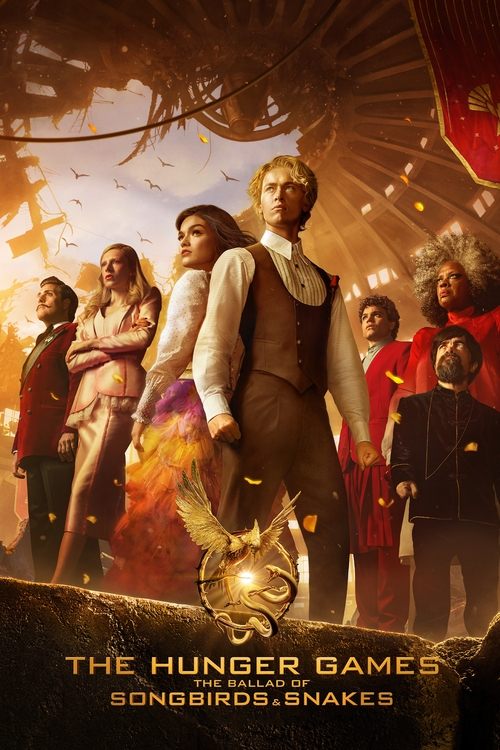
The Hunger Games: The Ballad of Songbirds & Snakes
2023 · Francis Lawrence
For when you want a big, immersive dystopia to sink into for a whole evening — and you're more interested in watching someone become a monster than in rooting for a hero. Comfortable franchise territory with a colder heart.
What it's about
Sixty-four years before he rules Panem as a tyrant, young Coriolanus Snow is a broke Capitol student gambling his family's future on one assignment: mentoring Lucy Gray Baird, the singing tribute from District 12, in an early, brutal version of the Hunger Games. What starts as ambition curdles into something more complicated as his fortunes become tangled with hers. It's a villain's origin story set in a Capitol still scarred by civil war.
The experience
A slow-burn epic in three movements — part arena thriller, part twisted romance, part moral unraveling. It's darker and more patient than the earlier films, asking you to watch a charming young man make one compromising choice after another.
Performances
Tom Blyth makes Snow's corrosion feel gradual and plausible, and Rachel Zegler brings a genuine singing voice and live-wire charisma to Lucy Gray — her ballads are the film's soul.
The craft
Francis Lawrence, who directed three of the original films, stages a rawer, war-scarred Capitol far from the later films' gloss, and the movie is built around folk music as both survival tactic and seduction. The songs are performed for real and land best with good sound.
Why it matters
It revived a defining Young Adult franchise after an eight-year hiatus and proved the series could work as tragedy rather than heroism, sending Suzanne Collins's story back up the bestseller lists.
Snapshot
The Ballad of Songbirds & Snakes is a prequel to the four-film Hunger Games franchise (2012–2015), adapted from Suzanne Collins's 2020 novel of the same name. It returns Francis Lawrence — director of the previous three installments — to a saga he had helped shape into one of the defining Young Adult franchises of the 2010s, this time reaching back sixty-four years before Katniss Everdeen to trace the origins of the tyrant Coriolanus Snow. The film is at once a franchise revival and a deliberate tonal reset: a villain-origin story that swaps the audience-surrogate heroine of the original quartet for an ambitious, morally corroding young man on the make in a Capitol still scarred by civil war. Positioned as a return to a lucrative property after an eight-year hiatus, it is best understood as a study in how a franchise metabolizes its own mythology — mining the backstory of its antagonist for a meditation on how tyranny is made rather than born.
Industry & production
The film was produced by Lionsgate, the studio for which the Hunger Games franchise had been a foundational commercial pillar; the original four films were among the company's most important assets of the 2010s. Nina Jacobson and Brad Simpson of Color Force produced, continuing their stewardship of the series, alongside Francis Lawrence. Collins, who has retained unusually tight authorial control over adaptations of her work, is credited among the producing team, reflecting a production culture built around fidelity to the source novel.
The project's genesis is straightforward and well documented: Collins published the prequel novel in May 2020, and Lionsgate moved to adapt it quickly, with the film arriving in November 2023. The gap between the 2015 Mockingjay – Part 2 and this film represents the franchise's dormancy and revival — a common industry pattern in which studios return to proven IP after the market has had time to reset. The casting reflected a generational handoff: Tom Blyth as the young Coriolanus Snow (a role indelibly associated with Donald Sutherland's elderly president in the earlier films) and Rachel Zegler, fresh from Steven Spielberg's West Side Story (2021), as Lucy Gray Baird. The supporting cast folded in established names — Viola Davis, Peter Dinklage, Jason Schwartzman, Hunter Schafer — signaling a prestige register alongside the YA-franchise machinery.
The film was a substantial commercial performer, reviving the franchise theatrically; precise box-office figures are not something I will assert here without the record in front of me, but its release was treated by Lionsgate as a tentpole event and it succeeded well enough to spur the studio toward further adaptations. Production drew on European locations and studio work, with much of the shoot associated with Germany, in keeping with the franchise's practice of building the Capitol and districts through a mix of location and constructed sets.
Technology
The film was shot and finished as a large-format digital production in the mainstream 2020s studio idiom, delivered in a widescreen aspect ratio suited to its scale. Its technological interest lies less in novel capture formats than in the maturation of the visual-effects pipeline the franchise had used to build Panem. The Capitol — a decaying, brutalist metropolis a decade after a devastating war — is realized through the now-standard blend of physical sets, location architecture, and digital set extension. The arena of this earlier, cruder Hunger Games is deliberately conceived as a bombed-out amphitheater rather than the elaborate simulated wilderness of the later games, a design choice that let the production lean on real ruined-architecture textures augmented digitally rather than fully synthetic environments.
The film sits squarely within the post-Mockingjay generation of digital-intermediate color workflows and CG-assisted world-building; it does not, on the available record, mark a technical first, and I won't manufacture one. Its craft achievement is coherence — extending an established visual universe backward in time so that the Capitol reads as a recognizably earlier, more austere version of the gilded city audiences already knew.
Technique
Cinematography
The cinematography is credited to Jo Willems, Lawrence's regular collaborator, who shot Catching Fire, Mockingjay – Part 1 and Part 2. Willems's return is a load-bearing element of the film's continuity: the franchise's established visual grammar — the cool, controlled palette of the Capitol against the warmer, grainier textures of the districts — is carried backward and inflected for an earlier era. The prequel's Capitol is rendered colder and grayer than the decadent city of the Katniss films, its post-war austerity legible in desaturated interiors and hard institutional light. The District 12 sequences and the Covey's outdoor performances open the frame toward a more naturalistic, folk-inflected warmth, drawing a visual line between confinement and freedom that maps onto the film's moral geography.
Editing
The film is a long one, structured — like the novel — in distinct movements (the reaping and mentorship, the games, and a final district-set act). The editing's central challenge is this tripartite structure, which effectively delivers three tonal registers in sequence: a Capitol-set political drama, an arena-set survival thriller, and a pastoral-turned-paranoid final act in District 12. The cutting must manage the deceleration from the propulsive games section into the slower, more insidious character study that follows, where the tension migrates from physical survival to moral erosion.
Mise-en-scène / staging
Production design is the film's most expressive channel. The brutalist, war-scarred Capitol — a decade removed from rebellion — is staged as an environment of scarcity and menace, its academy and government spaces conveying institutional cruelty through architecture. The first arena, a cracked open-air amphitheater, deliberately reads as primitive next to the later franchise's spectacle, underscoring that the audience is watching the Hunger Games in a formative, brutal, under-produced infancy. Costume design tracks Coriolanus's precarious status — the faded finery of a fallen aristocratic family maintaining appearances — while Lucy Gray's rainbow ruffled dress becomes a recurring visual motif of performance and defiance.
Sound
Music is unusually load-bearing here because the source material makes song central to plot and character. Lucy Gray is a performer, and her ballads — including material derived from Collins's lyrics — function as narrative events, not decoration. The songs, notably "The Hanging Tree," which the franchise's audience already knew from Mockingjay, are seeded here as diegetic performances, retroactively explaining a piece of series mythology. The sound design otherwise observes franchise convention, contrasting the sterile acoustics of the Capitol with the open, resonant spaces of the districts.
Performance
The film rests on Tom Blyth's Coriolanus Snow, a performance tasked with the delicate work of playing a not-yet-villain: charismatic, sympathetic in flashes, and gradually revealing the calculation beneath. The role is shadowed by Donald Sutherland's iconic older Snow, and Blyth's achievement is to make the corrosion legible as a continuous arc rather than a switch. Rachel Zegler, a trained singer, carries the film's musical dimension and gives Lucy Gray an ambiguous, self-possessed quality that resists the ingénue template. Viola Davis's Dr. Gaul, the games' grotesque architect, and Peter Dinklage's disillusioned Dean Highbottom supply the film's thematic engine, articulating competing philosophies of human nature that Coriolanus must choose between.
Narrative & dramatic mode
The film's defining formal choice is the villain-origin story — a mode that inverts the identification structure of the original franchise. Where Katniss was the moral center against whom the Capitol was measured, here the audience is aligned with a future tyrant, invited to watch sympathetically as ambition, humiliation, and fear harden into cruelty. This is dramatic irony operating at the level of the whole franchise: viewers who know what Snow becomes watch his choices with foreknowledge, so the film generates suspense not from what he will do but from when and how the turn will complete.
The tripartite structure inherited from the novel gives the film a serialized, chaptered feel. The mentorship-and-games sections operate as political and survival drama; the final District 12 act shifts into something closer to a paranoid romance, where love and self-preservation become fatally entangled. The dramatic mode is tragic in the classical sense — a protagonist whose defining flaw is visible from the start, moving inexorably toward a corruption the audience already knows is his destiny.
Genre & cycle
The film belongs to the dystopian Young Adult adaptation cycle that the original Hunger Games (2012) had itself catalyzed — a wave that included Divergent and The Maze Runner and that had largely exhausted itself commercially by the late 2010s. As a 2023 release, Songbirds & Snakes is a late-cycle return, arriving after the boom had subsided, and it functions partly as a test of whether the progenitor franchise could outlive the trend it started.
Generically it hybridizes science-fiction dystopia, survival-arena thriller, political drama, and — distinctively — the musical, given the centrality of Lucy Gray's performances. It also participates in the broader 2020s vogue for prequels and origin stories mining existing IP for backstory, a franchise-extension strategy visible across the industry. The villain-origin specifically links it to a lineage that includes films like Joker (2019), reframing an established antagonist as a tragic protagonist.
Authorship & method
The film's authorship is genuinely divided between three figures. Francis Lawrence, directing his fourth Hunger Games film, is the franchise's stabilizing authorial hand — the steward of its visual and tonal continuity across a decade. His method here is one of continuity and elaboration rather than reinvention: he reassembled key collaborators to ensure the prequel felt of a piece with the earlier films while accommodating its darker, more novelistic material.
Suzanne Collins is the second author. Her control over the adaptation of her fiction is a defining production fact; the screenplay, credited to Michael Lesslie and Michael Arndt (an Oscar-winning screenwriter for Little Miss Sunshine and a veteran of major franchise work), hews closely to her novel. The film's ideas about power, spectacle, and human nature are Collins's, and the adaptation's method is fidelity.
The third authorial layer is the returning craft team: cinematographer Jo Willems and composer James Newton Howard, both franchise veterans, provide continuity of image and score. Howard's return is significant given the musical dimension; his work threads the diegetic songs into a coherent score. This is filmmaking-by-continuity — an authorship of institutional memory, where the "author" is as much the assembled franchise apparatus as any single voice.
Movement / national cinema
The film belongs to no art movement; it is a product of the American studio franchise system, financed and distributed by Lionsgate for a global mass audience. Its physical production, associated substantially with Germany, reflects the standard economics of contemporary tentpole filmmaking — international shooting locations and facilities serving an American IP. Culturally it is squarely within the Hollywood dystopian blockbuster tradition rather than any national or regional cinema.
Era / period
Songbirds & Snakes is a film of the early-2020s franchise-revival moment, when studios systematically returned to dormant IP and mined established universes for prequels, origin stories, and legacy sequels. It arrives after the theatrical disruption of the pandemic years and amid industry anxiety about the durability of pre-existing franchises. Its release also coincided with a cultural climate attentive to the mechanics of authoritarianism and media spectacle — themes the Hunger Games series had always engaged, now sharpened by a decade of political change. The film reads, in that context, as a franchise's attempt to speak to a darker, more disillusioned moment than the hopeful-resistance arc of its predecessors.
Themes
The film's governing theme, drawn directly from Collins, is a debate about human nature staged as political philosophy: are people inherently savage, requiring control (Dr. Gaul's view), or is cruelty made by circumstance? Coriolanus's arc dramatizes the second answer curdling into the first — a young man not born evil but shaped into it by poverty, humiliation, fear, and opportunity. Related themes cluster around this core: the manufacture of spectacle as social control, and the origins of the Hunger Games themselves as a propaganda instrument; the corrupting logic of ambition and status anxiety; and the tension between love and self-preservation, resolved fatally in Snow's final betrayal. The film is also, self-reflexively, about the birth of the very spectacle the franchise trades in — an origin story for the machinery of the earlier films. Names, songbirds, snakes, and the recurring "Hanging Tree" song function as motifs binding these ideas.
Reception, canon & influence
Critical reception was mixed-to-favorable, with reviewers generally praising Blyth's and Zegler's performances, the production design, and the ambition of the villain-origin premise, while some found the film's substantial length and tripartite structure unwieldy — the final act's shift in register was a frequent point of debate. I won't quote specific reviews or cite an aggregate score without the record before me. Commercially, the film successfully revived the franchise and validated Lionsgate's return to the property.
Influences on the film (backward): Most directly, it inherits the entire visual, tonal, and thematic architecture of the four preceding Hunger Games films, carried forward by Lawrence, Willems, and Howard. Beyond the franchise, it draws on the villain-origin lineage sharpened by Joker (2019), on the long tradition of dystopian science fiction concerned with spectacle and social control (the series' debts to Orwell, to The Running Man, and to reality-television critique are well established), and on the classical tragic structure of the corrupted protagonist. Collins's novel is the proximate source and the film's fidelity to it is its method.
Legacy / what it shaped (forward): Its most concrete legacy is the reactivation of the Hunger Games franchise as an ongoing concern, positioning Lionsgate to pursue further Collins adaptations and signaling that the property could survive beyond its original quartet. Within the series' internal mythology, it retroactively deepened the character of President Snow and supplied origins for elements — most notably "The Hanging Tree" — that the earlier films had left unexplained, an act of franchise world-building that reshapes how the original films are read. As a late entry in the YA-dystopia cycle, it stands as evidence of a progenitor franchise outlasting the trend it began. Its broader influence on filmmaking is still unfolding and, this close to release, any larger claim would be premature.
A Deleuzian reading
A girl in a rainbow ruffled dress, singing.
The full Deleuzian reading of The Hunger Games: The Ballad of Songbirds & Snakes →
Reception
Opened softer than any previous Hunger Games film and got shrugging reviews as an 'unnecessary prequel,' but legged out at the box office and rode the 2023 TikTok-fueled Hunger Games renaissance into being warmly reclaimed — the prequel fans now insist was better than it had any right to be.
How The Hunger Games: The Ballad of Songbirds & Snakes was received, from release to now →
How to watch The Hunger Games: The Ballad of Songbirds & Snakes: what to notice on a first viewing
- Notice how gray and desaturated the Capitol's interiors look. Jo Willems shoots Capitol spaces cold and institutional, then opens the frame to warmer, grainier light whenever the film reaches District 12 or the Covey's outdoor stages. The palette maps the film's moral geography: confinement is cold, freedom is warm.
- Watch Lucy Gray's rainbow dress against the gray Capitol. The dress is the one saturated object in an otherwise institutional palette, and it keeps reappearing every time she performs. She knows the dress is a costume, wears it anyway, and it works as both survival strategy and defiance.
- Listen for when Lucy Gray sings versus background scoring. Her ballads happen as events inside scenes, not as mood music laid over them; characters react to the songs as things that just occurred. Song functions as plot here, not decoration, so what she sings changes what happens next.
- Look at the cracked, ruined amphitheater where the games happen. The first arena is a bombed-out civic ruin, deliberately cruder than the polished spectacle of the later franchise films. You're watching the Hunger Games in their primitive, under-produced infancy, before anyone perfected making death watchable.
- Track small shifts in Coriolanus's face as he calculates. Tom Blyth plays charm and calculation on the same face at once, so sympathy and suspicion build together rather than switching. The corrosion reads as a continuous slide, not a single decision, which is what makes it feel like tragedy.
Influences: the films it descends from and the films it influenced
- The Hunger Games: Catching Fire (2013) — Lawrence and Willems set the anamorphic widescreen arena grammar and the reflective, glass-and-marble Capitol staging that the prequel reuses as its inherited visual language.
- The Hunger Games (2012) — Established the franchise's desaturated Capitol-versus-District palette and the vérité handheld coverage of the arena that Songbirds & Snakes deliberately restages, in cruder period-appropriate form, for the 10th Games.
- The Hunger Games: Mockingjay – Part 1 (2014) — Introduced 'The Hanging Tree' as a diegetic protest ballad scored by James Newton Howard, the exact device Songbirds & Snakes retroactively supplies an origin for by embedding it in Lucy Gray's repertoire.
- Joker (2019) — Provided the sympathetic-descent template — a slow character study that walks a pitiable figure into the monster we already know — that the film's villain-origin architecture directly borrows.
- The Godfather Part II (1974) — Model of the prequel-as-tragic-origin: dramatizing how a specific man is corrupted into the tyrant the audience already knows, letting foreknowledge generate dramatic irony from each moral compromise.
- Macbeth (1971) — Supplies the classical tragic-corruption structure the dossier names — ambition and circumstance grinding a protagonist toward villainy in staged acts — that the tripartite Snow arc reproduces.
- Battle Royale (2000) — Foundational grammar of the state-sanctioned, youth-killing-youth arena as televisual spectacle, the survival-thriller mechanism the prequel depicts in its primitive early-Games form.
- The Running Man (1987) — Ancestor of the lethal game-show-as-instrument-of-state-control, the spectacle-as-social-management premise Snow himself theorizes and refines within the film.
- Nineteen Eighty-Four (1984) — Desaturated, brutalist totalitarian production design and surveillance-state iconography that the prequel's austere post-war Capitol and Academy interiors descend from.
- Cabaret (1972) — Pioneered diegetic musical performance as political commentary inside an authoritarian order, the technique Songbirds & Snakes adopts by using Lucy Gray's staged songs as coded resistance and characterization.
- Cruella (2021) — Sibling villain-origin of a canonical antagonist built on costume-as-character-motif, matching the prequel's use of wardrobe (the reptilian Snow palette, the arena styling) as a signaling device.
- Maleficent (2014) — Recasts a known villain's beginnings to retroactively reframe how the original stories are read — the same franchise-world-building move that reshapes President Snow across the earlier films.
- Dune (2021) — Sibling in monumental brutalist production design, using vast concrete-and-monolith architecture to render authoritarian power as spatial oppression, the register the prequel's Capitol adopts.
Similar films
- The Hunger Games: Catching Fire (2013) — influence & lineage
- The Hunger Games (2012) — influence & lineage
- Battle Royale (2000) — influence & lineage
- The Long Walk (2025) — same viewing thread
- The Maze Runner (2014) — same viewing thread
- Snowpiercer (2013) — shared sensibility
- Divergent (2014) — shared sensibility
- Pan's Labyrinth (2006) — shared sensibility
All the films related to The Hunger Games: The Ballad of Songbirds & Snakes →
Watch it with: curated runs of related films
- Young Under a Darkening Sky — Watch these in a run as the frame darkens — the institutions built to shelter the young (a school, a walled glade, a nation, a highway) curdle into deadly contests and regimes they have to outlast.