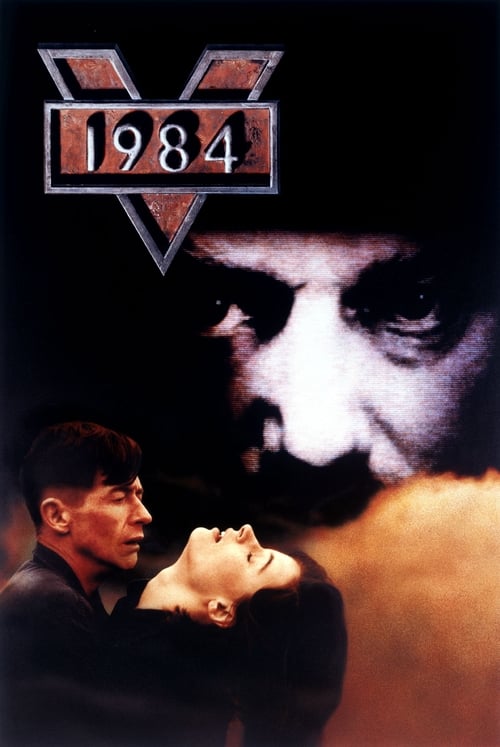
Nineteen Eighty-Four
1984 · Michael Radford
For when you want to be challenged, not comforted — a film to sit with when the news has you thinking about power, surveillance, and truth. Not a casual watch; it stays with you for days.
What it's about
In a totalitarian state where the government rewrites the past to fit the present, a low-level functionary spends his days falsifying old newspapers — and his nights nursing a private, punishable habit of remembering. When he begins a forbidden affair with a younger woman, the two carve out a fragile pocket of privacy in a society where every room has a screen and every thought can be a crime. It is Orwell's novel filmed straight, in the very year of its title.
The experience
Grim, austere, and quietly devastating — less a thriller than a slow tightening around the throat. It's paced like dread itself: deliberate, hushed, with moments of tenderness that feel dangerous precisely because you know how watched they are.
Performances
John Hurt is extraordinary as Winston — gaunt, haunted, every flicker of hope visible and doomed on his face. Richard Burton, in his final screen role, brings a terrifying gentleness to the party official O'Brien; he barely raises his voice, and that's what chills.
The craft
Radford shot in and around London during the actual spring and summer of 1984, matching the novel's calendar, and built his dystopia not from neon futurism but from bomb-damaged brick and 1940s ration-book drabness — the world Orwell was actually looking at. The desaturated, ash-gray photography is a statement in itself: the future as a permanent postwar.
Why it matters
It stands as the definitive screen version of the most-invoked political novel of the twentieth century, and its austere, backward-looking production design became the counter-model to glossy sci-fi dystopias.
Snapshot
Michael Radford's Nineteen Eighty-Four is the rare literary adaptation that was made to arrive precisely on time. Shot in and around London during the spring and summer of 1984, on the actual calendar dates specified in George Orwell's novel wherever the production could arrange it, the film treats its own contemporaneity as a structural condition rather than a marketing hook. The result is a work of deliberate, almost punishing austerity: a vision of Airstrip One built not from the chrome-and-neon futurism that dominated science fiction cinema in the years after Star Wars and Blade Runner, but from bomb-damaged brick, wartime rationing, institutional linoleum, and the specific visual memory of Britain in the late 1940s — the world Orwell was actually looking at when he wrote.
John Hurt plays Winston Smith, the Outer Party functionary at the Ministry of Truth whose work consists of rewriting the historical record so that it always agrees with the present. Suzanna Hamilton plays Julia, whose sexual appetite is itself an act of sabotage against a state that has criminalised pleasure. Richard Burton, in his final screen role, plays O'Brien, the Inner Party inquisitor who befriends Winston in order to break him. The film follows the novel's tripartite structure closely: the establishment of a life under surveillance, the brief illicit idyll of the affair, and the extended annihilation of the self in the Ministry of Love.
What distinguishes the film in the long history of Orwell adaptation is its refusal of consolation at every level of craft. There is no ironic distance, no thriller momentum, no counter-Utopian glimmer. The photography is drained of color, the cutting is patient to the point of stasis, and the performances are physical rather than rhetorical. It is, more than most screen dystopias, a film about a body being worn down.
Industry & production
The production was mounted by Umbrella-Rosenblum Films with Virgin Films, the film arm of Richard Branson's Virgin group, which was then briefly attempting to establish itself as a British production and distribution presence. Simon Perry produced. The involvement of Virgin is central to the film's most-discussed off-screen controversy, and it is worth being precise about what is well documented and what is not.
Radford commissioned an original score from Dominic Muldowney, the composer then working at the National Theatre, and shot and cut the film with that score in mind. Virgin subsequently commissioned music from the Eurythmics — Annie Lennox and Dave Stewart, then at a commercial peak — and the version released in most territories incorporated Eurythmics material alongside Muldowney's. Radford publicly and repeatedly objected, framing the substitution as a commercial imposition on a finished film; the Eurythmics, for their part, have said their contribution was solicited in good faith and that they were unaware of the director's opposition. Radford aired the grievance at an awards ceremony, which converted an internal dispute into a public one. The upshot for the film's afterlife is that Nineteen Eighty-Four exists in more than one musical configuration, and home-video and restoration releases over the years have variously carried the Eurythmics version, the Muldowney-dominant version, or both. Anyone writing about the film's sound design has to specify which cut they mean.
The rights history matters too. Orwell's estate, guided for decades by his widow Sonia Orwell and the executors after her, had been cautious about screen adaptations following the 1954 BBC television version and the 1956 British feature. The 1984 film was made with estate cooperation, and the fidelity of the adaptation — its refusal to update, modernize, or supply a redemptive ending — reflects a production culture in which the novel's authority was the point.
Budgetarily the film was modest by the standards of contemporaneous science fiction. Its scale is achieved through location, crowd staging, and art direction rather than effects work. Reliable, well-sourced budget and gross figures for the film are not something the general record establishes with confidence, and I will not supply numbers I cannot stand behind; what is clear is that the film was a critical event more than a commercial one, and that its reputation has been made in retrospect through television broadcast, video, and later restoration rather than through its theatrical run.
Technology
The film's technological interest is twofold: the technology it depicts, and the technology used to depict it.
Within the fiction, Orwell's telescreen is realized as a bulky, low-resolution monochrome cathode-ray device — a two-way instrument, receiver and transmitter in one housing, that can be dimmed but never switched off. Radford and his designers resisted any temptation to futurise it. The telescreens look like early British broadcast television hardware, which is exactly right: Orwell was extrapolating from the BBC and from wartime radio, not imagining flat panels. The same logic governs the "speakwrite" dictation apparatus and the pneumatic-tube memory holes in the Ministry of Truth, both rendered as heavy, clanking, industrially plausible objects. The film's most prescient technological idea is not a gadget but an architecture: the observation that total surveillance requires no perfection, only the credible possibility of being watched at any moment.
Behind the camera, cinematographer Roger Deakins and Radford pursued a distinctive photochemical strategy. The film was processed using a bleach-bypass (silver-retention) technique, in which the bleaching step of the color negative process is skipped or curtailed so that silver is retained alongside the dye image. The consequence is a picture with raised contrast, coarsened grain, desaturated color, and dense, ashy blacks — a color film that behaves as though it is fighting an urge to become black-and-white. This was not a common approach in 1984; the technique's wide adoption in commercial cinema came later, in the 1990s, with films like Saving Private Ryan and Se7en helping to normalize silver-retention and related processes as an expressive option. Nineteen Eighty-Four is one of the significant early narrative-feature uses of the look in English-language cinema, and it is one of the reasons the film's images remain so immediately identifiable.
Technique
Cinematography
Deakins — early in a career that would become one of the defining bodies of work in modern cinematography — photographs Airstrip One as a world in which light is a scarce, rationed commodity. Interiors are lit as though from insufficient overhead sources: bare bulbs, grimy windows, the sickly glow of the telescreen itself. Faces are frequently underexposed relative to their surroundings, so that characters seem to be receding into the fabric of their rooms. The palette runs to slate, ochre, dun, and a pervasive institutional gray-green; the bleach-bypass processing pushes it further, so that even the countryside sequence with Julia — the film's one passage of green and sunlight — reads as blanched and faintly unreal, a memory of nature rather than nature itself.
Camera movement is restrained. Radford and Deakins favour static compositions and slow, unemphatic reframing, letting the geometry of the sets do the expressive work: Winston small at the base of a vast ministry façade, or hemmed into the shallow depth of his flat with the telescreen's rectangle always in frame or implied just off it. The Two Minutes Hate and the mass rallies are shot with a documentary-adjacent looseness that contrasts with the rigid framing of private life — the crowd is granted energy the individual is denied.
Editing
Tom Priestley's cutting is the film's most under-discussed formal achievement. Priestley — whose credits include Deliverance and Karel Reisz's The French Lieutenant's Woman — builds the film out of long-held takes and unhurried transitions, refusing the accelerated grammar that a thriller reading of the material would demand. The effect is temporal rather than dramatic: the audience is made to inhabit duration, boredom, and dread rather than suspense.
The exception is the film's handling of Winston's interpolated material — the propaganda footage, the Hate sequences, the fragments of Goldstein's book, and the recurring image of Winston's mother and sister sinking. These arrive as intrusions into the film's slow base rhythm, and the collision between the two tempos is where the editing does its most pointed work: the state's images are fast, loud, and rhetorically shaped, while lived experience is slow and inarticulate.
Mise-en-scène / staging
Production designer Allan Cameron's Airstrip One is the film's central interpretive argument. Rather than building a future, the production reconstructed a past that never ended: London as it looked in the aftermath of the Blitz, with rubble lots, boarded terraces, austerity-era clothing, and public buildings whose monumentality is Stalinist and Victorian at once. The film made extensive use of real London locations, including derelict industrial and institutional spaces, which grounds the fiction in a texture no studio construction quite achieves.
The Ministry of Truth is staged as bureaucratic infinity — repeating desks, repeating corridors, the pneumatic tubes swallowing paper. Winston's flat is a cell with a view. Charrington's junk shop above the antique-strewn room is the film's only space of accumulated time, and its warm clutter is precisely why it must be destroyed. Big Brother's face appears not as a slick corporate logo but as a coarse, high-contrast poster image, printed and pasted and weathered — propaganda as physical object, subject to rain.
Costume follows the same discipline: Party overalls in blue and gray, Julia's Anti-Sex League sash as a garment of enforced virtue, Winston's ill-fitting layers. The staging of bodies in crowds — canteen queues, rally masses, the mass calisthenics before the telescreen — is choreographed to eliminate individual silhouette.
Sound
The sound world is dominated by the telescreen: a continuous low-level presence of announcements, production statistics, martial music, and exhortation that never fully recedes. Radford treats this as ambient rather than foregrounded, so that the audience acclimatises to it exactly as the characters have — which makes the moments of genuine silence, in the junk-shop room, register as almost physically shocking.
Muldowney's score works in a deliberately institutional idiom: brass, percussion, and choral writing that sounds like state ceremonial music rather than film scoring, including his setting of the Oceania anthem. It is music produced by the world of the film rather than commentary upon it. The Eurythmics material, by contrast, operates in a contemporary synth-pop register, and whatever one's view of the dispute, the two approaches pull in genuinely different directions — one toward diegetic totalitarian pageantry, the other toward 1980s pop modernity. Radford's objection was aesthetic as much as contractual.
Performance
John Hurt's Winston is a performance of physical depletion. Gaunt, hollowed, moving with the caution of a man conserving strength, Hurt plays a character whose interiority is almost entirely inaccessible to the camera — appropriate for a man who has spent his adult life ensuring nothing shows on his face. The diary sequences, in which Winston writes and we hear his thought, are among the few moments of released expression, and Hurt plays them with a furtive relief that is almost embarrassing to watch.
Suzanna Hamilton's Julia is the film's counterweight: physical, appetitive, uninterested in theory, entirely clear that her rebellion is of the body. The film's frank nudity is not decorative; it is the argument, since in Orwell's scheme sexual pleasure is the one form of privacy the Party cannot fully colonize. Hamilton plays Julia's pragmatism without condescension.
Richard Burton's O'Brien is the film's most remarkable turn precisely because it is so unemphatic. Burton, in his last completed film — he died in August 1984, and the film carries a dedication to him — plays the torturer as a tired, courteous intellectual, delivering the Party's metaphysics in a quiet, weary, almost pastoral register. The voice that made Burton famous is used here at low volume. It is far more frightening than shouting would be: O'Brien is not a sadist enjoying himself but a professional explaining a settled truth. Cyril Cusack's Charrington supplies the film's cruellest reversal, his benign shopkeeper's warmth revealing itself as a long, patient piece of stagecraft.
Narrative & dramatic mode
The film adheres to the novel's three-part architecture and, crucially, to its ending. There is no escape, no surviving fragment of resistance, no ambiguity offered to the audience as relief. The dramatic mode is anti-thriller: the machinery of suspense is repeatedly set up and then refused. We are given a hidden room, a forbidden book, a secret brotherhood, a possible ally — every apparatus of the conspiracy narrative — and each turns out to have been a component of the trap.
The film is also, unusually for a screen adaptation of a first-person-limited novel, willing to sit inside Winston's unreliable interiority. Dream and memory intrude without signposting: the golden country, the mother and sister sinking, the room where there is no darkness. The film does not always mark these as subjective, which produces a low-grade epistemic instability appropriate to a story about the destruction of the evidentiary basis of reality.
Structurally, the Ministry of Love section takes up a proportion of the running time that would be unthinkable in a conventionally shaped drama. Radford lets the interrogation extend, repeat, and grind. The famous inversions — two plus two, the room where there is no darkness, Room 101 — are staged not as climaxes but as stages in a procedure. The final beat, Winston's reconciliation with Big Brother, is played as quiet, tearful sincerity rather than horror, which is the point.
Genre & cycle
Nineteen Eighty-Four sits at the intersection of the literary-adaptation prestige film and the dystopian science fiction cycle, and it is instructive precisely because it declines the visual conventions of the latter. The early 1980s produced Blade Runner (1982), The Road Warrior (1981), Escape from New York (1981), and Tron (1982) — futures rendered through production design as spectacle. Radford's film belongs instead to a lineage of what might be called retrodystopia: the future as a continuation and intensification of an already-experienced deprivation.
It also belongs to a specifically British strand of political-apocalyptic filmmaking that runs through Peter Watkins's The War Game (1965) and Punishment Park (1971), and which found a contemporaneous television counterpart in Mick Jackson's Threads (1984) and, slightly earlier, Barry Hines and the whole documentary-realist tradition of British social filmmaking. That tradition's commitment to grime, weather, bad food, and institutional ugliness is fully present here.
Within the narrower cycle of Orwell adaptation, the film is the third major screen version, following Rudolph Cartier and Nigel Kneale's landmark 1954 BBC production with Peter Cushing, and Michael Anderson's 1956 feature with Edmond O'Brien — the latter notoriously released with an alternative, more defiant ending in some territories. Radford's fidelity to the novel's conclusion reads partly as a corrective to that history.
Authorship & method
Michael Radford came to the film from Another Time, Another Place (1983), a restrained Scottish-set drama of wartime longing that already displayed his interest in repression, landscape, and the erotics of constraint. He would later direct Il Postino (1994), a film of almost opposite temperature, and the two together suggest a filmmaker whose consistency lies in an attention to interiority under social pressure rather than in a signature style. Radford wrote the screenplay himself, and the adaptation is notable for how little it invents: dialogue is drawn extensively from Orwell, and structural compression rather than reinvention is the method.
Roger Deakins's contribution is foundational and, in hindsight, career-defining. He had come up through documentary and had photographed Another Time, Another Place for Radford; Nineteen Eighty-Four was among the films that established him as a major narrative cinematographer before his long association with the Coen brothers, Sam Mendes, and Denis Villeneuve. The willingness to strip color from the image, to underlight faces, and to let compositions sit still is recognizably continuous with work he would do decades later.
Dominic Muldowney's score, as noted, is written as state music rather than film music — an approach owing something to his theater background and to a modernist British concert tradition. Tom Priestley's editing brings the rhythmic patience of the British art-adaptation film. Allan Cameron's production design supplies the film's governing historical thesis. Emma Porteous's costume work carries the same argument into the body.
The collaborative signature, in short, is subtraction: every department was working to remove rather than add — color, light, tempo, ornament, hope.
Movement / national cinema
The film arrives at a specific and consequential moment in British cinema. The early 1980s saw the founding of Channel 4 and its Film on Four strand, the international success of Chariots of Fire (1981) and Gandhi (1982), and a brief, much-discussed sense of a British film "renaissance" — alongside a parallel current of politically abrasive filmmaking responding to Thatcherism, exemplified by The Ploughman's Lunch (1983), the films of Derek Jarman, and shortly after, My Beautiful Laundrette (1985).
Nineteen Eighty-Four is legible within that political current without being a topical allegory. Radford has consistently resisted reading the film as a coded attack on any single contemporary government, and the film's austerity aesthetic points backward to 1948 rather than sideways to 1984 Westminster. But the choice to make Airstrip One out of recognizable, unglamorised London — with real derelict spaces and real weather — inevitably places the film in dialogue with a decade of British films arguing about national decline, surveillance, and state power. It is a British film about Britain, in a way the 1956 version, with its American lead and internationalised setting, deliberately was not.
Era / period
Two periods are in play, and the film's power comes from holding them together. The depicted period is Orwell's imagined 1984, but the material period the film reconstructs is Britain from roughly 1940 to 1950: bombsites, rationing, utility clothing, Ministry of Information rhetoric, the BBC's Broadcasting House as bureaucratic model. The film treats the novel as historical testimony about the 1940s that happens to be set forward — which is a defensible reading of Orwell's method and an unusual one to commit to on screen.
The production period, 1984, supplies the third layer. Making the film on the calendar it depicts is a conceptual gesture that gives the whole enterprise a documentary charge: the film is not predicting, it is checking. And 1984 in Britain was itself a year of confrontation — the miners' strike ran through it, questions of policing, media, and truth were live — so audiences brought a political charge to the film that Radford did not have to supply.
Themes
The film's central subject is the destruction of the epistemic self. The Party's ambition, as O'Brien patiently explains, is not merely obedience but the abolition of the private capacity to know: if the record can be rewritten and the memory of the rewriting erased, then there is no place outside the Party from which anything can be verified. Winston's job — literally manufacturing a past — makes him the ideal test case, since he alone knows the record is false and cannot prove it.
From this follow the film's other preoccupations. Language as an instrument of constraint: Newspeak is presented not as jargon but as an engineering project to make heresy unthinkable by removing the words for it. Memory as resistance: the film's most tender objects — the glass paperweight, the fragment of rhyme about St Clement's, the photograph Winston once held and destroyed — are all pieces of unauthorised past, and each is annihilated in turn. Sexuality as politics: the affair is a rebellion because pleasure creates a loyalty the Party does not control; the Anti-Sex League is not prudery but strategy. Permanent war: the shifting alliance between Oceania, Eurasia, and Eastasia demonstrates that the enemy's identity is irrelevant to the war's function, which is to consume surplus and maintain fear. The body as the final ground: what breaks Winston is not argument but rats — the point being that there is no philosophical redoubt beneath physical terror.
Radford's treatment is notably unmoralised. The film does not editorialise, does not offer a surrogate for the audience's outrage, and does not allow Julia and Winston any dignity in their collapse. Both betray each other; both mean it.
Reception, canon & influence
Critical reception at the time was substantially positive, with particular and near-universal praise for the three central performances and for Deakins's photography. Burton's death two months before the film's release gave his performance an elegiac weight in reviews that it might not otherwise have carried, and the film's dedication to him made that reading explicit. The most common reservation among contemporary critics was that the film's fidelity and its unrelieved bleakness made for an admirable but airless experience — an objection that has softened considerably with time. The film was recognized at the Evening Standard British Film Awards and by other British critical bodies of the period; a full award-by-award accounting is not something I can give reliably, and I would rather leave the specifics to the record than approximate them.
Influences on the film (backward). The primary source is obviously Orwell's 1949 novel, and behind it Orwell's own reporting — The Road to Wigan Pier, Homage to Catalonia, and the wartime BBC work that supplied the Ministry of Truth. Visually, the film draws on documentary and photojournalistic records of Blitz-damaged London, on Soviet and wartime British poster art for the Big Brother iconography, and on the institutional monumentalism of interwar totalitarian architecture. Cinematically, it stands in the shadow of the 1954 Cartier/Kneale television production, which established much of the visual vocabulary for screen Orwell, and it responds to the earlier film adaptations by refusing their compromises. The broader dystopian film tradition — Metropolis, Alphaville, Fahrenheit 451, and Gilliam's roughly contemporaneous Brazil (1985), which took the same source material's atmosphere in a satirical direction — forms the field within which Radford's severity registers as a choice.
Legacy (forward). The film's influence has run along two tracks. Aesthetically, its bleach-bypass photography and rubble-realist future have become a durable template: the idea that a dystopia should look degraded and continuous with our own recent past, rather than sleek and discontinuous with it, runs through Children of Men (2006), through much post-9/11 surveillance cinema, and through a great deal of television production design. Deakins's own subsequent career carried elements of the approach into mainstream American filmmaking.
Culturally, Radford's film is for many viewers the canonical screen Nineteen Eighty-Four — the version that supplies the mental image when the novel's phrases enter public argument. Its imagery is regularly redeployed in commentary about surveillance capitalism, facial recognition, algorithmic content moderation, and state data collection, sometimes with more enthusiasm than precision. The film also functions as an object lesson in the politics of final cut: the Muldowney/Eurythmics dispute is cited in discussions of directorial authority and distributor intervention, and the existence of competing musical versions has made restoration and re-release a matter of genuine scholarly interest rather than routine catalog maintenance.
Its most lasting achievement, though, is tonal. Radford demonstrated that the most frightening register for political dystopia is not spectacle or hysteria but exhaustion — a world where the horror has become the weather, and where the last thing to go is not freedom but the ability to remember having wanted it.
A Deleuzian reading
Big Brother's face is a printed poster.
The full Deleuzian reading of Nineteen Eighty-Four →
Reception
Released in the actual year 1984 to solid reviews but modest box office, it spent decades as the respected-but-underseen Orwell adaptation — then a Criterion release and a wave of 'dystopia is trending' political moments (US theaters even staged mass protest screenings of it in April 2017) cemented it as the definitive screen version of the novel.
How Nineteen Eighty-Four was received, from release to now →
How to watch Nineteen Eighty-Four: what to notice on a first viewing
- Count how often the telescreen sits inside the frame. Deakins hems Winston into shallow depth with that rectangle present or implied just off the edge. The compositions stay static, so the geometry of the room does the work instead of camera movement. The watcher is never in a place you could point to. He is a permanent possibility, and every shot has to carry him.
- Watch Winston correct a printed article and drop the old page. He speaks the new version into the speakwrite and feeds the previous one into a pneumatic tube. Radford shoots it as clerical routine. Paper, tube, next item, all day. The corrected article is not a lie about an event. With no other copy left, it becomes the event, which is the real horror here.
- Look at how little light each room actually has. Bare bulbs, grimy windows, and the sickly wash of the telescreen. Faces are often darker than the walls behind them. Bleach-bypass processing pushes the whole palette to slate, dun, and gray-green. Light is rationed like everything else in Oceania. People recede into their rooms rather than standing out against them.
- Look closely at the Big Brother poster on the brick. It is coarse, high-contrast, printed and pasted, with rain getting into it. Allan Cameron built Airstrip One out of bomb-damaged London around 1948 rather than out of any imagined future. This future is not advanced. It is an old deprivation that never ended, which is why the film looks like documentary rather than science fiction.
- Listen to what is playing under every scene. Announcements, production figures, and martial music run at low level and never quite stop. Muldowney writes brass and choral music that sounds like state ceremony rather than film scoring. You acclimatize to it exactly as the characters have. When the junk-shop room finally gives you silence, the quiet lands like an event.
The whole guide to watching Nineteen Eighty-Four, with the keys for a rewatch →
Influences: the films it descends from and the films it influenced
- Nineteen Eighty-Four (1954) — Nigel Kneale's live multi-camera BBC production invented the screen grammar Radford inherits — the telescreen as an actual in-frame video image rather than a described device, and Room 101 as a bare interrogation cell rather than a torture set — which Radford reproduces while stripping out the theatrical declamation the live studio forced on Peter Cushing.
- Metropolis (1927) — Lang's blocking of worker columns as a single depleted mass moving in lockstep — bodies arranged as architectural ornament, heads bowed on the beat — is the direct staging model for the Two Minutes Hate and the canteen queues, where crowd choreography does the ideological work instead of dialogue.
- Otōto (Her Brother) (1960) — Kazuo Miyagawa's silver-retention printing — deliberately skipping the bleach to hold silver in the emulsion for crushed blacks, milky whites and near-dead color — is the literal photochemical process Deakins adopts, making this the technical parent of the film's entire palette rather than a stylistic analog.
- Alphaville (1965) — Godard and Coutard built the future from unretouched present-day Paris shot at night on fast stock, refusing any constructed futurism — the founding argument for Radford shooting Airstrip One in surviving bomb-damaged London and Alexandra Palace rather than designing a world.
- Fahrenheit 451 (1966) — Nicolas Roeg stages the state broadcast as domestic furniture — a wall screen the family speaks back to, lit as ordinary room light — and drains the actors of inflection, establishing the flat-affect-plus-flat-image register the telescreen scenes in Victory Mansions run on.
- The War Game (1965) — Watkins shot a hypothetical British catastrophe in handheld 16mm reportage grain among real rubble and non-professional faces, proving that the credibility of an unfilmable future depends on borrowing the texture of the newsreel record — the exact photojournalistic-of-the-Blitz idiom Radford's Airstrip One quotes.
- A Clockwork Orange (1971) — Kubrick's twin devices — music expropriated by the state and re-voiced through synthesizer as an instrument of conditioning, and the aversion chamber where a strapped-down subject is broken by administered image — are the working precedents for the diegetic state anthems and for the clinical, unhysterical procedure of Room 101; both films also site their dystopia in actual British brutalist estates.
- The Conversation (1974) — Walter Murch made the surveillance signal itself the score — hiss, dropout, tape wow and re-scrubbed dialogue functioning as the film's music — which is how the telescreen's unceasing production-figure drone operates in Radford's mix: ambient, unmotivated by cutting, and impossible for the characters or the audience to switch off.
- Stalker (1979) — Tarkovsky films real derelict industry — the Estonian power-station outflow, flooded concrete, rusted plant — in extended takes on near-monochrome tinted stock, establishing that duration plus authentic ruin reads as future decay; Radford's long, unhurried takes across wrecked London work on the same premise.
- Se7en (1995) — Darius Khondji ran silver-retention on the release prints to hold black and kill color saturation — the same photochemical lever Deakins pulled — and paired it with an unrelieved wet, lightless city, carrying the bleach-bypass dystopia directly into American studio filmmaking.
- Saving Private Ryan (1998) — Janusz Kamiński's ENR silver-retention pass plus a 45-degree shutter turned the drained, high-contrast, grain-forward image into the default visual signature for historical catastrophe, mainstreaming the process Radford's film had used for the same purpose fourteen years earlier.
- Children of Men (2006) — Emmanuel Lubezki shoots a future built entirely from present-day London and Bexhill — degraded, littered, architecturally continuous with now — and lets extended unbroken takes rather than cutting carry the dread, which is Radford's rubble-realist premise and long-take discipline extended into handheld.
- The Lives of Others (2006) — Hagen Bogdanski removed blue from the palette outright and shot the surveillance scenes in locked-off frames that hold on a listening man doing nothing, reproducing Radford's pairing of a color-suppressed image with static framing that makes watching, not action, the film's formal subject.
- Never Let Me Go (2010) — Adam Kimmel photographs the dystopia in existing English institutional buildings with period-drab costume and no designed futurism whatsoever, the purest inheritance of Radford's rule that the future should look like a worn continuation of our own recent past rather than a break from it.
- Prisoners (2013) — Deakins carries his own 1984 method into American genre work — a desaturated winter grade, sourced practical light, and wide static compositions that refuse to cut in for emphasis during interrogation and confinement scenes, so the camera's stillness reads as complicity.
- The Zone of Interest (2023) — Glazer and Łukasz Żal shoot from hidden locked-off cameras running simultaneously, and Johnnie Burn's ambient bed makes atrocity a continuous off-screen sound present in every room — the fullest realization of Radford's discovery that the correct register for political horror is weather, not spectacle.
- House of Sand and Fog (2003) — Deakins' early experiment in a deliberately desaturated, fog-bleached low-key palette here is the prototype for the seed's severe naturalism and threshold lighting.
- The Merchant of Venice (2004) — Radford's own authorial signature — literate seriousness and protagonists crushed inside an oppressive system — is carried directly into his framing of Shylock as a man trapped by the law and prejudice of the Venetian state.
- V for Vendetta (2006) — V casts John Hurt — Radford's crushed dissident Winston Smith — as the tyrant Chancellor Sutler, an intentional casting inversion, and lifts its telescreen-propaganda-address grammar for Norsefire's state broadcasts.
- Brazil (1985) — Made from the same Orwellian material at the same moment, Roger Pratt's extreme wide-angle distortion and Norman Garwood's ducting-choked interiors take the identical premise — bureaucracy as physical environment — into farce, so that the two films read as a controlled experiment in what tone does to the same production-design problem.
- Threads (1984) — Shot the same year in the same British realist tradition, Jackson mixes degraded 16mm and video with real Sheffield locations, unglamorous local casting and caption cards, arriving independently at Radford's conclusion that state horror is most convincing when photographed like a document rather than a film.
- 1984 (1956) — The definitive remake explicitly answers Anderson's: it restores the uncompromising ending Anderson softened with alternates, and rebuilds the war-worn totalitarian London and telescreen apparatus with the fidelity the 1956 compression sacrificed.
- The Hunger Games: The Ballad of Songbirds & Snakes (2023) — Desaturated, brutalist totalitarian production design and surveillance-state iconography that the prequel's austere post-war Capitol and Academy interiors descend from.
Similar films
- A Clockwork Orange (1971) — influence & lineage · same viewing thread
- Brazil (1985) — influence & lineage
- The Lives of Others (2006) — influence & lineage
- Children of Men (2006) — influence & lineage
- Metropolis (1927) — influence & lineage
- The Trial (1962) — same viewing thread
- 1984 (1956) — shared sensibility
- Threads (1985) — shared sensibility
All the films related to Nineteen Eighty-Four →
Watch it with: curated runs of related films
- Discipline and Defiance — A run of men pitted against total institutions — prisons, wards, camps, the state — where the only freedom left is refusing to break.