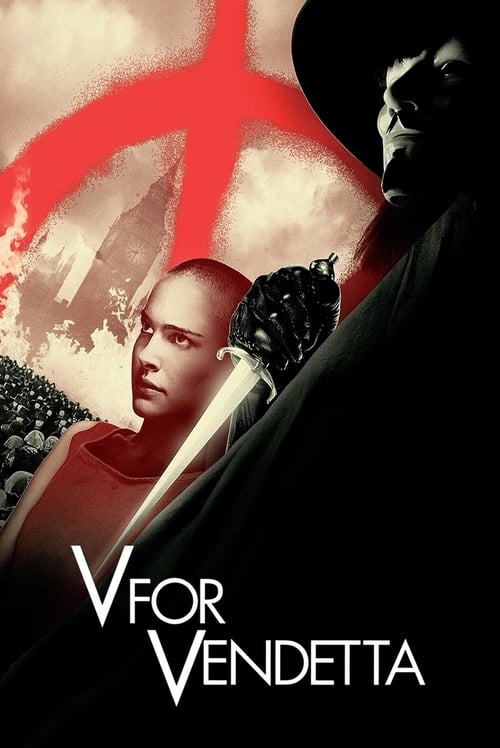
V for Vendetta
2006 · James McTeigue
For when you want a rewatchable dystopian thriller with an actual pulse of anger in it — entertaining enough for a Friday night, pointed enough to chew on after. Comfort food for people who like their comfort food political.
What it's about
In a near-future Britain ruled by a fascist party, a masked figure calling himself V wages a one-man theatrical war against the regime — assassinations, sabotage, and broadcasts that dare the public to stop being afraid. When he rescues Evey, a young television employee, from the secret police, she's pulled into his campaign and forced to decide what she's willing to lose for it. Adapted from Alan Moore and David Lloyd's graphic novel, it's a revenge story wrapped inside a story about how tyranny is maintained and how it falls.
The experience
A slick, talky, surprisingly idea-driven blockbuster — stretches of monologue and political dread punctuated by operatic set pieces. It's rousing rather than subtle, and it wants to leave you arguing about where resistance ends and terrorism begins.
Performances
Hugo Weaving acts an entire performance through a fixed mask, doing it all with voice and body language; Natalie Portman anchors the film emotionally as Evey, including a famously raw, transformative stretch at its center.
The craft
Written and produced by the Wachowskis and directed by James McTeigue, it translates a dense graphic novel into clean, punchy pop filmmaking — bold production design, fire-and-fireworks spectacle, and dialogue that treats a mainstream audience as capable of listening. The finale is built for a big screen and loud speakers.
Why it matters
Its legacy escaped the cinema: the Guy Fawkes mask became a real-world emblem of protest and hacktivism worldwide, making this one of the rare films whose iconography outgrew the movie itself.
Snapshot
V for Vendetta is a dystopian action-thriller adapted from the graphic novel by Alan Moore and David Lloyd, set in a near-future Britain ruled by the fascist Norsefire party. A masked terrorist-liberator who calls himself only "V" (Hugo Weaving) wages a theatrical campaign of assassination and demolition against the regime, drawing a young television worker, Evey Hammond (Natalie Portman), into his orbit and, ultimately, into his cause. Directed by first-time feature filmmaker James McTeigue and written and produced by the Wachowskis, the film transplants Moore's Thatcher-era parable of anarchism versus fascism into the anxieties of the post-9/11 Anglo-American moment: surveillance, indefinite detention, torture, and government-manufactured fear. Its most durable legacy lies outside the cinema entirely — the stylized Guy Fawkes mask worn by V became, in the years after release, a globally recognized emblem of protest movements. The film is notable both as an unusually explicit piece of political allegory from a major studio and as a case study in adaptation friction, given Moore's total public disavowal of the project.
Industry & production
The film was produced by Joel Silver's Silver Pictures together with the Wachowskis (credited then as Andy and Larry Wachowski), with financing from Virtual Studios, and released through Warner Bros. It was the Wachowskis' first major production following the Matrix trilogy, and it functioned in part as a directorial launch for James McTeigue, who had served as first assistant director on the Matrix films and on other large-scale productions. The Wachowskis wrote the screenplay and remained closely involved as producers, and much reporting and critical commentary has treated the film as bearing their creative fingerprints as strongly as McTeigue's — a collaboration whose precise division of authorship is difficult to fix from the public record.
Production was based principally at Babelsberg Studios in Germany, with location work in and around London for the recognizable civic landmarks — Parliament, the Old Bailey — that the story targets for destruction. The most widely discussed production event was a mid-shoot recasting: James Purefoy was originally cast as V and filmed for a period before departing the role, with Hugo Weaving stepping in. Accounts describe Weaving completing the performance, with some of the earlier footage retained and revoiced. The exact mechanics of that transition have been reported in general terms rather than fully documented, so the precise extent of reshooting versus dubbing should be treated as approximate.
The release history carries its own political charge. The film was widely anticipated for a 5 November 2005 opening — Guy Fawkes Night, the date at the heart of the story — but was ultimately released in early 2006. Commentators at the time linked the delay to the July 2005 London transit bombings and the sensitivity of a plot centered on a sympathetic bomber attacking London; the studio's stated reasons were more prosaic, and the causal connection remains a matter of speculation rather than confirmed fact. The film was a solid commercial performer for a mid-budget genre picture, though specific figures are outside the scope of this account.
Technology
V for Vendetta was photographed on 35mm film by Adrian Biddle, working in the anamorphic-scaled, high-contrast idiom of contemporary studio genre filmmaking rather than pursuing the digital-image experimentation associated with the Wachowskis' Matrix work. The film is not primarily a visual-effects showcase; its set-piece technology is concentrated in a handful of sequences — the demolitions of the Old Bailey and Parliament, rendered with fireworks and pyrotechnic spectacle, and the climactic slow-motion knife combat, which uses digital enhancement to trace the arcs of V's blades through the air. These effects are integrated to serve theatrical spectacle rather than to foreground the apparatus, a deliberate restraint given the pedigree of the filmmakers. The central technical-performance challenge was the fixed Guy Fawkes mask itself: an immobile molded face that eliminated conventional facial expression as an actor's tool, forcing the performance into voice, posture, and gesture (discussed further under Performance).
Technique
Cinematography
Adrian Biddle's cinematography favors a controlled, desaturated palette punctuated by warm firelight and the reds of Norsefire iconography, a visual scheme that codes the regime's world as cold and administered while associating V's spaces — the Shadow Gallery, the finale — with warmth, color, and spectacle. Compositions lean toward the graphic and symmetrical, an appropriate register for a film adapted from a comic and preoccupied with iconography, propaganda, and staged image-making. This was among Biddle's final films; he died in late 2005, shortly after its completion, which lends the work a valedictory weight in accounts of his career. His credits included major genre and effects-heavy productions, and the assured, classical handling here is consistent with that experience.
Editing
Martin Walsh edited the film. The cutting alternates between conventional thriller construction — the police procedural strand following Inspector Finch as he reconstructs V's origins — and set-piece stylization, most conspicuously the slow-motion finale, in which time dilation and rhythmic cutting transform a knife fight into balletic spectacle. The film also relies on montage to compress backstory and political history, notably in the sequence reconstructing the Larkhill detention facility and the epistolary flashback to the imprisoned Valerie, one of the film's most praised passages. Walsh's editing generally subordinates flash to clarity, keeping the layered plot legible.
Mise-en-scène / staging
Production and costume design build a plausible near-future authoritarian Britain out of recognizable present-day elements: state television, ubiquitous surveillance, curfews, and the black-and-red heraldry of the Norsefire party, whose cross-like insignia and rally staging evoke twentieth-century fascism without exact quotation. V's Shadow Gallery — crammed with the art, film, and music the regime has proscribed — functions as a mise-en-scène thesis statement, positioning culture itself as the terrain of resistance. Staging throughout is deliberately theatrical: V performs, quotes, and orchestrates, and the film frames him accordingly, treating public space as a stage for symbolic acts.
Sound
Dario Marianelli composed the score, which moves between brooding, string-driven suspense and grander orchestral statement. The film's most celebrated musical gesture is its deployment of Tchaikovsky's 1812 Overture, which V plays over loudspeakers to accompany the destruction of the Old Bailey and which returns, with cannon and fireworks, for the climactic demolition — a diegetic-to-spectacular fusion of music and pyrotechnics that has become the film's sonic signature. The soundtrack also incorporates period and popular songs to characterize the world outside the regime's control. Marianelli was, in this same mid-2000s period, producing acclaimed work in the literary-adaptation register, and the score's blend of the elegiac and the martial reflects that range.
Performance
Hugo Weaving performs V entirely behind an unchanging mask, a constraint that pushes the entire characterization into vocal cadence — a florid, alliterative, quasi-theatrical diction — and into physical bearing: the tilt of the head, the flourish of the hands, the choreography of movement. Critics widely regarded it as a considerable feat of expressive economy given the erasure of the face. Natalie Portman anchors the film's emotional and political arc as Evey, whose transformation from frightened bystander to committed radical includes the film's harshest sequence, her imprisonment and interrogation, for which Portman's head is shaved on camera. The supporting cast is deeply British and heavily weighted with veterans: Stephen Rea as the melancholy detective Finch, John Hurt as the ranting Chancellor Sutler (a pointed piece of casting given Hurt's earlier role as the persecuted protagonist of Nineteen Eighty-Four), Stephen Fry as a closeted television host, and Tim Pigott-Smith, Roger Allam, and Rupert Graves in regime and police roles.
Narrative & dramatic mode
The film operates in two interlocking modes. The first is the mystery-thriller: Finch's investigation gradually excavates the regime's founding crime — a biological attack, blamed on terrorists, that Norsefire itself engineered to seize power — so that the audience learns the world's true history alongside the detective. The second is the melodrama of Evey's radicalization, structured around her capture, imprisonment, and the revelation that V himself has staged her ordeal to free her of fear. This second strand is the film's most morally provocative device and its most debated: V's methods toward Evey are indistinguishable, in their mechanics, from the regime's, and the film asks the viewer to accept a coercive liberation. The narrative culminates in a mass public uprising, thousands of citizens donning identical V masks — a shift from the individual avenger to a collective symbol that resolves the story on the register of allegory rather than realism.
Genre & cycle
V for Vendetta sits at the intersection of several cycles. It belongs to the mid-2000s wave of graphic-novel adaptations aimed at adult audiences — a lineage that includes other Alan Moore-derived films — distinguished from the superhero mainstream by its literary source and political ambition. It is equally a dystopian science-fiction film in the tradition of Nineteen Eighty-Four, Brazil, and Fahrenheit 451, and its casting of John Hurt makes that lineage explicit. And it is a post-9/11 political allegory, part of a cluster of 2000s films metabolizing the war on terror, surveillance, and detention. Its distinctive move within these cycles is to make the sympathetic protagonist a terrorist by any conventional definition — a genre gamble that generated much of the film's controversy.
Authorship & method
The film is a genuinely divided authorship. James McTeigue directs, in his feature debut, bringing a background as an assistant director on large-scale productions; the Wachowskis wrote the screenplay and produced, and the film is stylistically and thematically continuous with their concerns — systems of control, awakening from imposed illusion, the transformation of the ordinary person into an agent of change. Distinguishing McTeigue's contribution from the Wachowskis' is difficult from the outside, and responsible accounts treat the film as a collective work of that circle rather than a pure auteur statement. Key collaborators include cinematographer Adrian Biddle, in one of his last credits; composer Dario Marianelli; and editor Martin Walsh, an Academy Award winner for Chicago. The source authorship is itself contested: the film is based on the work of Alan Moore and David Lloyd, but Moore, consistent with his practice on all screen adaptations of his comics, disavowed the film and had his name removed, so that on-screen credit for the source attaches to Lloyd alone. Moore's stated objections centered on both his general refusal of Hollywood adaptation and specific concerns about how the story's anarchist politics were reframed.
Movement / national cinema
The film resists tidy national classification. It is an American-financed studio production (Warner Bros., Silver Pictures, Virtual Studios), physically made largely in Germany at Babelsberg with British location work, telling an emphatically British story with a predominantly British cast. It is best understood as a transatlantic co-production of the kind common to 2000s genre filmmaking, in which Hollywood capital and infrastructure are brought to bear on ostensibly national material. Its politics, likewise, are hybrid: a British source text about Thatcherism retooled to speak to American audiences about the Bush-Blair years.
Era / period
Released in 2006, the film is saturated with the concerns of its moment. Norsefire's rise through a manufactured terror attack, its use of a subservient state broadcaster, its detention camps and torture, its scapegoating of Muslims and gay people, and its rhetoric of security over liberty read as pointed commentary on the war on terror, the Iraq War, the debates over surveillance and rendition, and the imagery of Abu Ghraib and Guantánamo then circulating in public consciousness. The film updates Moore's 1980s parable — written against Thatcherism and Cold War nuclear dread — into a specifically 2000s idiom, which is precisely the transposition Moore objected to and which many critics identified as the film's central interpretive act.
Themes
The film's governing theme is the relationship between fear and political power: the regime rules by manufacturing terror, and V's counter-project is to strip citizens of their fear, whether by spectacle or by the coercive ordeal he inflicts on Evey. Adjacent to this sit the film's meditations on the distinction — or non-distinction — between terrorism and resistance, on the ethics of violence in the service of liberation, and on the ambiguity of a hero whose means mirror his enemy's. A second cluster concerns identity and symbol: V is defined by the erasure of his individual face into an idea ("beneath this mask there is an idea, and ideas are bulletproof"), and the film ends by multiplying that mask across a crowd, arguing that symbols outlive persons. The film also foregrounds culture and memory as sites of resistance — the banned art of the Shadow Gallery, the smuggled love letter of Valerie — and treats the persecution of sexual minorities as a defining marker of the regime's evil, a thematic emphasis notably sharpened from the source.
Reception, canon & influence
Critical reception was mixed-to-positive. The film drew praise for Weaving's masked performance, for Portman's arc and the Valerie sequence, and for its willingness to stage explicit political argument within a studio genre film; skeptics found its politics muddled or adolescent, its embrace of a terrorist hero glib, and its adaptation reductive of Moore's more searching anarchism. Alan Moore's public disavowal became part of the film's reception story, framing it within the recurring conflict between Moore and screen adaptation.
The influences on the film run in two directions: backward to the dystopian literary-cinematic canon (Nineteen Eighty-Four above all, invoked directly through John Hurt's casting, alongside Brazil and Fahrenheit 451), and to the source graphic novel's own Thatcher-era anarchist politics and Guy Fawkes iconography, itself drawn from the historical Gunpowder Plot of 1605.
The film's forward influence is disproportionate to its critical standing and is concentrated in a single, remarkable afterlife: the Guy Fawkes mask designed for the film became, over the years following release, the adopted emblem of the hacktivist collective Anonymous and subsequently of Occupy and numerous other protest movements worldwide — one of the rare instances of a film's designed object escaping the film entirely to become a live political symbol. The phrase "Remember, remember the fifth of November" and the image of masked crowds likewise entered wider circulation. Within cinema, the film consolidated a template for adult, politically inflected graphic-novel adaptation and remains a frequently cited reference point in discussions of post-9/11 allegory and of the sympathetic-terrorist protagonist. Its standing in the critical canon is contested, but its standing in political culture is, unusually, secure.
Reception
Critics were split in 2006 — some called it muddled dorm-room politics, and Alan Moore famously disowned it sight unseen — but the film outgrew its reviews: within a few years its imagery was on real streets worldwide, and it's now treated as one of the defining political thrillers of its decade.
How V for Vendetta was received, from release to now →
How to watch V for Vendetta: what to notice on a first viewing
- Watch V's hands and head tilt instead of his face. Weaving never removes the mask, so every emotion routes through posture, hand flourish, and vocal cadence. The performance proves a face isn't required to build a character viewers trust.
- Notice how gray the regime's world looks against V's warm-lit rooms. Biddle desaturates every official space while giving V's hideout warm light and color. The palette itself tells you who controls the state and who controls spectacle.
- Look at what fills the Shadow Gallery's shelves and walls. V's hideout is stocked with the art, film, and music Norsefire has banned, turning a single room into an archive of everything outlawed. The set argues that culture itself is the ground on which resistance happens.
- Track how V treats public spaces as a stage. V performs, quotes, and orchestrates every appearance in public, from his introductions to his broadcasts, staging politics as theater. This theatricality is the film's argument that symbols move people more than arguments do.
- Listen for the songs playing in shops and homes outside official broadcasts. Marianelli's score and the soundtrack's period songs mark out spaces the regime hasn't fully colonized, distinct from its brooding, martial cues. Sound tells you where control ends and ordinary life still survives.
The whole guide to watching V for Vendetta, with the keys for a rewatch →
Influences: the films it descends from and the films it influenced
- Nineteen Eighty-Four (1984) — V casts John Hurt — Radford's crushed dissident Winston Smith — as the tyrant Chancellor Sutler, an intentional casting inversion, and lifts its telescreen-propaganda-address grammar for Norsefire's state broadcasts.
- A Clockwork Orange (1971) — Kubrick's near-future authoritarian Britain and his ironic scoring of violence and spectacle to canonical classical music is the direct model for V's Tchaikovsky-1812-scored demolitions and state-conditioning premise.
- Brazil (1985) — Its retro-futurist ducted-bureaucratic totalitarian production design and gallows-satire tone shape V's Norsefire ministry interiors and its vision of the state as an absurd machinery of control.
- Fahrenheit 451 (1966) — The book/art-hoarding-as-resistance motif and the state-fireman-of-culture premise feed directly into V's contraband Shadow Gallery and censorship-state setup.
- The Battle of Algiers (1966) — Pontecorvo's sympathetic framing of an insurgent bombing campaign against a repressive state is the formal template for V's cinematically-endorsed terrorist protagonist.
- The Wild Bunch (1969) — Peckinpah's multi-camera, stuttered slow-motion balletic-violence montage is the exact grammar of V's climactic knife fight rendered in ramped slow motion.
- The Phantom of the Opera (1925) — Lon Chaney's masked, theater-haunting avenger who must perform entirely through a fixed face, gesture, and voice is the model for Weaving's fully-masked vocal-and-body performance.
- The Count of Monte Cristo (1934) — The film screens this version diegetically; its wrongful-imprisonment-into-avenger revenge architecture is the scaffolding V and Evey literally watch and then re-enact.
- Watchmen (2009) — The next major Alan Moore adaptation — likewise publicly disavowed by Moore — extending V's template of the faithful, politically-freighted adult Moore film with slow-motion set pieces.
- The Dark Knight (2008) — Carries V's post-9/11 masked-agent-versus-order argument into the blockbuster, staging explicit debate over fear, mass surveillance, and extra-legal violence as the film's engine.
- Ninja Assassin (2009) — McTeigue's Wachowski-produced follow-up carries forward the same circle's stylized slow-motion bladed choreography and arterial blood-spectacle.
- The Hunger Games (2012) — Popularizes V's image-vocabulary — a designed emblem of revolt and masked/uniformed crowds rising against an authoritarian capital — as the structural climax of a mass-market uprising narrative.
- The Matrix (1999) — Same authorial circle: the awakening-from-imposed-illusion narrative, the trench-coated messianic outsider, and fetishized slow-motion combat choreography recur as a shared Wachowski signature.
- Sin City (2005) — A contemporaneous panel-faithful comic adaptation whose high-contrast, near-monochrome desaturation established the mid-2000s adult graphic-novel look V shares.
- A History of Violence (2005) — A same-era serious-cinema graphic-novel adaptation that legitimized adult comic sources as a vehicle for grown-up dramatic argument, V's exact project in a genre register.
- Children of Men (2006) — A same-year near-future authoritarian Britain — detention, surveillance, and a desaturated gray palette — rendering post-9/11 security-state anxiety in parallel to V's dystopia.
- 300 (2006) — A same-year Frank Miller adaptation built on graphic-symmetry tableaux and ramped slow-motion as its core stylistic engine, mirroring V's symmetrical staging and slow-mo climax.
- 1984 (1956) — It directly extends the war-worn totalitarian-London setting and Big Brother surveillance iconography, and consciously cites the lineage by casting John Hurt (Winston in Radford's 1984) as the all-seeing High Chancellor.
Similar films
- The Matrix (1999) — influence & lineage
- The Dark Knight (2008) — influence & lineage
- A Clockwork Orange (1971) — influence & lineage
- The Hunger Games: Catching Fire (2013) — same viewing thread
- Kingsman: The Secret Service (2015) — same viewing thread
- Captain America: The Winter Soldier (2014) — same viewing thread
- RoboCop (1987) — same viewing thread
- The Matrix Revolutions (2003) — shared sensibility
All the films related to V for Vendetta →
Watch it with: curated runs of related films
- Rogue Heroes, Rigged Systems — A run of slick, propulsive 21st-century spectacle — spies, super-soldiers, sci-fi survivors, and dystopian rebels all squaring off against some vast machine or shadowy apparatus — best watched back-to-back when you want momentum, style, and a lone figure taking on the whole board.