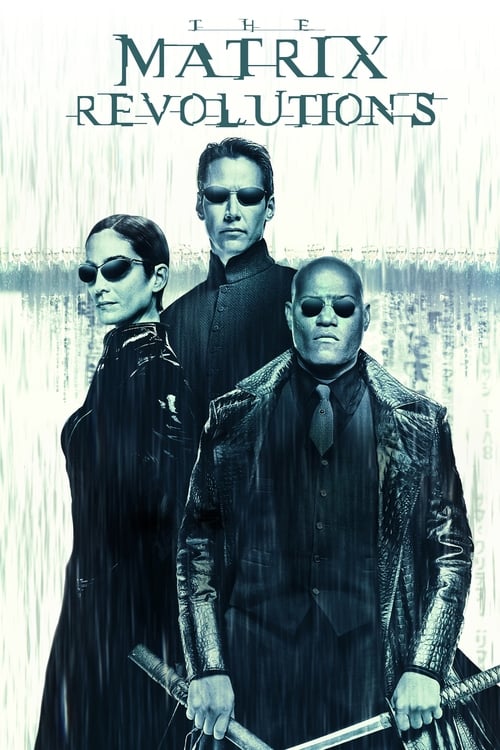
The Matrix Revolutions
2003 · Lana Wachowski
For finishing what you started: the closing night of a trilogy binge, when you want scale, catharsis, and a real ending rather than another cliffhanger.
What it's about
The endgame. Machine armies breach the digs above Zion and the last human city braces for a full-scale siege, all mechs and swarming sentinels, while Neo travels toward the Machine City itself to try to end the war at its source. Standing in the way is Agent Smith, now a virus consuming the Matrix from within.
The experience
Darker and heavier than its predecessors — less playful puzzle-box, more full-on war film, driving toward an operatic, mythic finale. It's grim, sincere, and swings for the fences.
The craft
The siege of Zion is a staggering piece of effects filmmaking — walls of machines pouring through a breach while humans in exo-suit loaders hold the line — and the final showdown plays out as rain-soaked comic-book opera. The sound design and score go for the apocalyptic. Big screen, good subwoofer.
Why it matters
The trilogy's most divisive entry, argued over since release — but its willingness to end a blockbuster saga on sacrifice and ambiguity rather than easy triumph has aged into a genuine talking point.
Snapshot
The Matrix Revolutions is the third film in the trilogy that the Wachowskis (then credited as Andy and Larry Wachowski) launched in 1999, and the direct continuation of The Matrix Reloaded, released six months earlier the same year. Where the first film was a self-contained genre coup and Reloaded an expansionist middle chapter, Revolutions is a war film and an eschatology: it abandons much of the playful epistemology of the original to stage the siege of Zion, the last human city, against a machine army, while Neo (Keanu Reeves) carries the conflict to the Machine City itself to broker an end to the war. It is the most divisive entry in the series — widely read as anticlimactic relative to the 1999 original — and the one that most fully commits to the trilogy's Christian, Buddhist, and Gnostic substrata, resolving the saga not through victory but through sacrifice and a negotiated truce. The two sequels were shot back-to-back, and Revolutions is best understood as the second half of a single production rather than a discrete project, which shapes nearly everything about its style, scale, and reputation.
Industry & production
Revolutions was produced by Joel Silver for Warner Bros. and the Wachowskis' Village Roadshow co-financing arrangement, the same apparatus that had carried The Matrix and Reloaded. The defining production fact is that Reloaded and Revolutions were filmed simultaneously in a continuous shoot, primarily at Fox Studios Australia in Sydney, with location work in the Bay Area and elsewhere — a back-to-back model that the Lord of the Rings films had recently made conspicuous but which here served a single mammoth narrative split across two release dates. This allowed the enormous physical builds (the Zion dock, the hovercraft interiors, the machine environments) to be amortized across two films and let the effects houses plan a unified pipeline.
Warner Bros. positioned the two sequels as a tentpole event, and the marketing leaned on the cultural saturation the first film had achieved. A distinctive distribution gambit accompanied Revolutions: Warner Bros. opened the film simultaneously across major world markets on the same day, a coordinated global release unusual for the period and intended both to capitalize on anticipation and to blunt piracy. I won't cite specific grosses, but the critical and commercial consensus is consistent: Revolutions was a substantial earner that nonetheless underperformed Reloaded and was received more coolly, the trilogy's box-office and critical arc bending downward across its two 2003 installments. The film's release also sat within a larger transmedia franchise — the Animatrix anthology of short films and the Enter the Matrix video game — which carried plot threads (notably the character Niobe and the events around the ship Osiris) that the films assumed but did not fully dramatize.
Technology
The Matrix films were a watershed for digital visual effects, and Revolutions pushed the trilogy's signature tools to their largest scale. The first film's "bullet time" — a frozen or hyper-slow camera move around action, achieved with arrays of still cameras and digital interpolation — had become a global reference point; the sequels evolved this into what the effects team (led by John Gaeta) called "virtual cinematography," in which performers and environments were captured photographically and reconstructed as manipulable digital data, allowing wholly synthetic camera moves through scenes that had no single real vantage. This image-based rendering approach underwrites the film's most ambitious set pieces.
Revolutions concentrates this technology in two arenas. The first is the Battle of Zion: the defense of the dock, in which human-piloted APUs (armored exoskeletons) fire on a swarming horde of Sentinels, is a sustained, almost entirely digital combat sequence of a density that was near the ceiling of what was achievable in 2003. The second is the climactic Neo–Smith fight in the rain, a fully virtual aerial duel between two characters who are, for much of the sequence, digital constructions inhabiting a CG environment. The film is therefore a key document in the early-2000s transition from effects as augmentation to effects as the primary medium of the image, and it was a major workload for the effects vendors (centered on ESC Entertainment, the Wachowskis' own facility, alongside other houses) that the sequels had stood up. The IMAX angle is also relevant: Revolutions was among the films released in large-format presentation, part of the period's experimentation with premium exhibition.
Technique
Cinematography
Bill Pope, the cinematographer of all three original films, shot Revolutions, lending the trilogy a consistent photographic signature. Pope's scheme famously color-codes the diegesis: the simulated Matrix carries a green cast (evoking phosphor monitors and code), while the "real" world of the ships and Zion is rendered cooler and more naturalistic. Revolutions complicates this with sequences that depart from both palettes — the strange limbo of Mobil Avenue, a train station between worlds, and the blinding, overexposed brightness of the Machine City, which Neo "sees" as light after he is blinded. The Zion battle is staged in deep, smoky darkness pierced by muzzle flash and tracer fire, a register closer to a war picture than to the chic noir of the 1999 film. Pope's camera work integrates with the virtual-cinematography pipeline, so that "photography" here is partly a planning discipline for shots that would be completed digitally.
Editing
The film was edited by Zach Staenberg, who had cut the previous two installments and won the Academy Award for editing the original Matrix. Staenberg's challenge in Revolutions is cross-cutting at scale: the climax braids at least three simultaneous lines — the Sentinel assault on Zion's dock, Niobe's desperate flight of the Logos through the mechanical tunnels, and Neo and Trinity's approach to the Machine City — and then converges them on Neo's confrontation with Smith. The cutting must sustain spatial legibility across enormous digital battlefields while maintaining the parallel-rescue tension of classical crosscutting. The Zion sequence in particular is an exercise in keeping geography readable amid near-total chaos, and the film's pacing reflects its identity as a sustained third act rather than a freestanding story with its own setup.
Mise-en-scène / staging
Revolutions is the trilogy's most architecturally militarized installment. The Zion dock is a vertical industrial cathedral of gantries and APUs; the staging emphasizes scale, verticality, and the human body dwarfed by both its own machines and the enemy's. The film's visual rhetoric repeatedly opposes the organic and crowded humanity of Zion against the geometric, swarming, hive-logic of the Sentinels and the Machine City, which is imagined as a vast face-like aggregation of insectile mechanisms. The Smith-saturated Matrix — a world in which every body wears Smith's face — turns staging itself into a thematic statement about replication and the erasure of difference.
Sound
Dane Davis, the trilogy's sound designer (an Oscar winner for the first film), gives Revolutions a dense, mechanized soundscape: the percussive report of the APU cannons, the chittering metallic mass of the Sentinels, and the elemental roar of the final rainstorm duel. The sound design is integral to selling the digital imagery as weighty and physical. The Zion battle is one of the louder, more relentless sustained mixes of its era's action cinema, and the contrast between the war's industrial din and the eerie quiet of Mobil Avenue or the Oracle's garden is a deliberate dynamic strategy.
Performance
Keanu Reeves plays a Neo who has, by this film, become almost wholly iconographic — messianic, often still, increasingly defined by gesture and stance rather than dialogue, and for the climax literally blinded, so that Reeves performs sightless attunement rather than vision. Hugo Weaving's Agent Smith is the film's most kinetic performance, a gleeful, expanding malevolence whose viral self-replication lets Weaving inflect dozens of bodies. Carrie-Anne Moss's Trinity carries the film's most affecting passage, a death scene that is the emotional hinge of the finale. Laurence Fishburne's Morpheus, so central to the first film as prophet and mentor, is comparatively sidelined here, his certainty having outlived its narrative usefulness — a deliberate diminishment as the trilogy questions the prophecy he believed. Mary Alice takes over the role of the Oracle (following Gloria Foster's death during production), and Jada Pinkett Smith's Niobe is given real agency in the rescue plot.
Narrative & dramatic mode
Revolutions operates in the mode of apocalyptic war epic crossed with religious allegory. It is structurally the resolution movement of a three-part symphony, and it largely forgoes exposition and reversal in favor of escalation and culmination. The dramatic engine is sacrifice rather than revelation: where the first film climaxed on Neo's awakening to power, the trilogy ends on his surrender of it — Neo achieves peace not by defeating the machines but by allowing Smith, the uncontainable anomaly, to assimilate him, thereby giving the Machine mainframe the means to delete the rogue program. The mode is therefore tragic and redemptive rather than triumphant. This is also where the trilogy's investment in determinism versus choice resolves: the "prophecy" is reframed less as destiny than as a system of control, and Neo's final act is meaningful precisely because it exceeds the role written for him.
Genre & cycle
The film sits at the intersection of science fiction, the war film, and the comic-book-influenced action spectacle, and it belongs to several cycles at once. It is the terminus of the Matrix trilogy's own cycle; it is part of the early-2000s wave of effects-driven, mythologically ambitious blockbusters (contemporaneous with the Lord of the Rings and Star Wars prequel trilogies) that treated genre cinema as vehicle for grand metaphysical narrative; and it draws openly on Hong Kong action cinema and Japanese anime and manga, traditions the Wachowskis had foregrounded from the start. Within the action genre, Revolutions notably pivots from the martial-arts-and-gunplay register of the earlier films toward large-scale mechanized siege warfare, making it as much a sibling to military SF as to the wuxia-inflected gun-fu of 1999.
Authorship & method
Revolutions is a Wachowski film through and through — written and directed by the siblings (then Andy and Larry; both later came out as transgender women, Lana and Lilly, and the trilogy has since been widely re-read through a trans-allegorical lens, a reading Lilly Wachowski has publicly affirmed in general terms about the Matrix films). Their method is auteurist and synthetic: a magpie absorption of philosophy (Baudrillard, Gnostic and Buddhist thought, messianic Christianity), of anime (notably Ghost in the Shell), of Hong Kong action, and of comics, fused into a coherent personal cosmology. The key collaborators form a remarkably stable repertory: cinematographer Bill Pope, editor Zach Staenberg, composer Don Davis, sound designer Dane Davis, effects supervisor John Gaeta, fight choreographer Yuen Woo-ping, and production designer Owen Paterson all carried across the trilogy. Don Davis's score for Revolutions extends his brass-heavy, minimalist-influenced symphonic idiom and culminates in "Neodämmerung," a choral setting (sung in Sanskrit, drawing on the Upanishads) that scores the final duel — one of the trilogy's most overtly ritualized musical gestures. The continuity of this team is central to the trilogy's stylistic unity and to reading the two sequels as one work.
Movement / national cinema
The film is a product of the American studio system but is transnational in its creative DNA and its physical making. Shot in Australia with a substantial Australian crew, drawing its action grammar from Hong Kong (Yuen Woo-ping's choreography) and its imagistic and thematic imagination from Japanese animation, Revolutions exemplifies the globalized blockbuster of the early 2000s — Hollywood capital and distribution wrapped around a deliberately international set of aesthetic sources. It does not belong to a national "movement" in the art-cinema sense; its lineage is better described as the convergence of American genre filmmaking with East Asian action and animation traditions that the Wachowskis helped mainstream for Western audiences.
Era / period
Revolutions is firmly a film of the early-2000s digital-effects boom and of a specific post-9/11 cultural moment. Released in November 2003, it arrived into an American culture preoccupied with war, security, and apocalyptic stakes, and its imagery of a besieged last city defending itself against an overwhelming, faceless enemy inevitably resonated with that climate, even though the trilogy's conception predated those events. Technologically it belongs to the threshold period when digital tools were first capable of carrying entire sequences, before that capacity became routine; aesthetically it sits at the tail of the "bullet time" cultural moment, when the trilogy's innovations had already been so widely imitated and parodied that the sequels had to escalate beyond them.
Themes
The film's governing themes are sacrifice, choice against determinism, and the possibility of peace between irreconcilable orders of being. Neo's arc completes the trilogy's interrogation of free will: the prophecy that promised a savior is revealed as a mechanism of control, and genuine freedom lies in the unscripted act. Smith functions as Neo's necessary opposite and shadow — the trilogy explicitly frames them as equation and remainder, two halves of a system that can only be balanced by their mutual cancellation. Replication and the loss of individuality run through the Smith plague, in which difference is consumed by sameness. The religious syncretism is overt: Christian sacrifice and resurrection, Buddhist non-attachment and the cycle of cause and effect (the program child Sati, the karmic logic of "love" named as a kind of code), and Gnostic suspicion of the constructed world all coexist. Finally there is the theme of coexistence over conquest — the trilogy ends not with humanity's victory but with a truce, the Oracle and the Architect agreeing to a fragile peace, a resolution that frustrated viewers wanting catharsis but is consistent with the films' anti-triumphalist ethics.
Reception, canon & influence
Critical reception of Revolutions was the most muted of the trilogy. Many reviewers found it spectacular but emotionally and intellectually thinner than the original — praising the Zion battle's technical achievement while judging the resolution opaque or unsatisfying, and lamenting that the philosophical play of the 1999 film had given way to operatic war and cryptic theology. This relative disappointment hardened into the conventional wisdom that the sequels could not match the original, though critical reassessment over the following two decades has been more generous, with some writers arguing that the trilogy's ambitions are best appreciated as a whole and that Revolutions' refusal of a clean triumph is a feature rather than a failure.
The influences on the film are the same currents that fed the whole trilogy: Japanese anime and manga (above all Ghost in the Shell and the broader mecha tradition visible in the APUs and Sentinels), Hong Kong action cinema, Baudrillard's Simulacra and Simulation, Gnostic and Buddhist and Christian thought, and the cyberpunk literary lineage of Gibson and Dick. Its influence forward is inseparable from the trilogy's: the Matrix films reshaped action choreography, popularized virtual cinematography and digital camera freedom, and saturated popular culture with their imagery and ideas to the point that the films' own vocabulary ("red pill," "the Matrix" as metaphor) entered everyday speech. Revolutions specifically demonstrated the feasibility of feature-length digital battle spectacle and contributed to normalizing the back-to-back, transmedia franchise model. The trilogy was later extended by Lana Wachowski's The Matrix Resurrections (2021), which reflexively reckoned with the saga's own legacy, retroactively reframing Revolutions as the end of the "classic" trilogy and the resolution against which the fourth film defines itself. Where the historical record is thin — particularly around internal production decisions and precise commercial figures — this account refrains from inventing specifics, but the broad arc is well established: Revolutions is the somber, war-weary close to one of the most influential film cycles of its era.
A Deleuzian reading
The image that stays is Neo on his knees in the machine fields, eyes burned to scar tissue, telling Trinity he can still see.
The full Deleuzian reading of The Matrix Revolutions →
Reception
Landed with a thud in 2003 — critics panned it and even fans exhausted by Reloaded's philosophy lectures shrugged — but two decades on it's a poster child for sequel reappraisal, with a vocal camp arguing the Wachowskis' sincerity was the point all along.
How The Matrix Revolutions was received, from release to now →
Influences: the films it descends from and the films it influenced
- Ghost in the Shell (1995) — Direct source for the green digital-rain cipher, the diving-into-the-net imagery, and the cyborg-soul iconography the Wachowskis storyboarded almost shot-for-shot into the trilogy's machine world.
- Akira (1988) — Established the anime grammar of biomechanical body-horror and apocalyptic scale that the Sentinel swarms and the cathedral-of-light Deus Ex Machina face directly extend.
- Mobile Suit Gundam / Patlabor mecha tradition (1989) — Source of the piloted-exoskeleton 'APU' design — human-operated walking gun-platforms with reload mechanics staged exactly as anime mecha cockpit drama.
- The Wild Bunch (1969) — Originated the slow-motion/normal-speed intercut and multi-angle coverage of massed gunfire that the Zion dock battle scales up into a feature-length balletic siege.
- Police Story (1985) — Hong Kong action's geographically legible, full-body wire-and-stunt choreography fed Yuen Woo-ping's fight design for the rain-soaked Neo/Smith aerial duel.
- Once Upon a Time in China (1991) — Yuen Woo-ping's wire-fu vocabulary of suspended, gravity-defying combat here is the same choreographic hand that stages the trilogy's airborne superhuman brawls.
- Apocalypse Now (1979) — Model for operatic, doom-laden war spectacle scored to choral grandeur — the 'Neodämmerung' Sanskrit choir over the final duel works as the trilogy's 'Ride of the Valkyries.'
- Aliens (1986) — Template for the militarized-verticality siege — grunts in powered loaders defending a chokepoint against an insectile swarm, the direct staging blueprint for the dock defense.
- Blade Runner (1982) — Set the cyberpunk color-coded palette of rain, neon, and machine-light that Bill Pope inverts into the trilogy's sickly green Matrix vs. amber real-world grading.
- Speed Racer (2008) — The Wachowskis push virtual cinematography to its logical end — layered, depth-collapsing digital compositing born from the trilogy's green-screen 'camera anywhere' freedom.
- 300 (2006) — Inherits the speed-ramped, fully-digital battlefield and last-stand-at-the-chokepoint staging, treating the entire war film as a green-screen comic-panel composite.
- Sky Captain and the World of Tomorrow (2004) — Took the trilogy's proof that actors could perform inside an entirely synthetic, virtually-photographed environment and built a whole feature on the workflow.
- Sucker Punch (2011) — Extends the anime-into-live-action pipeline of mecha, wire-fu, and digital-camera impossibilities the Matrix normalized for Western blockbusters.
- Avatar (2009) — Industrialized the virtual-camera and performance-capture-into-CG-environment methodology that Gaeta's Matrix work prototyped, making 'shoot the scene as data' the blockbuster standard.
- Inception (2010) — Carries forward the simulated-reality action grammar where physics bends to a coded layer — corridor fights and gravity inversions descend from the Matrix's rule-breaking staging.
- The Matrix (1999) — Origin of bullet-time — the John Gaeta virtual-camera array and CG interpolation that Revolutions extends into fully synthetic 'virtual cinematography' for the Burly Brawl-scale superbrawl.
- The Matrix Reloaded (2003) — Shot back-to-back with the same repertory (Pope, Staenberg, Gaeta, Don Davis, Yuen Woo-ping); its Burly Brawl pioneered the all-digital crowd-fight tech Revolutions reuses for the airborne finale.
- Equilibrium (2002) — Directly imitates the trilogy's trench-coated, gun-fu choreography fused with wire-assisted martial arts as a stylized signature.
Similar films
- The Matrix Reloaded (2003) — influence & lineage · same viewing thread
- The Matrix (1999) — influence & lineage
- Ghost in the Shell (1995) — influence & lineage
- Blade Runner (1982) — influence & lineage
- Akira (1988) — influence & lineage · same viewing thread
- Neon Genesis Evangelion: The End of Evangelion (1997) — same viewing thread
- Evangelion: 3.0+1.0 Thrice Upon a Time (2021) — same viewing thread
- Puella Magi Madoka Magica the Movie Part III: Rebellion (2013) — same viewing thread
All the films related to The Matrix Revolutions →
Watch it with: curated runs of related films
- Bodies at the End of the World — A run of visionary, punishing films where flesh is scarred, melted, mechanized or sacrificed while the world tips into its last days — watch these back to back when you want cinema at its most extreme and transcendent.