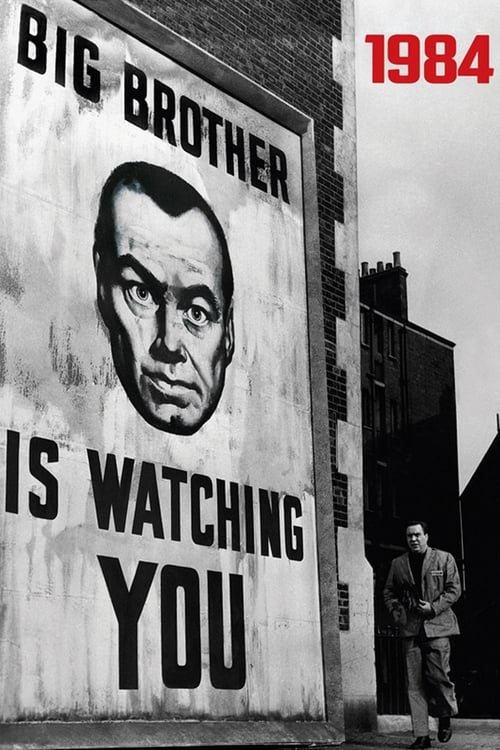
1984
1956 · Michael Anderson
For when you want a bleak, thought-provoking classic — dystopia at its most sobering, chosen for the ideas as much as the story. Challenge, not comfort; it pairs well with a long argument afterward.
What it's about
In the superstate of Oceania, where the Party watches every citizen and Big Brother's face is everywhere, Winston Smith spends his days rewriting history at the Ministry of Truth — erasing people and events on command. His rebellion is small and human: a forbidden love affair with a young woman named Julia, and a dangerous hope that a resistance exists. In this world, even a private feeling is a crime.
The experience
Stark, paranoid, and increasingly suffocating — a doomed romance played out under constant surveillance. The black-and-white austerity gives it a chill that creeps up on you.
Performances
Edmond O'Brien grounds Winston in sweaty, ordinary desperation — a bureaucrat's face slowly discovering fear — which makes the machinery around him feel all the more crushing.
The craft
The first big-screen attempt at Orwell's novel, staging telescreens, Thought Police, and ministry corridors with the stark black-and-white economy of 1950s British genre filmmaking. Its drab, boxed-in production design does much of the storytelling — a world engineered to make privacy impossible.
Why it matters
A Cold War artifact that shows how urgently Orwell's warning was felt within a decade of the book, and the template later screen versions would react against.
Snapshot
Michael Anderson's 1984 is the first theatrical feature adaptation of George Orwell's 1949 novel, a British production released in 1956 at the height of the Cold War. It transposes Orwell's vision of Oceania — a perpetually warring superstate governed by the Party and the unseen Big Brother — into the idiom of mid-1950s genre filmmaking, somewhere between the dystopian science-fiction picture, the political thriller, and the doomed romance. At its center is Winston Smith (Edmond O'Brien), a functionary in the Ministry of Truth whose job is the continuous falsification of the historical record, and whose private rebellion takes the form of a forbidden love affair with Julia (Jan Sterling) and a furtive, naïve faith in an underground resistance. That faith leads him to the Inner Party official renamed O'Connor in the film (Michael Redgrave), and from there to capture, torture, and the systematic destruction of his selfhood. The film occupies an awkward but historically important position: produced only two years after the celebrated 1954 BBC television version, made for a popular cinema audience, and burdened by a now-notorious decision to shoot two different endings for different markets, it has long been regarded as a flawed and compromised treatment of a canonical book. Yet it remains the screen's earliest sustained attempt to render Orwell's totalitarian world in images, and as such it is a significant document both of Orwell's early reception on film and of how 1950s cinema imagined the totalitarian future.
Industry & production
1984 was a British production of the mid-1950s, made by Holiday Film Productions and shepherded by the American producer N. Peter Rathvon, a former senior executive of RKO who had moved into independent production. It was distributed in the United Kingdom through the Associated British circuit and in the United States by Columbia Pictures. The film was shot in British studios with British technical crews, but its two leading roles were filled by imported American players — Edmond O'Brien and Jan Sterling — a casting strategy plainly aimed at securing the American market, and one with significant consequences for the film's texture.
The project followed close on the heels of the BBC's 1954 television adaptation, scripted by Nigel Kneale and directed by Rudolph Cartier with Peter Cushing as Winston Smith, which had caused a public sensation in Britain over its perceived horror and brutality. The theatrical film thus arrived in a climate where Orwell's story was already current and controversial. The rights had been licensed from the Orwell estate; Orwell himself had died in 1950, and his widow, Sonia Orwell, retained a guarded protectiveness over the property. The historical record indicates that she was unhappy with the liberties the film took, and the picture subsequently fell into a long rights limbo that kept it difficult to see for decades — a circumstance that has shaped its reputation as much as its content. Precise budget figures and box-office returns are not securely documented in the accessible record, and it would be invention to assign numbers to either.
The screenplay was credited to William P. Templeton and Ralph Gilbert Bettison, working-screenwriters of the period rather than literary adapters of note, and the compression of Orwell's dense, interiorized novel into a roughly ninety-minute feature is the source of much of the film's difficulty: Orwell's long expository passages, his invented apparatus of Newspeak and doublethink, and above all Winston's relentless inner monologue resist straightforward dramatization.
Technology
As a production, 1984 employs no unusual technology; it is a conventional black-and-white 35mm studio feature of its era. Its technological interest lies instead in what it depicts and how it visualizes Orwell's imagined apparatus of surveillance and control. The film must give physical form to the novel's most famous device — the telescreen, the two-way receiver-transmitter that watches as it broadcasts — and to the omnipresent posters and loudspeakers through which the Party colonizes private life. These are realized with the practical means of 1950s set design and rear-projection rather than any optical novelty: screens embedded in walls, the disembodied voice of authority, the iconography of Big Brother's gaze. The film also literalizes the war footing of Oceania through stock-footage-derived imagery of rockets and aerial threat, situating the story in the atomic anxiety of the period. There is no record of significant special-effects innovation; the film's futurism is achieved through art direction and suggestion, and its imagined surveillance state is rendered with the modest technical vocabulary available to a mid-decade British studio picture.
Technique
Cinematography
The cinematography is by C. Pennington-Richards, a capable British cameraman of the period, and it works in a register of high-contrast monochrome appropriate to the material. The visual world of the film is gray, austere, and rubble-strewn, drawing on the still-recent memory of Blitz-damaged London to imagine Airstrip One as a bombed and exhausted city. Pennington-Richards exploits the expressive resources of black-and-white — hard shadow, institutional gray, the cold planar surfaces of Party architecture — to convey a society drained of warmth and privacy. The camera is frequently positioned to register the watching telescreens and the looming posters, so that the framing itself enacts the theme of surveillance. The interrogation and torture sequences in the film's final movement adopt a harsher, more clinical lighting that strips away the modest lyricism of the love scenes. The overall photographic approach is functional and atmospheric rather than flamboyant; it serves the dystopian mood without calling attention to itself.
Editing
The editing organizes a narrative that must move briskly through a great deal of Orwellian material. The film's structure follows the novel's broad three-part arc — Winston's growing dissidence and the writing of his secret diary; the love affair with Julia and the false hope of the Brotherhood; and the long sequence of capture, interrogation, and re-education in the Ministry of Love — and the cutting compresses Orwell's extended passages into dramatically legible scenes. The pacing is necessarily economical, and one of the persistent criticisms of the film is that this compression flattens the gradual psychological erosion that the novel renders so patiently. The editing is at its most effective in the final act, where the rhythm of interrogation and breakdown gives the film its strongest dramatic momentum.
Mise-en-scène / staging
The production design is the film's most considered achievement. It builds a coherent visual society out of Party slogans, the recurring face of Big Brother, the drab uniforms and regimented communal spaces, and the contrast between public regimentation and the small, forbidden privacies Winston and Julia carve out — the rented room above the junk shop, the brief countryside escape. The staging repeatedly sets the individual body against the mass: rallies, the ritual Two Minutes Hate, the collective spaces in which deviation is impossible. Within this, the film stages intimacy as transgression, the lovers' room becoming a fragile island whose inevitable violation is the engine of the plot. The art direction's evocation of a shabby, war-worn, totalitarian London — neither sleekly futuristic nor merely contemporary — is the element that most successfully translates Orwell's imagined world to the screen.
Sound
The score is by Malcolm Arnold, one of the most accomplished British film composers of the era, whose music supplies much of the film's atmosphere of dread and institutional menace. The sound design foregrounds the apparatus of the Party: the omnipresent voice of the telescreen, the public-address announcements, the martial and propagandistic noise of Oceania's perpetual war footing. This aural saturation — the impossibility of silence or true privacy — is one of the film's most faithful renderings of Orwell, conveying through sound the totality of Party intrusion into consciousness.
Performance
Performance is the film's most contested dimension. Edmond O'Brien, a respected American character actor, plays Winston Smith as a heavier, more conventionally beleaguered everyman than Orwell's frail and sickly clerk; his Americanness sits uneasily within the otherwise British world of the film, and the casting has frequently been judged a miscalculation, though O'Brien brings a real conviction to Winston's terror and collapse in the later scenes. Jan Sterling's Julia is similarly an American presence in an English landscape. The film's strongest performances come from its British supporting players: Michael Redgrave brings authority and a chilling reasonableness to O'Connor, the Inner Party intellectual who first appears as a fellow conspirator and is revealed as Winston's tormentor, and Donald Pleasence — who had appeared in the 1954 BBC version and would later appear in the 1984 Michael Radford adaptation — lends his distinctive presence to the role of Parsons, the doomed enthusiast undone by his own child. The disjunction between the imported leads and the native supporting cast is one of the film's defining and most discussed features.
Narrative & dramatic mode
The film's dramatic mode is dystopian tragedy structured as a doomed romance and a thriller of entrapment. Its forward motion comes from Winston's escalating rebellion — the diary, the affair, the contact with what he believes is the resistance — and from the dramatic irony, sustained throughout, that the apparatus of the state is always already watching, that his every act of defiance is anticipated and permitted in order to be crushed. The love affair with Julia provides the emotional core and the illusion of freedom; its discovery and the lovers' arrest mark the hinge into the film's harrowing final movement. There the mode shifts decisively from romance to interrogation drama, as O'Connor methodically dismantles Winston's mind. The single most consequential dramaturgical fact about the film is its alternate endings: the production shot two different conclusions for different markets — one closer to Orwell's devastating original, in which Winston is broken and comes to love Big Brother, and a more defiant variant in which the lovers' rebellion is given a last, doomed assertion. This bifurcation, more than any other choice, defines the film's troubled fidelity to its source and has been the focus of much subsequent discussion.
Genre & cycle
1984 belongs to the cycle of 1950s science-fiction and dystopian cinema, but it is a distinctive entry within it. Where much of the decade's science fiction concerned alien invasion, atomic mutation, and monsters — frequently read as displaced expressions of Cold War and nuclear anxiety — Orwell's story offered an explicitly political dystopia, locating the threat not in the alien or the irradiated but in the totalitarian organization of human society itself. The film thus sits at the intersection of science fiction and the political-allegorical drama, anticipating the more sustained tradition of dystopian adaptation that would follow. In the immediate context of 1956, the anti-totalitarian theme carried an unmistakable Cold War charge, readily assimilable to Western anti-communist sentiment, even as Orwell's critique was aimed at totalitarianism in any form. The film also participates in the broader postwar British tradition of literary adaptation for the screen, bringing a prestige novel to a popular audience.
Authorship & method
The film is most legible as the work of its director, Michael Anderson, a versatile British craftsman of the 1950s whose output ran across genres. The same period saw him direct the war film The Dam Busters (1955) and the lavish international hit Around the World in 80 Days (1956), and his career would continue across decades into later science fiction such as Logan's Run (1976) — a body of work that marks him as a dependable professional rather than a thematically driven auteur. 1984 bears the signs of efficient genre direction: clear staging, brisk narrative management, and an emphasis on atmosphere and incident over the interior philosophical dimension that is the novel's substance.
Among the key collaborators, composer Malcolm Arnold is the most distinguished, and his score is a genuine asset; cinematographer C. Pennington-Richards supplied the film's effective monochrome dystopian surface; and the screenwriters William P. Templeton and Ralph Gilbert Bettison undertook the difficult labor of compression that necessarily reshaped Orwell's design. The renaming of the inner-party inquisitor from Orwell's "O'Brien" to "O'Connor" — to avoid confusion with the lead actor Edmond O'Brien — is a small but telling instance of the production's pragmatism overriding strict fidelity. The film's authorship is finally that of a commercial adaptation: a collaborative studio enterprise translating a literary monument into the conventions of mid-1950s popular cinema.
Movement / national cinema
1984 is a product of the British film industry of the mid-1950s, a period of solid commercial production organized around studios and distribution circuits such as the Associated British and Rank organizations. It belongs to no avant-garde or new-wave movement; it predates the British New Wave of social realism that would emerge at the end of the decade, and it is best understood as mainstream British studio filmmaking with one eye firmly on the American market — hence the imported American leads and the American distribution through Columbia. As an instance of national cinema it reflects a specifically British engagement with Orwell, who was a British writer and a central figure in postwar British intellectual life, and whose work had just been the subject of a landmark British television event. The film's vision of Airstrip One as a battered, austere London also draws on a recognizably British postwar landscape of rationing, reconstruction, and the lingering visual memory of wartime damage.
Era / period
The film is a precise artifact of 1956, a year near the height of the Cold War, in the immediate aftermath of the Korean War, the McCarthy era in the United States, and amid the nuclear standoff between the superpowers. Orwell's anti-totalitarian parable, written in 1949 with the Stalinist Soviet Union and wartime propaganda states clearly in view, mapped readily onto the political anxieties of 1956, and the film's reception was inevitably colored by the Western reading of the story as a warning against communist totalitarianism. The atomic backdrop of the film — the perpetual war, the rocketry, the sense of a civilization reduced and regimented by unending conflict — speaks directly to the nuclear dread of the period. The film also belongs to a moment of intense public interest in Orwell's novel specifically, prompted by the controversy surrounding the 1954 television version, which had made Nineteen Eighty-Four a subject of national debate in Britain only shortly before the feature reached cinemas.
Themes
The film carries over Orwell's central themes, however compressed. Foremost is the totalitarian assault on objective truth: Winston's very profession, the rewriting of the historical record so that the past conforms to the Party's present needs, dramatizes Orwell's terror of a power that controls reality by controlling memory and language. Closely linked is the theme of surveillance and the abolition of private life, embodied in the telescreen and in the impossibility of an unwatched thought. The love affair with Julia advances the theme of intimacy and the body as the last refuge of freedom — and the film's tragedy lies in the demonstration that even this refuge can be invaded and weaponized, that the state can compel the betrayal of love itself. The interrogation sequences foreground the theme of the deliberate destruction of the self, the reduction of a human being not merely to obedience but to genuine internal submission. Throughout runs Orwell's vision of perpetual war as an instrument of domestic control, and of a society in which hope, resistance, and even the capacity to conceive of an alternative have been engineered out of existence. The film's divided endings register an ambivalence about the bleakest of these conclusions, with at least one version reluctant to leave the audience in Orwell's total despair.
Reception, canon & influence
The 1956 1984 has generally been received as a worthy but compromised adaptation, overshadowed both by the novel itself and by the more admired 1954 BBC television version that preceded it and the more faithful Michael Radford film of 1984 that followed. Contemporary and later commentary has tended to fault the casting of American leads in an otherwise British world, the inevitable thinning of Orwell's dense political and psychological texture, and above all the decision to produce alternate endings — a compromise widely read as a betrayal of the novel's uncompromising pessimism. The reported displeasure of Orwell's widow and the resulting rights complications kept the film out of easy circulation for many years, which both depressed its profile and lent it a certain obscure-curiosity status among Orwell adaptations. Specific contemporary critical notices and commercial figures are not reliably documented in the readily available record, and it would be an invention to characterize them in detail.
Influences on the film run directly to Orwell's 1949 novel and, more immediately, to the 1954 BBC production whose public impact created the appetite for a feature version; the casting of Donald Pleasence across multiple adaptations is a small thread of continuity in the property's screen history. The film also draws on the broader visual culture of postwar Britain and on the conventions of 1950s science fiction. Its influence forward is principally that of a precedent: as the first feature adaptation, it established that Orwell's notoriously interior and discursive novel could be filmed at all, and it stands as the earliest point of comparison for every subsequent screen treatment, most directly Radford's 1984 version, which is widely regarded as the definitive film adaptation and which corrected many of the perceived compromises of Anderson's picture. More broadly, the film is a node in the long cultural afterlife of Nineteen Eighty-Four, contributing to the steady migration of Orwell's imagery — Big Brother, the telescreen, the surveillance state — from literature into the shared visual vocabulary of dystopian cinema. Its lasting value is documentary and historical: it preserves the mid-1950s cinema's first reckoning with one of the twentieth century's defining political nightmares.
A Deleuzian reading
Start with the memory hole.
The full Deleuzian reading of 1984 →
Reception
Barely made a ripple in 1956 and then vanished for decades — the Orwell estate, unhappy with liberties taken, kept it out of circulation, so most film fans only discovered it long after Michael Radford's 1984 version had become the definitive screen Nineteen Eighty-Four. Today it circulates as a rediscovered Cold War curio rather than a rehabilitated classic.
How 1984 was received, from release to now →
Influences: the films it descends from and the films it influenced
- Metropolis (1927) — Anderson's staging of the lone protagonist swallowed by uniformed, geometrically marshaled crowds descends directly from Lang's choreography of worker masses dwarfed by monumental totalitarian architecture.
- The Cabinet of Dr. Caligari (1920) — The film's high-contrast monochrome surface — flattened shadow, oppressive interiors signaling a deranged authority — inherits the German Expressionist vocabulary of using distorted light to externalize a controlling state of mind.
- Things to Come (1936) — As a British studio attempt to film a literary dystopia at scale, it sets the precedent of design-led futurist world-building (Korda production values) translating ideas-fiction into popular spectacle, the same brief Anderson inherits.
- M (1931) — Lang's depiction of a whole society mobilized into mutual surveillance and pursuit — the citizenry as an apparatus of watching — anticipates the film's dramatization of the surveillance state turning neighbors into informers.
- Nineteen Eighty-Four (BBC TV) (1954) — The immediate precedent: Cartier and Nigel Kneale's teleplay first solved the telescreen as a two-way watching device and first staged the interrogation set-pieces, and the property's casting thread runs through Donald Pleasence, who appears in both productions.
- The Dam Busters (1955) — Anderson's own prior film shows the same hand — brisk monochrome staging, atmosphere-over-interiority, and efficient management of incident — the craftsman's method he carries into the Orwell adaptation.
- The Trial (1962) — Welles extends the same craft of the interrogation drama set inside cavernous totalitarian architecture, using monochrome scale and labyrinthine bureaucracy to crush the individual accused.
- Alphaville (1965) — Godard builds a surveillance dystopia from present-day locations and an omnipresent controlling voice/apparatus, sharing the technique of realizing an all-seeing state through ambient watching rather than future production design.
- Fahrenheit 451 (1966) — Truffaut develops the telescreen device into the wall-screen 'family,' extending the film's central technology — the two-way domestic screen as instrument of conformity and surveillance.
- THX 1138 (1971) — Lucas pushes the facet of aural saturation of surveillance to its limit, building the totalitarian state largely through omnipresent monitoring sound and disembodied control voices.
- A Clockwork Orange (1971) — Kubrick extends the interrogation/re-conditioning climax — the state strapping a dissident down to forcibly remake his will — the same coercive set-piece that anchors Room 101 and O'Connor's inquisition.
- The Conversation (1974) — A sibling in the sound craft: Coppola dramatizes surveillance through the texture and saturation of recorded/overheard audio, the same aural realization of being watched.
Similar films
- Nineteen Eighty-Four (1984) — influence & lineage
- Brazil (1985) — influence & lineage
- A Clockwork Orange (1971) — influence & lineage
- The Trial (1962) — influence & lineage
- THX 1138 (1971) — influence & lineage
- Metropolis (1927) — influence & lineage
- Children of Men (2006) — influence & lineage
- The Lives of Others (2006) — influence & lineage