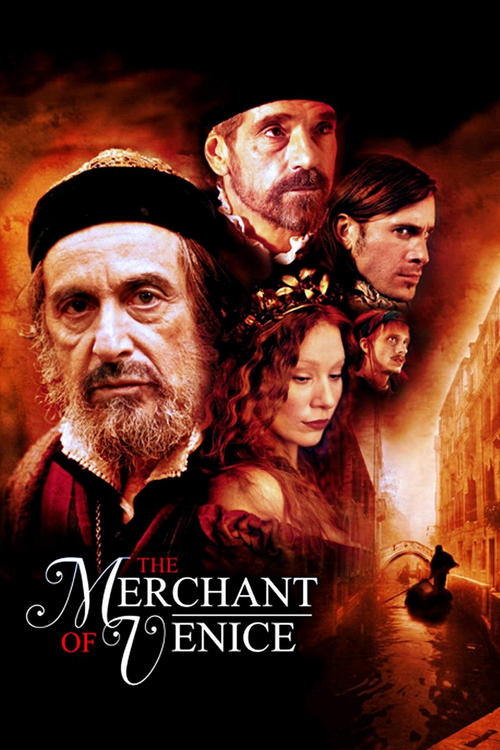
The Merchant of Venice
2004 · Michael Radford
For when you want Shakespeare done seriously on screen — a night of rich language, moral complication, and a courtroom climax that plays like a thriller. One to discuss afterward, not just watch.
What it's about
Venice, 1596. To bankroll his courtship of Portia, a brilliant and wealthy heiress, young Bassanio turns to his friend Antonio, a merchant whose fortune is tied up at sea. Antonio borrows the money from Shylock, a Jewish moneylender he has publicly scorned — and Shylock, in a bitter jest, sets the bond at a pound of Antonio's flesh. What begins as a romantic comedy of suitors and riddles darkens into a courtroom reckoning over money, prejudice, and revenge.
The experience
Handsome, brooding, and morally uneasy — the romance sparkles at the edges, but the film leans into the play's darkness, treating Shylock's humiliation and rage with real gravity. It leaves you unsettled about who the villain actually is.
Performances
Al Pacino's Shylock is the reason to watch: wounded, vengeful, and devastating in the famous 'Hath not a Jew eyes?' speech, he makes a figure often played as a caricature fully, painfully human. Jeremy Irons brings a melancholy depth to Antonio.
The craft
Michael Radford stages it in a grimy, candlelit, historically textured Venice — canals, masks, and the walled Jewish ghetto — grounding the play in the real prejudice of its time rather than prettifying it. The muted, painterly look suits the story's darkness.
Why it matters
Notable as the first full-length English-language sound film of a play cinema had long avoided because of its fraught treatment of antisemitism — a landmark in bringing Shakespeare's most troubling comedy to the screen.
Snapshot
Michael Radford's The Merchant of Venice holds a peculiar distinction in the history of Shakespeare on film: it is generally regarded as the first full-length, theatrically released sound film in English of one of Shakespeare's most performed and most troubling comedies. The play had reached screens before — in silent versions and, most influentially, in Jonathan Miller's 1980 BBC television production with Laurence Olivier as Shylock — but the cinema had largely avoided it, and the reason is not hard to locate. The Merchant of Venice is a romantic comedy built around a usurious Jewish moneylender who demands a pound of a Christian merchant's flesh, and in the wake of the twentieth century the play's antisemitism became, for many, insurmountable. Radford's adaptation, anchored by Al Pacino as Shylock, Jeremy Irons as the melancholy merchant Antonio, Joseph Fiennes as Bassanio, and Lynn Collins as Portia, confronts that difficulty head-on rather than evading it. The film opens not with romance but with a prologue — on-screen text and documentary-like images establishing the conditions of Jewish life in late-sixteenth-century Venice: confinement to the Ghetto, the compulsory red hat, the contempt of the Christian mercantile class. The film thereby reframes Shylock's villainy as the product of systematic humiliation, and stages the play less as comedy than as tragedy-tinged drama. It is a handsome, sober, classically mounted period adaptation that treats the text with reverence while pointedly historicizing its prejudice.
Industry & production
The film was an international co-production drawing on British, Italian, Luxembourgish, and American financing, a typical structure for a mid-budget literary period piece of the early 2000s that could not rely on a single national market. It was produced by Cary Brokaw and Barry Navidi, the latter a longtime collaborator with Al Pacino who had been instrumental in shepherding Pacino's earlier Shakespeare project Looking for Richard (1996). Pacino's involvement was decisive to the project's viability: a star of his stature attached to Shylock made an otherwise commercially unpromising Shakespeare adaptation financeable. In the United States the film was distributed by Sony Pictures Classics, the specialty-division model appropriate to an art-house literary release rather than a wide commercial rollout.
Production drew on the obvious advantage of authentic location: Venice itself, supplemented by studio and location work in Luxembourg, which provided the production infrastructure and tax incentives that made the budget workable. The Venetian settings — canals, palazzi, the Rialto, the confines of the Ghetto — were exploited for their genuine texture, though the logistics of shooting in the historic city imposed constraints familiar to any production working there. The film arrived after a relatively long gap in Radford's directing career; he had not had a major feature since the enormous international success of Il Postino (1994), and The Merchant of Venice marked a return to large-scale period filmmaking. I should note that detailed, verifiable figures for the production's budget and box-office performance are not something I can state with confidence here; the film was a modest specialty release rather than a wide commercial hit, and precise numbers should be checked against a reliable industry source rather than asserted.
Technology
Technologically the film is unremarkable in the best sense: it is a conventionally shot photochemical period production of its moment, made on 35mm film and finished for theatrical projection in the standard widescreen format. There is no ostentatious digital intervention; the early-2000s timing places it just before the wholesale shift to digital intermediate workflows became universal, and the film's aesthetic ambitions are pictorial and painterly rather than effects-driven. Where the production's technical effort went was into the recreation of period Venice — practical sets, costume, and the use of real architecture — rather than into visual-effects spectacle. The candlelit and lamplit interiors, the reliance on available and motivated light sources to evoke a pre-electric world, represent the film's principal technical-aesthetic commitment, an approach with a long lineage in period cinematography.
Technique
Cinematography
The cinematography is by Benoît Delhomme, the French director of photography whose work tends toward richly textured, painterly imagery. His Venice is gilded and shadowed in equal measure — the wealth of the merchant class rendered in warm, burnished interiors and the glitter of canals, set against the cramped darkness of the Ghetto. Delhomme leans on the iconography of Venetian Renaissance painting, with compositions and a palette that evoke the chiaroscuro and golden light of the Old Masters. The visual strategy reinforces the film's thematic divide: the Christian world of Belmont and the Rialto is suffused with light and abundance, while Shylock's world is constrained, interior, and shadowed. The camera is generally classical and unobtrusive, serving the performances and the text rather than calling attention to itself, in keeping with a tradition of literary adaptation that prizes legibility and atmosphere over formal display.
Editing
The editing, by Lucia Zucchetti, observes the rhythms of the spoken text. A Shakespeare film lives or dies on how it cuts around language, and the picture's principal editorial task is to sustain the long rhetorical set-pieces — Shylock's "Hath not a Jew eyes?" and the trial scene's confrontation over the bond — while shaping them into cinematic time. The cutting is measured rather than aggressive, allowing scenes to breathe and giving actors room to inhabit the verse. The film's structure also requires the interleaving of two worlds and two tonal registers — the courtship-comedy of Belmont and the casket plot, against the darkening loan plot in Venice — and the editing manages this counterpoint, building toward the convergence of both threads in the courtroom.
Mise-en-scène / staging
Production design (by Bruno Rubeo) and costume (by Sammy Sheldon) carry much of the film's interpretive weight. The decision to open with documentary-style framing of the Ghetto, the red hats, and the public burning of Hebrew texts establishes a mise-en-scène of historical specificity that conditions everything that follows. Belmont, Portia's estate, is staged as a realm of leisured wealth and ritual — the casket test with its caskets of gold, silver, and lead given the gravity of ceremony — contrasted with the mercantile bustle and the moral squalor of the Venetian streets where Antonio spits upon Shylock. The staging is fundamentally theatrical in its respect for the scenes as written, but it uses real and recreated space to ground the rhetoric in a tangible, lived world.
Sound
The score is by Jocelyn Pook, a composer whose work (notably for Stanley Kubrick's Eyes Wide Shut) favors haunting vocal textures and a liturgical, otherworldly quality. Pook's music for the film draws on period and quasi-period sonorities and vocal writing to deepen the emotional and elegiac register, particularly around Shylock and the film's tragic undertow. The sound design otherwise supports the realism of the Venetian setting — water, crowds, the acoustics of stone interiors — while never overwhelming the primacy of the spoken verse, which remains the film's central sonic event.
Performance
Performance is the film's reason for being and its greatest strength. Al Pacino's Shylock is notably restrained by the standards of his later screen work — interiorized, wounded, and dignified rather than histrionic. He plays the moneylender as a man hardened by a lifetime of contempt, and the production's framing licenses an interpretation in which Shylock's monstrous demand for the pound of flesh is the eruption of accumulated grievance rather than innate malice. The "Hath not a Jew eyes?" speech and Shylock's devastation at his daughter Jessica's elopement and conversion are the performance's emotional poles. Jeremy Irons brings a deep, unexplained melancholy to Antonio — the play's opening "In sooth I know not why I am so sad" — and the production allows the homoerotic charge in Antonio's devotion to Bassanio to register without insisting on it. Joseph Fiennes plays Bassanio as an ardent and somewhat compromised suitor, and Lynn Collins, in a breakout role, gives Portia intelligence and wit, especially in the trial scene where, disguised as a young lawyer, she turns Shylock's bond against him. The supporting ensemble includes Zuleikha Robinson as Jessica, Charlie Cox as Lorenzo, Kris Marshall as Gratiano, Heather Goldenhersh as Nerissa, and Mackenzie Crook as the clown Launcelot Gobbo.
Narrative & dramatic mode
Radford's adaptation makes a decisive interpretive choice about dramatic mode. Shakespeare's text is formally a comedy — it ends with reunions, the resolution of the ring plot, and the restoration of harmony at Belmont — but the film tilts the whole toward drama and tragedy. By foregrounding Shylock's persecution and treating his forced conversion at the trial's end as a catastrophe, the film refuses the comic resolution's easy triumphalism. The narrative retains the play's double plot — the bond plot in Venice and the casket/courtship plot in Belmont — and their structural rhyme (both turn on contracts, hazards, and the binding force of an oath or a written word). The film closes not on unmitigated comic happiness but on notes of unease: Jessica's ambiguous position between two worlds, and Antonio's solitary place outside the paired lovers. The dramatic mode is thus revisionist — using the text faithfully while redirecting its emotional verdict.
Genre & cycle
The film belongs to the genre of the prestige literary Shakespeare adaptation, and specifically to the cycle of theatrically ambitious Shakespeare films that flourished from the late 1980s through the early 2000s. That cycle was inaugurated commercially by Kenneth Branagh's Henry V (1989) and Much Ado About Nothing (1993), and extended through Branagh's Hamlet (1996), Baz Luhrmann's Romeo + Juliet (1996), Pacino's own Looking for Richard (1996), Julie Taymor's Titus (1999), Michael Hoffman's A Midsummer Night's Dream (1999), and others. By 2004 this wave had crested, and The Merchant of Venice arrived as a comparatively traditionalist entry — period-set, textually faithful, star-driven — rather than a radical reimagining in the Luhrmann or Taymor mode. It is also legible within the broader category of the European-financed historical costume drama.
Authorship & method
The film is fundamentally Michael Radford's work as both director and screenwriter; he adapted the play himself, making the cuts and emphases that shape its reading. Radford's career — Another Time, Another Place (1983), Nineteen Eighty-Four (1984), White Mischief (1987), and above all Il Postino (1994) — shows a recurring interest in literate, emotionally serious, often melancholy material and in characters caught within oppressive systems, a sensibility well suited to a sympathetic Shylock. His method here was one of careful historicization: the prologue and the production's documentary impulse represent an authorial intervention designed to make the play's antisemitism the film's explicit subject rather than its embarrassment.
The authorship is genuinely collaborative in the ways that matter for this film. Cinematographer Benoît Delhomme supplied the painterly Venetian light; composer Jocelyn Pook supplied the elegiac, vocally inflected score that deepens the tragic reading; editor Lucia Zucchetti shaped the verse into cinematic rhythm; and the design team of Bruno Rubeo and Sammy Sheldon built the tangible period world. Above all, Al Pacino's interpretation of Shylock is itself a form of authorship — a continuation of the actor's sustained engagement with Shakespeare — and the film is in large part a vehicle for that performance.
Movement / national cinema
The film does not belong to any aesthetic movement; it is a mainstream international art-house production rather than the product of a defined school. In terms of national cinema it is most accurately described as a transnational European co-production with significant British creative authorship and American star power and distribution. Its lineage is the tradition of British literary and heritage filmmaking — the prestige adaptation of canonical English texts — crossed with the pan-European financing model that sustained mid-budget period cinema in the 2000s. The use of authentic Venetian locations ties it to a long tradition of films that exploit the city's cinematic seductiveness.
Era / period
Made and released in 2004, the film sits at the tail end of the Shakespeare-film boom and just before the full digital transition. Its production values, photochemical image, and faith in starry classical performance mark it as a product of that early-2000s prestige moment. Its represented period — Venice in 1596, the year often associated with the play's likely composition — is rendered with deliberate historical specificity, and that specificity is the film's central interpretive instrument. The choice to date and place the action so exactly, and to begin with the historical facts of Jewish persecution, reflects a particular early-twenty-first-century critical consciousness about staging a play whose prejudice can no longer be presented innocently.
Themes
The film's governing theme is intolerance and its consequences. By historicizing Shylock's oppression, it makes the question of how a despised man becomes vengeful — and how a society manufactures its own monsters — the moral center of the work. Closely bound to this is the theme of justice versus mercy, dramatized in the trial scene where Portia's "quality of mercy" speech is set against the literalism of the law and the bond. The film also explores the relationship between money, contract, and human bonds: the entire plot turns on debts, oaths, rings, and the binding force of the written word, and on the proximity of love and commerce in a mercantile world. Other threads include religious and ethnic othering and forced conversion; the costs of assimilation embodied in Jessica; same-sex devotion and unrequited love in Antonio's attachment to Bassanio; and the performance of identity, literalized in Portia's cross-dressed disguise as the lawyer who saves Antonio's life. Friendship, fidelity, and the limits of romantic comedy's promise of harmony run throughout.
Reception, canon & influence
Critical reception was broadly respectful and ranged from positive to mixed. The dominant strand of praise concerned Pacino's Shylock, widely regarded as one of his more disciplined and moving late performances, and the film's intelligent decision to confront the play's antisemitism directly through its historicizing frame. The handsome production, the Venetian photography, and the strength of the ensemble — with particular attention to Lynn Collins's Portia and Irons's Antonio — were frequently noted. Reservations tended to center on the inherent difficulty of the material — that no amount of contextualization fully resolves the play's troubling design — and on the film's relatively conventional, reverent approach, which some found admirable and others found tame. I want to be careful not to overstate specifics: I can't reliably attribute particular quotations or award results here, and the precise contours of its critical and commercial reception should be confirmed against contemporary reviews and a reliable database rather than asserted from memory.
The influences on the film are clear and acknowledged in its very form. Backward, it draws on the long performance history of The Merchant of Venice on stage and screen, and especially on the post-Holocaust theatrical tradition of playing Shylock sympathetically — a tradition that runs through Olivier's celebrated stage and television interpretations and beyond. It belongs aesthetically to the heritage-adaptation lineage and to the Shakespeare-film cycle launched by Branagh. Pacino's prior Looking for Richard is a direct biographical antecedent, evidence of the actor's sustained Shakespearean engagement that made this film possible.
Forward, the film's legacy is more modest. It stands as the definitive screen feature of the play in English and is widely used in educational contexts precisely because of its textual fidelity and its explicit framing of the antisemitism problem — its prologue makes it a teaching text about how to stage a difficult work responsibly. It also marked an early notable screen role for Lynn Collins and an early appearance for Charlie Cox, both of whom went on to larger careers. The film did not spawn imitators or shift the direction of Shakespeare on film; rather, it serves as a thoughtful, perhaps culminating, late entry in the prestige-Shakespeare cycle, and as the enduring reference point for anyone seeking to see this particular play realized seriously on screen.
A Deleuzian reading
A man spits.
The full Deleuzian reading of The Merchant of Venice →
Reception
Received politely but quietly in 2004 — Pacino's Shylock drew awards-season chatter that never materialized, and the film underperformed at the box office. Today it's remembered as one of the more respectable screen Shakespeares of its era, though it never got a real reappraisal wave.
How The Merchant of Venice was received, from release to now →
Influences: the films it descends from and the films it influenced
- Looking for Richard (1996) — Pacino's documentary-essay on performing Richard III established his late-career actor-as-author method — workshopping verse on camera, demystifying the text — which The Merchant of Venice directly extends into a finished narrative feature.
- Henry V (1989) — Branagh codified the prestige-Shakespeare film grammar Radford works within: full spoken verse, naturalistic screen-scaled acting over stage declamation, and lush tangible period production as the default register.
- The Merchant of Venice (1973) — Olivier's televised Shylock crystallized the post-Holocaust stage tradition of playing the role for sympathy and wounded dignity — the precise interpretive lineage Pacino's performance continues.
- The Godfather (1972) — Gordon Willis's low-key motivated chiaroscuro — faces half-swallowed by underlit interiors lit from practical window/candle sources — is the lighting grammar Delhomme adapts, paired with the same interiorized, withholding Pacino register.
- Death in Venice (1971) — Visconti's painterly, mortality-soaked Venetian photography — diffused canal light and elegiac slowness — is the template for the film's handsome, melancholy treatment of the city as a place of decline.
- Nineteen Eighty-Four (1984) — Radford's own authorial signature — literate seriousness and protagonists crushed inside an oppressive system — is carried directly into his framing of Shylock as a man trapped by the law and prejudice of the Venetian state.
- A Room with a View (1985) — The Merchant-Ivory heritage template — fidelity to a canonical literary text, meticulously tangible period design, and ensemble restraint over star spectacle — is the production-aesthetic Radford inherits wholesale.
- Eyes Wide Shut (1999) — Jocelyn Pook's vocally-inflected, liturgical score ('Masked Ball') first reached cinema here; Radford engaged the same composer and her wordless-voice method to lend the comedy its elegiac, tragic undertow.
- Caravaggio (1986) — Jarman's painterly tableaux stage Renaissance light-dark contrast as moral framing — figures emerging from blackness in Caravaggesque pools of light — anticipating the film's chiaroscuro historicizing of its world.
- Coriolanus (2011) — A later actor-led prestige Shakespeare in the sober, serious mode — a star's sustained Shakespearean engagement driving a screen feature — extending the Pacino/Radford model of performance-as-authorship.
- Macbeth (2015) — Kurzel pushes the painterly-chiaroscuro, motivated-firelight treatment of historicized Shakespeare further — the same instinct to render the period world through low-key source lighting and a brooding vocal score.
- Richard III (1995) — Loncraine relocates the play to a 1930s fascist Britain precisely to foreground its political subject — the same strategy of using a historicizing frame to make an uncomfortable theme explicit that Radford's documentary prologue performs for antisemitism.
- Othello (1995) — A prestige screen Shakespeare that confronts a play built on a 'difficult prejudice' through sober textual fidelity rather than evasion — the same reverent, problem-acknowledging approach to inflammatory material.
- Hamlet (1996) — The maximalist peak of the same prestige cycle — uncut text, lavish period design, marquee ensemble — against which Radford's leaner, single-performance-driven entry defines itself.
- Titus (1999) — Taymor brackets a difficult, brutal Shakespeare text with a constructed framing device that mediates the audience's relationship to its cruelty — a kindred use of an interpretive frame to make hard material legible.
- Romeo + Juliet (1996) — The cycle's opposite pole — radical contemporary re-setting and MTV cutting — marking the stylistic boundary of the early-2000s Shakespeare boom that Radford's traditionalist film closes from the other end.
Similar films
- The Godfather (1972) — influence & lineage
- Death in Venice (1971) — influence & lineage
- Hamlet (1996) — influence & lineage
- Schindler's List (1993) — shared sensibility
- The Passion of the Christ (2004) — shared sensibility
- Rocco and His Brothers (1960) — shared sensibility
- Shoeshine (1946) — shared sensibility
- Othello (1951) — shared sensibility