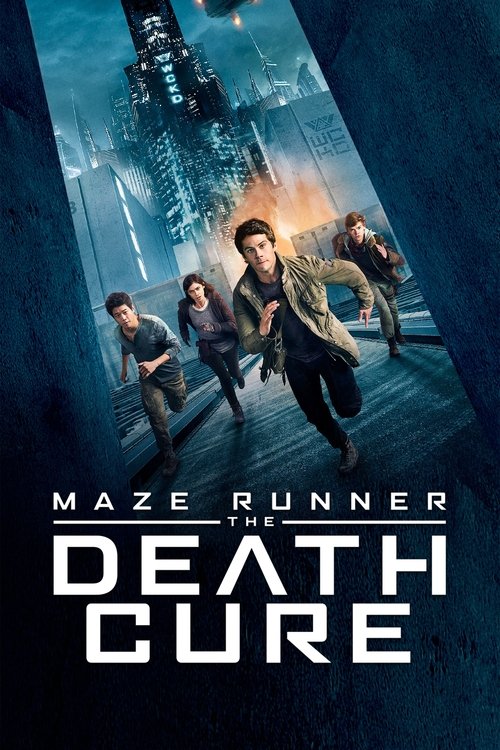
Maze Runner: The Death Cure
2018 · Wes Ball
For when you want big, uncomplicated blockbuster momentum — a binge-capper for anyone who's watched the first two, best enjoyed with popcorn and low stakes for yourself.
What it's about
The final chapter of the Maze Runner trilogy sends Thomas and his surviving Gladers on a rescue mission: break into the Last City, a fortified metropolis controlled by the organization WCKD, to save their captured friend Minho. The city is the deadliest maze they've faced, the world outside is being eaten by a plague, and the answers they've chased since waking up in the first maze — about the virus, the experiments, and their own role in a hunt for a cure — are all waiting inside the walls.
The experience
A near-relentless action picture — train heists, sieges, chases, a city coming apart — that runs long but rarely idles. It's more war movie than puzzle box, and it plays its friendships and losses with genuine weight for a YA finale.
Performances
Dylan O'Brien anchors it with a scrappy, physical sincerity — notable given he returned to finish the film after a serious on-set injury shut down production.
The craft
Wes Ball stages practical, large-scale set pieces — the opening train raid is a genuine showstopper — and closes the trilogy with consistent visual muscle: dust-choked wastelands against the sleek glass of the Last City. It's built for a big screen and a loud sound system.
Why it matters
One of the few young-adult dystopian franchises of its era to actually complete its story on screen, arriving as the capstone — and effectively the closing bell — of the post-Hunger Games YA boom.
Snapshot
Maze Runner: The Death Cure is the third and concluding chapter of the film trilogy adapted from James Dashner's young-adult novels, and the capstone of a franchise that ran from 2014 to 2018. Directed by Wes Ball from a screenplay by T.S. Nowlin, it returns Dylan O'Brien's Thomas and his surviving Gladers to a single objective: penetrate WCKD's fortified "Last City" to rescue the captured Minho and, in the process, resolve the mystery of the maze, the Flare virus, and their own engineered role in a search for a cure. Where the first film was a contained puzzle-box thriller and the second an open-world chase across a ruined landscape, The Death Cure is a siege picture — a large-scale action-adventure that trades enigma for spectacle. It is notable in production history less for its narrative than for the eighteen-month delay caused by O'Brien's serious on-set injury, which turned a routine franchise closer into one of the more troubled shoots of the late-cycle YA boom. It arrived in early 2018 as the genre it belonged to was already collapsing.
Industry & production
The film was produced and distributed by 20th Century Fox (through the studio's mid-budget genre operation), with Ellen Goldsmith-Vein's Gotham Group and Temple Hill Entertainment — the same producing apparatus behind the earlier installments and much of the studio-era YA slate — again shepherding the property. The trilogy was conceived as a franchise from the outset: Dashner's The Death Cure (2011) closed the original novel arc, and Fox greenlit the concluding adaptation on the strength of the first two films' international performance, which reliably outpaced their domestic returns.
The production's defining fact is its interruption. Filming was underway in Vancouver in March 2016 when Dylan O'Brien was badly injured performing a stunt involving a moving vehicle; the shoot was suspended, and after a lengthy recovery the film — originally dated for early 2017 — was pushed roughly a year to a January/February 2018 release. Principal photography ultimately relocated to and concentrated in Cape Town, South Africa, whose surrounding terrain and studio facilities had already served the trilogy and supplied both the arid wasteland and the built environments of the Last City. The delay is worth stating plainly because it reshaped the film's commercial context: it opened well after the YA-dystopia cycle had lost its box-office momentum, and while precise grosses should not be asserted here without the ledger in front of us, the broad record is that it closed the series respectably on the international market rather than as a domestic event.
Technology
The Death Cure is a conventional digital-era studio production built around large physical sets extended with visual effects. Wes Ball's own background is the relevant technical thread: he came to the franchise from visual-effects and motion-graphics work, and his method throughout the trilogy favored building tangible environments — the maze walls, the WCKD interiors, the city ramparts — and then extending them digitally rather than staging action against empty greenscreen. The Death Cure accordingly leans on set construction, practical vehicles and stunt work, and CG augmentation for the scale of the walled city, aerial gunship sequences, and the climactic conflagration. The film was finished as a digital-intermediate release and exhibited in standard and premium large-format presentations. Specific camera and lens packages are not something I can attribute with confidence, and I won't invent them; what is safe to say is that the film sits squarely within the standard toolkit of a late-2010s studio action tentpole.
Technique
Cinematography
Director of photography Gyula Pados, the Hungarian cinematographer who shot the trilogy's second installment (The Scorch Trials), returns for the finale, lending visual continuity to the back half of the series. His images favor a hard, high-contrast look: bleached daylight and dust for the exterior wasteland and the assault on the walls, cooler and more controlled sources for WCKD's clinical interiors, and firelit oranges for the third-act destruction of the city. The camera is mobile and often handheld through the action, close on bodies during the infiltration and the train-heist opening, then pulling back for the establishing scale of the Last City. It is a functional, muscular style rather than an authored one — the visual signature of the film is the contrast between institutional sterility and apocalyptic ruin rather than any single bravura strategy.
Editing
Cut by Dan Zimmerman, who edited the trilogy and gives it a consistent rhythm, The Death Cure is structured as a sequence of set-pieces — the opening train rescue, the city infiltration, the hospital-tower extraction, the final battle and evacuation — strung on a rescue-then-escape spine. The editing is brisk and event-driven, prioritizing legibility of action and forward momentum over the more elliptical, mystery-withholding construction of the first film. At well over two hours it is the longest of the three, and the assembly reflects a closer's obligation to resolve every dangling thread and give each returning character a beat, which lends the back half a valedictory, checklist quality.
Mise-en-scène / staging
The production design completes the trilogy's central visual argument: an opposition between the engineered and the ruined. WCKD's Last City is a gleaming, walled enclave of glass towers and ordered streets, ringed by fortifications that hold back a desperate infected populace — a literal architecture of privilege and quarantine. Outside and beneath it lie slums, resistance hideouts, and wasteland. Staging repeatedly organizes the frame around barriers — walls, gates, checkpoints, windows — extending the maze motif from the first film into the geography of a whole city. The costuming continues the series' division between institutional uniform and improvised survivor gear.
Sound
John Paesano, composer for all three films, scores the finale with the trilogy's established idiom of driving percussion, synth textures, and swelling orchestral action cues, providing the strongest through-line of authorship across the series. The sound design foregrounds the mechanical and the martial — gunfire, engines, the roar of the crowd and the fire — against the quieter clinical hums of WCKD's spaces. As with most of the film's craft, the mix is competent and purpose-built for large-format action rather than distinctive.
Performance
Dylan O'Brien anchors the film as Thomas, carrying the emotional register of the rescue mission with the earnest physicality that defined his lead across the trilogy; his return after a genuinely dangerous injury gives the performance an off-screen weight. The ensemble is the film's real asset. Thomas Brodie-Sangster's Newt supplies the trilogy's most affecting arc as his infection advances, and the film's dramatic peak belongs to the two of them. Ki Hong Lee (Minho), Kaya Scodelario (Teresa), Dexter Darden (Frypan), Nathalie Emmanuel (Harriet), and Rosa Salazar (Brenda) fill out the loyal circle; Giancarlo Esposito's Jorge and Barry Pepper's Vince supply gravitas among the adults. On the antagonist side, Aidan Gillen's officious Janson and Patricia Clarkson's morally-armored Ava Paige give WCKD its human faces, and Walton Goggins arrives as the disfigured resistance leader Lawrence. Will Poulter returns as Gally, reversing his earlier villainy. The performances are pitched to franchise sincerity rather than nuance, but the cast's evident rapport does much of the closer's emotional work.
Narrative & dramatic mode
Dramatically the film operates in the rescue-and-siege mode: a clear objective (free Minho, breach the city), a ticking clock (Newt's decline, the war at the walls), and a series of escalating incursions. Nowlin's screenplay compresses and rearranges Dashner's novel substantially, subordinating the book's more diffuse plotting to a propulsive mission structure and preserving room for reversals — Teresa's contested loyalties, Gally's return, the revelation of Thomas's own biological significance. The mode is earnest and melodramatic in the classical sense: sacrifice, loyalty, and betrayal are the load-bearing beats, and the film reaches for tragic feeling in Newt's storyline while otherwise delivering the catharsis of a genre closer. Mystery, the engine of the first film, is largely spent; here the pleasures are momentum and resolution.
Genre & cycle
The Death Cure is a science-fiction action-adventure and, more specifically, the terminal entry in the 2010s young-adult dystopian adaptation cycle — the wave that ran from The Hunger Games (2012) through the Divergent series and The Maze Runner itself, all built on best-selling YA trilogies featuring young protagonists resisting authoritarian systems in a ruined future. Within that cycle, the Maze Runner films skewed harder toward action-horror and chase mechanics than toward romance or civics. By the time The Death Cure opened in 2018, the cycle had effectively burned out — the Divergent films had failed to complete their own arc theatrically — making this one of the last studio-scale examples of the form, and something of an epitaph for it.
Authorship & method
The trilogy is genuinely a repertory effort, and its authorship is best understood as a stable creative team rather than a single vision. Wes Ball directed all three films, his feature career launched entirely by the franchise after his acclaimed VFX-driven short Ruin brought him to Fox's attention; his method — practical builds extended with digital effects, kinetic action staging — carries through to the finale, and the trilogy became his calling card en route to directing Kingdom of the Planet of the Apes (2024). T.S. Nowlin wrote all three screenplays, giving the adaptation a consistent hand in compressing Dashner's novels into mission-driven cinema. John Paesano scored the entire trilogy, the clearest sonic signature of authorship across the series. Gyula Pados shot the second and third films, and editor Dan Zimmerman cut all three. This continuity of craft — director, writer, composer, and post team held largely intact across four years and a traumatic production interruption — is the film's defining authorial fact: it is a closer made by the people who opened the series.
Movement / national cinema
The film belongs to no art movement; it is mainstream American studio filmmaking, a Hollywood franchise product. Its only meaningful "national cinema" dimension is industrial geography: like many mid-budget studio genre films of the decade, it was physically produced abroad — in Cape Town, South Africa — for economic and logistical reasons, using South African crews, locations, and facilities to realize an ostensibly placeless dystopian future. This is characteristic of the runaway-production economics of 2010s Hollywood rather than of any regional cinema.
Era / period
The Death Cure is a late-2010s studio tentpole, and it is legible as a period artifact in two ways. Industrially, it closes out a specific commercial moment — the YA-dystopia gold rush — arriving just after that moment had passed and just before the 2019 Disney–Fox merger reorganized the studio that made it. Thematically, it belongs to a decade preoccupied with walls, quarantine, engineered pandemics, and the ethics of sacrificing the few to save the many — anxieties that would read very differently only two years later. Its late release date, forced by the production delay, thus doubles as an accidental marker of a cycle and a studio era ending at once.
Themes
The film's controlling themes are quarantine and the walled society — the literal architecture of the Last City dramatizes who is protected and who is left outside to die; the ethics of the cure — WCKD's utilitarian argument that torment and sacrifice of the immune young is justified by the search for a remedy, versus the Gladers' insistence that no such calculus is legitimate; loyalty, found family, and sacrifice — the rescue premise turns the entire plot into an argument that the group will not abandon its own, culminating in the trilogy's most wrenching loss; and betrayal and redemption, threaded through Teresa's divided allegiance and Gally's return. Underneath runs the series' persistent maze metaphor: systems built by unseen authorities to test and consume the young, escaped only by refusing the terms of the test.
Reception, canon & influence
Critically, The Death Cure was received as a competent, energetic franchise closer rather than a work of distinction — praised for its action staging and the cast's committed sincerity, faulted for length and for the diminishing returns of a mythology that had grown thinner as its central mystery was spent. I won't attach specific scores or grosses without the record in front of me, but the consensus shape is clear: reviews were mixed-to-lukewarm and warmer toward the film as an emotionally satisfying conclusion than as a standalone achievement.
Its influences run backward to two lineages: Dashner's source novels, and the cinematic template of The Hunger Games, which made the YA-dystopia trilogy a viable studio format; behind those stand the broader traditions of siege and prison-break action cinema and of dystopian science fiction's walled-city imagery. Its legacy forward is modest and mostly industrial. The film did not spawn imitators — it arrived at the end, not the start, of its cycle — and its most durable consequence is as a career launchpad: it established Wes Ball as a studio action director, leading directly to Kingdom of the Planet of the Apes, and consolidated Dylan O'Brien's, Thomas Brodie-Sangster's, and Kaya Scodelario's profiles. In the longer view its significance is period-defining by position rather than by innovation: as one of the last completed entries in the YA-dystopia wave, The Death Cure functions in film history less as an influence than as a closing bracket — the point at which a dominant commercial genre of the 2010s reached its end.
Reception
It landed in January 2018 to shrugging reviews and a decent-not-huge box office, and its reputation hasn't so much shifted as crystallized: it's now remembered as the closing bell of the 2010s YA-dystopia boom, the franchise that — unlike Divergent — actually got to finish its story.
How Maze Runner: The Death Cure was received, from release to now →
How to watch Maze Runner: The Death Cure: what to notice on a first viewing
- Notice the walls, gates, and checkpoints framing every scene. Staging keeps returning to barriers, walls, gates, windows, extending the maze from the first film into the geography of a whole city. The whole city is built as another maze, just at a bigger scale.
- Notice the difference between WCKD's cool interiors and the firelit ruins. Clinical, controlled light marks WCKD's spaces, while bleached daylight and dust cover the wasteland, and orange firelight takes over during the city's destruction. The lighting alone tells you which side of the wall you are on at any moment.
- Watch how close the camera stays during the train heist. The opening rescue is shot mobile and handheld, close on bodies, before the film pulls back to show the Last City's full scale. Getting in close first makes the following wide shots of the city actually land as huge.
- Listen for the score shift between action cues and quiet hums. Paesano's driving percussion and swelling orchestral cues punctuate gunfire and engines, against the quieter clinical hums of WCKD's interior spaces. The music tells you when you have crossed from the machinery of the institution into open conflict.
The whole guide to watching Maze Runner: The Death Cure, with the keys for a rewatch →
Influences: the films it descends from and the films it influenced
- The Maze Runner (2014) — The trilogy opener installed the repertory team (Ball/Nowlin/Paesano/Zimmerman) and the literal wall-as-barrier motif that Death Cure inherits and inverts, moving the ensemble from being walled-in to breaking-in.
- Ruin (2011) — Ball's VFX-driven short that won him the Fox contract — the origin of his signature method of digitally extending practical builds into ruined, overgrown vertical landscapes.
- The Hunger Games (2012) — Established the YA-dystopia-trilogy-as-studio-tentpole format and the handheld, close-in shooting of a young ensemble under duress that Death Cure adopts wholesale.
- Escape from New York (1981) — Template for the infiltration of a sealed quarantine-zone city to extract a captive, shot in high-contrast night imagery of engineered structures gone to ruin.
- The Great Escape (1963) — The ensemble prison-break blueprint — a bonded crew of specialists executing a coordinated, multi-stage breakout as the spine of set-piece structure.
- Aliens (1986) — Codified the siege-under-fire set-piece rhythm with a rapport-driven ensemble and practical sets augmented by effects, the structural grammar Ball's action follows.
- 28 Days Later (2002) — Source of the sprinting-infected quarantine imagery and the handheld, high-contrast digital-video chaos that Death Cure's Crank-horde sequences echo.
- Children of Men (2006) — Model for immersive handheld chase staging pushing characters through checkpoints, walls, and militarized cordons of a quarantined society.
- Logan's Run (1976) — The walled-city dystopia whose enclosed, orderly society hides a lethal secret, with production design built on the engineered-vs-ruined contrast.
- I Am Legend (2007) — Foregrounds the ethics-of-the-cure plague narrative — immunity harvested at a cost — set against ruined-metropolis imagery of engineered spaces reclaimed by decay.
- Kingdom of the Planet of the Apes (2024) — Ball's direct next step: he carries the trilogy's practical-plus-CG method and engineered-vs-ruined landscape staging onto a larger canvas of overgrown human structures.
- The Hunger Games: Catching Fire (2013) — Modeled how to escalate a YA franchise's later chapters into siege-scale, countdown-driven action set pieces rather than world-building exposition.
- Divergent (2014) — Parallel entry in the same commercial cycle, built on faction/walled-city world-building and a training-to-rebellion arc that terminates in an assault on the controlling authority.
- The Giver (2014) — Same-wave YA adaptation staging the engineered-vs-ruined dichotomy — a sterile controlled society whose order conceals a lethal ethical bargain.
- World War Z (2013) — Contemporary swarming-horde set pieces married to a race-against-quarantine search-for-a-cure structure, using CG massing of bodies over practical action anchors.
- Mad Max: Fury Road (2015) — Runaway-production vehicular convoy staging blending practical stunts with CG cleanup — the kinetic wasteland-chase idiom Death Cure draws on for its train and city sequences.
Similar films
- The Maze Runner (2014) — influence & lineage
- World War Z (2013) — influence & lineage
- Divergent (2014) — influence & lineage
- The Hunger Games (2012) — influence & lineage
- The Hunger Games: Catching Fire (2013) — influence & lineage
- Mad Max: Fury Road (2015) — influence & lineage
- The Matrix Revolutions (2003) — shared sensibility
- The Matrix Reloaded (2003) — shared sensibility