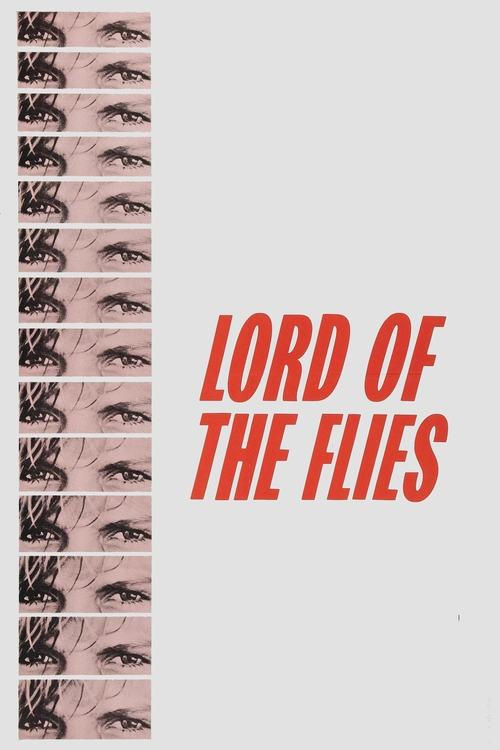
Lord of the Flies
1963 · Peter Brook
When you want a lean, unsettling classic that gets under your skin — the kind of film you finish in ninety minutes and argue about for days. Not a comfort watch; it's a mirror held up to human nature.
What it's about
A planeload of English schoolboys crashes on a deserted tropical island with no adults left alive. They elect a leader, blow a conch shell to call assemblies, and try to build a miniature civilization — and then watch it come apart as a rival faction discovers how much easier hunting and fear are than rules. It's the famous fable of order sliding into savagery, filmed with real boys on a real island.
The experience
Stark, eerie, and increasingly frightening — it feels less like a staged drama than a documentary of something that actually happened, which makes the descent genuinely disturbing. The black-and-white images have a raw, sunstruck beauty that cuts against the horror.
Performances
The entire cast is nonprofessional schoolboys, and that's the point — their unpolished, unactorly behavior gives the film a documentary truthfulness no trained child cast could fake.
The craft
Peter Brook, a giant of the theater, shot it like an ethnographic experiment: real boys, a real island, hours of improvised footage carved into a fable in the editing room. The grainy black-and-white photography and rough location sound give it a textural authority that studio filmmaking of the era couldn't touch.
Why it matters
It set the template for how Golding's novel lives in the popular imagination and stands as a landmark of adaptation-by-experiment — proof that a director could test a book against reality rather than illustrate it.
Snapshot
Peter Brook's Lord of the Flies is one of the strangest objects in British cinema of the early 1960s: a literary adaptation made by a theater director with no professional cast, no studio, no sound recording worth the name, and a shooting method closer to ethnographic documentary than to narrative filmmaking. Golding's 1954 novel — a group of English schoolboys marooned after a wartime evacuation flight goes down, who build a parliament around a conch shell and then dismantle it into a hunting cult — had by 1961 become a fixture of Anglo-American classrooms and campus argument. Brook's response was not to illustrate the book but to test it: to put real boys on a real island and photograph what happened, then find the fable inside sixty-odd hours of exposed film.
The result is a film of extraordinary textural authority and deliberate formal roughness. Its black-and-white images have the grain and opportunism of reportage; its dialogue, almost entirely post-synchronised, floats fractionally free of the bodies speaking it, producing an uncanny flatness that reads less as technical failure than as the sound of a fable being narrated over documentary evidence. It remains the definitive screen version of Golding, and one of the founding texts of the modern "children left to themselves" strain that runs through Battle Royale, Lost, The Hunger Games and Yellowjackets.
Industry & production
The film was made outside both the British studio system and Hollywood, financed as an American independent by producer Lewis M. Allen (with Dana Hodgdon), on a budget widely described as tiny — figures in the low hundreds of thousands of dollars circulate, but the exact accounting is not reliably documented and is best treated as approximate. Allen's involvement matters as more than bookkeeping: he would go on to produce Truffaut's Fahrenheit 451 (1966), and the pairing of a European art-cinema sensibility with American independent money is precisely the production logic that made Brook's film possible. No British distributor or American major would plausibly have underwritten a feature performed entirely by unknown children, shot on a Caribbean island, with a first-time-ish film director whose reputation belonged to the stage.
Brook was in 1961 among the most celebrated theater directors in the world, fresh from work at Stratford and the newly formed Royal Shakespeare Company. His screen credits were slight — The Beggar's Opera (1953) with Olivier, and the Duras adaptation Moderato Cantabile (1960) — and his approach to Lord of the Flies was avowedly experimental.
Casting was conducted by open call in Britain, largely through press advertisements, drawing several dozen boys of roughly prep-school age, none of them professional performers. James Aubrey was cast as Ralph, Tom Chapin as Jack, Hugh Edwards as Piggy and Roger Elwin as Roger; a young Nicholas Hammond, later of The Sound of Music, appears as Robert. An often-repeated production anecdote holds that Edwards won Piggy by writing to Brook to say he was fat and wore glasses; the story is durable but essentially unverifiable.
Principal photography took place in Puerto Rico in the summer of 1961, much of it on the offshore island of Vieques, with the boys accompanied by tutors and effectively living the shoot as a long camp. Brook has described the production as semi-improvisational: Golding's dialogue was retained in substance, but scenes were built from what the boys did, and the camera crew frequently worked as observers rather than stagers. Post-production then consumed an extraordinary length of time — the film was not released until 1963, appearing at Cannes that year and entering American release through Continental Distributing, the art-house arm of Walter Reade–Sterling. It was a modest commercial performer, an art-house and campus title rather than a general release, and precise box-office figures are not part of the reliable record.
Technology
The technological profile of the film is one of calculated poverty. It was shot in black-and-white on lightweight equipment, largely with available light, in conditions — surf, jungle, sand, tropical humidity — that made a conventional camera-and-sound package impossible. Synchronous location sound was effectively abandoned; the great majority of the dialogue was re-recorded by the boys in post-production and laid against picture, a decision forced by circumstance and then absorbed into the film's aesthetic.
Two consequences follow. First, the camera was freed: unencumbered by the blimping and cabling of sync shooting, it could follow running children through undergrowth, shoot into hard sun, and stay running long past the point where an expensive production would have cut. Second, the enormous shooting ratio — reports commonly cite something on the order of sixty hours of exposed footage reduced to roughly ninety minutes — became not waste but method. The film was in a real sense found at the editing bench, in the manner of a documentary, rather than executed from a shot list. The opening montage of still photographs and graphic elements, compressing the novel's backstory of English schooling, war and evacuation into a wordless prologue, is a further instance of technological thrift converted into rhetoric: information the production could not afford to dramatize is delivered as a photographic essay.
Technique
Cinematography
Tom Hollyman, the principal cinematographer, came from magazine photojournalism rather than features, and the film carries that inheritance directly: high-contrast tropical light left largely uncorrected, blown skies, sudden flare, compositions grabbed rather than built. Gerald Feil worked closely on the camera team and shot additional material; the precise division of labor between the two, and the extent of Brook's own operating, is somewhat blurred in the surviving credits and commentary. The grammar is observational — bodies caught in medium and long shot, the frame frequently reframing to catch up with action — but Brook punctuates it with images of hieratic stillness: the conch held up, the pig's head on its stake, the fire seen from below. That oscillation between reportage and icon is the film's central visual argument. The most famous instance is the ending, where the sudden low-angle arrival of the naval officer's white-uniformed legs converts the boys' world, in a single cut of scale, into something small and shameful.
Editing
Cutting was the longest and most consequential phase of the production. Brook drove it personally over an extended period, working with collaborators whose credits are variously listed and not entirely consistent across sources. The method — sift a documentary mass for the fable latent in it — produces a film that is elliptical rather than smoothly continuous. Time passes without markers; social decay registers as a series of jumps in the boys' hair, dirt and paint rather than as dramatized stages. The set pieces are built by accumulation and rhythm: the hunt chants assembled from fragments, and above all Simon's death, staged as a storm-lit frenzy in which the editing deliberately withholds a clear view of who does what, so that the killing becomes collective and unassignable — a formal enactment of the scapegoat mechanism the film is describing.
Mise-en-scène / staging
There are no sets. Brook, whose theater thinking would be codified five years later in The Empty Space (1968), stages the film as he staged plays: on bare ground, with a few charged objects doing the work of scenography. The conch is the film's entire constitutional apparatus, a prop that confers speech and whose destruction ends politics; Piggy's spectacles are simultaneously fire, reason and vulnerability; the pig's head is an altar. The rock platform functions as an amphitheatre — a found version of the thrust stage Brook favoured — with the boys arranged in assembly and then, progressively, in circle and chorus. Notably, Brook renders the novel's central hallucination, the head's colloquy with Simon, without giving the head speech: the image is left to carry the meaning, a purely cinematic solution to Golding's most literary passage.
Sound
Raymond Leppard — the harpsichordist and early-music scholar, not a film composer by trade — supplied the score, whose liturgical boy-choir writing sets the film's terms in its first minute: English children singing sacred music over images of the institutions that made them. Against that, the dubbed dialogue sits slightly askew, thin and close-miked, without the ambience of the spaces it purports to occupy. The effect, whether or not fully intended, is estranging in a way that suits an allegory. The chanting of the hunters — the rhythmic "kill the pig" refrain — bridges score and diegesis, and the film's most frightening passages are the ones where music, chant and surf become indistinguishable.
Performance
The performances are the film's great gamble. Working with untrained children, Brook did not attempt to extract conventional acting; he built situations and photographed behavior, letting the boys' actual group dynamics — hierarchy, exclusion, the pleasure of license — feed the fiction. Aubrey's Ralph is decent and increasingly baffled, a boy losing an argument he does not know how to have; Chapin's Jack has the specific charisma of the confident schoolboy, which is exactly the point; Edwards's Piggy is the film's most affecting creation precisely because he is not "performing" pathos. Brook later wrote that the experience convinced him Golding had erred only in his timescale — that with adult supervision removed, the collapse would take not months but a long weekend. The performances are the evidence for that claim.
Narrative & dramatic mode
The film is a fable that has been shot as a documentary, and it keeps both registers live. It declines psychological explanation almost entirely: no backstories, no motivating traumas, no interior monologue. Characters are positions — law, force, intellect, mysticism — and the drama is the mechanics by which one position defeats another. Brook compresses Golding heavily, trusting the audience's likely familiarity with the novel and cutting exposition in favour of process: how a meeting is convened, how a rule is broken, how a rumor becomes a religion. The ending retains Golding's deliberate anticlimax, the officer's arrival functioning as an ironic rescue that returns the boys to the adult war whose logic they have been reproducing in miniature. The film's refusal to editorialise at that moment — holding on Ralph's weeping face rather than moralizing — is its most disciplined choice.
Genre & cycle
Lord of the Flies belongs formally to the Robinsonade, the castaway-adventure tradition running from Robinson Crusoe through The Swiss Family Robinson, and specifically to Golding's polemical inversion of R. M. Ballantyne's The Coral Island (1858), the Victorian boys'-adventure novel the book names and refutes. Brook's film converts the boys'-own adventure into something adjacent to horror without ever adopting horror's machinery. It also sits inside the early-1960s cycle of prestige literary adaptations made for the art-house market, and — through its handheld observation of children — inside the wider international turn toward non-professional performance. Its long-run generic legacy is the "feral youth" or "children's dystopia" cycle, a form that barely existed as such before it.
Authorship & method
The film is unambiguously Brook's, but its authorship is collaborative in a specific way: he supplied the conceptual frame and the editorial intelligence, while Hollyman and Feil supplied a photographic idiom Brook could not have generated from theater practice, and Leppard supplied the sacred register that keeps the film from being merely brutal. Brook wrote the adaptation himself, largely by subtraction from Golding. The method — cast non-actors, place them in the real conditions of the story, shoot vastly more than needed, then discover the film in the cutting room — is continuous with his stage experiments of the same years. Lord of the Flies was made between his 1962 Royal Shakespeare Company King Lear with Paul Scofield, shaped by Jan Kott's bleak reading of Shakespeare, and the Artaud-inflected Theater of Cruelty work that culminated in Marat/Sade (staged 1964, filmed 1967). Seen in that sequence, the film is not an excursion but the cinematic node of a single decade-long project on cruelty, ritual and the thinness of civil order.
Movement / national cinema
Nominally British, the film is in practice stateless: American money, a Puerto Rican location, an English cast, a director whose formation was theatrical and whose sympathies were continental. It shares the documentary inheritance of Free Cinema (1956–59) and the location realism of the British New Wave — 1963 is also the year of This Sporting Life and Billy Liar — but it has no interest in the New Wave's regional, class-realist project. Its nearer relatives are European: Brook had just made Moderato Cantabile in France, and the film's ellipticality and refusal of psychology belong to the same moment as Antonioni and Bresson. It is best understood as a British art film made in the international independent margin rather than as a national-cinema product.
Era / period
The film's period charge is Cold War. Golding wrote in the shadow of the Second World War and the camps; Brook filmed less than a year before the Cuban Missile Crisis and released in its immediate aftermath, and the prologue's imagery of evacuation and atomic threat makes the frame explicit: the island is a scale model of a world already at war. Equally present is the end of empire. The boys are products of the English public school, and what they attempt to reconstruct on the island — assembly, chiefs, hunting parties, a savage "other" projected onto the dark — is a compressed parody of the colonial order Britain was in the process of dismantling across those same years. The film also anticipates the decade's social-psychological turn: within a few years, Milgram's obedience experiments and later Zimbardo's Stanford prison study would give popular culture a scientific vocabulary for exactly the argument Brook had dramatized.
Themes
The governing theme is the fragility of consent. Brook is less interested in innate evil than in institutions: the conch works until enough boys decide it does not, and there is no reserve of authority beneath it. Reason is embodied in Piggy and is defeated not by counter-argument but by ridicule, class contempt and finally a rock. Mysticism, embodied in Simon, is destroyed by the very ritual it tries to interrupt — the film's clearest statement of scapegoating, where the group's fear requires a victim and finds one. The "beast" is the film's central irony: an object of terror that turns out to be a dead adult, a corpse from the adult war, so that the thing the boys fear on the mountain is literally their inheritance. Around these run the film's subsidiary concerns: masculinity as performance, hunting and face-paint as license, the pleasure of chanting in unison, and the complicity of the adult world that arrives at the end in a warship to restore an order it has itself abandoned.
Reception, canon & influence
Contemporary reception was respectful and divided. The film's austerity, its rough sound and its non-professional performances were read by some reviewers as amateurism and by others as integrity; it was admired more consistently for its images and its ending than for its handling of Golding's ideas, and its commercial life was that of a specialized release. Accounts of Golding's own view circulate in various forms and should be treated cautiously — the documentary record here is genuinely thin. The film's canonical position was consolidated over time rather than at release, largely through the novel's entrenchment in school curricula, which gave Brook's version a permanent secondary life, and later through its Criterion Collection edition (spine 43), which restored it as a serious object of study with participant commentary from Brook and his collaborators.
Backward, the film draws on several distinct lines. Golding's novel is the immediate source, itself an answer to Ballantyne. The cinematic ancestry is the tradition of children filmed without sentimentality: Vigo's Zéro de conduite (1933), Buñuel's Los Olvidados (1950), Clément's Forbidden Games (1952), Truffaut's Les Quatre cents coups (1959). The observational grammar descends from British and American documentary practice of the late 1950s, and the ritual and cruelty of the staging from Artaud, Kott, and Brook's own contemporaneous theater.
Forward, its influence is broad and largely uncredited because it has been absorbed into common narrative property. Harry Hook's 1990 American remake stands as the negative case, demonstrating how much of Brook's power lay in method rather than plot. More consequentially, the premise Brook made legible on screen — children, an enclosure, the rapid manufacture of a lethal social order — underwrites Koushun Takami's Battle Royale and Kinji Fukasaku's 2000 film of it, which references Golding directly; the survivalist television imagination of Survivor and Lost; The Hunger Games and its successors; and, most recently, Yellowjackets, which restages the fable with adolescent girls and thirty years of hindsight. The film's other legacy is procedural: its demonstration that untrained children, filmed in real conditions over long takes and shaped in the edit, can carry a feature — a lesson visible afterward in Loach, in Clarke, and in much of the international social realism that followed.
A Deleuzian reading
A pig's head on a sharpened stick, planted upright in a clearing, flies working at it.
The full Deleuzian reading of Lord of the Flies →
Reception
It split critics at Cannes in 1963 — the rough, semi-improvised child performances read as amateurish to some — but it's since been canonized as the definitive Golding adaptation, enshrined early in the Criterion Collection.
How Lord of the Flies was received, from release to now →
How to watch Lord of the Flies: what to notice on a first viewing
- Notice how blown-out and bright the sky often looks. Tom Hollyman shoots in hard, uncorrected tropical light with blown skies and sudden flare, compositions grabbed rather than carefully built. The roughness reads as reportage, like the camera caught this rather than staged it.
- Listen for how the boys' voices sit apart from their mouths. Nearly all the dialogue was re-recorded afterward, so the voices carry none of the room tone or ambience of the spaces they occupy. The sound never quite fuses with the image, which keeps the whole film faintly unreal.
- Notice how few props this film actually uses. Brook stages on bare ground with almost no set, letting a handful of objects, the conch, the spectacles, do nearly all the scenography. Every object you see is doing real narrative work, not just filling the frame.
- Listen for the choir singing over the opening images. Raymond Leppard's score opens with sacred boy-choir music laid over images of the English institutions that made these boys. The music sets a tone of innocence and order before anything on the island has gone wrong.
- Watch how unrehearsed the boys' group behavior looks. Brook built situations and photographed the boys' actual hierarchy, exclusion, and pleasure rather than directing conventional performances. What you're watching often looks like real children being children, not actors playing a script.
The whole guide to watching Lord of the Flies, with the keys for a rewatch →
Influences: the films it descends from and the films it influenced
- Zéro de conduite (1933) — Vigo directed real schoolboys for physical behavior rather than line readings and let insurrection build as choreographed procession in bare institutional space — the grammar Brook reuses for the boys' chant-and-dance manufacture of tribal order.
- La Terra Trema (1948) — An all-non-professional cast filmed in the real locations of the story with dialogue wholly post-synchronised afterwards is the industrial precedent for Brook's rough, entirely re-voiced track and location-cast boys.
- Louisiana Story (1948) — Flaherty shot an unmanageable ratio around a single untrained boy and left the film to be discovered in the cutting room by his editor — the exact procedure behind Brook's enormous ratio and edit-first authorship.
- Germany Year Zero (1948) — An untrained child moving through real ruin, dubbed in post, with the camera holding documentary distance from his worst act rather than dramatizing it from inside — the withheld-view logic Brook applies to Simon's death.
- Los Olvidados (1950) — Buñuel cast children off the street and shot cruelty as social physics rather than melodrama, framing the child's body as evidence; Brook's boys are lit and observed on the same anti-sentimental terms.
- Jeux interdits (1952) — Clément's children invent a private liturgy — the animal cemetery, its stolen crosses — out of adult debris, carried by two non-professional leads; Brook's conch, spectacles and fire are the same device of children ritualizing found objects into law.
- Les Quatre cents coups (1959) — Truffaut let Léaud's behavior overrun the script (the improvised psychologist interview) and cut the character out of what the boy actually did — the same bargain Brook strikes by shooting vastly and building performance from accident.
- We Are the Lambeth Boys (1959) — Free Cinema practice of filming young people with a mute location camera and laying the entire sound track in afterwards is the direct British precedent for Brook's post-synchronised dialogue and its unpolished texture.
- Primary (1960) — The Drew Associates handheld, available-light, follow-the-action idiom supplied Hollyman and Feil the photojournalist grammar Brook could not have generated from theater: a camera that chases rather than composes.
- Kes (1969) — Loach cast a local boy, shot broadly in sequence in his own environment with long lenses from a distance, and let dialect and behavior dictate performance — the direct inheritance of Brook's proof that an untrained child can carry a feature.
- Scum (1979) — Clarke stages a closed male institution as a hierarchy manufactured around charged objects (the sock of snooker balls where Brook has conch and spectacles) and blocks its violence in unbroken camera-in-the-room takes rather than cutting for impact.
- Pixote (1981) — Babenco workshopped street children for months, filmed them in their real conditions and assembled the film from far more material than the script required — Brook's find-it-in-the-cutting-room method applied to a child ensemble.
- Lord of the Flies (1990) — The negative case: identical plot rendered with trained young actors, clean studio sync dialogue and a conventional orchestral score, which isolates by subtraction how much of Brook's effect came from method — non-actors, post-sync roughness, liturgical scoring — rather than story.
- Battle Royale (2000) — Fukasaku cites Golding explicitly and reproduces the structural machine Brook made legible on screen — a sealed enclosure, a fixed cohort of schoolchildren, order crystallizing around scarce charged objects — while scoring the killing to classical choral music in Brook's sacred-against-brutal register.
- Beasts of No Nation (2015) — Fukunaga built the film around a non-professional child lead and drilled his boy soldiers into chant-and-procession units, using their singing as a diegetic bridge across scene and time exactly as Brook's chant carries his elisions.
- The Maze Runner (2014) — The ensemble self-governance of stranded boys building a fragile ruled society (the Glade's Keepers, jobs, and hierarchy) and its erosion under external threat.
- Who Can Kill a Child? (1976) — Brook's semi-documentary method — non-professional children, long handheld takes on a real island, ritual violence arrived at through improvised play — supplies the exact performance register for the seed's unrehearsed island kids.
- Il Vangelo secondo Matteo (1964) — Pasolini films non-professional faces with reportage handheld framing in bare landscape while setting sacred choral music against brutality — the same counterpoint Brook builds between Leppard's boy-choir Kyrie and the hunt.
- Culloden (1964) — Watkins shoots an invented historical event entirely in newsreel grammar — jostled framing, glare, subjects treated as though a crew were present — the contemporaneous British case for documentary idiom applied to fiction, as in Brook's low-angle officer arrival.
- Marat/Sade (1967) — Brook's own Artaud-derived ensemble work in an empty playing space, where a group escalates into ritual frenzy and the camera stays inside the crowd rather than watching it — Lord of the Flies is the same Theater of Cruelty experiment run with children.
Similar films
- Battle Royale (2000) — influence & lineage
- Beasts of No Nation (2015) — influence & lineage
- Grave of the Fireflies (1988) — shared sensibility
- Prospero's Books (1991) — shared sensibility
- The Birds (1963) — shared sensibility
- Macbeth (1971) — shared sensibility
- Pan's Labyrinth (2006) — shared sensibility
- The Bridge (1959) — shared sensibility