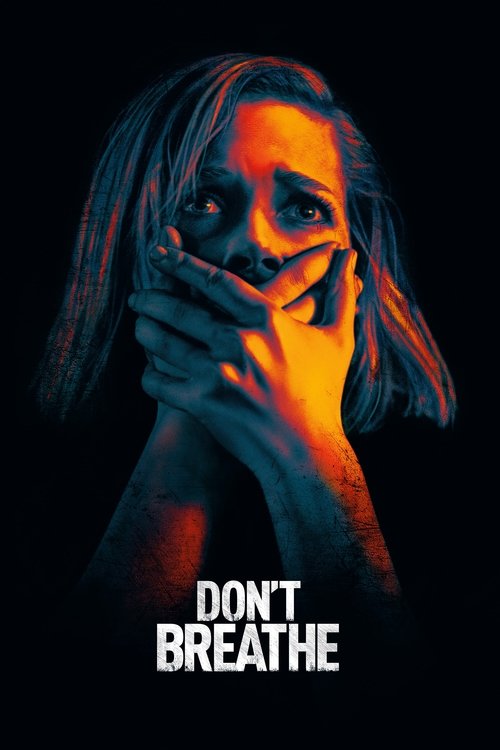
Don't Breathe
2016 · Fede Álvarez
When you're craving a real white-knuckle scare and want to spend ninety minutes with your shoulders up around your ears. Pure challenge, zero comfort — best watched with the lights off and the phone away.
What it's about
Three young burglars in a hollowed-out Detroit target the house of a blind Gulf War veteran, convinced he's sitting on a large cash settlement and that robbing a blind man will be the easiest score of their lives. Once they're inside and the doors lock, the man proves far more capable and dangerous than they ever imagined — and the house is hiding something worse than the money.
The experience
Almost unbearably tense from the moment the break-in starts, built around silence, darkness and held breath — long stretches play out with barely a word spoken. It's lean, mean and fast, with a nasty streak that keeps pulling the floor out from under you.
Performances
Stephen Lang is the engine of the film as the blind man: a largely wordless, physically ferocious performance that turns a vulnerable figure into something genuinely frightening without ever becoming a cartoon.
The craft
Fede Álvarez stages the house as a puzzle box, mapping its geography in long prowling camera moves so you always know where everyone is — which makes every creaking floorboard worse. The sound design is the real star: the film weaponizes quiet, and a sequence plunged into total darkness is a showpiece. It rewards good speakers and a dark room far more than a big screen.
Why it matters
A sleeper hit that opened at number one in the US on a roughly $10 million budget and earned well over $150 million worldwide, cementing Álvarez as a major genre director and spawning a franchise. It helped prove mid-2010s audiences would show up for original, R-rated horror with no stars and no IP.
Snapshot
Don't Breathe is a compact, tightly built thriller about three young burglars in a hollowed-out Detroit who break into the house of a blind Gulf War veteran. They believe he is keeping a large cash settlement inside. Once the doors are locked, the man turns out to be a far more capable and dangerous opponent than they assumed, and the house holds a secret worse than the money. Fede Álvarez directed it from a script he wrote with his long-time partner Rodo Sayagues, and Sam Raimi's Ghost House Pictures produced it. The film reverses the setup of Wait Until Dark (1967): here the vulnerable-seeming blind occupant is the predator and the intruders are the prey. It cost roughly $10 million, opened at number one in the United States in late August 2016, and earned well over $150 million worldwide. That made it one of the most profitable genre releases of its year. Its reputation rests on three things. It is a lesson in clear spatial staging. It inverts the usual moral alignment of the home-invasion film. And Stephen Lang gives an almost wordless, physically frightening performance as the Blind Man.
Industry & production
The film came out of the partnership formed after Álvarez's Uruguayan short ¡Ataque de Pánico! (2009) went viral and brought him to Hollywood. Raimi's Ghost House took him on, and his first feature was the Evil Dead remake (2013), which Ghost House produced and which made solid money worldwide. Don't Breathe was the follow-up. It was deliberately smaller and original rather than a franchise property. Álvarez has said he wanted to prove himself without the safety net of an existing brand. The working title was A Man in the Dark.
Raimi, Rob Tapert and Álvarez produced the film. Screen Gems, Sony's genre label, handled US distribution, as it had for Evil Dead. The story is set in Detroit, and some exteriors and establishing material were shot there, but most of the production, including the house interiors built as sets, was filmed in Hungary. That reflects the economics of mid-budget filmmaking in the 2010s, when Budapest's tax incentives and studio crews drew many American genre productions. The film premiered at South by Southwest in March 2016. Strong word of mouth from that festival helped position it for a late-summer wide release, a slot that has often worked for horror counter-programming.
The film's commercial success is well documented: a modest budget, a first-place opening weekend, and a final worldwide gross many times its cost. It came during a run of highly profitable low-budget horror (Blumhouse's output and the Conjuring films among others). It confirmed that a original, high-concept horror film with no supernatural element could still perform like an event release. A sequel, Don't Breathe 2 (2021), followed, directed by Sayagues with Álvarez as co-writer and producer.
Technology
Don't Breathe was shot digitally. Detailed public records of its exact camera and lens package are thin, so this account does not specify them. The most significant technical choices concern darkness and invisible digital stitching:
- The blackout sequence. In the film's most famous passage, the Blind Man cuts the power to the basement. The image switches to a desaturated, grey, night-vision-like look in which the actors' pupils shine. The audience can see, but the characters, now as blind as their pursuer, cannot. The effect was achieved through a combination of lighting and grading, not literal infrared photography, and it lets the audience watch the burglars grope past a man standing inches away.
- Composited long takes. The early tour through the house appears to be one unbroken camera move. It was built from several pieces joined digitally, a technique made routine by digital acquisition and compositing.
- Built sets. Shooting most of the house on stage, with ceilings and walls that could be removed, made possible the overhead and through-the-floor camera moves that map the building.
Technique
Cinematography
Pedro Luque, a Uruguayan cinematographer who had worked with Álvarez before, shot the film. He later shot Don't Breathe 2. The defining strategy is an early topographical long take. Soon after the three burglars enter, the camera leaves them and glides through the house on its own. It passes through rooms, up stairs, along hallways and over objects: a hammer, a gun under a bed, a padlocked basement door, glass on the floor. In effect it gives the viewer an inventory. Almost every item shown pays off later. This is "planting" in the classic Hitchcock sense, but delivered as a single fluid survey rather than a series of inserts, and it gives the audience a mental floor plan they can rely on for the rest of the film.
The palette is cold and decayed: sickly greens, sodium yellows and rot-browns in the house, and grey-blue in the empty Detroit streets. Luque often frames the Blind Man and the intruders in the same shot, so the viewer can measure the distance between them. A great deal of the film's suspense comes from that measurement.
Editing
Eric L. Beason, Louise Ford and Gardner Gould edited the film. Its rhythm alternates long held passages, in which the camera stays put while characters freeze in silence, with sudden bursts of fast cutting when the Blind Man finds someone. The 88-minute running time is lean. There is almost no subplot, and the first act (the characters' situations, Rocky's wish to get her younger sister out of Detroit, the decision to rob the house) is compressed into a few efficient scenes. The editing respects the geography the long take established, and cross-cutting between rooms relies on the viewer remembering where everyone is. The ending runs through several false resolutions in a row. Some critics found that structure exhilarating and others found it overextended.
Mise-en-scène / staging
The house is the film's main achievement. It is the last occupied home on an abandoned block, and it is presented both as a fortress (bars, multiple locks, a security system) and as a labyrinth (a basement, a hidden room, vents, a skylight). Naaman Marshall's production design makes it legible: we understand the relationship between upstairs, ground floor and basement. It is also oppressive, full of clutter that can make noise.
The staging repeatedly uses one image: a character pressed against a wall or holding their breath while the Blind Man stands close enough to touch. Because sight no longer protects anyone, ordinary objects become dangers. A creaking floorboard, a ringing phone or a shoe on broken glass can give someone away. The Blind Man's Rottweiler adds a sighted, scent-driven threat that the burglars cannot evade with silence alone.
Sound
The title is an instruction about sound, and the soundtrack is built around silence. Long stretches have little or no music. They are dominated by breathing, footsteps, the house settling, and the Blind Man's listening. The audience is trained to hear the way he does, so that a small noise becomes a crisis. Roque Baños, who also scored Álvarez's Evil Dead, wrote a score that leans toward texture, with low drones, scraping and processed sounds, rather than conventional melody. It mostly rises in moments of pursuit. Sound effects and score are blended closely enough that it is sometimes hard to tell where one ends and the other begins.
Performance
Stephen Lang, then best known as the military villain of Avatar (2009), plays the Blind Man (credited simply that way; the sequel names him Norman Nordstrom). He has very little dialogue. The performance is physical: an ex-soldier's bulk and economy of movement, a head tilting to track sound, sudden explosive violence. Lang plays him first as a grieving, almost sympathetic figure, which makes the later revelations more disturbing. His milky, unfocused eyes are a central visual motif.
Jane Levy, who also starred in Evil Dead, plays Rocky. She gives the film its moral centre and its endurance; the "final girl" role is extended here into someone whose motives are themselves compromised. Dylan Minnette plays Alex, the cautious one whose father works for a security company. Daniel Zovatto plays Money, the brash ringleader. Both are drawn as types, but the actors make them clear quickly. Franciska Törőcsik appears as the woman held captive in the basement, whose presence redefines the house's secret.
Narrative & dramatic mode
The film works within the conventions of suspense more than shock, in the Hitchcock sense: the audience usually knows more than the characters (where the Blind Man is, what is under the bed). The structure is a simple reversal. The first act is a heist, and the rest is a siege in which the attackers are trapped. The midpoint revelation that the Blind Man has imprisoned the young woman who killed his daughter in a car accident turns the film from a home invasion into a captivity narrative. A later revelation, the Blind Man's plan to forcibly impregnate a captive to "replace" his lost child, takes it into the territory of exploitation horror.
This shifting sympathy is the film's most debated narrative feature. The burglars are criminals. The victim of the burglary is first a sympathetic veteran who has been bereaved and maimed, then a captor and abuser. The film asks the audience to move its loyalties as the facts change, and it ends ambiguously. Rocky escapes with money, but news coverage reveals that the Blind Man survived and did not report the theft. That leaves their secrets bound together.
Genre & cycle
Don't Breathe belongs to the home-invasion thriller, a long-standing form that includes Wait Until Dark, Straw Dogs (1971), Panic Room (2002), The Strangers (2008), Funny Games (1997/2007) and You're Next (2011). It inverts the form's usual alignment, in which the homeowner is the victim. In this respect its closest predecessor is Wes Craven's The People Under the Stairs (1991), in which young intruders robbing a predatory homeowner discover a house of horrors and a captive inside.
It also belongs to a small mid-2010s cycle of sensory-limitation horror. Mike Flanagan's Hush (2016), about a deaf woman besieged at home, was released the same year. Don't Breathe anticipated the commercial wave that followed, led by A Quiet Place (2018) and Bird Box (2018), in which silence or blindness organises the threat. Arguing for direct influence on those films would be speculative. What can be said is that Don't Breathe showed the commercial appeal of the mode. Finally, it sits alongside 2016's lean, single-location survival thrillers, notably Jeremy Saulnier's Green Room, which likewise traps young people with a militarily skilled antagonist.
Authorship & method
Fede Álvarez (born 1978, Montevideo) built his career on technical precision and an affinity for physical, practical horror. Evil Dead was an exercise in practical gore. Don't Breathe turned the same rigour into restraint and spatial control. His films share a love of tightly planned set pieces and an emphasis on endurance, and they test bodies under stress. He later directed The Girl in the Spider's Web (2018) and Alien: Romulus (2024), where similar confined-space staging is applied to a franchise.
Rodo Sayagues, Álvarez's co-writer since their Uruguayan beginnings, shares writing credit. The script's economy, with few locations, few speaking parts and a stack of reversals, is a product of the partnership. Sayagues later directed the sequel.
Pedro Luque (cinematography), Roque Baños (music) and producers Sam Raimi and Rob Tapert complete the core team. Raimi's influence is generally understood as that of a mentor and producer, not a stylistic hand. The film has little of Raimi's slapstick, though some of its crowd-pleasing escalation recalls his approach to horror as an audience ride.
Movement / national cinema
Don't Breathe is an American studio genre film, but its makers were part of the visible movement of Latin American genre directors into Hollywood in the 2000s and 2010s, alongside figures such as Guillermo del Toro and Andrés Muschietti. Álvarez and Sayagues came from Uruguay, a small national cinema with almost no horror tradition. Their route through viral short, Hollywood producer and genre feature is a characteristic path of the YouTube era. The Hungarian shoot also places the film within the globalised production networks of contemporary American genre cinema, even though it shows no Hungarian or Uruguayan context on screen.
Era / period
The film is closely tied to post-recession America, and particularly to Detroit after the city's 2013 bankruptcy. Its opening images of empty streets and abandoned houses link it with other horror and genre films of the period that used the city's ruins as a landscape, most notably It Follows (2014). The burglars want money to escape the city: Rocky dreams of California. The Blind Man's money is an insurance settlement, compensation for a death. The economic logic of the film is the logic of a place where wealth has gone. It is also post–Iraq War in its subtext. The Blind Man is a Gulf War veteran wounded in service. The film presents him as a figure of damaged American masculinity, abandoned by the state and turned inward to monstrous self-justification, though it does not elaborate this politically.
Themes
- Seeing and not seeing. Blindness is the premise and the governing metaphor. The burglars mistake disability for weakness. The darkness that levels the field exposes their assumptions. The audience, who can see, is made complicit as a watcher who cannot intervene.
- Moral inversion. No one in the house is innocent. The film tests the viewer's readiness to switch sympathy and asks whether a victim of crime can also be its worst perpetrator.
- Grief turned into possession. The Blind Man's loss of his daughter becomes a project to replace her by force. That links the film to horror's long concern with patriarchal control over women's bodies. The forced-insemination scene is the clearest and most contested expression of this theme.
- Economic desperation. Detroit's decline is the reason for the crime. The film's sympathy for Rocky rests on her wish to escape poverty and a neglectful home.
- Home as prison. The fortified house, built to keep people out, turns out to be designed to keep someone in.
Reception, canon & influence
Critical reception. Reviews were broadly positive, and the film was widely praised as one of the sharpest commercial horror films of its year. Critics especially admired its spatial clarity, its sustained tension, and Lang's performance. The early long take and the blackout basement sequence were regularly singled out as bravura set pieces. The main reservations concerned the third act. Several reviewers found the turkey-baster insemination scene a gratuitous turn into exploitation that undermined the film's earlier restraint. Others objected to its multiple false endings. Some critics also noted the thinness of the young characters. Commercially it was a clear success, and its profits relative to cost became a standard example in discussions of horror's economics.
Backward influences. Its most obvious ancestor is Wait Until Dark (1967), which it consciously inverts. Its closest structural relative is The People Under the Stairs (1991). Its suspense grammar, built on planted objects, shared knowledge and held silence, draws on Hitchcock. Its siege staging draws on John Carpenter's lean confined-space thrillers and on the home-invasion cycle more broadly. Its creative team's previous work on Evil Dead, and Raimi's production presence, link it to the American "ride" horror tradition of the 1980s. Its Detroit setting connects it to contemporary ruin-landscape cinema.
Forward legacy. Its most direct descendant is Don't Breathe 2 (2021). The sequel recasts the Blind Man as a protective anti-hero, a decision that divided audiences given what the first film revealed about him. More broadly, Don't Breathe helped establish the late-2010s commercial vogue for sensory-deprivation horror, before A Quiet Place and Bird Box. It also strengthened the career model of the international genre director brought up through a producer's shingle. Álvarez's later work, especially Alien: Romulus, reapplies the film's tight spatial staging and escalating survival structure to franchise material. Within studies of the home-invasion film, it is cited as a key example of the form's reversal, in which the intruders are the victims and the house is the predator. Its canonical status is that of a widely admired, modern genre classic rather than a critics'-poll fixture. Its long take and blackout sequence are often used as teaching examples of how to build a space and then make an audience afraid of it.
Influences: the films it descends from and the films it influenced
- Wait Until Dark (1967) — Its climax has a blind woman smash the lights so her sighted attackers fight on her terms. Don't Breathe reverses that blackout gambit: the blind occupant becomes the predator and the intruders become the prey.
- The People Under the Stairs (1991) — Its template is a break-in by poor young burglars into a fortified house that holds a captive in the basement and turns them into prey. That heist-to-siege structure and the house as a labyrinth are what Álvarez rebuilt almost beat for beat.
- The Silence of the Lambs (1991) — In Buffalo Bill's basement, the killer watches a groping victim through night-vision goggles in total darkness. Luque's desaturated, simulated night-vision blackout sequence is built on that staging.
- Halloween (1978) — The opening Steadicam long take moves through a suburban house and maps its rooms in one continuous movement. That is the model for Don't Breathe's topographical tour of the house before any threat appears.
- Assault on Precinct 13 (1976) — Carpenter's widescreen siege staging keeps few characters in one sealed building with clear entrances and exits. Álvarez applies that geographic economy to a single house.
- Panic Room (2002) — Fincher's digitally stitched 'impossible' camera moves pass through floors, walls and keyholes to lay out a brownstone during a burglary. They are the direct technical precedent for Don't Breathe's composited, wall-passing long take.
- [REC] (2007) — Its finale is shot in the camera's night-vision mode in a pitch-black attic, where a creature that hunts by sound stalks blind survivors. This set up the grammar of sensory-limitation horror that Don't Breathe's blackout uses.
- The Descent (2005) — Blind cave dwellers hunt by sound and the characters must freeze in silence inches from them. The film alternates long held quiet with bursts of fast cutting, and Don't Breathe stages its encounters with Lang the same way.
- Rope (1948) — The camera moves around the room in apparently continuous takes and keeps a planted object (the chest) in the audience's mind. This is the Hitchcockian method behind Don't Breathe's long take, which plants the gun, the hammer and the basement door so they pay off later.
- Evil Dead (2013) — Álvarez's debut feature, made with Sayagues for the Raimi/Tapert Ghost House shingle, uses meticulously storyboarded practical set pieces in one isolated house. Don't Breathe applies the same exactness to restraint instead of gore.
- A Quiet Place (2018) — It extends Don't Breathe's rule that any sound you make can kill you into a whole film, and builds its suspense on near-silent soundtracks and objects planted in the house (the nail on the stair).
- Barbarian (2022) — In a rental house in ruined Detroit, a basement hides a captive-making monster. Like Don't Breathe, it keeps shifting which character the audience sides with and finds more spaces beneath the house.
- Don't Breathe 2 (2021) — Sayagues, the co-writer, directs this time, flipping the siege so the Blind Man defends a house against intruders. It reuses Lang's wordless physical menace and the original's long-take home tour, again shot by Pedro Luque.
- Alien: Romulus (2024) — Álvarez moves Don't Breathe's setup to a derelict station: young scavengers attempt a robbery and end up besieged. It keeps the clearly mapped corridors and a set piece where motion or sound gets you killed (the acid-blood zero-gravity sequence and the motion-tracker silence).
- A Quiet Place Part II (2021) — Álvarez inverts the premise (the antagonist is blind; intruders must stay silent) to develop the silence-as-survival-grammar that AQP II extends: every edit is sound-synchronized to the silence threshold, the audience learns to listen as tactically as the characters, and the spatial logic of threat is organized around sound rather than sight — the specific editing discipline AQP systematizes.
- It Follows (2014) — It uses Detroit's emptied neighbourhoods as a horror landscape and controls space with slow, deliberate camera moves, the same post-bankruptcy ruin setting Don't Breathe uses to motivate its robbery.
- Hush (2016) — It came out the same year and builds a whole home-invasion siege on a deaf protagonist. It works out the house's geography and plays one character's sensory gap against the other's, just as Don't Breathe does in reverse.
- Green Room (2015) — A small group of young people is trapped in one building after a transgression and has to learn its layout under attack. Both films use lean siege plotting where sudden violence breaks long stretches of crouched waiting.
- Evil Dead Rise (2023) — Álvarez's single-location siege thriller built on legible spatial geography and pursuit through a confined dwelling — the same director's confined-space craft that shapes the franchise's modern siege mode.
- 10 Cloverfield Lane (2016) — Released the same year. A home thriller in which a damaged, grieving older man is revealed to be keeping a woman in his basement as a replacement daughter, which is very close to Howard's 'Megan' twist.
Similar films
- A Quiet Place (2018) — influence & lineage
- [REC] (2007) — influence & lineage
- Wait Until Dark (1967) — influence & lineage
- Barbarian (2022) — influence & lineage
- Them (2006) — shared sensibility
- Tuner (2026) — shared sensibility
- Skinamarink (2023) — shared sensibility
- The Black Phone (2022) — shared sensibility