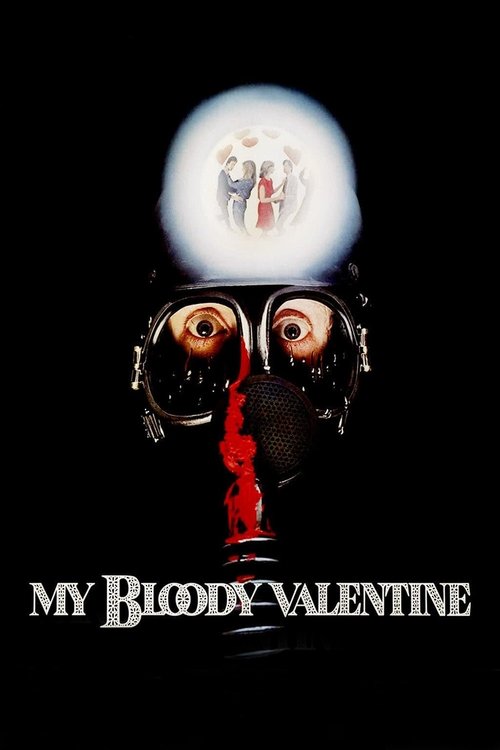
My Bloody Valentine
1981 · George Mihalka
For a Valentine's Day counter-programming night, or when you're craving a classic stalk-and-slash with more grit and personality than the formula usually allows. Comfort-food horror with a mean streak.
What it's about
Twenty years after a Valentine's Day mine disaster drove survivor Harry Warden to murderous revenge, the small coal town of Valentine Bluffs dares to throw its holiday dance again. When a figure in full mining gear and a gas mask starts killing, the town's young miners and their sweethearts realize the past isn't finished with them.
The experience
A tense, meat-and-potatoes slasher with a working-class heart — the love triangle between its miners feels lived-in, and the gas-masked killer stalking by helmet lamp delivers real jolts. It builds steadily to a claustrophobic final stretch underground.
The craft
Much of it was shot in a real colliery, and that authenticity is the film's secret weapon: the mine sequences are genuinely dark, cramped, and wet in a way no set could fake. The gas mask and pickaxe make for one of the slasher cycle's most striking killer designs.
Why it matters
A standout of the post-Halloween slasher boom — notorious for the gore the ratings board cut, later restored — and beloved enough to earn a 3D remake and a lasting cult as the definitive holiday-horror Valentine.
Snapshot
My Bloody Valentine is a Canadian slasher film produced in Montreal by Cinépix and released in the United States by Paramount Pictures in February 1981. It came out at the peak of the cycle that followed Halloween (1978) and Friday the 13th (1980). The story is set in Valentine Bluffs, a small mining town. Twenty years earlier, negligent supervisors left their posts for the town's Valentine's Day dance, and a methane explosion trapped five miners. The only survivor, Harry Warden, came out of the mine insane and took revenge on the men responsible. When the town revives the dance, someone in mining gear and a gas mask begins killing again, and the young miners and their girlfriends become the targets.
The film stands out among its peers for three reasons. The first is setting: it was shot largely in a real colliery in Sydney Mines, Nova Scotia. The second is its working-class milieu, which is unusual in a cycle usually built around middle-class suburbs and summer camps. The third is its censorship history. The MPAA's demands for cuts were severe enough that the film circulated for almost three decades in a mutilated form, and that history became central to its reputation. The 2009 home-video restoration of trimmed footage and a 3-D remake the same year confirmed its status as one of the canonical slashers of the early 1980s.
Industry & production
The film came out of the Canadian "tax-shelter" boom of the late 1970s and early 1980s. Under the Capital Cost Allowance, investors in certified Canadian productions received generous tax deductions, and the result was a surge of commercially minded, often American-facing genre films made in Canada. Cinépix, the Montreal company run by John Dunning and André Link, was one of the most prominent players in this economy. It had produced David Cronenberg's Shivers (1975) and Rabid (1977) and the teen comedy Meatballs (1979). Dunning and Link produced My Bloody Valentine with Stephen Miller, who is credited with the story. John Beaird wrote the screenplay.
The project was explicitly built around a holiday hook, following the model that Halloween had established and that Friday the 13th, Prom Night (1980), Terror Train (1980) and others were exploiting. Production histories commonly recount that the film was developed and shot quickly in late 1980 to make a Valentine's Day 1981 release.
The key production decision was to shoot in an actual mine. The filmmakers used the Princess Colliery in Sydney Mines, Cape Breton, which had stopped working in the 1970s. The town around it served as Valentine Bluffs, and local people appeared as extras. Accounts from cast and crew, given in later interviews and home-video supplements, describe hard conditions underground: cold, damp, cramped and dark, with real limits on how much equipment and lighting could be brought in. The precise figures for the budget and the shooting schedule are reported inconsistently, so this dossier does not state them.
Paramount bought U.S. distribution rights. It had already had a great success with Friday the 13th, and My Bloody Valentine was positioned as a follow-up product in the same vein. The MPAA then required extensive cuts to the gore before it would grant an R rating. George Mihalka and others have repeatedly connected this severity to the climate at the time. There was a public backlash against screen violence, which critics including Gene Siskel and Roger Ebert campaigned for, and John Lennon's murder in December 1980 is often cited as contributing to the board's mood. The cuts removed much of the special-effects makeup work by Tom Burman's team. The film reached theatres with many of its killings abbreviated to quick cut-aways.
Technology
Technically, the film is a conventional 35mm production. Its interest lies in how its tools were adapted to the location. Lighting in the mine was severely limited. Rodney Charters' photography leans on practical and motivated sources, above all the cap lamps on the miners' helmets. Narrow beams sweep through blackness, and the killer's own lamp becomes a stalking device. Shooting in real tunnels set physical limits on camera placement and movement, and this gives the climax a claustrophobic, sometimes disorienting quality that studio sets would not have produced.
Prosthetic and mechanical gore was supervised by Burman Studio. The killings were built around ordinary objects: a pickaxe, a nail gun, a showerhead, a clothes dryer, a pot of boiling water. Because most of this footage was cut for the R rating, for many years the film's technical ambitions were known mainly by reputation. Some of the excised material was rediscovered and reinserted for Lionsgate's 2009 special edition. Because it came from workprint-quality sources, the restored footage is visibly different in image quality from the rest of the film, which is itself a material record of the censorship.
Technique
Cinematography
Charters, a New Zealand-born cinematographer who later had a long career in American television, gives the above-ground scenes a plain, naturalistic look. Overcast Nova Scotia daylight, wooden houses, the pithead and the union hall make up a documentary-like texture of a working town. The most memorable compositions come underground. There, the frame is often mostly black, broken by headlamp beams, and the masked killer can emerge from the darkness at the edge of the light. Point-of-view shots, which had been standard in the cycle since Black Christmas (1974) and Halloween, are used, but less systematically than in some contemporaries. The film relies more on the inherent menace of the mine's geography: shafts, ladders, rail tracks and the descending cage.
Editing
Editing is credited to Jean LaFleur and Gérald Vansier. The structure follows the slasher pattern of intercutting between a growing group of potential victims and the killer's isolated attacks, and the pace speeds up once the party moves into the mine. The theatrical cut is hard to judge as a design, because the MPAA trims imposed abrupt elisions on many set pieces. Viewers familiar only with the theatrical version have often noted cuts that jump away just before the moment of violence. Comparing the theatrical and restored versions has become a standard case study of how ratings intervention reshapes editing rhythm.
Mise-en-scène / staging
The film's design is built on a deliberate collision between Valentine's Day iconography and industrial labour. Paper hearts, red and pink streamers and heart-shaped candy boxes are set against coal dust, lockers, overalls and heavy machinery. The killer's costume is a miner's full work gear with a gas mask and helmet lamp. It is both anonymous and specific to the place: any miner in town could be inside it, which serves the whodunit plot. It is also one of the most distinctive masked-killer designs of the cycle. A grimly comic note recurs when the killer leaves human hearts in Valentine candy boxes. The staging also gives weight to the social spaces of a working town, such as the bar, the laundromat and the union hall, and this anchors the film in community rather than in the isolated teenagers of the camp-set slasher.
Sound
Paul Zaza composed the score. He was a prolific composer for Canadian genre films of the period, including Prom Night. His music follows the conventions of the cycle, with sustained dissonant strings and stingers on the shocks. The underground sequences are shaped more by ambient sound: dripping water, creaking timber, echoing voices and the mechanical noise of the mine. The film ends with an original folk-style song, "The Ballad of Harry Warden", which retells the legend over the end credits. It is an unusual choice for the genre, presenting the killer as regional folklore, and it is often singled out in fan and critical discussion.
Performance
The cast was made up mostly of Canadian actors with modest screen careers at the time. Paul Kelman plays T.J. Hanniger, the mayor's son, who has come back to town after failing to make it out west. Lori Hallier plays Sarah, the woman caught between T.J. and Axel, played by Neil Affleck. Don Francks plays Chief Newby, Cynthia Dale plays Patty, and Keith Knight plays Hollis. Critics have often observed that the young characters are written and played as working adults rather than as high-school students. They are miners in their twenties with jobs, grudges and drinking habits. This gives the ensemble a rougher, less stylised quality than the teenage casts of contemporary slashers. The love-triangle tensions also provide the film's primary red herring. The acting is generally regarded as serviceable rather than distinguished, but its naturalism suits the film's sense of place.
Narrative & dramatic mode
The narrative combines three standard slasher elements. It opens with a past trauma that is told as a legend. It sets up a ritual occasion that is forbidden and then revived. And it is structured as a whodunit, in which the masked killer's identity stays uncertain until the final act. The prologue and flashbacks lay out the Harry Warden story, and the town's elders, including the mayor and the police chief, try to suppress the warnings as the new killings begin. Once the official dance is cancelled, the young people hold their own party at the mine, which moves the final act underground. The climax reveals that the killer is not Warden but Axel. As a child, Axel witnessed Warden's revenge killing of his father, one of the negligent supervisors, and the trauma has deranged him. The film ends with Axel escaping into the tunnels, mutilated but alive, and calling out in Warden's name. The ending leaves the cycle of violence open, in keeping with the genre's habit of irresolution. The dramatic mode is legend-as-curse: the town's history repeats itself because its injustices were never addressed.
Genre & cycle
My Bloody Valentine is a core text of the first great slasher boom, roughly 1978–1984. It follows the holiday-killer model of Halloween, the commercial template of Friday the 13th and the Canadian slasher line that includes Black Christmas, Prom Night, Terror Train and Happy Birthday to Me (1981). Its typical elements include:
- a past wrong
- an anniversary or holiday
- a masked killer
- a series of inventive killings
- a final survivor or survivors
- a twist identity reveal
It departs from the cycle's norms in two ways. Its protagonists are working-class adults rather than suburban teenagers. And its "final girl" structure is diluted: Sarah survives, but the climax is shared with T.J., and the film is less organised around a single heroine than Halloween or Friday the 13th are. Within the subgenre, it is often grouped with films that take their menace from place, such as camps, trains and hospitals. Here the mine serves as both labyrinth and tomb.
Authorship & method
George Mihalka is a Hungarian-born director who moved to Canada and built a career in Quebec's English- and French-language industries. Before this film he had directed the teen comedy Pinball Summer (1980). Afterwards he worked across genres in film and television, including The Blue Man (also known as Eternal Evil, 1985), Office Party (1988) and Bullet to Beijing (1995), as well as French-language features. In retrospective interviews, he has described his intention to make the characters and town credible and grounded, so that the horror arises from a recognisable community. That approach is visible in the film's emphasis on place and on its adult cast.
His key collaborators were:
- John Beaird (screenplay) wrote the script from Stephen Miller's story.
- Rodney Charters (cinematography) shaped the film's visual identity through his photography in the mine.
- Paul Zaza (music) brought experience across the Canadian genre cycle. "The Ballad of Harry Warden" gives the film a folkloric frame.
- Jean LaFleur and Gérald Vansier (editing) worked on a cut that was later reshaped by MPAA demands.
- Burman Studio (makeup effects) produced the gore whose suppression became central to the film's history.
- John Dunning and André Link (Cinépix, producers) were the commercial architects of the project and of Cinépix's broader genre strategy.
The film is best understood as a collaborative, producer-driven genre object. It does not fit a strong auteurist account, although Mihalka's attention to milieu is a real signature.
Movement / national cinema
The film belongs to the history of Canadian popular cinema in the tax-shelter era. That period has been studied as a moment when federal incentives produced a large number of English-language genre films that were often disguised or deliberately "placeless", made to pass as American. My Bloody Valentine is partly an exception. Its Nova Scotia locations, its mining-town economy and its regional setting are unmistakably present on screen, even though the film was aimed at the American market and does not name a province. Scholars of Canadian horror, often following discussions of Cronenberg and of "Canuxploitation" as fans call it, have read the cycle as an under-recognised strand of national cinema. Within that strand, My Bloody Valentine is one of the most frequently cited examples, together with Black Christmas, Prom Night and Terror Train. It is also part of the history of Cinépix, which later became a founding component of Lionsgate. That institutional lineage connects to the 2009 restoration and remake.
Era / period
The film was released at the peak of the slasher boom, and also at the point where that boom met organised resistance. Siskel and Ebert's well-known 1980 condemnation of the "women in danger" cycle, the tougher MPAA stance on gore, and wider anxieties about violence all shaped how the film was received and how it was cut. The early 1980s also brought economic decline in older resource industries across North America, including coal. The film does not address this directly, but its setting in a mining town governed by management and union structures sits against that background. Its fate in the theatrical cut belongs to the period's history of censorship as much as to its history of genre.
Themes
- Negligence and class grievance. The original sin is management's carelessness. The supervisors leave their posts for a dance and the miners die. The revenge narrative thus starts from an act of labour injustice, and the town's authorities later repeat the fault by suppressing the warnings. Critics have read the film as a slasher with an unusual awareness of class, in which the violence is a return of buried, literally underground, grievance.
- The return of the repressed and community memory. The Harry Warden legend works as communal folklore that the elders want forgotten and the young treat as a joke. The ballad at the end turns the killing into a story that will go on being told.
- Love, rivalry and masculinity. The Valentine's setting is mirrored by the love triangle among T.J., Sarah and Axel. The film's men, adult miners whose prospects are limited, are defined by stalled ambition and competitive male bonding. The killer turns out to be one of them, a son destroyed by inherited trauma.
- Inheritance of trauma. Axel's derangement comes from witnessing violence as a child. The cycle passes down through generations, and the open ending implies it will continue.
- Ritual and its profanation. The holiday's sentimental emblems, such as candy boxes and paper hearts, are turned into vehicles for horror. This is the genre's characteristic joke about calendar-based celebration.
Reception, canon & influence
Critical reception. On release, mainstream critics largely dismissed the film or treated it as one more product in a disreputable cycle. Many reviewers lumped it in with the wider wave of slashers that critics were attacking at the time. It performed modestly at the box office. Reliable figures exist in trade sources but are not stated here. It was not a breakout hit on the scale of Friday the 13th, and a planned sequel did not appear at the time. Its reputation grew afterwards through television broadcasts, home video and the genre fan press, which kept the story of the missing gore alive for decades.
Influences on the film (backward).
- Halloween (1978) supplied the holiday-killer premise, the masked stalker and the subjective camera.
- Friday the 13th (1980) supplied the commercial model of a past tragedy, an anniversary revenge and a sequence of set-piece killings, and it was Paramount's own template.
- Black Christmas (1974) and the Canadian cycle, including Prom Night and Terror Train, supplied the Canadian production culture and the holiday or occasion structure.
- More broadly, the giallo tradition of masked killers and whodunit reveals shaped the formula, mostly by way of these American and Canadian intermediaries.
- The legend-told-around-a-campfire framing, here a town legend and a ballad, echoes folk horror and the oral tale.
Legacy (forward).
- Cult canonisation. By the 1990s and 2000s, the film was routinely ranked among the best slashers of the original cycle in fan and critical surveys. Quentin Tarantino has named it among his favourite slasher films.
- A censorship case study. Its theatrical cuts made it a standard reference in discussions of the MPAA and genre violence. The 2009 Lionsgate special edition reinserted about three minutes of cut footage, and the visible difference in image quality made the censorship legible. That release made the film a landmark in the restoration of genre cinema on home video.
- The remake. Lionsgate's My Bloody Valentine 3D (2009), directed by Patrick Lussier, used the property to lead the late-2000s revival of 3-D horror. It reworked the Harry Warden story and the mining setting, and it confirmed the original's value as a brand.
- Iconography. The miner killer, with gas mask, helmet lamp and pickaxe, has become one of the recognisable figures of the slasher pantheon. It recurs in merchandising, homage and retrospective writing.
- Regional and industrial horror. The film is often cited as an early model for slashers that root horror in a specific working environment and in class resentment. Critics have traced similar concerns in later regional and industrial horror. How much it directly influenced these later films is hard to document, and claims of direct lineage should be treated with caution.
- Canadian genre history. It remains a central text in the reassessment of the tax-shelter era. It shows that the period's commercial genre films could carry a distinct sense of place even while aiming at the American market.
Influences: the films it descends from and the films it influenced
- A Bay of Blood (1971) — Bava's giallo turns murder into a sequence of separate, inventive practical-effect killings tied to one location, the body-count design that reached My Bloody Valentine's mine and town set pieces by way of Friday the 13th.
- Black Christmas (1974) — The Canadian original of the holiday slasher: it plays festive decorations and ritual against the killing and keeps the killer hidden until late, the template for MBV's Valentine hearts set against industrial carnage.
- Shivers (1975) — Cinépix producers John Dunning and André Link set their genre model here: low-budget Canadian horror built for the American market, with graphic effects as the selling point, the same production logic they later used on My Bloody Valentine.
- Halloween (1978) — Gave MBV the holiday-titled slasher, the killer whose face stays masked, and the killer's-eye subjective camera that MBV restages through gas-mask point-of-view shots in the tunnels.
- Friday the 13th (1980) — Paramount's own commercial template: a tragedy from years earlier, revenge on its anniversary, and kills staged as showcases for practical gore. MBV copies the structure directly, with Burman's effects in the role Savini's played.
- Prom Night (1980) — A Canadian tax-shelter slasher that ties a past accident to revenge at a present-day community event and ends on an unmasking that reveals a hidden identity, the whodunit design MBV uses for the Harry Warden legend.
- Valentine (2001) — Brings back the Valentine's Day slasher with killings built around holiday iconography (cards, cupid mask, hearts) and a revenge for a humiliation in the past, a post-Scream reworking of MBV's device of setting valentines against violence.
- The Descent (2005) — Lights its underground horror almost entirely with helmet lamps, flares and glow sticks carried by the cast, building on the cap-lamp lighting MBV pioneered in its real mine.
- Hatchet (2006) — Sells a local killer legend told inside the film along with old-school practical gore, a deliberate revival of the early-'80s slasher model MBV represents.
- My Bloody Valentine 3D (2009) — Remakes the property directly: it reworks the Harry Warden backstory, the mine setting and the gas-mask-and-pickaxe killer, and uses stereoscopic 3-D to push the pickaxe toward the viewer.
- Thanksgiving (2023) — An homage to the period's holiday slasher, with a small-town community, a masked whodunit killer and kills built around holiday iconography using practical effects, all taken straight from the MBV model.
- Terror Train (1980) — A Canadian-shot slasher where a themed party is trapped in one real industrial space, a moving train, and the killer hides among costumed revellers. This is the same mix of occasion and confined location that MBV builds in its mine.
- Happy Birthday to Me (1981) — Made in the same year by the Cinépix team of Dunning and Link: an occasion-titled Canadian slasher that sells its gimmick kills and builds to a whodunit reveal, MBV's production twin.
- The Burning (1981) — Opens on a legend told around a campfire about a disfigured killer, uses practical gore by a single effects artist (Savini), and was cut for gore on release. MBV shares the folk tale told as a frame, the showcase effects and the censorship history.
- The Prowler (1981) — The killer wears working gear (WWII combat fatigues) instead of a costume mask, the revenge is tied to an anniversary dance, and the practical gore was later celebrated uncut. This parallels MBV's mining-gear killer and its gore that came back in restoration.
- Curtains (1983) — A late Canadian tax-shelter slasher with an adult cast and a masked killer whodunit, made in the same Quebec-centred industry, showing how the formula carried over into adult-ensemble horror after MBV.
Similar films
- Halloween (1978) — influence & lineage
- Black Christmas (1974) — influence & lineage
- Friday the 13th (1980) — influence & lineage
- The Funhouse (1981) — shared sensibility
- The Texas Chain Saw Massacre (1974) — shared sensibility
- X (2022) — shared sensibility
- The Slumber Party Massacre (1982) — shared sensibility
- Halloween II (1981) — shared sensibility