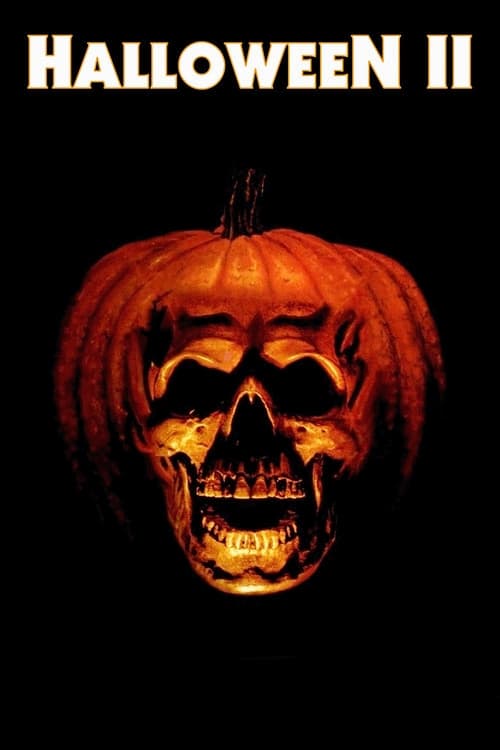
Halloween II
1981 · Rick Rosenthal
For Halloween night when one Haddonfield visit isn't enough — queue it straight after the original for one continuous long night of terror. A comfort pick for slasher fans, a solid scare for everyone else.
What it's about
Picking up in the final seconds of the first film, Michael Myers vanishes into the Haddonfield night after taking six bullets, while a wounded, shell-shocked Laurie Strode is taken to the local hospital. He follows. Through the empty corridors of the night shift, Michael works toward her room as Dr. Loomis scours the town, closing in on a revelation about why Michael won't stop.
The experience
A slower, darker ride than the original — long prowls down fluorescent hallways, a near-empty hospital after midnight, and kills that are nastier and more explicit. It trades Carpenter's restraint for dread-soaked atmosphere and bigger shocks.
Performances
Donald Pleasence goes gloriously big as Loomis, all wild-eyed conviction, while Jamie Lee Curtis plays Laurie's trauma with a drained fragility that's genuinely affecting.
The craft
Dean Cundey's widescreen cinematography makes the hospital a maze of shadows and dead fluorescent light — few sequels look this good. Carpenter and Debra Hill wrote and produced, and the synth theme returns in a colder, meaner arrangement. The empty-corridor sound design rewards a dark room and good speakers.
Why it matters
It turned a self-contained independent classic into a studio franchise, and its sibling revelation reshaped the series' mythology — and slasher-sequel storytelling — for decades.
Snapshot
Halloween II begins in the last seconds of John Carpenter's Halloween (1978) and carries on through the same night. Michael Myers has disappeared after being shot by Dr. Sam Loomis. Laurie Strode, injured and in shock, is taken to Haddonfield Memorial Hospital. Michael follows her there and kills the small night-shift staff one by one, while Loomis searches the town and is finally led to the hospital by a revelation: Laurie is Michael's younger sister, adopted after the murder of Judith Myers in 1963. The film was written and produced by Carpenter and Debra Hill and directed by first-time feature director Rick Rosenthal. It is a transitional object in two senses. It turned a self-contained independent hit into a studio franchise with a backstory, and it pulled Carpenter's restrained suspense model toward the harder, gorier conventions that the slasher boom of 1980–81 had made commercially standard. It is rarely ranked with the original. It matters to film history because it set much of the franchise's mythology, including the sibling bond, the Samhain idea and Michael's apparent indestructibility, and because it showed how a sequel could simply continue the night instead of starting a new one.
Industry & production
The original Halloween was made independently for a famously small budget and became one of the most profitable independent films of its time. A sequel was close to inevitable. Carpenter and Hill had little appetite for repeating themselves, but they stayed on as writers and producers. Rights and financing involved the original's backers, Irwin Yablans and Moustapha Akkad, who are credited as executive producers, and the film was made under the Dino De Laurentiis banner. Universal Pictures handled distribution. This marked the series' move from independent exploitation into a major studio's release schedule.
Carpenter chose not to direct. Rosenthal, a young American Film Institute graduate, got the job on the strength of his short work. Carpenter's own account, repeated in interviews over the years, is that writing the script was a chore because he felt the story was essentially finished. He has said the sibling twist was a device to give the sequel a reason to exist, and he has expressed regret about it.
The best-documented production story concerns post-production. Carpenter screened Rosenthal's cut, judged it insufficiently frightening by the standards of the current market, and shot additional material himself, including more explicit violence and some extended kill scenes. Rosenthal has said publicly that he disagreed with these changes. The finished film is therefore a hybrid authored by both men, and how much of it belongs to each has never been settled. The film was released in the United States at the end of October 1981 and was commercially successful, though it fell well short of the original's extraordinary returns.
Technology
The production kept the original's widescreen anamorphic Panavision format. That continuity in visual grammar mattered, because the film opens by restaging and reusing the climax of the 1978 film. Jamie Lee Curtis, whose hair had changed in the intervening years, wore a wig to match her earlier appearance. Interiors relied on practical lighting effects, and the hospital setting suited this: corridors lit by fluorescent tubes, nurses' stations and darkened wards gave Dean Cundey sources to motivate pools of light against deep black.
The score is a significant technological shift. Carpenter's 1978 music was spare and piano-led. For Halloween II he reworked his themes with Alan Howarth using a much heavier synthesizer palette, producing a denser, more electronic and more mechanical sound. That sound became the basis of the Carpenter–Howarth partnership through the early 1980s. The makeup and gore effects, especially the scalding, the hypodermic needle and the bloodletting set-pieces, reflect the rising importance of practical gore effects after Friday the 13th (1980), though the film's effects are modest by the standards of that cycle's most notorious entries.
Technique
Cinematography
Dean Cundey returned as director of photography, and he is the main source of the film's visual continuity with the original. He again uses deep anamorphic compositions in which Michael can be placed far back in the frame, at the edge of the frame or partly hidden in darkness, inviting the viewer to scan for him. The film keeps the subjective "Shape-cam" at certain moments, notably the early stretch in which Michael moves through Haddonfield's back yards and into neighbours' homes. Inside the hospital, Cundey sets long, symmetrical corridors against cramped rooms, using the building's architecture to create depth and to mark off spaces of safety and danger. Many viewers think the night exteriors, with their wet-looking streets, sirens and patrol-car lights, are among the most atmospheric images in the series.
Editing
The editors were Mark Goldblatt and Skip Schoolnik. The structure cross-cuts between three threads: Laurie, sedated and largely immobile in the hospital; Loomis and the police searching Haddonfield; and the staff, who are picked off one by one. Through the middle stretch, the pacing is noticeably slower than the original's, as it builds suspense around repeated routines: shift changes, phone calls and characters searching for each other. Carpenter's added material made the violent climaxes of individual scenes more explicit. The result is an uneven rhythm in which long stretches of quiet are broken by graphic inserts that some critics found jarring next to the rest of the footage.
Mise-en-scène / staging
The hospital is the film's defining choice. A place meant for care and safety becomes a labyrinth. The building is understaffed for a holiday night, and its cast is reduced to a skeleton crew: a guard, a doctor, an ambulance team and a few nurses. That gives the film a bounded, almost theatrical arena. Medical props become weapons and means of death: a syringe, a scalding therapy pool, an IV line used to drain a victim's blood. The staging leans on the anonymity of institutional space, including empty parking lots, a dark basement and long tiled halls. Laurie's stumbling escape through these spaces, injured and drugged, makes the hospital the film's antagonist as much as Michael is.
The film's most famous single image comes from outside the hospital: a jack-o'-lantern in the opening credits that splits open to reveal a skull. It works as a statement of intent, holiday iconography opened up to show the horror inside.
Sound
The Carpenter–Howarth score restates the original's main theme and motifs, but in a heavier, more synthetic arrangement, with drones and stingers that are more insistent than the 1978 film's. The original sound design used silence and ambient night noise very effectively. The sequel is more aggressive and more often underlined by music. The Chordettes' "Mr. Sandman" is used ironically, and that cheerful 1950s pop song set against carnage became one of the film's most often cited touches. Sound also shapes the hospital's geography. Intercom pages, telephones and Laurie's weak voice all mark how isolated people are from one another.
Performance
Jamie Lee Curtis returns as Laurie, but the script keeps her sedated and passive for much of the running time. Her performance is mainly physical: disorientation, exhaustion and a slow, limping escape. Viewers who valued the resourceful heroine of the original have often found this a step backwards for the character. Donald Pleasence's Loomis is larger and more apocalyptic than before, increasingly a prophet of evil whose authority others resist. He anchors the film's mythic register. Charles Cyphers returns briefly as Sheriff Brackett, whose grief at his daughter Annie's death takes him out of the story. The hospital staff, played by Lance Guest, Pamela Susan Shoop, Leo Rossi, Gloria Gifford, Tawny Moyer, Ana Alicia and others, are sketched quickly, in the familiar slasher manner. Stuntman Dick Warlock plays Michael, giving the Shape a slower, more upright and mechanical bearing than the original's.
Narrative & dramatic mode
The film is built as a direct continuation of the original rather than a sequel set years later. It takes place on the same Halloween night and runs into the early hours. This "same night" structure was unusual, and it creates a feeling of a nightmare that won't end. The film's main narrative addition is the backstory. Loomis learns from his colleague Marion Chambers, played by Nancy Stephens, that Laurie is Michael's sister. That turns Michael's motive from inexplicable to familial and destined. It also changes the dramatic mode: the original's random, pure evil is replaced by a hunter tracking a particular quarry.
The film also adds suggestions of the occult. "Samhain" is written in blood on a classroom chalkboard, and Loomis talks about the Celtic festival. These threads stay underdeveloped, but later entries in the series picked them up. The climax, in which Loomis ignites gas in an operating theatre and Michael, burning, walks out of the flames before collapsing, was meant to end the Michael Myers story. Carpenter and Hill planned for the series to become an anthology, beginning with Halloween III: Season of the Witch (1982).
Genre & cycle
Halloween II sits at the peak of the first American slasher cycle. In 1981 that cycle included Friday the 13th Part 2, My Bloody Valentine, The Burning, Happy Birthday to Me and Hell Night. Halloween had set the template, Friday the 13th had shown that explicit gore sold, and the sequel absorbed that lesson, most visibly in Carpenter's reshoots. In that sense it is a case of an originator adapting to its imitators. The film also reflects the cycle's growing interest in elaborate, set-piece deaths, its expendable young adults and its punishment of characters caught in sexual situations (the hot-tub sequence is the obvious example). Its hospital setting adds the institutional-thriller variant also seen in the near-contemporary Visiting Hours (1982).
Authorship & method
Authorship of Halloween II is divided. Rick Rosenthal is the credited director and handled most of the shoot. His approach, a slower and more atmospheric build, can be seen in the film's long stretches of suspense. He went on to direct Bad Boys (1983) and, two decades later, returned to the series with Halloween: Resurrection (2002).
John Carpenter wrote the script with Debra Hill, produced it, composed the score with Alan Howarth, and shot additional material. His hand shows most clearly in the score, the backstory and the more graphic kills. Debra Hill, co-writer and producer, carried over the original's practical, small-scale production sense. Dean Cundey, Carpenter's regular cinematographer on Halloween, The Fog (1980) and Escape from New York (1981), was probably the most important link between the two films' visual identities. The editors, Mark Goldblatt and Skip Schoolnik, assembled the composite. Goldblatt later had a notable career cutting large-scale action films.
Movement / national cinema
The film belongs to American commercial genre cinema at a specific moment. Independent exploitation forms that had proven their profitability in the late 1970s were being absorbed into studio distribution. Carpenter's own path was moving from independent production toward larger studio projects, and The Thing (1982) followed. Halloween II is part of that institutional shift. It is not tied to any aesthetic movement. Its context is the post-New Hollywood industry, in which formula, franchise and seasonal release patterns increasingly shaped genre production.
Era / period
Released in 1981, the film sits at the start of the Reagan era and on the cusp of home video's rise, which would soon change how slashers were consumed and sequelized. The slasher boom was at its height, and so were the critical and press backlash against screen violence and the debate over the genre's treatment of women. The film's shift toward explicit gore puts it inside that controversy. Its release on Halloween weekend shows the holiday-scheduling strategy the original had helped establish.
Themes
- Fate and inheritance. The sibling twist turns Laurie from an ordinary babysitter into someone marked by blood. Michael's pursuit becomes inevitable, and the horror moves from chance to destiny.
- The failure of institutions. The hospital, the police and the medical profession, all supposed to offer protection, prove incompetent, understaffed or absent. Loomis's struggle to be believed continues the original's critique of complacent authority.
- Indestructible evil. Michael survives six bullets and a fall. His near-immortality, which Loomis frames in supernatural terms, is the film's main contribution to the series' mythology.
- Domestic and holiday spaces violated. The festive pumpkin that opens on a skull, the cheerful pop song, the nurses' banter: the film repeatedly sets comfort against horror.
- Mistaken identity and collateral violence. In an early sequence, a costumed teenager, Ben Tramer, is mistaken for Michael and killed when a police car hits him and he burns in the crash. It shows how panic spreads violence beyond the killer himself.
Reception, canon & influence
Critical reception. Reviews in 1981 were generally mixed to negative. Common complaints were that the film was redundant compared with the original, that it relied on gore at the expense of Carpenter's earlier suspense, and that its heroine was passive. Audiences turned out in respectable numbers, and the film was profitable, but it is not generally ranked among the essential films of the cycle. Over the following decades it gained a more affectionate cult standing. Fans value its atmosphere, Cundey's photography, the hospital setting and its status as the "second half" of the original night. The exact balance of its critical reputation is hard to state precisely, because it has been revalued repeatedly as later sequels kept or discarded its mythology.
Influences on the film (backward). The film's main source is Halloween itself, which it continues, quotes and partly reuses. It also absorbs the gore-led commercial logic of Friday the 13th (1980) and the wider 1980–81 slasher cycle, and it draws on older Gothic ideas of familial curses and pagan ritual for its occult additions. The figure of the obsessed doctor-prophet hunting an inhuman killer carries on Loomis's role from the first film, itself drawn from older horror archetypes.
Legacy (forward). Halloween II shaped the franchise more than any other entry except the original:
- The sibling twist was taken up in Halloween 4: The Return of Michael Myers (1988) and its successors through Laurie's daughter Jamie Lloyd. It continued in Halloween H20: 20 Years Later (1998) and Halloween: Resurrection (2002), and Rob Zombie's remake continuity (2007, 2009) also kept it.
- The Samhain and occult threads were developed, in a very different form, in Halloween: The Curse of Michael Myers (1995).
- Indestructibility became Michael's defining trait across the series.
- The hospital setting returned in Zombie's Halloween II (2009), whose opening is set in a hospital, and in Halloween Kills (2021). Halloween Kills restages the "same night" continuation and returns to Haddonfield Memorial in clear tribute.
- The "same night" sequel became a recognized model, and David Gordon Green's Halloween Kills explicitly adopts it.
The film's legacy is also defined by later sequels rejecting it. David Gordon Green's Halloween (2018) discards every sequel and explicitly dismisses the sibling relationship as a story people made up. That later reworking confirms that Halloween II set the terms of the franchise's mythology, even for the film-makers who set out to undo it.
Influences: the films it descends from and the films it influenced
- Halloween (1978) — Halloween II starts in the last minutes of the first film. It re-stages Loomis shooting Michael from new angles and keeps the same Panavision widescreen look from Dean Cundey, with action happening deep in the frame, so the two films play as one continuous night.
- The Fog (1980) — Carpenter and Cundey's anamorphic night photography for The Fog, lit by practical sources with figures emerging from the dark, was carried over into the dim hospital corridors of Halloween II.
- Friday the 13th (1980) — Its model of staging elaborate kills built around makeup effects is the source of Halloween II's graphic set-pieces, the scalding hot tub and the syringe in the eye. Carpenter's reshoots added these to compete with Friday the 13th's box office.
- Black Christmas (1974) — Clark's handheld point-of-view shots from an unseen killer inside a building at night came before the subjective 'Shape-cam' that Halloween II takes over from the original film.
- Bride of Frankenstein (1935) — It is the classic horror sequel that opens directly after the previous film's climax: the monster survives the fire and the story carries on the same night. Halloween II uses the same structure when Michael walks away from Loomis's gunshots.
- Visiting Hours (1982) — It takes over the hospital setting directly: a stalker in an emptied hospital, with nurses' stations, lifts and a bedridden woman unable to escape, the same situation Halloween II set up with the sedated Laurie.
- X-Ray (Hospital Massacre) (1982) — It copies Halloween II's medical props used as weapons (scalpels, gurneys, surgical masks) and its after-hours hospital corridors as a maze around a single helpless heroine.
- Halloween III: Season of the Witch (1982) — It builds a whole film from the Samhain and pagan-ritual idea that Halloween II added, with the same Carpenter–Howarth synth score and Cundey's anamorphic photography.
- The Terminator (1984) — Mark Goldblatt, one of Halloween II's editors, cuts another killer that can't be stopped and keeps getting up after being 'killed'. The editing is relentless and leads to a climax with the body getting up again, the approach he had worked on in Michael's last walk through the fire.
- Halloween 4: The Return of Michael Myers (1988) — Its whole plot rests on Halloween II's sibling twist. The bloodline passes to Laurie's daughter Jamie, and Michael comes back to Haddonfield to hunt his family, not random victims.
- The Exorcist III (1990) — Its famous static wide shot of a hospital corridor during the night shift brings Halloween II's dread of the empty ward and nurses' station to its most extreme form.
- Halloween: The Curse of Michael Myers (1995) — It takes the Samhain clue Michael writes in blood in Halloween II and turns it into a whole Druidic 'Thorn' cult that explains why he can't be killed.
- Halloween H20: 20 Years Later (1998) — It keeps only the original and Halloween II as canon and rests on the brother–sister relationship. Laurie's escape after II becomes trauma she has buried, and the climax repeats her final confrontation.
- Halloween: Resurrection (2002) — Rosenthal returns to the series and brings the same slow-building stalking through a confined labyrinth, here transferred from hospital corridors to a house rigged with webcams.
- Halloween II (2009) — It opens with a long nightmare in a hospital that restages the 1981 film's same-night hospital pursuit almost beat for beat, with a guard decapitated and a wounded Laurie running through the wards.
- Halloween Kills (2021) — It adopts Halloween II's 'same night' continuation outright and sends its mob to Haddonfield Memorial Hospital. It also repeats Halloween II's three-way crosscutting between the injured Laurie, the hunters and the stalker.
- Escape from New York (1981) — It was made at the same time with the same team, Cundey shooting and Carpenter and Alan Howarth on synthesizers. Its layered, sequencer-driven sound is the same texture that rebuilds the Halloween theme for the sequel.
- Friday the 13th Part 2 (1981) — This is the other 1981 sequel that continues directly from its original: it opens with the previous survivor's fate and then sets up mythology to keep the killer going. It runs parallel to Halloween II's 'second half of the night' approach.
- Psycho II (1983) — Also shot by Cundey, it is the slasher-sequel model Psycho II defines itself against: it repeats its predecessor's body-count escalation, whereas Holland's script turns the sequel into a mystery about who is persecuting the original killer.
Similar films
- Halloween (1978) — influence & lineage
- Black Christmas (1974) — influence & lineage
- Bride of Frankenstein (1935) — influence & lineage
- The Texas Chainsaw Massacre Part 2 (1986) — shared sensibility
- Scream 2 (1997) — shared sensibility
- Scream (1996) — shared sensibility
- Psycho II (1983) — shared sensibility
- Dracula (1958) — shared sensibility