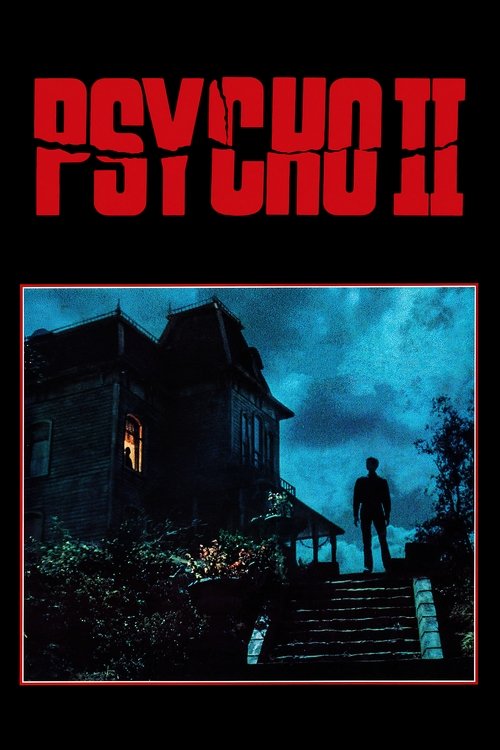
Psycho II
1983 · Richard Franklin
For when you want an old-school suspense picture that respects your patience — a twisty, character-driven thriller for a quiet night rather than a jump-scare machine. Comfort-food Hitchcock pastiche with a genuinely uneasy center.
What it's about
Twenty-two years after his crimes, Norman Bates is declared sane and released, over the furious objections of the sister of his most famous victim. He returns to the old house and motel, takes a diner job, and tries to live quietly — until notes and phone calls start arriving that seem to come from his dead mother. Someone is working on him, or something inside him is waking up, and the film keeps you guessing which.
The experience
Slow-burning and surprisingly sad — it plays less like a slasher than a suspense mystery about a fragile man being gaslit, with real sympathy for its monster. The tension comes from waiting to see whether the people around Norman are crueler than he ever was.
Performances
Anthony Perkins returns to Norman Bates and makes decency itself suspenseful — every polite hesitation and nervous swallow reads as either recovery or relapse, and he keeps you unsure to the end. Meg Tilly brings a soft, ambiguous warmth as the waitress who befriends him.
The craft
Richard Franklin, a devoted student of Hitchcock, stages the film with elegant, patient camerawork that honors the original's geography — the house, the stairs, the motel office — while Jerry Goldsmith's melancholy score deliberately refuses to imitate the famous shrieking strings. The screenplay builds a real whodunit instead of coasting on the brand.
Why it matters
Widely expected to be a cheap cash-in at the height of the slasher boom, it instead earned a reputation as one of the most respectable belated sequels in horror — a model for how to continue an untouchable classic with care.
Snapshot
Psycho II came twenty-three years after Alfred Hitchcock's Psycho (1960). It is set twenty-two years after Norman Bates's arrest. The courts declare Norman (Anthony Perkins) sane and release him, over the objection of Lila Loomis (Vera Miles), the sister of Marion Crane. He goes back to the Bates house and motel, takes a job at a nearby diner, and befriends a young waitress, Mary (Meg Tilly). Soon he starts getting notes and phone calls that seem to come from his dead mother. The film then becomes a story about who is doing this, and why. It is less a slasher film than a study of a man who may have been cured being pushed back into madness by the people around him.
Universal made the film as a commercial sequel when slasher films were at their peak. The team behind it took Hitchcock's model seriously. Richard Franklin, an Australian director and open Hitchcock admirer, worked from a script by Tom Holland, with Dean Cundey as cinematographer and Jerry Goldsmith as composer. The result fits both the early-1980s horror market and the critical culture that treated Hitchcock as an auteur. It is now widely seen as one of the most accomplished horror sequels of its decade, and an early example of what later critics would call the "legacy sequel."
Industry & production
By the early 1980s Universal had learned what an established horror property could earn, and it had seen independent slasher films such as Halloween (1978) and Friday the 13th (1980) make large profits on small budgets. A Psycho sequel used a title the studio already owned, with a famous set still standing on its backlot.
Robert Bloch, who wrote the novel Psycho (1959), published his own sequel, Psycho II, in 1982. His book sends Norman out of the asylum and into Hollywood, and satirizes the slasher boom. Universal did not adapt it. The studio developed an original screenplay with Tom Holland, and the two works share only a title and a premise. Accounts of the development often say Universal first imagined the project on a smaller scale, possibly as a made-for-cable film, before making it a theatrical release. The details of that history are reported unevenly.
Two production facts show how the film relates to its source. Hilton A. Green produced it. He had been Hitchcock's assistant director on the 1960 film, so he was a direct personal link to the original. And Anthony Perkins returned as Norman. He had long been ambivalent about how closely the role defined his career, and his return gave the sequel a legitimacy that a recast version could not have had. Vera Miles also came back as Lila, now Lila Loomis, married to Sam Loomis, who is mentioned as dead.
The film was shot largely on the Universal lot, using the Bates house and a reconstructed motel. That gave Franklin real physical continuity with Hitchcock's spaces. The budget was modest by studio standards, widely reported at around $5 million. The film opened in June 1983 and did well commercially. Reported grosses are usually given as above $30 million in North America, which is why Universal went ahead with Psycho III (1986).
Technology
Psycho II is a conventional studio production of its time, without technological novelty. Its biggest technical difference from the original is color. Hitchcock shot Psycho in black-and-white partly for economy, using his television crew, and partly to make the violence bearable. The sequel opens with the shower murder from the 1960 film in its original monochrome, then moves into the color present. That transition states the film's whole project: the past is fixed and in black-and-white, and the present has to live in its shadow.
Its effects work reflects the more graphic standards of the early 1980s. There are knife wounds and a notorious shovel blow, and the violence is shown more directly than Hitchcock was allowed in 1960. Even so, Franklin is restrained compared with most of the cycle. The film uses gore at a few points and does not build its set pieces around it.
Technique
Cinematography
Dean Cundey had shot John Carpenter's Halloween, The Fog (1980) and Escape from New York (1981). He brought a mobile camera and a talent for deep darkness. Psycho II is a night-heavy film. The Bates house is lit with pools of practical-looking light and edges of shadow, and the frame often keeps dark space around Norman, so the viewer, like Norman, is unsure who else is in the house.
Cundey and Franklin use the familiar architecture as a visual system. The house sits above the motel, and the stairs, the upstairs hallway, Mother's room and the fruit cellar are each treated as charged spaces. Several shots openly echo Hitchcock's compositions: the high angle in the stairwell, the low-angle silhouette of the house against the sky, and the view through the peephole. The camera also often takes Norman's point of view, which Hitchcock usually withheld. The sequel wants to align the viewer with Norman, not simply hold him at a distance.
Editing
Andrew London edited the film. Its rhythm is mostly measured and suspense-driven, slow builds with sudden release, close to Hitchcock's methods and unlike the shock-cut pacing common in slasher films. Inserting the 1960 footage at the start is itself an editing statement. The film also uses crosscutting to keep the audience ahead of Norman: we learn about Lila and Mary's scheme before he could. Hitchcock argued for exactly this, suspense through the audience's superior knowledge rather than surprise. The final act then reverses the method with a series of reveals that pile up quickly in the last reels.
Mise-en-scène / staging
The house's interior is staged as a museum of the first film. Mother's room is preserved, the clothes and the indented bed are still there, and the stuffed birds of the motel parlor return. Franklin stages Norman's re-entry into these rooms as a confrontation with relics. When Norman goes up the stairs, or Mary sleeps in Mother's room, the scene borrows meaning from the original.
Several scenes knowingly invert or quote Hitchcock. A shower scene sets up an expectation and then refuses to deliver it. The diner and kitchen scenes at the motel recall the sandwich-and-milk conversation in the parlor between Norman and Marion. The motel itself, now run by a sleazy manager (Dennis Franz) who rents rooms by the hour, shows the moral decline of the outside world. The staging suggests that the respectable "normal" world has become more corrupt than Norman.
Sound
Jerry Goldsmith's score largely sets aside Bernard Herrmann's strings-only design, except for the original music heard over the opening footage. Goldsmith writes a melancholy, lyrical main theme that frames Norman as a sympathetic and nearly tragic figure, against more conventional suspense material. That choice to score Norman's pathos and not only the menace is one of the film's clearest interpretive decisions.
Sound design matters to the plot. Ringing telephones, an offscreen voice that seems to be Mother's, and footsteps on the floor above are the means by which Norman is tormented. Because the threat arrives so often as sound without a visible source, the film keeps open the question of whether Mother exists, in Norman's head or in the house.
Performance
Perkins's performance anchors the film and is widely considered among his best later work. His Norman of 1983 is middle-aged, tentative, desperate to be normal, and painfully alert to how others see him. The nervous charm of 1960 is still there, now weighed down by twenty-two years of institutional life. Perkins plays most of the film as a man holding himself together by effort, and the slow return of the old tics is unsettling because we have come to want him to stay well.
Meg Tilly plays Mary as an ambivalent figure whose sympathy for Norman grows while she is supposed to be deceiving him. Their relationship gives the film its emotional center. Vera Miles turns Lila from the determined investigator of 1960 into a vengeful, hard-edged figure. Robert Loggia plays Norman's psychiatrist, Dr. Raymond, as his only defender. Claudia Bryar, as the diner's older employee Mrs. Spool, gives a quiet performance that matters a great deal to the ending.
Narrative & dramatic mode
Structurally, Psycho II is a mystery dressed as a slasher sequel. The central question is "who is pretending to be Mother?" more than "will Norman kill?" The film's main irony is that the "sane" characters, including Lila, Mary and those who collude with them, set out to recreate Norman's madness, and they may be what triggers the violence they claim to fear. The narrative keeps the audience's sympathy on Norman's side for much of its length, a sharp change from the original's famous switch of identification from Marion to Norman.
The final act piles up twists: a claim about Norman's parentage, a series of deaths, and a closing image of Norman back in the house with "Mother" again. Critics have split over whether this works. Some see it as a fitting tragic return to the starting point. Others see it as plot mechanics overriding the character study that came before. The ending also, conveniently, makes further sequels possible.
Genre & cycle
Psycho II arrived at the height of the American slasher cycle. That cycle drew on Psycho and on the Italian giallo, and was set off commercially by Halloween and Friday the 13th. By 1983 the cycle depended on serial sequels with interchangeable victims and a nearly supernatural killer.
The film deliberately sidesteps these conventions. Its violence is limited, its body count modest, and its protagonist is the supposed monster, treated with sympathy. In that sense it is a slasher film criticizing slasher films. It reclaims the cycle's founding text and gives it back psychological and moral complexity. It also belongs to the early-1980s wave of studio horror sequels and revivals, alongside Halloween II (1981), Amityville II: The Possession (1982) and Jaws 3-D (1983). It differs from most of them in how seriously it takes its predecessor.
Authorship & method
Richard Franklin (1948–2007) was one of the most self-declared Hitchcockians of his generation. As a film student at the University of Southern California, he had contact with Hitchcock, and he openly modeled his own work on Hitchcock's methods. His Australian thriller Road Games (1981), a road-movie take on Rear Window starring Stacy Keach and Jamie Lee Curtis, worked as a calling card for this project. Psycho II lets him put his reverence into practice. He storyboards suspense, controls point of view and plants visual echoes. His later career included Cloak & Dagger (1984), Link (1986) and F/X2 (1991). Over his career he never quite got out from under the comparison to his idol.
Tom Holland wrote the screenplay. He had already written genre scripts such as The Beast Within and Class of 1984 (both 1982). He went on to direct Fright Night (1985) and Child's Play (1988), both of which, like Psycho II, are aware of horror's history and treat genre conventions with a self-conscious wit. His script's reversal of sympathy and its mystery structure are the main sources of the film's identity.
Dean Cundey (cinematography) brought the visual vocabulary of the Carpenter films. He went on to shoot Back to the Future (1985), Who Framed Roger Rabbit (1988) and Jurassic Park (1993). Jerry Goldsmith (music) had already scored The Omen (1976, Academy Award) and Alien (1979). His decision to write a new theme rather than imitate Herrmann helped the sequel establish its own tone. Andrew London edited. Hilton A. Green produced, which links the production to Hitchcock's original crew.
Movement / national cinema
Psycho II is a Hollywood studio production of the post-New Hollywood era. Its director's background in the Australian New Wave genre cinema of the 1970s, sometimes grouped under "Ozploitation," is still worth noting. Franklin's Patrick (1978) and Road Games were among the Australian genre films of that decade aimed at international markets, and his hiring fits a broader pattern of Australian directors moving to Hollywood in the late 1970s and 1980s, including Peter Weir, Bruce Beresford, Fred Schepisi and George Miller. The film itself has no Australian identity. The more useful context is the director's American training in film history and Hitchcock studies.
Era / period
The film belongs to the early Reagan era, and to the moment when Hollywood found that its own back catalogue was a source of franchises. It came out three years after Hitchcock's death in 1980, when his reputation stood at a critical peak, supported by auteurist criticism and by younger directors, Brian De Palma most obviously, whose openly Hitchcockian thrillers had made homage a recognizable mode. Psycho II sits between that critical reverence and the commercial logic of the sequel boom.
Some critics have also read its interest in psychiatric release, rehabilitation and community suspicion against the background of 1970s and early-1980s deinstitutionalization in American mental health care. The film does not take up that context explicitly, so the reading is interpretive.
Themes
- Rehabilitation and its impossibility. The film asks whether a person can escape their past when others refuse to let them. Norman's attempt at a normal life is undermined as much by outside persecution as by inner compulsion.
- The persecutor as monster. Lila's quest for justice turns into a campaign to recreate madness. The film reverses the moral roles of the original and asks the audience to examine its own appetite for Norman to "kill again," which is exactly what a sequel audience has paid for.
- Mothers and origins. The question of who Norman's mother really was is pushed to its limit in the third act. Maternal identity becomes the film's central mystery and its tragic trap.
- Memory and the burden of the original. The house, the motel and the opening footage make the past physically present. Norman is haunted by 1960 the way the film is haunted by Hitchcock.
- Voyeurism and spectatorship. The peephole, the hidden watcher and the staged performances of "Mother" keep returning to the original's concern with looking and being looked at.
Reception, canon & influence
Critical reception. On release, reviews were mixed to moderately favorable. Many critics started from skepticism about sequelizing a Hitchcock classic, then were surprised by the film's craft and by Perkins's performance. Others found the closing twists contrived or judged the whole project unnecessary. The film did well commercially. Its reputation has risen steadily since, and it is now often cited as one of the best horror sequels of the 1980s and as a model for honoring a canonical original without simply repeating it.
Influences on the film (backward). The main influence is Hitchcock's Psycho and, more broadly, Hitchcock's whole grammar of suspense, including point-of-view identification and the audience's superior knowledge. Franklin's own Road Games shows the same apprenticeship. The early-1980s slasher cycle that Psycho had partly inspired is a defining context too, sometimes as a model and often as a foil. Bloch's 1982 novel is part of the property's history, though the film does not adapt it.
Legacy (forward). Psycho II launched a franchise. Perkins himself directed Psycho III (1986), and Mick Garris directed the television film Psycho IV: The Beginning (1990), written by Joseph Stefano, screenwriter of the 1960 film. There was also the unrelated television pilot Bates Motel (1987). Later came Gus Van Sant's shot-for-shot remake (1998) and the A&E series Bates Motel (2013–2017), whose sympathetic, inside-out portrait of Norman follows a line the 1983 film had already opened.
More broadly, Psycho II anticipates the "legacy sequel" decades early: a returning original star, a story set in real elapsed time, an aging protagonist and a plot about the weight of the past. Later films such as Halloween (2018) take up the same model. Tom Holland's later work, especially Fright Night, carries forward the film's knowing relationship to genre history. How far Psycho II directly influenced later sequels, beyond being a respected precedent, is hard to document. The connections are clearer as resemblance than as acknowledged lineage.
Influences: the films it descends from and the films it influenced
- Psycho (1960) — Psycho II opens with the original shower murder in black and white before cutting to color. It then restages the original's set pieces (the house, the parlor, the shower, the cellar) as a reversed visual quotation, using Hilton A. Green's producing link and Hitchcock's own Universal backlot sets.
- Rear Window (1954) — Its spatial grammar of a voyeur's point-of-view shot, a reverse shot and the place being watched underlies both Franklin's Road Games and Psycho II's house-to-motel sightlines, where Norman and the camera watch from the house's windows down to the motel office.
- Halloween (1978) — Dean Cundey brought over the low-key, practical-source night lighting and Panavision widescreen compositions that leave dark negative space where a threat might be. He relit Hitchcock's Gothic house in that vocabulary instead of mimicking John L. Russell's flat 1960 black-and-white.
- The Fog (1980) — Cundey's blue-black night exteriors and backlit silhouettes here are the direct template for Psycho II's rain-swept house exteriors and the figure of 'Mother' seen against a window.
- Dressed to Kill (1980) — De Palma's openly quoted shower-murder fake-out and mid-film killing of the apparent lead showed that Psycho's set pieces could be reworked as knowing variations. Psycho II answers with a shower scene that withholds its violence.
- Psycho III (1986) — Perkins directs himself and pushes Psycho II's ironic distance further into black comedy. It opens with a bell-tower fall that quotes Vertigo, extending Franklin's practice of quoting Hitchcock outside the Psycho film itself.
- Psycho IV: The Beginning (1990) — Joseph Stefano returns to write it, and it completes the inside-out turn Psycho II began: Norman tells his story through flashbacks to the young Norman and Norma, which makes the 'acousmatic mother' finally visible.
- Fright Night (1985) — Holland carries over Psycho II's knowing, genre-literate script. Here the monster is a charming neighbor watched from a bedroom window, a Rear Window setup, and an aging horror-host star (Roddy McDowall) is defined by the genre's past.
- Child's Play (1988) — Holland again builds the first act as a mystery about who is really doing it, with the audience's suspicion moving between the child, the mother and the doll, in the way Psycho II keeps it uncertain whether Norman, Mother or someone else is the killer.
- Halloween H20: 20 Years Later (1998) — An early full use of the Psycho II model: the original star returns (Jamie Lee Curtis), story time matches the real years since the original, and the plot is about trauma that has never been resolved.
- Scream (1996) — It joins the slasher to a whodunit with a hidden killer, as Holland's script did. It also uses the 1980s cycle's self-awareness as plot mechanics, which Psycho II pioneered by making its killer a product of Psycho's own legend.
- Psycho (1998) — The opposite answer to the same question of how to follow a canonical Hitchcock: a near shot-for-shot color remake that shows, by contrast, why Psycho II's strategy of quoting and inverting worked better than replicating.
- Halloween (2018) — It repeats Psycho II's legacy-sequel design: the original star returns after real elapsed time, earlier sequels are thrown out, an original set piece is restaged with roles reversed, and the past is a weight the characters carry.
- Road Games (1981) — Franklin's dry run for Psycho II: a Rear Window rebuilt for the open road, with storyboarded point-of-view suspense and the audience knowing more than the characters. It got him the job and established his practice of planting Hitchcock references as visual rhymes.
- Blow Out (1981) — A contemporary American-New-Wave Hitchcockian work that likewise uses the master's suspense-over-surprise structure and point-of-view identification. Both films treat Hitchcock as a grammar to develop rather than a template to copy.
- Halloween II (1981) — Also shot by Cundey, it is the slasher-sequel model Psycho II defines itself against: it repeats its predecessor's body-count escalation, whereas Holland's script turns the sequel into a mystery about who is persecuting the original killer.
Similar films
- Psycho (1960) — influence & lineage
- Halloween II (1981) — influence & lineage
- Halloween (1978) — influence & lineage
- Scream (1996) — influence & lineage
- Hannibal (2001) — shared sensibility
- Scream 2 (1997) — shared sensibility
- Smile (2022) — shared sensibility
- The Shining (1980) — shared sensibility