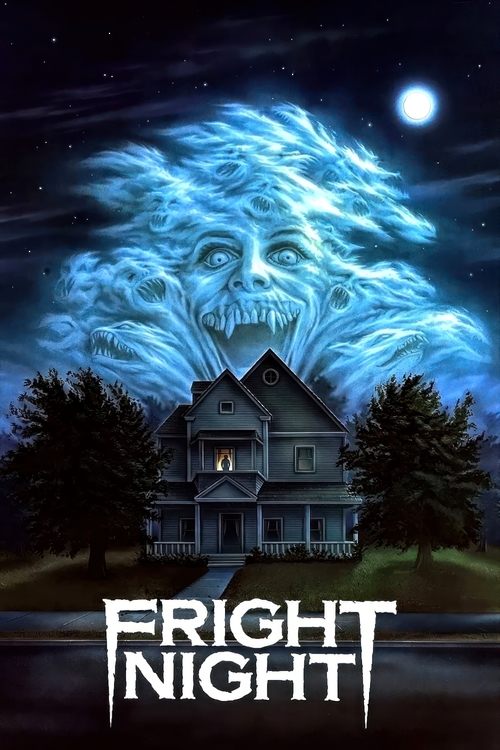
Fright Night
1985 · Tom Holland
The ideal Halloween-night crowd-pleaser — for when you want to be scared and entertained in equal measure, with enough charm to watch with friends who don't usually do horror. Pure comfort horror with teeth.
What it's about
Charley Brewster, a teenager raised on late-night horror TV, becomes convinced that his charming new next-door neighbor is a vampire — and nobody believes him. Desperate, he recruits Peter Vincent, a washed-up horror-movie actor who hosts the local creature-feature show, to help him fight a predator who is every bit as real, seductive and dangerous as the old films promised. The hunt comes home to the suburbs, with Charley's girlfriend and his jittery best friend caught in it.
The experience
A near-perfect blend of laughs and real scares — playful and self-aware about vampire lore without ever defusing the threat. It moves briskly from boyish paranoia to full gothic showdown, and the monster stays genuinely menacing even when the film is being funny.
Performances
Chris Sarandon's Jerry Dandrige is one of the great screen vampires — urbane, amused, and quietly terrifying — while Roddy McDowall gives the film its heart as Peter Vincent, a coward and fraud who has to decide whether to become the hero he only ever played.
The craft
Tom Holland's script wittily uses horror-movie knowledge as a survival skill, and the film showcases some of the decade's best practical creature effects — transformations and makeup that still land hard. The vampire's lair sequences have a lush, old-Hollywood gothic glow that pops on a big screen.
Why it matters
A sleeper hit of 1985 that helped define the horror-comedy of its era and proved the vampire film could be modern, funny and scary at once; it spawned a sequel, a remake, and an enduring cult following.
Snapshot
Fright Night is a suburban vampire film that knows the history of its own genre and uses it as a plot device. Charley Brewster (William Ragsdale) is a teenager raised on late-night horror television. He becomes convinced that his suave new neighbour, Jerry Dandrige (Chris Sarandon), is a vampire. Nobody believes him, so he turns for help to Peter Vincent (Roddy McDowall), a washed-up actor from old Gothic horror films who now hosts a TV horror show. Peter Vincent's name joins Peter Cushing and Vincent Price.
The film was written and directed by Tom Holland, his first feature as director. Columbia Pictures released it in the summer of 1985. It combines a Rear Window-style setup with Hammer-era vampire lore and up-to-date special-effects make-up. The result treats the old movie vampire as a real and sexually charged threat while also making him a joke about outdated movie conventions. It was a commercial success. It led to a sequel and, much later, a remake, and it is now regarded as a key film in the 1980s revival of the vampire picture and in horror-comedy more broadly.
Industry & production
The film was made inside the Hollywood studio system of the mid-1980s. Columbia distributed it and Herb Jaffe produced it. Holland came to the project as a screenwriter in demand. His recent credits included The Beast Within (1982), Class of 1984 (1982, co-written), Psycho II (1983) and Cloak & Dagger (1984). Psycho II had shown he could write a sequel to a revered horror classic that took its source seriously while revising it. Holland has said in interviews over the years that directing Fright Night was his condition for selling the script. The detailed terms of that deal are not well documented in the sources I am confident of.
The budget was modest by studio standards but large for horror. A significant share went on optical and make-up effects. These came from Boss Film Studios, the company Richard Edlund founded after leaving Industrial Light & Magic, which had just worked on Ghostbusters (1984). That gave the film a level of visual-effects finish unusual for a mid-decade horror picture. Steve Johnson, then at Boss Film, is credited among the make-up effects artists; his work includes the creature transformations. John DeCuir Jr. was the production designer.
Fright Night opened in August 1985 and did well at the box office. Exact gross figures vary by source and are not repeated here. Its success made the case for a Columbia sequel, Fright Night Part 2 (1988).
Technology
The film's technical identity comes from practical make-up and optical effects of the pre-digital era. Its transformations use prosthetics, articulated appliances and replacement heads. These include Jerry's elongated jaw and bat-like features, Amy's grotesquely widened mouth late in the film, and the drawn-out, painful death of Evil Ed in wolf form. They belong to the same mid-1980s moment as The Howling (1981), An American Werewolf in London (1981) and The Thing (1982), when on-screen transformation was a selling point in itself.
Boss Film supplied optical compositing for the film's supernatural set pieces: glowing eyes, the bat creature in the climax, and the destruction of Jerry and his companion Billy Cole by sunlight and dissolution. The film depends on these physical, tactile effects, and they show both what that craft could do and where it fell short. Some shots have aged better than others, and later commentators often single out Billy Cole's melting death as a showcase of goo-and-gelatine effects.
Brad Fiedel's synthesizer-led score belongs to the same technological moment. Fiedel had just scored The Terminator (1984) with largely electronic instruments.
Technique
Cinematography
Jan Kiesser photographed the film. The look is polished studio Gothic laid over suburbia. The Brewster home and the street are lit in a fairly naturalistic way. The Dandrige house is shaded with deep blues, hard backlight and coloured gels, which recall the saturated palettes of Hammer and Italian Gothic horror. The opening sequence sets out the film's way of seeing. The camera drifts through the night neighbourhood and settles on Charley's window, making him and the audience watchers before anything has happened. Point-of-view shots across the gap between the two houses are the main visual device of the first act, and they draw directly on Hitchcock's courtyard voyeurism. In the nightclub and the climactic house siege, the camera becomes more expressionistic, with canted angles and bursts of strobe and coloured light.
Editing
Kent Beyda's editing balances two tempos: the patient build-up of suspense and the rapid timing of comedy. The first half follows a familiar pattern for a film about someone no one believes. Charley glimpses something, the camera cuts to the evidence, then cuts back to an adult's sceptical face. Much of the comedy depends on reaction shots, especially McDowall's horrified double-takes. The final siege is cut as a sequence of mostly separate set pieces: Evil Ed's death, Billy's destruction, and Jerry's last transformation. The result moves more like a carnival dark ride than a single continuous action.
Mise-en-scène / staging
The production design is built on a contrast between two houses. The Brewster home is ordinary middle-American space, full of TV glow and kitchen-table banter. The Dandrige house, behind a façade that is only slightly odd, opens into a Gothic interior of antiques, a grand staircase, and a portrait of a woman who looks like Amy. That portrait is a standard device of the romantic Dracula tradition, the vampire's lost love reborn.
Peter Vincent's TV studio and apartment are crowded with props, posters and memorabilia from his films. The film stages him as a living museum of Gothic horror. The nightclub sequence is the film's most famous staging. Jerry seduces Amy (Amanda Bearse) on the dance floor to Fiedel's song "Come to Me," and mirrors show that he casts no reflection. The scene restages the Dracula seduction as a 1980s pop dance number.
Sound
Fiedel's score has two layers. One is a brooding synthesizer register that recalls Carpenter-style electronic horror scoring. The other is a romantic, almost lush line attached to Jerry's seduction of Amy. The soundtrack also carries period pop and rock songs, including a title song by the J. Geils Band, which tie the film to the soundtrack-album marketing common at the time.
Sound effects carry many of the jokes and shocks: the creaking coffin, Jerry's whistling (a recurring sign that he is near), and the wet, layered sounds of the transformations. The audio sometimes gives away a threat before the picture shows it.
Performance
The film rests on its pairing of performers. Chris Sarandon, who earned an Academy Award nomination for Dog Day Afternoon (1975), plays Jerry as a relaxed, mocking, plainly sexual neighbour. He eats apples, flirts with Charley's mother, and lets his menace show only when he needs it. The performance updates the Christopher Lee and Frank Langella school of the attractive Count into a 1980s yuppie bachelor.
Roddy McDowall's Peter Vincent is the film's emotional and comic centre. He plays a self-dramatizing coward whose film persona outlasts his courage, and whose journey from fraud to real vampire hunter gives the film its arc. McDowall was a long-serving Hollywood actor, so the casting carries its own meta-commentary.
William Ragsdale plays Charley as a straight man and a determined everyteen. Amanda Bearse balances the "good girlfriend" role with the menace of Amy's later transformation. Stephen Geoffreys plays "Evil" Ed Thompson with a high-pitched, manic energy. It is the film's most stylized performance and a fan favourite, and his scenes give it much of its pathos.
Narrative & dramatic mode
The story borrows its structure from Rear Window and from the tale of the boy who cried wolf. A witness sees a crime through a window. Authority figures, including his mother (Dorothy Fielding) and the police detective Lennox (Art J. Evans), dismiss him. Once the villain knows he is being watched, he turns the watching around and starts hunting the watcher.
The second structural strand is the recruitment of an expert. Charley's appeal to Peter Vincent reworks the Van Helsing role. The expert's knowledge turns out to be only screen knowledge, and he has to earn it as faith and practice. Expertise that comes from the movies is first mocked, then confirmed, which is how the film builds its mixed tone. A cross held up without belief does nothing. Jerry taunts Vincent that he needs faith for it to work, and the film makes belief itself the battleground.
The dramatic mode alternates between comedy and real horror without fully settling into parody. The vampire's threat is played seriously, especially in Ed's seduction and death and in Amy's transformation. The comedy comes mainly from how people react to the threat, not from mocking it.
Genre & cycle
Fright Night sits where several mid-1980s cycles meet:
- The vampire revival. After the late-1970s versions of Dracula and the TV Salem's Lot (1979), the mid-to-late 1980s brought a run of updated vampire films aimed at younger audiences. Examples include Once Bitten (1985), Vamp (1986), The Lost Boys (1987) and Near Dark (1987). Fright Night came early in that run and helped show the vampire could be made contemporary and marketable again.
- Teen horror. The film shares its suburban setting, teenage hero and blind adults with the slasher cycle, but sets itself against the slasher. Peter Vincent complains on screen that audiences now want masked psychopaths instead of classic monsters, and the film as a whole argues for bringing back the Gothic monster.
- Horror-comedy. Alongside An American Werewolf in London, Gremlins (1984), The Return of the Living Dead (1985) and Re-Animator (1985), it belongs to a strong mid-decade period for films that pair laughs with graphic effects.
- Self-aware horror. Peter Vincent's TV show, the horror-host framing and the characters' fluency in genre rules anticipate the more explicit genre-literacy of the 1990s.
Authorship & method
Tom Holland (writer-director). The film shows Holland's main interest as a screenwriter: taking a horror tradition and turning it into a story about the gap between genre fantasy and real experience. Psycho II did this by asking what came after Hitchcock's ending. Fright Night does it by putting a Hammer vampire next door to a kid who grew up watching Hammer films. Holland's direction is competent, classical and effects-friendly rather than showy. He keeps scenes clear and gives his actors room. He went on to direct Fatal Beauty (1987) and Child's Play (1988), the latter another genre-fusion success that turned a suburban everyday object into a horror figure.
Key collaborators:
- Jan Kiesser (cinematography) gave the film its pairing of ordinary suburbia with the coloured Gothic interior.
- Brad Fiedel (music) brought the synthesizer language of The Terminator to a romantic Gothic subject, along with a seduction theme that became one of the film's signatures.
- Kent Beyda (editing) managed the shifts between comedy and terror.
- John DeCuir Jr. (production design) designed the contrast between the two houses.
- Richard Edlund / Boss Film Studios (visual effects) and make-up artists including Steve Johnson gave the film effects of blockbuster quality, which helped it stand out from lower-budget horror of the period.
- Herb Jaffe (producer) steered it through Columbia.
Movement / national cinema
Fright Night is a product of the American studio genre cinema of the 1980s. It does not belong to an art-cinema movement. It does, however, take part in a transatlantic conversation. Its main reference point is the British Hammer Films Gothic cycle of the late 1950s to the 1970s, which the film treats as a lost golden age. That cycle is filtered through American television syndication and the local horror-host tradition, figures like Vampira and the many regional "Shock Theater" hosts who programmed old horror films for late-night audiences. The film's version of horror history is American and televisual: a generation that came to Hammer and Universal through the TV set, not the cinema.
Era / period
The film belongs to the Reagan-era suburban cinema of the mid-1980s, the same terrain as the films produced by Steven Spielberg and the John Hughes teen pictures. In that world, danger enters a tidy middle-class neighbourhood. Several period details matter:
- Charley lives with a single mother, and the father is absent.
- The vampire takes the form of an affluent, single, stylish man who moves in next door.
- Pop music, MTV-era style and nightclub culture sit alongside the Gothic.
Many commentators have also read the film against the anxieties of the AIDS era. It was released in the year the epidemic became a major mainstream news story, and it is about a seductive, infectious figure whose bite transforms the young. That reading is interpretive. Holland has not presented the film as an allegory of the epidemic, and the context should be treated as one critical frame among several.
Themes
- Belief, faith and media. The film's central idea is that symbols work only through belief. Vincent's cross is useless until his faith is real. The theme extends to cinema: horror movies, often dismissed as fakery, turn out to carry true knowledge.
- Voyeurism and the suburban gaze. The window-watching setup turns the neighbourhood into a place of surveillance and of disbelief. The person who looks is punished for what he sees.
- Adolescence and sexuality. The vampire stands for adult desire breaking into teenage life. Charley and Amy's hesitant sexual relationship is set against Jerry's practised seduction, and Amy's transformation turns an awakening sexuality into the monstrous.
- Queerness and difference. Critics and audiences have long read queer subtext in the film: Jerry's live-in companion Billy Cole, the homoerotic charge of Jerry's approach to Charley, and especially Jerry's seduction of Evil Ed, an outcast he wins over by offering understanding and belonging. Ed's death is shot with real sadness. This reading is now central to how the film is discussed, though how much was intended remains a matter of interpretation.
- Obsolescence and nostalgia. Peter Vincent, an actor out of work because tastes have moved to the slasher, is a fable about genres and performers outliving their time. The film's rescue of him doubles as a rescue of the Gothic tradition.
Reception, canon & influence
Critical reception. On release the film drew mixed-to-favourable reviews. Its effects, the performances of Sarandon and McDowall, and its affectionate handling of genre were generally praised. Some critics found the tone uneven or the final act too driven by effects. I am not reproducing particular critics' verdicts here, because I cannot verify the exact wording. The film was recognized at the Saturn Awards, where the genre-focused Academy of Science Fiction, Fantasy and Horror Films honoured it, including as Best Horror Film. Its standing rose steadily through home video, cable and repertory screenings. It is now widely treated as one of the defining American horror films of the 1980s and a high point of horror-comedy.
Influences on the film.
- Hitchcock's Rear Window (1954), for the voyeuristic setup.
- The Hammer Dracula films, especially with Christopher Lee and Peter Cushing, and the Gothic work of Vincent Price, all honoured by name in "Peter Vincent."
- The Universal horror tradition and the TV horror-host culture that kept it alive.
- Stephen King's 'Salem's Lot and Tobe Hooper's 1979 adaptation, for the vampire who comes to a small community and acquires a house with a "familiar."
- The romantic-Dracula strand running through Dan Curtis's TV Dracula (1974) and John Badham's Dracula (1979), for the reincarnated-love motif.
- The early-1980s effects-driven horror films (The Howling, An American Werewolf in London), for the spectacle of transformation.
Legacy and what it shaped.
- Direct continuations. Fright Night Part 2 (1988, dir. Tommy Lee Wallace) brought back Ragsdale and McDowall. A remake followed in 2011 (dir. Craig Gillespie, written by Marti Noxon, with Anton Yelchin and Colin Farrell, and David Tennant in a reimagined Peter Vincent), then the direct-to-video Fright Night 2: New Blood (2013).
- The 1980s vampire wave. Together with The Lost Boys and Near Dark, it set the template for the contemporary, youth-focused, style-conscious vampire. That line runs to Buffy the Vampire Slayer, where Noxon was later a key writer-producer, and beyond.
- Meta-horror. Its genre-literate teenagers and its argument about horror's rules and authenticity anticipate the knowing horror of the 1990s, most famously Wes Craven's Scream (1996).
- The horror-host figure. Peter Vincent has become a lasting archetype: the faded genre star turned reluctant real-life hero, invoked in later affectionate tributes to the actors and TV hosts of classic horror.
- Cult afterlife. The film has a strong following among fans, with anniversary screenings, cast reunions at conventions, and repeated restored home-video releases. The record suggests its reputation is now higher than it was in 1985, largely because the queer reading, the nostalgia, and the craft of its practical effects have all grown in critical interest.
The record is thinner on some production specifics, such as exact budget and grosses, development timelines and the division of effects credits within Boss Film, and those details should be checked against primary sources before they are cited.
Influences: the films it descends from and the films it influenced
- Rear Window (1954) — Holland borrows its premise and its shot grammar: a confined young man watches a neighbour's lit windows across the gap between buildings, and binocular-style point-of-view inserts are cut against his reactions until he becomes certain a killing has happened next door.
- Horror of Dracula (1958) — Fisher's Hammer film sets the template that Fright Night quotes directly: Cushing's Van Helsing driving off the vampire with an improvised cross and strong light, saturated Eastmancolor Gothic interiors, and Lee's tall, sexually charged Count, all folded into the name and screen persona of 'Peter Vincent'.
- Dracula (1974) — Curtis and Richard Matheson invented the motif of the Count finding his lost love reincarnated in a living woman, shown through her painted portrait; Holland restages it as Jerry seeing Amy as the double of the woman in his portrait.
- Salem's Lot (1979) — Hooper's adaptation supplies the plot machinery of a vampire who buys an old house in an ordinary town and works through a human familiar who moves coffins and deals with the neighbours, the role Billy Cole plays for Jerry Dandrige.
- Dracula (1979) — Badham's film, built around Frank Langella, turns Dracula into a romantic leading man who wins women by seduction rather than force, the model for Sarandon's charming Jerry and the way he takes Amy on the nightclub floor.
- The Howling (1981) — Rob Bottin's on-camera transformations, done with air bladders and mechanical pieces and held in long takes, established the practical-effects showcase that Fright Night's Evil Ed werewolf death and Amy's mouth transformation build on.
- An American Werewolf in London (1981) — Landis proved that broad comedy and properly frightening practical gore could share one film, and Rick Baker's lit transformation work became the benchmark for the latex-and-mechanics spectacle of Fright Night's final act.
- Ghostbusters (1984) — Richard Edlund's newly formed Boss Film Studios developed its mix of puppet, prosthetic and optical work on Ghostbusters and carried that pipeline, including its comic tone for creature effects, straight into Fright Night's vampire and ghoul effects.
- Psycho II (1983) — Holland carries over Psycho II's knowing, genre-literate script. Here the monster is a charming neighbor watched from a bedroom window, a Rear Window setup, and an aging horror-host star (Roddy McDowall) is defined by the genre's past.
- The Lost Boys (1987) — Schumacher takes over Fright Night's set-up of a teenage hero against a stylish vampire, with genre experts the hero turns to for help: the comic-book-trained Frog brothers fill Peter Vincent's role, and the vampire's seduction again happens in a youth-culture setting.
- The Monster Squad (1987) — Dekker and Shane Black build on Fright Night's idea that horror fandom is real knowledge: kids raised on Universal monster lore use what they learned from the movies to fight actual monsters in suburbia.
- Fright Night Part 2 (1988) — The direct sequel brings back Ragsdale and McDowall, keeps the horror-host-turned-hunter character and the disbelief structure, and swaps the sexes of the seductive vampire, with Julie Carmen as Jerry's sister.
- Child's Play (1988) — Holland reuses his own Fright Night structure: a child knows a supernatural killer is in the home, the adults refuse to believe him, and the build-up runs on reaction cutting before practical effects take over in the last act.
- Scream (1996) — Craven and Kevin Williamson turn into a full system what Fright Night started: teenagers who have learned the genre's rules from watching horror films, and a plot that tests whether those rules hold up against a real killer.
- Disturbia (2007) — Caruso's film is the cleanest heir to Fright Night's suburban Rear Window: a confined teenager spies on the next-door house with surveillance gear and binoculars, is sure the charming neighbour is a killer, and cannot get any adult to believe him.
- Fright Night (2011) — Marti Noxon's remake keeps the two-houses voyeur premise but moves it to a Las Vegas exurb, and recasts the TV horror host as a Vegas stage magician (David Tennant), updating the faded-genre-star character for a new kind of entertainment.
- Summer of 84 (2018) — RKSS rebuild Fright Night's set-up as a period piece, with a teenager watching a neighbour across the cul-de-sac and suspecting him of murder, and use a synthesizer score in the manner of Fiedel.
- The Terminator (1984) — Brad Fiedel's synthesizer writing for Cameron's film comes just before his Fright Night score; the same electronic palette is used in both, pulsing and menacing in one, lush and romantic in the other.
- Near Dark (1987) — Bigelow's film belongs to the same 1980s revival that pulled the vampire out of the castle and into present-day America, removing Gothic props such as fangs, coffins and capes and keeping the vampire's lure as an erotic invitation.
- House (1985) — A 1985 suburban horror-comedy that likewise balances practical creature transformations against a sincere emotional story and a winking love of old monster movies, made with the same latex and animatronic toolkit.
Similar films
- Scream (1996) — influence & lineage
- Child's Play (1988) — influence & lineage
- Near Dark (1987) — influence & lineage
- Halloween (1978) — shared sensibility
- House (1985) — shared sensibility
- Late Night with the Devil (2024) — shared sensibility
- A Nightmare on Elm Street (1984) — shared sensibility
- Dead of Night (1945) — shared sensibility