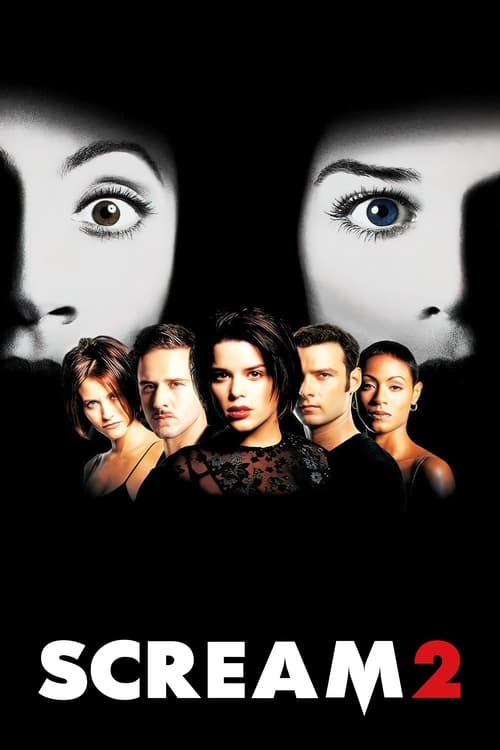
Scream 2
1997 · Wes Craven
Perfect for a group watch where everyone shouts guesses at the screen — when you want scares with a wink, not nihilism. Comfort horror for people who love the genre enough to laugh at it.
What it's about
Two years after surviving the Woodsboro murders, Sidney Prescott is trying to be a normal college student — hard to do when the killings have become a bestselling book and a splashy Hollywood movie called Stab. At the movie's premiere, someone in the Ghostface costume starts killing for real, restaging the original crimes on campus, and Sidney, Gale, and Dewey are pulled back into a game where everyone knows the rules of sequels.
The experience
A knowing, fast-moving whodunit that's somehow scary and funny in the same breath — it jokes about sequel rules while ruthlessly following them. The set pieces are tenser and more elaborate than you expect from a follow-up.
Performances
Neve Campbell deepens Sidney from survivor to someone visibly weary of being a story other people profit from, and Courteney Cox and David Arquette's prickly Gale-and-Dewey chemistry becomes the series' beating heart. The opening sequence hands Jada Pinkett a short, ferocious showcase.
The craft
Kevin Williamson's script turns the machinery of sequels into the plot itself — a killer copying a movie based on real murders, watched by an audience in killer masks — and Wes Craven stages it with real suspense, including a theater-set opening that ranks among the great horror cold opens. Made in under a year amid intense secrecy, it's remarkably assured.
Why it matters
It proved the self-aware slasher revival wasn't a one-off, cementing the late-'90s horror boom and the franchise's habit of critiquing the very industry cycle that produced it.
Snapshot
Scream 2 is the rare sequel whose subject is its own existence. Released by Dimension Films on 12 December 1997, less than a year after Scream had legged out from a soft opening into a genuine phenomenon, it takes as its premise the commercial logic that produced it: the Woodsboro murders have been turned into a book by Gale Weathers and then into a movie called Stab, and a new killer restages the original crimes as the film's audience watches. Sidney Prescott (Neve Campbell) is now a freshman at Windsor College in Ohio, studying theater, dating, and attempting to be a person rather than a case file. The film's opening sequence — a packed Stab premiere where the studio has handed out Ghostface robes and masks, so that the murder of a real woman in the aisle reads to hundreds of people as a promotional stunt — is among the most pointed images American horror produced in the 1990s, and it sets the terms for everything after.
Kevin Williamson's screenplay externalizes the film's self-awareness through Randy Meeks (Jamie Kennedy), who delivers a lecture on the rules of sequels the way he had delivered the rules of slashers in Scream. Wes Craven, then in his fourth decade of directing horror, treats that reflexivity not as a joke but as a structural problem to be solved: how do you frighten an audience that has been told, in advance, exactly what you are about to do? His answer across the film's set pieces — a sorority balcony, a soundproof recording booth, an overturned police cruiser, an empty theater — is craft applied at full pressure. Scream 2 is a studio genre picture made fast, under duress, with a leaked script and a fixed release date, and it remains the most formally confident entry in the series.
Industry & production
The production is inseparable from the Miramax/Dimension model of the mid-1990s. Dimension, the genre label run under Bob Weinstein within Harvey and Bob Weinstein's Miramax (then a Disney subsidiary), specialized in modestly budgeted films aimed at a teenage audience, sold hard through soundtrack tie-ins, MTV, and young television stars. Scream had cost little and returned a great deal; the sequel was fast-tracked almost immediately, with Craven, Williamson, and producers Cathy Konrad and Marianne Maddalena returning, and a budget commonly reported in the $24 million range — roughly double the first film's, still small by studio standards.
The compressed schedule is the defining production fact. Shooting took place in mid-1997, principally in and around Atlanta, with Agnes Scott College in Decatur, Georgia providing the collegiate architecture of "Windsor," and additional work in Southern California. The film was written, shot, cut, and released inside about a year — the industrial behavior Randy's lecture describes.
Compounding this, a version of Williamson's script leaked onto the internet during pre-production and circulated widely, exposing the killers' identities. This is one of the earliest well-documented instances of online spoiler culture materially altering a studio production: Williamson rewrote substantial portions of the third act, pages arrived on set late, and cast members have described working without a full script or knowing their characters' fates. Accounts of exactly what changed, and of how many alternate scenes were shot as decoys, vary between interviews and press retrospectives; the specific route of the leak has never been established in the public record, and the more colorful versions of the story should be treated as trade folklore rather than documented history. What is not in dispute is that the finished film's ending was written under emergency conditions — which may explain why its revelation leans on melodramatic revenge rather than on the tight construction of the original.
The casting reflects the era's television-to-horror pipeline. Sarah Michelle Gellar had premiered in Buffy the Vampire Slayer in March 1997 and appeared in I Know What You Did Last Summer (also written by Williamson) that October; Joshua Jackson, cast in a small role as a film-theory student, would soon anchor Williamson's Dawson's Creek. Courteney Cox and David Arquette returned from Scream, Cox playing sharply against her Friends persona. Jada Pinkett, Omar Epps, Elise Neal, Duane Martin, Timothy Olyphant, Liev Schreiber, Laurie Metcalf, and the veteran British character actor David Warner (as the theater director) fill out an unusually deep bench for a slasher sequel.
Commercially it worked. The film's opening weekend was reported at roughly $33 million — then among the largest December openings on record — with a domestic total above $100 million and a worldwide figure commonly cited in the $170 million range. It opened a week before Titanic and held respectably against it. That performance, more than the first film's slower build, is what convinced the industry that teen horror was a reliable annual business.
Technology
Scream 2 is a photochemical film made at the edge of the digital transition: 35mm, a widescreen scope frame, optical and in-camera effects, and prosthetic gore executed by KNB EFX Group, the makeup house (Robert Kurtzman, Greg Nicotero, Howard Berger) that had handled the first film. There is essentially no digital imagery in it. The suspense is built from camera placement, lens choice, and cutting, which is part of why it has aged as well as it has. Post-production fell in the period when Avid nonlinear systems had become the industry norm, and the film's speed to market depended on that.
More interesting is technology as subject and as production condition. Diegetically, the film runs on telephony and broadcast: Ghostface's voice-changer, cellular calls placed from inside the room, Gale's live remotes and news van, campus answering machines. Non-diegetically, it was shaped by a technology the industry had not yet learned to manage — the consumer internet. In 1997, message boards and the first generation of film-gossip sites had made scripts and spoilers portable in a way studios could not contain. Scream 2, a film about how information about murders becomes entertainment, was rewritten because information about it became entertainment. The convergence is genuinely uncanny and did not require anyone to plan it. The film also arrived in the first year of DVD in North America, at the tail of the VHS-rental cinephilia that had produced Randy Meeks in the first place.
Technique
Cinematography
Peter Deming shot the film, having taken over on Scream after Mark Irwin's departure late in that production. Deming's background — Evil Dead II, and in the same year as Scream 2, David Lynch's Lost Highway — shows in a willingness to let the widescreen frame go dark and to use its horizontal excess as a threat. The compositions repeatedly park a character at one edge and leave the opposite third of the frame open and unresolved, so the audience scans rather than watches.
The opening sequence is the showpiece: a roving, mobile camera moving through a lobby and then an auditorium of masked figures, where the identifying feature of the killer has been mass-produced and distributed to everyone present. The framing makes the crowd indistinguishable from the threat, and the murder occurs in front of a spectating audience that reads it as performance. Elsewhere Deming works in a cleaner, brighter register than most slashers — a great deal of Scream 2's violence happens in daylight or in fully lit institutional spaces — which removes the genre's usual alibi of darkness.
Editing
Patrick Lussier, who cut all three of the original trilogy's entries and later became a director himself (Dracula 2000, My Bloody Valentine 3D), builds the film's suspense on withheld information rather than on shock cutting. The recurring device is the long, patient hold that outlasts comfort, broken by a cut that arrives either early or late but almost never on the beat the genre has trained the audience to expect. The film's most discussed structural decision — killing Randy in broad daylight, mid-film, in a parked news van, off a conversation that had been playing as comic relief — depends entirely on editorial rhythm: the sequence gives no preparatory coverage, no build, no score cue that says now.
Mise-en-scène / staging
Craven's staging is organized around barriers that permit sight but not help. The film returns obsessively to glass, distance, and audience: a theater auditorium, a recording studio's soundproofed window, a car's cage between front and back seat, a stage viewed from empty tiered seating. In the studio sequence, Gale watches through glass as Dewey is attacked and can neither hear nor reach him; the geometry is the whole scene. In the police-car sequence, Sidney and her friend Hallie are trapped behind a partition with the unconscious killer slumped in front, and escape requires climbing over him — a staging idea that converts the slasher's chase into a problem of proximity and nerve.
The finale returns Sidney to the college theater where she has been rehearsing a Greek tragedy, and Craven stages the confrontation on and around the set: raked seating, fire effects, chorus masks. Sidney's survival is achieved, pointedly, by acting — by playing dead well enough to be believed.
Sound
Marco Beltrami, whose career was launched by Scream, expands his palette considerably here: clustered and prepared strings, percussive stingers, and a wordless soprano line associated with Sidney's stage role as Cassandra, the prophet nobody believes. That figure is the film's thesis in one instrument. The soundtrack album, in the Dimension house style, was a marketing instrument in its own right; Nick Cave and the Bad Seeds' "Red Right Hand," carried over from the first film, recurs as the series' unofficial motif.
The most distinctive sound practice is a production one: Roger L. Jackson, who voices Ghostface across the franchise, performed the phone calls live to the actors from off set rather than recording them in post, so the performances are reactions to a voice actually speaking. And the recording-studio set piece makes soundproofing itself the antagonist — a horror sequence whose horror is silence.
Performance
Campbell plays Sidney as someone managing a chronic condition rather than encountering a new one: guarded, quick to violence, exhausted by her own notoriety. Cox sharpens Gale from opportunist toward something closer to a professional with a conscience, and her scenes with Arquette's Dewey generate the series' most durable relationship. Kennedy plays Randy's cinephilia as defensive armor, which makes his death land as more than a plot beat.
The film's most audacious performance is Laurie Metcalf's. A founding-generation member of Chicago's Steppenwolf ensemble, best known then for Roseanne, she spends most of the film as a fussy, over-eager local reporter and then, on the reveal, switches into full-throated theatrical fury — a deliberate register change that reads as a performer dropping a character rather than a character dropping a mask. Timothy Olyphant, early in his career, plays the film-student killer with a chilly, seminar-room glibness that is arguably scarier than the screaming.
Narrative & dramatic mode
The film operates in two modes at once. On the surface it is a whodunit: a closed circle of suspects, red herrings distributed evenly, a two-killer solution matching the first film's. Beneath it is a commentary track made flesh, in which characters analyze the genre they are trapped in — Randy's sequel rules, the film-theory class debating whether sequels can surpass originals, Mickey's stated intention to plead the influence of movies at trial.
The crucial move is that the meta-layer does not protect anyone. Knowing the rules does not save Randy; it is, in a sense, what exposes him. And the resolution deliberately refuses the postmodern reading it has been advertising: Mickey's media-blame motive is revealed as an affectation, and he is shot by his partner, Mrs. Loomis, whose motive is the oldest one available — a mother avenging her son. The film sets up a thoroughly 1990s explanation and then replaces it with Aeschylus. That Sidney is simultaneously rehearsing Cassandra in a production drawn from the Oresteia — a cycle of familial revenge that cannot stop itself — is not decoration; it is the film's argument about sequels.
Genre & cycle
Scream 2 sits at the exact center of the late-1990s teen slasher revival, and is largely responsible for its industrial shape. Scream proved the audience existed; Scream 2 proved it would return on schedule. Within eighteen months the cycle had produced I Know What You Did Last Summer and its sequel, Urban Legend, The Faculty, Halloween H20, Disturbing Behavior, and, by 2000, Final Destination — most of them sharing the formula of television-familiar young casts, PG-13-adjacent brutality negotiated down from harder cuts, and a soundtrack album.
Within horror's longer history, the film is a self-conscious late entry in the slasher tradition codified by Halloween (1978) and Friday the 13th (1980), which themselves descend from Psycho (1960), Peeping Tom (1960), Black Christmas (1974), and the Italian giallo. Its specific innovation is to make the sequel — historically the slasher's most degraded form — the site of formal ambition.
Authorship & method
Craven is the decisive authorial presence, and Scream 2 is best read as the culmination of a project he had been pursuing for years. He came to horror from academia — graduate study in philosophy and writing, and a period teaching humanities — and his films had long carried an interest in what horror does to the people watching it. Wes Craven's New Nightmare (1994) had already collapsed the boundary between a horror franchise and the world that consumed it, casting Heather Langenkamp and Craven himself as themselves; it failed commercially, and Scream is in many respects its idea made accessible. The Stab premiere in Scream 2 is New Nightmare's thesis staged as a mass event.
Craven's method is patience: extended suspense architecture, precise geography, and a refusal to release tension on the audience's schedule. He is also, notably, generous to his performers — the Scream films contain more sustained non-horror acting than the genre normally permits.
Williamson's contribution is the voice: dialogue that is fast, referential, and structurally aware, in which characters articulate genre theory without ever quite escaping it. His concurrent output in 1997–98 — I Know What You Did Last Summer, The Faculty, Dawson's Creek — makes him the single most influential writer in American teen media of that moment.
The key collaborators are unusually stable across the trilogy: Deming's scope photography, Lussier's editing, Beltrami's score, Konrad and Maddalena producing. That continuity is why the three films feel like one authored object rather than a franchise assembled by committee.
Movement / national cinema
Scream 2 belongs to no movement. It is American commercial cinema of the mini-major era — a Miramax/Dimension product, made inside the independent-distributor-turned-studio ecology that defined 1990s Hollywood. To claim a movement affiliation would be to invent one.
It is, however, legible within an international lineage of films about cinema audiences and murder: Bogdanovich's Targets (1968), with its sniper at a drive-in; Lamberto Bava and Dario Argento's Demons (1985), in which a cinema audience becomes the monster; Bigas Luna's Anguish (1987), a film about a film about a killer in a theater; and Argento's Opera (1987), which stages murder as performance before a captive spectator. Craven's opening does not require these as sources, and no documented line of influence to them has been established, but Scream 2 is the American mainstream's most widely seen version of the idea they share.
Era / period
The film is a precise artifact of late 1997: the peak of the Weinstein-era Miramax, the first full year of Buffy and the WB's teen-drama strategy, the arrival of DVD, the moment when the internet became a factor in film publicity, and the last months before Titanic rewrote every assumption about the youth audience's scale. It also lands squarely inside the mid-1990s culture war over media violence — the lawsuits and legislative hearings that followed Natural Born Killers and their like — which is precisely what Mickey's courtroom fantasy satirizes. Two years later, after Columbine, that satire stopped reading as satire, and the film's most glib joke became the hardest thing in it to watch. Later commentary has likewise revisited the Stab premiere sequence in light of real mass violence in American cinemas; the scene's meaning has shifted under it without a frame being changed.
Themes
Four run through the film. Spectatorship and complicity: an auditorium of paying customers cheering while a woman is stabbed to death among them is not a subtle image, and it is aimed at the people watching Scream 2 in an auditorium. Celebrity and the manufacture of narrative: Gale's book becomes a movie, Cotton Weary trades his wrongful conviction for a talk-show slot, and Sidney's trauma is public property she cannot repossess. Repetition and inheritance: the film's structure — same masks, same beats, same body count escalated — dramatizes the sequel as a form of compulsion, and then supplies a literal maternal-revenge plot to explain it. Survival as performance: Sidney's role as Cassandra, her rehearsals, and finally her playing dead to survive all propose that in a world where everything is watched, the only defense is control over what you appear to be.
Reception, canon & influence
Critical reception in December 1997 was broadly favourable, with a recurring line of praise — that Scream 2 was one of the uncommon horror sequels that came close to matching its original — and a recurring reservation, that the self-commentary had begun to substitute for tension and that the killers' motives were thinner than the first film's. Reviews in the major American outlets were generally positive; the film has held up well in retrospective assessment, and it is frequently ranked at or near the top of the franchise by later critics.
Its influences run backward through Craven's own New Nightmare, through Psycho — whose structural shock of killing a protagonist mid-film Randy's death consciously echoes, and whose avenging-parent revelation the ending rhymes with — through the slasher canon of Halloween and Black Christmas, and through Greek tragedy, which the film cites openly. Its industrial ancestor is simply Scream itself.
Forward, its influence is substantial and specific. It set the template for the meta-horror strain that runs through Behind the Mask: The Rise of Leslie Vernon (2006), The Cabin in the Woods (2012), The Final Girls (2015), Happy Death Day (2017), and a great deal of 2010s and 2020s genre filmmaking that treats audience knowledge as a resource rather than an obstacle. Its Stab device — a franchise inside the franchise — became the series' organizing engine through Scream 3 (2000), Scream 4 (2011), and the 2022 Scream, and anticipated by two decades the legacy-sequel discourse those later films satirize. Scream VI (2023) restages the Scream 2 opening's central idea directly, filling a crowded public space with people in Ghostface costumes.
Academically, the Scream films are among the most written-about horror titles of the 1990s, standard material in scholarship on postmodern horror, reflexivity, and teen media, and readily legible through Carol Clover's Final Girl framework from Men, Women, and Chain Saws (1992) — with the caveat that Sidney, by the second film, has become something Clover's model did not quite anticipate: a survivor who has read the literature on herself.
One aspect of its legacy is genuinely uncomfortable. Jada Pinkett's Maureen, moments before her death, complains that horror films are full of white people — an unusually direct piece of self-criticism for a mainstream 1997 studio picture — and the film then kills both of its Black leads in the opening ten minutes. Whether that is critique or the thing critiqued has been argued both ways ever since, and the argument is a fair one to leave open. It is characteristic of Scream 2 that the film says the smart thing out loud and then does the ordinary thing anyway, which is, after all, exactly what Randy warns sequels always do.
Reception
A rare sequel that landed to strong reviews just twelve months after the original, it's since climbed even higher — a big chunk of the fanbase now argues it's the best Scream, period.
How Scream 2 was received, from release to now →
How to watch Scream 2: what to notice on a first viewing
- Watch how the opening crowd is dressed identically. At the Stab premiere the studio has handed out Ghostface robes and masks to the whole audience, so Ghostface is visually indistinguishable from everyone watching. A theater full of costumes makes a real murder read as a promotional stunt.
- Notice how much of the violence happens in daylight. Peter Deming shoots a great deal of the film's danger in bright, fully lit institutional spaces rather than in the genre's usual shadows. The film removes darkness as an excuse for not seeing the threat coming.
- Listen for the wordless soprano line tied to Sidney. Marco Beltrami threads a wordless soprano voice through the score, tied to Sidney's stage role as Cassandra, the prophet nobody believes. One instrument is quietly telling you who nobody in this story will listen to.
- Notice the glass and distance that separate characters from danger. Craven repeatedly stages scenes behind windows, partitions, and soundproofed glass, where a character can see trouble but cannot reach or hear it. Being able to see a threat and being able to stop it turn out to be two different things.
The whole guide to watching Scream 2, with the keys for a rewatch →
Influences: the films it descends from and the films it influenced
- Psycho (1960) — Supplies the structural device Randy's murder restages — killing the audience's designated interpreter/point-of-identification partway through, mid-scene and in ordinary light, so the remaining runtime has no reliable guide — and the avenging-parent reveal whose logic the Mrs. Loomis ending rhymes with.
- Peeping Tom (1960) — Establishes the grammar Scream 2's Stab premiere inherits: staging a killing as a screening, so that the act of watching horror is itself the mise-en-scène, with the on-screen audience's reaction shots doing the work usually assigned to the victim's.
- Targets (1968) — The prototype for violence erupting inside a movie house, cut against the projected film so the screen's soundtrack masks the real screams — exactly the Cineplex logic by which Maureen's stabbing reads as part of the show to everyone around her.
- Black Christmas (1974) — Origin of the slasher's anonymous telephone voice as a sustained performance rather than a gimmick — obscene, mimicking, and geographically proximate — the technique Scream 2 extends by having Roger Jackson perform live off-set into the actors' earpieces so their reactions are to real speech, not to a marked cue.
- Halloween (1978) — Teaches the widescreen composition Scream 2 runs on: leaving the anamorphic frame's edges and background as dead negative space the audience is trained to police, so the shape can enter, hold, and exit without a cut or a music sting.
- Terror Train (1980) — Pioneers the masked-crowd set piece in which the killer's costume is indistinguishable from dozens of others and is swapped mid-sequence, dissolving the audience's ability to track a body through a room — the exact problem the Ghostface-robed premiere crowd creates.
- Blow Out (1981) — Opens with a slasher pastiche-within-the-film screened for its own crew, and builds its climax around soundproofing and recorded voice as instruments of murder — the two devices Scream 2 fuses in the Stab opening and the sound-booth sequence where a room engineered to keep noise out keeps help out too.
- Evil Dead II (1987) — Peter Deming's first major feature as DP, where he developed the unbroken mobile-camera prowl through architecture he later brings to Scream 2's opening — a camera that establishes real, continuous geography so the audience always knows the exits, and the characters don't.
- Wes Craven's New Nightmare (1994) — The direct method ancestor: casts the franchise's own personnel as themselves and lets the fiction metabolize its audience, a thesis Scream 2 takes out of the art-house register and stages as a mass event with Stab's opening-night crowd.
- Scream (1996) — Supplies the working template Scream 2 must both honor and violate — the pre-title celebrity-victim prologue built on the phone call, Beltrami's prepared-string stingers, and the whodunit contract in which every suspect gets an alibi scene the edit deliberately clips short.
- Halloween H20: 20 Years Later (1998) — The legacy-sequel Scream 2 made commercially possible, and the debt is literal: Dimension had Beltrami's Scream cues tracked into John Ottman's score, so the 1978 franchise's revival is scored partly with the music written for its 1996 commentary.
- Scream 3 (2000) — Takes the Stab device Scream 2 invented and moves it onto the soundstage, where the murders follow a stolen screenplay's revisions — Deming again shooting scope, so a fake set's missing fourth wall becomes another barrier that permits sight but not help.
- Behind the Mask: The Rise of Leslie Vernon (2006) — Converts Randy's spoken rules into procedure by shooting the slasher's preparation as documentary — cardio training, sightline rehearsal, pre-cut escape routes — the logical endpoint of a film that already treats genre mechanics as diegetic knowledge.
- The Cabin in the Woods (2012) — Shot by Peter Deming, carrying the same daylight-legible scope coverage into a film that literalises the Scream 2 premise: genre rules aren't observed by the characters, they are enforced by an off-screen production apparatus watching on monitors.
- Happy Death Day (2017) — Builds on the Sidney problem Scream 2 introduced — a Final Girl who has read the literature on herself — by giving Tree iterative knowledge of her own murder, so suspense migrates from what will happen to which withheld detail the edit is still holding back.
- Scream VI (2023) — Restages the Scream 2 opening's core problem directly, filling a public space with civilians in Ghostface robes so the mask stops identifying the killer and starts camouflaging him, and adding the same glass-barrier staging in the bodega and apartment-ladder set pieces.
- Scream 4 (2011) — Builds the meta 'rules of the sequel' architecture and, with Peter Deming's later-series photography, the visual continuity spine that Scream 4 recycles onto the vocabulary of remakes and requels.
- Scream (2022) — Established the 'rules of the sequel' lecture as a recurring set piece, the template the 2022 film updates into its 'requel rules' seminar.
- I Know What You Did Last Summer (1997) — Williamson's other 1997 script, showing the same construction principle from the other side — a teen ensemble whose guilt is dispensed in withheld fragments — and confirming that the dialogue's speed and cross-talk, not the mask, is the reproducible Williamson unit.
- The Faculty (1998) — Williamson writing and Marco Beltrami scoring again, with characters who diagnose their own situation by naming precedent (Body Snatchers, The Puppet Masters) — proving the reflexive-dialogue engine detaches from the slasher and ports to any genre with a rulebook.
Similar films
- Scream (1996) — influence & lineage
- Scream VI (2023) — influence & lineage
- Evil Dead II (1987) — influence & lineage
- Halloween (1978) — influence & lineage
- The Cabin in the Woods (2012) — influence & lineage
- Black Christmas (1974) — influence & lineage
- Scream (2022) — shared sensibility
- Scream 4 (2011) — shared sensibility