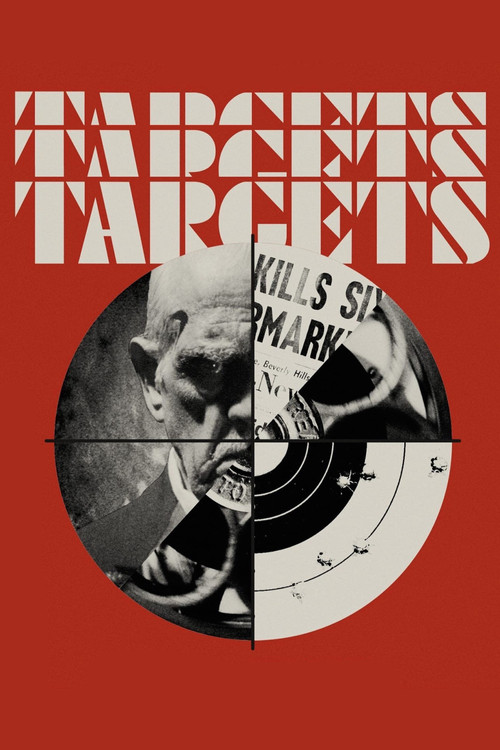
Targets
1968 · Peter Bogdanovich
For when you're craving a scare with something on its mind — a lean, unnerving thriller that doubles as a farewell to old-fashioned horror. Best watched at night, and it will stay with you.
What it's about
Two stories run side by side across Los Angeles. Byron Orlok, an elderly horror-movie legend, announces his retirement, convinced the gothic monsters he played can't compete with the horrors in the morning paper. Meanwhile a polite, clean-cut young man methodically buys rifles and, without warning or explanation, begins shooting strangers. The film follows both men as their paths bend toward the same drive-in theater.
The experience
Genuinely chilling in a matter-of-fact way — the sniper scenes are quiet, procedural, and stripped of motive, which makes them scarier than any monster movie, while the Orlok scenes are wry and elegiac. The contrast keeps you off balance right up to the finale.
Performances
Boris Karloff, in one of his final roles, is magnificent playing a barely disguised version of himself — funny, weary, and dignified — effectively delivering his own eulogy for an entire era of movie monsters.
The craft
Made fast and cheap for Roger Corman, it's a marvel of resourceful direction: Bogdanovich's debut cross-cuts the two strands with cold precision, stages violence at an unnerving distance, and turns a drive-in screen into one of the great settings for a climax.
Why it matters
It announced Peter Bogdanovich as a major new director, gave Karloff a career-crowning send-off, and — arriving amid America's reckoning with mass shootings — became a landmark of horror rooted in the everyday rather than the supernatural.
Snapshot
Targets is a film about the retirement of one kind of horror and the arrival of another. Boris Karloff, in his seventy-ninth year and playing a barely disguised version of himself, is Byron Orlok, an English horror star who announces he is quitting pictures because the monsters he embodied have been rendered quaint by the daily newspaper. In a parallel strand that shares no scene with him for most of the running time, a clean-cut young insurance salesman named Bobby Thompson (Tim O'Kelly) buys rifles the way other men buy fishing tackle, kills his wife and mother in their tract house, climbs an oil storage tank above a Los Angeles freeway, and begins shooting motorists. The two lines converge at a Reseda drive-in where Orlok is making a personal appearance and Bobby has set up behind the screen.
Made for Roger Corman on a budget usually reported in the region of $130,000 and shot in a matter of weeks, it is a debut feature that functions simultaneously as a piece of exploitation contract-fulfilment, an essay on the obsolescence of Gothic horror, and one of the most lucid American films ever made about guns and looking. Its argument is delivered less through dialogue than through structure: two stories, one baroque and one blank, cut against each other until the blank one wins.
Industry & production
The film exists because of an accounting problem. Karloff owed Corman two days of work left over from The Terror (1963), and Corman held footage from that picture he wanted amortised. He offered Bogdanovich — then his assistant, second-unit hand and script doctor — a deal of characteristic ruthlessness: use Karloff for his remaining days, incorporate roughly twenty minutes of The Terror, shoot the rest new, and deliver a releasable feature. Bogdanovich and Polly Platt, his wife and collaborator, devised a story that turned every constraint into a premise. The Corman footage became a film-within-the-film screened for its own star; the star's two days became a character defined by his imminent withdrawal from work; the poverty of means became a formal principle.
Karloff, by widely repeated accounts, was sufficiently taken with the material that he worked five days rather than the contracted two. He was frail — emphysema, a leg brace, a lifetime of back injury from the Frankenstein boots — and the film neither hides this nor sentimentalizes it.
Bogdanovich has consistently credited Samuel Fuller with an uncredited rewrite that gave the script its shape, including the decision to run the two narratives in parallel and withhold their meeting. Fuller took neither credit nor, in most tellings, payment. The documentary record here rests largely on Bogdanovich's own recollections, repeated over decades and never contradicted by Fuller, rather than on production paperwork; it should be read as a well-attested anecdote rather than a contract.
Corman sold the finished picture to Paramount, and its release in August 1968 ran directly into the year's political violence. Martin Luther King Jr. had been killed in April, Robert F. Kennedy in June. Paramount, plainly nervous about a film whose selling point was a sniper, gave it a cautious release and appended an anti-gun message to prints. A film that had been conceived as a commentary on the news became, awkwardly, part of it, and the distribution was too tentative for the picture to find an audience. Its commercial failure is not in dispute; specific grosses are not reliably documented and are best left unstated.
Technology
Targets is a case study in what the late-1960s toolkit made possible for a crew small enough to fit in two cars. Color negative of the period was slow by later standards, and the film's look reflects a negotiation with that limit: hard, unmodulated California daylight for the exteriors, where there is more light than anyone needs, and a night climax at a working drive-in that represents the real technical gamble — a large exterior space lit essentially by a projected image, car headlights and practical fixtures.
Two instruments matter thematically as well as practically. The first is the zoom and long telephoto lens, then newly central to American shooting practice and a signature of the Hungarian-trained cameramen entering Hollywood. The sniping sequences are built on long-lens compression: figures flattened against the freeway, distance abolished optically while remaining absolute physically. The second is the telescopic sight itself. The film repeatedly gives us the crosshair view, and the equivalence it proposes — that a scope is a viewfinder, that aiming and framing are the same gesture — is the picture's governing idea rather than a decorative motif. Lightweight cameras and location sound gear are what let the production shoot on real freeways, in real tract housing and at a real drive-in; the film's realism is inseparable from the portability of its equipment.
Technique
Cinematography
László Kovács shot the film, one of several he made in this period that quietly redefined how American movies looked; he had fled Hungary in 1956 with Vilmos Zsigmond after filming the uprising, and would go on to Easy Rider (1969), Five Easy Pieces (1970) and, for Bogdanovich, What's Up, Doc? (1972) and Paper Moon (1973). His work here is deliberately unbeautiful in the Bobby scenes and slightly richer, more classically composed, in the Orlok scenes — a stylistic split that tracks the film's two orders of horror. The violence is shot in flat, even, midday light: the gun shop, the freeway, the suburban kitchen. There is no chiaroscuro because there is nothing hidden. The camera holds at a slight remove and refuses reaction shots at the moments a conventional thriller would supply them, so that killings register as small, distant events in a landscape that does not respond.
Editing
The film's engine is parallel montage, and its most sophisticated decision is one of restraint: the two strands are cut against each other for an hour without any of the reassuring convergences a thriller normally offers. There is no investigation, no closing net, no cross-cut chase. Suspense is generated purely by adjacency — the audience understands that these lines must meet long before the characters do. Within sequences the cutting is unhurried and often withholds: shots continue past the point of narrative usefulness, particularly during the freeway shootings, where the duration of a held wide shot is what makes the violence obscene. The film was cut in-house on Corman-scale resources, with Bogdanovich himself carrying the editing credit — one more consequence of a production where roles overlapped by necessity.
Mise-en-scène / staging
Polly Platt's design work is the unsung achievement. Bobby's world is rendered with almost documentary specificity: the low-ceilinged family house, the wood paneling, the Coke bottles, the neat suburban bedroom where an arsenal is laid out on the bedspread like laundry. Nothing is stylized, and that is the point — the film locates horror in the exact décor of respectable American life. Orlok's world, by contrast, is hotel suites, screening rooms, back-lot corridors: transitional, borrowed spaces belonging to a man on his way out.
The staging of the climax is the film's masterstroke. The drive-in gives Bogdanovich a space in which the screen is a physical object with a front and a back, an audience arranged in metal boxes, and a killer occupying the position of the projectionist's counterpart. When Orlok walks toward Bobby while his own enormous image advances on the screen behind him, the doubling is achieved entirely in the geometry of the location — no effect, no cut, just an old man and his projected ghost converging on a boy who cannot tell which one to shoot.
Sound
Targets has essentially no non-diegetic score. Its soundtrack is radio pop from car dashboards, television chatter, freeway hum and the reports of a rifle. Detailed music credits for the picture are thin in the standard references, and it would be a mistake to overstate them; the salient fact is the absence of orchestral commentary. Nothing tells the audience how to feel. The gunshots are the crucial acoustic decision: small, flat, dry cracks rather than the amplified booms of studio convention, so that each death arrives with almost no sonic weight. The most disturbing passages are the quietest — the domestic murders play out with household sound continuing underneath.
Performance
Karloff gives one of the great late performances in American cinema, and its power comes from the fact that he is not really acting a role so much as inhabiting a condition. The long hotel-room scene in which Orlok, drunk and maudlin with the young director Sammy Michaels (played by Bogdanovich himself), recites the Appointment in Samarra parable — Somerset Maugham's version of the tale in which Death's gesture in Baghdad is not a threat but an appointment — is staged with minimal cutting and lets Karloff simply talk. Elsewhere Orlok watches Karloff's own younger self in Howard Hawks's The Criminal Code (1931) on television, an act of self-confrontation that no writing could improve on.
Tim O'Kelly's Bobby is the opposite and equally exact: pleasant, polite, affectless, a performance built entirely on the absence of interiority. He offers no motive and the film supplies none. When he tells his wife that he gets funny ideas, the line lands flat and unanswered, and the film never returns to explain it. O'Kelly never had a comparable role again, which has the accidental effect of leaving the character unattached to any star persona.
Narrative & dramatic mode
The film is a bifurcated tragedy with a thriller's chassis. One line is elegiac and interior — an artist's reckoning with obsolescence, played in dialogue scenes and largely static. The other is procedural and exterior — a chronicle of preparation and execution, played almost silently. Neither is subordinate; the film denies itself a protagonist for most of its length. Its dramatic mode is closer to Fuller's tabloid modernism than to classical suspense: blunt, structurally declarative, uninterested in psychology as explanation.
Crucially, Targets refuses the causal apparatus the material invites. There is no traumatic backstory, no clinical diagnosis, no scene in which anyone accounts for Bobby. The film's proposition is that the violence has no depth, and that its lack of depth is precisely what the old horror — with its castles, curses and legible evil — cannot represent.
Genre & cycle
The picture stands at the exact hinge between two horror regimes. Behind it is the Gothic cycle: Universal in the 1930s, Hammer and the AIP Poe films in the 1950s and 60s, Corman and Karloff themselves. In front of it is the American horror of the ordinary — domestic, contemporary, unexplained. Psycho (1960) had already made the decisive move and Peeping Tom (1960) had already fused camera and weapon; Targets is unusual in making the transition its explicit subject rather than merely enacting it. That it appeared in the same year as Night of the Living Dead is one of the tidier coincidences in genre history: two independently produced, low-budget American films, both of which relocate horror into a landscape that looks like the news.
It also inaugurates, more or less, the American mass-shooting film. Bobby is transparently modeled on Charles Whitman, who killed and wounded scores of people from the University of Texas tower in August 1966, and the film's freeway and tower geometry follow that template closely.
Authorship & method
Bogdanovich came to directing from criticism — program notes and monographs for the Museum of Modern Art on Welles, Hawks and Hitchcock, and interviews with the directors he revered — making him a near-exact American analog of the Cahiers du cinéma generation. Targets is legible as criticism performed in the medium: it quotes Hawks, invokes Hitchcock's structural principle of suspense-through-knowledge, and casts its own director as a young cinéaste pleading with an old star to keep working.
The collaborators are as determining as the director. Polly Platt shares the story credit and designed the film; her contribution to Bogdanovich's early work — locations, casting instincts, visual research, the tactile authenticity of the American settings — was long undercredited and is now generally recognized as central. Kovács supplied the flat, unromantic photography. Fuller supplied, by all accounts, the structure. Karloff supplied a lifetime of iconography that the film then dismantles. Bogdanovich's method throughout is subtractive: no score, no explanation, no reaction shots, no plot mechanics. The film is closer to Hawksian professionalism — get it told, don't decorate — than to the flourish-heavy debut features of his contemporaries.
Movement / national cinema
Targets is an early document of New Hollywood in its Corman-incubated form. The pipeline that produced it — cheap genre pictures as apprenticeship, with total creative latitude in exchange for total budgetary discipline — also produced Coppola, Scorsese, Hellman, Demme and Dante. It belongs to the 1967–69 rupture alongside Bonnie and Clyde, The Graduate and Easy Rider, but its temperament is distinct: where those films are stylistically exuberant, Targets is austere, and its modernism consists of what it withholds. It is also a Los Angeles film in a specific sense, attentive to freeways, tract houses, oil infrastructure and the dying drive-in exhibition economy, treating the city as a flat field in which sightlines carry further than sound.
Era / period
The film's release date is inseparable from its meaning. 1968 in the United States meant Tet, the King and Kennedy assassinations, televised urban unrest, and a gun-control debate that produced the Gun Control Act signed that October. Targets arrived in August, between the second assassination and the legislation, and Paramount's decision to attach a message about firearms to it registers the collision. It also arrived at the terminal moment of the Production Code, months before the MPAA ratings system took effect in November 1968 — a film about the exhaustion of one representational regime, released as another gave way.
Karloff died in February 1969, some months after the release. He completed several Mexican-produced pictures afterward, released posthumously, but Targets is unambiguously his last major performance, and the film's valedictory quality was retroactively confirmed almost immediately.
Themes
The controlling theme is the disenchantment of the image. Orlok's grievance — that the painted monster no longer frightens anyone — is the film's thesis, and the climax literalises it by having a real killer fire at a projected face. Horror as craft, as costume, as shared cultural agreement, is set against horror as an unremarkable afternoon.
Second is the equivalence of the gun and the camera. Both are aimed; both frame; both convert persons into images at a distance; both make the operator invisible and the target visible. The film builds this into its optics rather than stating it, and it is the reason Targets survives as a work about spectatorship and not merely about violence.
Third is the domestic setting of American atrocity. The murders that begin the spree occur in a family home among people who are polite to each other. The weapons are legally purchased in a well-lit shop by a young man who is served courteously. Nothing is transgressive at the point of sale.
Fourth is generational displacement — the old professional yielding to a young man he cannot comprehend — which the film treats without nostalgia. Orlok's final confrontation dispels the terror by physical contact: an old man walks up and takes the gun, and the killer collapses into a whimpering complaint about his aim. The horror is not defeated so much as revealed to be pathetically small, which is worse.
Reception, canon & influence
Critical response in 1968 was strong and largely astonished that a first feature from a young critic under Corman's aegis should be this controlled, and the film was widely read as an announcement of a serious directorial talent — an assessment vindicated three years later by The Last Picture Show (1971). The audience did not follow; the release was too cautious and the subject too raw. Its reputation has grown steadily since, sustained by repertory programming, home-video restoration and its increasingly uncomfortable contemporaneity.
Looking backward, the film's debts are explicit. Psycho established the modern, domestic, motiveless killer; Peeping Tom established the camera-as-weapon; Hawks supplied the ethic of narrative economy and appears in the film by name; Hitchcock supplied the principle that suspense derives from what the audience knows and the characters do not; Fuller supplied the structure. Karloff's own filmography — Universal, AIP, The Criminal Code — is the raw material the picture consumes.
Looking forward, its influence is broad and often unattributed. The sniper as figure of blank modern menace runs through Dirty Harry (1971) and Taxi Driver (1976); the affectless, unexplained American killer through Halloween (1978), Henry: Portrait of a Serial Killer (1986) and, in a very different register, Gus Van Sant's Elephant (2003), which inherits Targets' refusal of motive and its use of duration and long lenses. The meta-horror strand that reached mass audiences with Scream (1996) and continues in Joe Dante's work descends in part from Targets' insight that the genre's own history can be its subject. And every subsequent American film that stages a mass shooting in ordinary daylight, in a familiar public space, without music, is working in a grammar this one wrote first.
Its most enduring value may be the discomfort of its accuracy. A film made to use up two days of an old actor's contract turned out to have described, with unnerving economy, a form of American violence that has since become routine — and to have understood, in the same gesture, that the movies had lost the ability to imagine anything more frightening than the news.
A Deleuzian reading
A young man climbs an oil storage tank above a Los Angeles freeway, sits down with his rifle, and starts shooting at cars.
The full Deleuzian reading of Targets →
Reception
Buried on release in 1968 — arriving right after the MLK and RFK assassinations, Paramount barely marketed a film about an all-American sniper — but critics loved it, and it's since been canonized as one of the great directorial debuts and the perfect farewell for Boris Karloff.
How Targets was received, from release to now →
How to watch Targets: what to notice on a first viewing
- Notice how flat and shadowless the daylight scenes look. Kovács shoots the freeway and suburban scenes in even midday light with no chiaroscuro, while the Orlok scenes stay richer and more classically composed. The flatness tells you nothing here is hidden; the horror is sitting in plain sight.
- Watch for shots framed through a rifle's crosshairs. The film repeatedly gives you the view through a telescopic sight, treating the scope as a viewfinder and the act of aiming as a kind of framing. Aiming and framing start to look like the same gesture, which is the film's real subject.
- Listen for how small and dry each gunshot sounds. There is no score anywhere in the film, and the shots land as flat, quiet cracks rather than the amplified booms studio movies usually supply. Nothing tells you how to feel about what you just heard, which makes it land harder, not softer.
- Notice ordinary household objects sitting beside weapons. Platt's design lays rifles out on a bedspread with the same flat attention given to Coke bottles and wood paneling in the house. The guns are staged as just more household objects, which is exactly what makes the room so unsettling.
- Notice the film alternate between two strangers' stories. An aging horror star and a clean-cut young man share no scenes for most of the runtime, cut side by side with no explanation offered. You start to sense these two lives must meet long before the film ever tells you why.
The whole guide to watching Targets, with the keys for a rewatch →
Influences: the films it descends from and the films it influenced
- The Criminal Code (1931) — Its prison-yard footage is literally projected inside Targets as Byron Orlok's screening-room clip, so Hawks's compressed, uninflected staging of a killing becomes the film's own embedded standard of narrative economy — and Karloff's 1931 face becomes the raw material the 1968 film consumes.
- The Sniper (1952) — Established the American procedural grammar of the unexplained rooftop shooter — rifle-sight framing, victims dropped in ordinary daylight, and killings staged as flat civic incident rather than dramatized crime — which Targets strips of even Dmytryk's psychiatric alibi.
- Rear Window (1954) — Supplies both the telephoto lens as a diegetic instrument of looking and Hitchcock's structural axiom that suspense comes from what the audience knows and the characters don't — the exact engine of the drive-in sequence, where we see the rifle behind the screen and the crowd cannot.
- Psycho (1960) — Invented the mid-film structural rupture and the clean-cut domestic American killer whose interiority is withheld; Bogdanovich keeps the rupture and the blankness but removes the third-act psychiatrist scene that explained it away.
- Peeping Tom (1960) — Fused the optical apparatus to the murder weapon — viewfinder as gunsight — which Targets literalizes by shooting long stretches through the telescopic sight, making the audience's act of aiming identical to the killer's.
- The Manchurian Candidate (1962) — Its convention-hall finale gives the modern template for the elevated sniper's-nest set piece — high concealed perch, crosshair POV over an unsuspecting public crowd — which Targets relocates from political conspiracy to motiveless suburban banality.
- The Terror (1963) — Its footage and its two unused Karloff contract days are the literal production condition of Targets; Corman's reuse economy is not just background but the film's method, since the discarded Gothic material becomes the obsolete horror the new plot destroys.
- The Naked Kiss (1964) — Fuller's tabloid construction — a violent cold open delivered with no psychological setup, then two unrelated tracks forced into collision — is the uncredited structural armature he reportedly handed Bogdanovich for the Orlok/Thorley dual plot.
- Bonnie and Clyde (1967) — Broke the Hollywood convention of musically cued violence, letting gunfire land as dry, percussive, unaccompanied sound in bright rural daylight — the acoustic register Targets adopts wholesale by refusing any nondiegetic score.
- Hells Angels on Wheels (1967) — László Kovács's flat, available-light, long-lens coverage of American roadside space — freeway, motel, parking lot as unromanticized fact — is the exact photographic method he then applies to Targets' gun shop, tract house and drive-in.
- Dirty Harry (1971) — Opens by inverting Targets' finale — Scorpio's rooftop scope POV drops a swimmer in a sunlit pool with no motive, no score cue and no cut to horrified onlookers — importing the sniper as blank modern menace into the police procedural.
- Taxi Driver (1976) — Extends Targets' fetishized weapon-preparation grammar — the methodical laying-out, loading and rigging of guns shot as domestic routine — while withholding any causal account of the violence it culminates in.
- Halloween (1978) — Takes the affectless, unexplained killer and plants him in flat anamorphic suburban daylight, staging stalking in wide static frames that hold longer than comfort allows and denying the audience the reaction shots that would license relief.
- Henry: Portrait of a Serial Killer (1986) — Pushes the subtractive method further: killings are presented in unemphatic medium-wide coverage as routine daily activity, with no build-up, no motive and no dramatic punctuation — the Bobby Thompson scenes carried to their end point.
- Matinee (1993) — Directly rewrites the Orlok premise — an aging horror showman's theatrical scares collapse against real-world dread inside a packed movie house — making the theater itself the arena where cinematic and actual terror compete, as at the Reseda drive-in.
- Scream (1996) — Mass-market inheritor of Targets' central insight that the horror genre's own history can be its subject matter, with characters watching genre films on screens while the killer moves through the same room.
- Elephant (2003) — Inherits the full package — refusal of motive, long-lens Steadicam compression of ordinary institutional space, extended real-time duration, no score, and a mass shooting staged in flat daylight among people who register it only as it reaches them.
- Zodiac (2007) — Stages its daylight attacks with clinical wide coverage and no musical cue, and structurally refuses the explanatory closure of identity or motive — Targets' withheld interiority scaled to a two-and-a-half-hour investigation that finds nothing behind the rifle.
- Scream 2 (1997) — The prototype for violence erupting inside a movie house, cut against the projected film so the screen's soundtrack masks the real screams — exactly the Cineplex logic by which Maureen's stabbing reads as part of the show to everyone around her.
- Cecil B. Demented (2000) — Stages its climax through and behind the drive-in screen, using the running projection and the seated crowd as the actual geography of the attack — the structural precedent for Waters' shot-inside-a-screening set pieces.
- Easy Rider (1969) — Kovács's other 1969 landmark: the same telephoto compression of highway and small-town Americana, and the same sudden roadside shooting delivered without musical warning or a reaction shot to soften it.
Similar films
- Dirty Harry (1971) — influence & lineage
- Taxi Driver (1976) — influence & lineage
- Peeping Tom (1960) — influence & lineage
- The Manchurian Candidate (1962) — influence & lineage
- Point Blank (1967) — shared sensibility
- In the Line of Fire (1993) — shared sensibility
- Invasion of the Body Snatchers (1978) — shared sensibility
- The Killers (1964) — shared sensibility