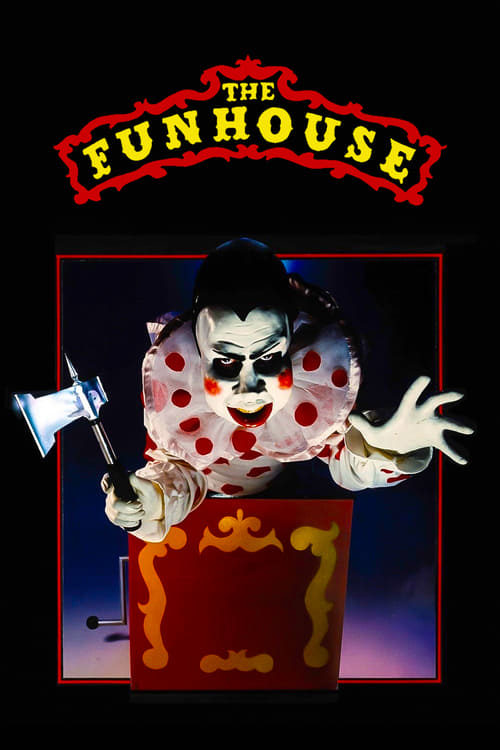
The Funhouse
1981 · Tobe Hooper
Perfect for a Halloween-season night when you want atmosphere over body count — a slasher setup with an old-monster-movie soul. Creepy and tense rather than punishing.
What it's about
Four teenagers sneak into a trashy traveling carnival and decide to spend the night inside its funhouse dark ride. From their hiding place they witness a murder by a masked, deformed carnival worker — and find themselves locked in with him and his barker father until dawn.
The experience
A slow-building carnival nightmare: the first half soaks in the midway's seedy, neon-lit sleaze, then the trap snaps shut and it becomes a tense cat-and-mouse through animatronic ghouls and machinery. The monster is as pitiable as he is terrifying, which gives the scares an unusual ache.
The craft
Hooper shot it in anamorphic widescreen, and the funhouse becomes a genuinely cinematic space — strobing lights, lurching mechanical props, fog, and screaming calliope sound. The creature makeup is a showpiece, and the whole thing rewards a big screen and loud speakers.
Why it matters
Hooper's first major-studio feature, it stood apart from the slasher boom by reaching back to carnival-sideshow and Frankenstein traditions, and its reputation has grown steadily among genre fans.
Snapshot
The Funhouse is Tobe Hooper's first feature for a major studio. Universal Pictures released it in March 1981, at the height of the slasher boom that followed Halloween (1978) and Friday the 13th (1980). The story looks like a standard slasher setup. Four teenagers hide overnight in a carnival dark ride, see a murder, and are hunted until dawn. The film's sympathies and textures run elsewhere. Hooper and screenwriter Lawrence Block build it as a carnival Gothic. The setting is a travelling midway of freak tents, peep shows, fortune tellers and mechanical horrors. The killer, Gunther, is a deformed, mute son kept hidden by his barker father. He is closer to Frankenstein's creature or the performers of Tod Browning's Freaks (1932) than to the faceless avengers of contemporary slashers.
The film was shot in anamorphic widescreen by Andrew Laszlo, with creature makeup associated with Rick Baker and Craig Reardon. It is more polished than Hooper's earlier, rougher pictures, and it remains a key text for anyone tracing the line from classic Universal horror through the 1970s American nightmare film to the commercial horror of the 1980s. It was not a major commercial success on release. Its reputation has risen steadily since, and it is now often counted among Hooper's best work.
Industry & production
The film came at a turning point in Hooper's career. The Texas Chain Saw Massacre (1974) had made his name. Since then he had made the troubled Eaten Alive (1976) and directed the well-received CBS miniseries of Stephen King's Salem's Lot (1979). The Funhouse gave him a studio-backed theatrical feature with higher production values. Derek Power and Steven Bernhardt produced it, Mace Neufeld served as executive producer, and Universal distributed.
The production was based in Florida. The funhouse interiors were built as sets, reportedly at studio facilities in the Miami area. Morton Rabinowitz handled production design. Building the ride as a set mattered a great deal: it gave Hooper and Laszlo full control over the tunnels, the animatronic figures and the machinery room beneath the attraction, where the climax plays out.
One often-noted oddity is that the tie-in novelization reached shops before the film. Dean Koontz wrote it under the pseudonym "Owen West", and it was published in 1980 while the film's release slipped. Koontz's book expands the backstory considerably, especially that of Amy's mother, and differs from the film in many respects.
The film was released in the US in March 1981. It is generally described as a modest performer that did not match the slasher hits of the period. Reliable figures are not widely documented, so none are given here. A frequently repeated industry story holds that Steven Spielberg's regard for Hooper's work, The Funhouse included, helped Hooper land Poltergeist (1982). The story is told often, but the exact weight of this particular film in that decision is not firmly established.
Technology
The film was shot in 35mm anamorphic Panavision, at an aspect ratio of about 2.35:1. That was an unusual degree of scope for a teen horror film, which more typically used flat 1.85:1 framing on low budgets. The wide frame suits the horizontal sprawl of the midway and the long, shallow corridors of the dark ride. It also gives Hooper room to place threats at the edges of compositions.
Practical effects carry the horror. The animatronic funhouse figures include a large laughing fat-lady automaton at the entrance, plus skeletons, witches and swinging dummies. They were built to work on camera as both set dressing and atmosphere. Gunther's makeup is a prosthetic head with a cleft, misshapen face, revealed when he removes a Frankenstein's-monster mask. It belongs to the makeup boom of 1980–81 that also produced The Howling and An American Werewolf in London. Rick Baker is commonly credited with the design and Craig Reardon with execution and application. Accounts differ on the exact split, so it is best described as a collaboration.
The climax depends on mechanical set-building: a full-scale engine room of gears, chains and electrical apparatus beneath the ride. Its working machinery becomes the means of the monster's destruction.
Technique
Cinematography
Andrew Laszlo was a seasoned studio and New York cinematographer whose credits include Walter Hill's The Warriors (1979) and Southern Comfort (1981). He gives the film a lush, saturated look. The midway is lit with coloured bulbs, neon and gel washes of red, green and blue, so the carnival reads as both seductive and poisonous. Inside the funhouse he keeps pools of light in large areas of darkness, which lets the scope frame fall away into black.
The camera often moves slowly through space. Long tracking shots down the midway and fluid moves through the ride's tunnels set up a prowling, surveilling point of view. The opening sequence takes this to the level of explicit pastiche. A subjective, masked point-of-view shot in a family home echoes the opening of Halloween, and it leads into a shower attack that restages Psycho (1960). It then turns out to be a prank by Amy's younger brother Joey with a rubber knife. Hooper announces his awareness of the cycle's conventions and then turns away from them.
Editing
Jack Hofstra edited the film. Its rhythm is unusually patient for a 1981 horror release. The first third is mostly a slow tour of the carnival: the freak show, the magician, the fortune teller's tent and the strip-show tent. It builds atmosphere and unease rather than delivering early kills. That choice, which some contemporary viewers found slow, is central to the film's design. The midway is the true subject, and the violence arrives only once the audience has absorbed its world.
The murder the teenagers witness through the floorboards is cut from their hidden point of view, so the audience shares their position as voyeurs. In the second half the cutting tightens into cross-cut pursuit through the ride's corridors and crawlspaces. Intercutting with Joey's own frightening night at the fairground widens the threat beyond the funhouse.
Mise-en-scène / staging
The carnival is a fully realised décor of exhibition and exploitation. The freak show displays preserved anomalies, including animal "specimens" in jars and a live two-headed cow, inviting the same look of fascinated disgust the horror film itself relies on. William Finley's shabby magician, Marco the Magnificent, and Sylvia Miles's Madame Zena, the fortune teller, sketch a community of cynical showfolk.
The funhouse is staged as a series of thresholds: the barker's platform, the cars on their track, the tunnels of animated grotesques, the hidden office above and the engine room below. Hooper's characteristic interest in domestic and institutional spaces turned monstrous, carried over from the Sawyer house in Chain Saw, here takes the form of a backstage world. The ride is a building with a front for customers and a hidden interior where the real family business, including concealment and murder, goes on.
The Frankenstein mask Gunther wears is a pointed piece of staging. It is a commercial copy of Universal's own iconic monster, worn by an actual "monster" working a cheap attraction. The prop places the film within, and in tension with, the studio's horror heritage.
Sound
John Beal's score is full and orchestral, closer to classical horror scoring than to the minimalist synthesizer cues that Halloween had made fashionable. It uses swelling strings, dissonant brass and carnival-inflected themes. The score's old-fashioned grandeur fits the film's Gothic leanings.
The soundtrack is crowded with diegetic carnival noise: barkers' patter, crowd hubbub, calliope-style music, mechanical clatter and, above all, the recorded laughter of the funhouse's animatronic figures. That laughter repeats indifferently through scenes of terror and becomes one of the film's signature effects. Gunther's non-verbal grunts and cries make him more animal and more pitiable at once.
Performance
Elizabeth Berridge plays Amy Harper, a reluctant rebel rather than a stock "final girl". Her performance stresses fear and exhaustion more than steely competence, and the ending leaves her visibly traumatised rather than triumphant. Cooper Huckabee (Buzz), Largo Woodruff (Liz) and Miles Chapin (Richie) fill out the doomed group. Richie's theft from the cash box sets the hunt in motion.
Kevin Conway gives the standout supporting turn. He plays the barkers for the funhouse, the freak show and the strip show, and his main role is Conrad Straker, Gunther's father. The triple casting suggests the midway is run by a single predatory showman wearing different hats. Wayne Doba plays Gunther physically, working through the mask and the prosthetics with a hunched, childlike movement that invites both revulsion and pity. Sylvia Miles and William Finley add character-actor colour. Finley was a regular of Brian De Palma's films, and his presence is one of several links to the 1970s American horror and thriller scene.
Narrative & dramatic mode
The structure moves from one night into another. Amy's family home in the prologue gives way to the carnival's public face, then to its concealed interior, and finally to the industrial underworld beneath the ride. The plot is driven by transgression in steps. Amy disobeys her parents, the teenagers hide in the ride after closing, they spy on Gunther's sexual encounter with Madame Zena and its fatal outcome, and Richie steals the money. Each step takes them further into the carnival's hidden economy and its punishments.
The dramatic mode is suspense and Gothic dread rather than the episodic body-count of the period's slashers. Deaths are relatively few and spread out. Moral weight is shared out ambiguously. Gunther kills, but he is also the abused and hidden product of his father's world. Conrad is the more knowing villain. The teenagers are careless consumers of the spectacle. The ending withholds catharsis: Amy stumbles out at dawn as the carnival packs up, as if nothing had happened.
Genre & cycle
The Funhouse sits at the crossroads of several traditions:
- The slasher cycle of 1978–84. The film shares the cycle's basic architecture: teenagers, a confined space, a masked killer and a surviving young woman. Through its opening pastiche, its sympathetic monster and its slow build, it also positions itself as a commentary on the formula.
- The carnival and freak-show horror tradition. This line runs from Freaks through literary sources such as Ray Bradbury's Something Wicked This Way Comes (1962) and the wider "dark carnival" imagery of American pulp horror.
- The Universal monster film. Gunther's Frankenstein mask, the father–son bond and the monster's ultimate destruction by machinery and electricity all recall the studio's 1930s cycle.
- The 1970s backwoods / grotesque-family film. Hooper's own Chain Saw is the key example. Like the Sawyers, the Strakers are a predatory family business preying on outsiders.
Authorship & method
Tobe Hooper (1943–2017) brought to The Funhouse a recurring set of concerns: monstrous families, decaying American roadside and carnival culture, the uneasy bond between spectacle and violence, and spaces that turn into traps. Compared with Chain Saw's documentary grain, The Funhouse shows Hooper working in a more classical, studio register. The camera movement is controlled, the colour design is precise and the visual references are deliberate. Many critics see it as his most formally composed film before Poltergeist.
Lawrence Block wrote the original screenplay. (He is not the crime novelist of the same name.) It lays out the teen-in-peril premise, but the film's texture owes much to Hooper's staging.
Andrew Laszlo (cinematography) contributed scope framing and saturated night lighting comparable to his work on The Warriors.
John Beal (music) supplied a traditional orchestral score that sets the film apart from synth-led contemporaries.
Jack Hofstra (editing) kept the deliberate pacing that defines the first act.
Morton Rabinowitz (production design) built the funhouse as a full environment.
Rick Baker and Craig Reardon (makeup) created Gunther's face, which anchors the film's horror and its pathos.
Movement / national cinema
The film belongs to American commercial genre cinema in the transition from the independent "New Horror" of the 1970s into the studio-distributed horror of the early 1980s. Hooper, like George A. Romero, Wes Craven and John Carpenter, emerged from low-budget independent production. The Funhouse is one example of the major studios absorbing that generation and its style. No formal movement is involved. The relevant context is the post-Halloween industrial situation, in which studios such as Universal, Paramount and United Artists sought youth-market horror while auteur-minded directors tried to put their own concerns into the formula.
Era / period
The film's moment is roughly 1980–82, the peak of the slasher boom and of practical makeup effects. It is also the moment Hooper moved from independent to studio filmmaking. Its carnival setting has a nostalgic, slightly anachronistic feel. The travelling show it depicts was already a fading institution of American small-town life. That gives the film an elegiac undertone beneath its shocks.
In Britain, the film became caught up in the early-1980s "video nasties" controversy. It is frequently reported to have appeared briefly on the Director of Public Prosecutions' list, possibly through confusion with another title. The precise circumstances are inconsistently recorded and should be treated with caution.
Themes
- Looking and paying to look. The whole carnival is an economy of spectacle: freak exhibits, strip tents, a peep at a fortune teller's body. The teenagers' crisis begins when they spy on a paid sexual encounter. The film implicates its audience, which has also paid to see grotesques.
- Monstrous families and abused children. Conrad conceals and exploits his deformed son, and their relationship mirrors Amy's restrictive home and Joey's fondness for horror pranks. Parents protecting or hiding children is a central motif.
- Disobedience and punishment. Amy's defiance of her parents leads to a nightmarish night. The film plays this cautionary structure ambivalently and stresses trauma rather than moral reward.
- Sympathy for the monster. Like Universal's Frankenstein films and Freaks, The Funhouse asks viewers to recognise Gunther's suffering even as he kills.
- The machinery of entertainment. The animatronic laughter, the mechanical ride and the engine room that destroys Gunther suggest an amusement industry indifferent to the human cost it runs on.
Reception, canon & influence
Critical reception. Reviews in 1981 were mixed. Some critics praised the film's visual craft, atmosphere and departures from slasher routine. Others found it slow or thin on incident. It was generally not seen as a breakthrough on release. Its reputation grew through home video, repertory screenings and later reappraisal of Hooper's career. Today it is widely regarded as one of his most accomplished and personal studio films and a notable outlier in the 1981 slasher landscape. Detailed contemporary review quotations are not reproduced here; the overall pattern of mixed initial response and later rehabilitation is well documented.
Influences on the film (backward).
- Psycho (1960) and Halloween (1978), directly pastiched in the opening sequence.
- Universal's Frankenstein cycle of the 1930s, evoked through Gunther's mask, the father–son relationship and the monster's mechanical destruction.
- Tod Browning's Freaks (1932), with its carnival community of performers and exhibition of human difference.
- The broader American "dark carnival" Gothic associated with Ray Bradbury.
- Hooper's own Texas Chain Saw Massacre, with its predatory family enterprise and a mute, masked son serving a dominant patriarch.
Legacy (forward).
- Within Hooper's career, it is the bridge to Poltergeist (1982) and the studio phase that followed. Its father-and-monstrous-son business also anticipates the extended carnival-grotesque comedy of The Texas Chainsaw Massacre 2 (1986).
- More broadly, it helped establish the funhouse or dark ride as a horror setting, later revisited in films such as Dark Ride (2006) and Hell Fest (2018). Rob Zombie's House of 1000 Corpses (2003), with its roadside murder ride, shares the same macabre roadside-attraction sensibility, though a direct influence is not formally established.
- Critically, it is now regularly cited as a slasher-era film that questioned the formula from within. Its monster invites pity, its "final girl" is shattered rather than triumphant, and its true antagonist is a culture of exploitative spectacle.
Influences: the films it descends from and the films it influenced
- Frankenstein (1931) — Hooper copies Universal's monster iconography directly: Gunther first appears in a rubber Frankenstein mask, and his mute, groping performance under a domineering 'father' borrows Karloff's blend of menace and pathos.
- Freaks (1932) — Browning's carnival is a closed community with its own pecking order, and this structure carries over to the barkers, freak-show exhibits and carny loyalties that turn on the outsider teens after hours.
- Nightmare Alley (1947) — The geek-show trade, where a barker's patter sells a degraded human attraction, sits behind Conway's barker selling deformity as spectacle and the film's idea of the carnival as an exploitative family business.
- Psycho (1960) — The opening restages the shower attack shot for shot, down to the curtain tear and the stabbing knife (here a rubber prop), to signal that it will take apart the slasher grammar Hitchcock started.
- Carnival of Souls (1962) — Harvey's deserted amusement pavilion turns empty fairground architecture at night into a supernatural trap, which is the spatial idea behind the closed funhouse becoming a maze of corridors and machinery.
- The Texas Chain Saw Massacre (1974) — Hooper reworks his own template of a masked, inarticulate son serving a patriarch's roadside trade, with trespassing youths killed one by one inside the family's workplace.
- Halloween (1978) — The opening subjective tracking shot of a masked prowler moving through a house toward a girl is pastiched outright, so the slasher's voyeuristic POV is set up only to be exposed as a brother's prank.
- Suspiria (1977) — Argento's saturated primary-colour gels, reds and blues lighting interiors as unreal stage space, anticipate the coloured night lighting of the midway and the funhouse interior.
- Eaten Alive (1976) — Hooper's earlier soundstage horror already relies on lurid red-gel lighting, a decaying roadside business and a deranged proprietor, and The Funhouse refines that artificial, studio-built style with a larger budget.
- Poltergeist (1982) — The Funhouse served as Hooper's audition piece for studio polish, and its controlled camera moves, coloured light effects and animated toys and mechanical props scaled up directly into the Spielberg-produced suburban spectacle.
- The Texas Chainsaw Massacre 2 (1986) — Hooper brings back the father-and-monstrous-son business as grotesque comedy, staging the climax in an amusement-park underground lair full of carnival junk and machinery.
- House of 1000 Corpses (2003) — Zombie's 'Murder Ride' roadside attraction and its showman host Captain Spaulding update Hooper's barker-run dark ride as the gateway to a murderous family.
- Dark Ride (2006) — The plot of young people sneaking into a closed haunted ride after hours, where animatronic scares hide a real killer, is lifted directly from the Funhouse premise.
- Hell Fest (2018) — The killer moves unseen among staged scares in a horror-park maze, a version of Hooper's idea that real violence can hide inside paid-for fake terror.
- The Texas Chainsaw Massacre Part 2 (1986) — Hooper's carnival underworld, with its malformed son hidden in the machinery of an amusement ride, anticipates Cary White's underground Texas Battle Land lair strung with fairground lights and dead attractions.
- The Warriors (1979) — Cinematographer Andrew Laszlo brings the same widescreen night photography, with wet, neon-gelled exteriors and pools of hard light in deep darkness, from Hill's Coney Island odyssey to Hooper's midway.
- The Elephant Man (1980) — Both films use full-face prosthetics on a sideshow 'monster' to draw pity as much as horror, and both frame the exhibition of deformity as the real cruelty.
- An American Werewolf in London (1981) — In the same year, Rick Baker's latex-and-appliance work moved creature makeup toward expressive, close-up flesh, the approach he and Craig Reardon applied to Gunther's split skull and albino face.
- Something Wicked This Way Comes (1983) — This is the Bradbury source text of the American dark-carnival Gothic Hooper draws on: a travelling show run by a sinister showman who preys on young people who wander the grounds after closing.
Similar films
- The Texas Chain Saw Massacre (1974) — influence & lineage
- Halloween (1978) — influence & lineage
- Carnival of Souls (1962) — influence & lineage
- House of 1000 Corpses (2003) — influence & lineage
- Frankenstein (1931) — influence & lineage
- Halloween II (1981) — shared sensibility
- The Texas Chainsaw Massacre Part 2 (1986) — shared sensibility
- Beetlejuice (1988) — shared sensibility