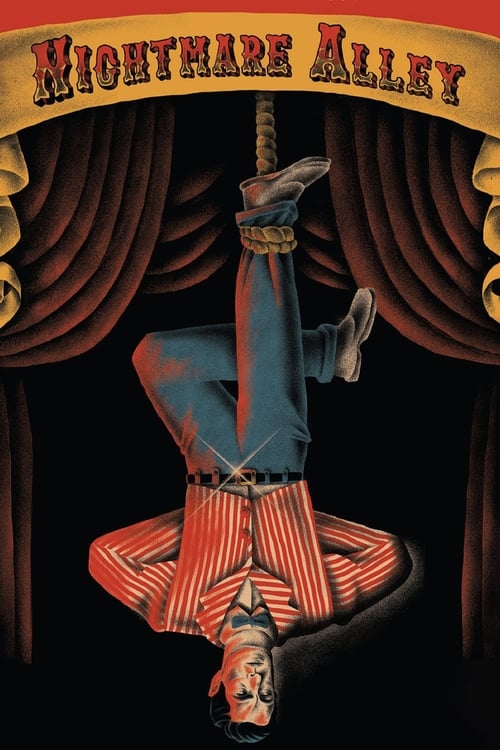
Nightmare Alley
1947 · Edmund Goulding
When you want noir at full strength — cynical, adult, and merciless — and you're in the mood to watch a charming man play with fire. A challenge, not a comfort watch.
What it's about
A handsome, hungry drifter named Stanton Carlisle signs on with a traveling carnival and starts studying the mind-reading act run by Mademoiselle Zeena and her alcoholic husband — especially the secret verbal code that makes it work. Armed with that code and his own considerable charm, he sets his sights far beyond the midway, reinventing himself as a society mentalist for wealthy audiences who badly want to believe. The higher he climbs, the bigger the con has to get.
The experience
A slow-tightening noose of a film — seductive at first, then steadily colder and more unnerving as ambition curdles into something dangerous. It leaves a genuine chill; this is one of the darkest films any Hollywood studio made in the 1940s.
Performances
Tyrone Power, then Fox's biggest romantic idol, fought to play against type here, and it's the performance of his career — using his own matinee-idol magnetism as the con man's weapon so you feel exactly how his marks get taken.
The craft
Edmund Goulding directs with unusual patience for a studio picture, letting the carnival world breathe — its hierarchies, hustles, and cruelties — before the story moves into gleaming high-society rooms that prove no less predatory. The shadowy black-and-white photography gives both worlds a nocturnal, fatalistic glamour.
Why it matters
A flop its own studio barely promoted in 1947, it was rediscovered decades later as a touchstone of the noir canon, its reputation cemented further when Guillermo del Toro remade it in 2021.
Snapshot
Nightmare Alley is a psychological crime drama produced and distributed by Twentieth Century-Fox, adapted from William Lindsay Gresham's 1946 novel about the ascent and ruin of a carnival grifter. Tyrone Power, then one of Fox's most bankable romantic leads, plays Stanton Carlisle, a charismatic roustabout who learns a mentalist's verbal code, reinvents himself as a high-society mind reader, overreaches into a spiritualist swindle, and finally collapses into alcoholic degradation as a carnival "geek." The film is remembered as one of the darkest studio pictures of the 1940s and, in later decades, as a touchstone of the film noir canon — though at the time of release it was a commercial disappointment that its own studio seemed reluctant to promote. Its reputation has been substantially amplified in the twenty-first century, capped by Guillermo del Toro's 2021 remake, which returned the source material to wide attention.
Industry & production
The project originated less from studio initiative than from a star's ambition. Tyrone Power, a matinee idol whose Fox career had been built on swashbucklers and romances, sought out darker, more demanding material after wartime military service, and he pushed for the adaptation of Gresham's bestselling novel as a vehicle to remake his image. Fox's production chief Darryl F. Zanuck controlled the studio's output tightly, and the picture was produced by George Jessel — better known as an entertainer and impresario than as a film producer, and an unusual match for such grim material.
The novel itself was a sensation of a sordid kind: a portrait of carnival hustlers, spiritualist fraud, and psychological manipulation that ran well past the boundaries of what Hollywood typically dramatized. Adapting it under the Production Code required negotiating its bleakest elements — the "geek" who bites the heads off live chickens, the sexual and financial predation, the unrelieved cynicism about faith and grief. The screenplay by Jules Furthman softens and compresses the book, most conspicuously by grafting a measure of redemption onto the ending, where the novel offers essentially none.
The commonly repeated account is that Fox and Zanuck, having made a film that ran against Power's box-office persona, gave it a muted release and limited promotional support, and that it underperformed commercially. These claims are well established in the film's reception history, but precise contemporary box-office figures are not something I can state with confidence and should not be invented here. The picture's subsequent scarcity — it was for years difficult to see, owing partly to rights entanglements — further shaped its afterlife as a rediscovered cult object rather than a hit.
Technology
Nightmare Alley is a conventional late-1940s studio production in its base technology: 35mm black-and-white photography, standard Academy ratio, optical monaural sound, and predominantly soundstage-based shooting on the Fox lot, with the carnival milieu built as a set rather than captured on location. What distinguishes it technologically is not novelty but the mature deployment of the era's tools — particularly the panchromatic film stock and lighting instruments that allowed cinematographer Lee Garmes to work in the deep-shadow, high-contrast register associated with noir. The film belongs to the classical studio system at the height of its craft rather than to any moment of technical experimentation.
Technique
Cinematography
Lee Garmes, an Academy Award–winning cinematographer whose credits include his celebrated work with Josef von Sternberg (Shanghai Express), brings a controlled chiaroscuro to the film. The carnival sequences favor pooled light, tent canvas, and encroaching darkness; the later high-society and hotel-room scenes trade the grotesque for a cooler, more austere elegance. Garmes uses low-key lighting to isolate faces — Stanton's especially — and to stage the recurring motif of a man moving between illumination and shadow, con and confession. The visual scheme tracks the moral arc: the film grows literally darker as Stanton descends, and the closing "geek" material is among the most shadowed and squalid imagery a major studio permitted in this period.
Editing
Barbara McLean, Fox's leading editor and a longtime collaborator of Zanuck's, cut the film. The structure is essentially a rise-and-fall arc, and the editing supports a clean, forward-driving classical narrative rather than a fragmented or flashback-heavy design. The most discussed structural gesture is circular rather than technical: the film opens with Stanton's fascinated, faintly appalled questions about how a man sinks low enough to become a geek, and it closes by answering that question with Stanton himself — a rhyme set up and paid off across the whole picture.
Mise-en-scène / staging
The carnival is the film's governing environment and its central metaphor: a machinery of illusion built to separate marks from their money and their grief. Staging repeatedly foregrounds apparatus — the mentalist's code, the crystal ball, the séance's manufactured "spirit" — so that the audience is let in on the mechanics of deception even as the on-screen marks are taken in. The transition from the tented, crowded, tactile carnival to the polished nightclub and the psychiatrist's austere office marks Stanton's social climb visually, while the return to carnival mud at the end completes the descent. Del Toro's later remake would make this contrast even more explicit, but the 1947 film already stages the two worlds as moral opposites that turn out to be the same racket at different price points.
Sound
The film's sound design is conventional for its period, built on dialogue, room ambience, and Cyril J. Mockridge's score. The most thematically loaded use of sound is diegetic: the verbal "code" that Zeena and Pete use in their act, in which ordinary-seeming questions encode information, is the film's core device — a demonstration that sound and language themselves can be instruments of fraud. The séance sequences likewise depend on the manipulation of the audience's ear as much as the eye.
Performance
Tyrone Power's performance is the film's engine and its principal claim on posterity. Cast against his established charm, he uses that very charm as Stanton's weapon, then lets it curdle: the confident patter of the mentalist gives way to desperation, paranoia, and finally the near-feral wreckage of the geek. It is widely regarded as the strongest and riskiest performance of his career. Joan Blondell brings weathered warmth and knowingness to Zeena, the veteran mentalist who carries the secret of the code; Coleen Gray plays Molly, the young performer who becomes Stanton's wife and, in the film's version, his tether to redemption; and Helen Walker is coolly formidable as Lilith Ritter, the psychiatrist whose manipulations outmatch Stanton's own. The ensemble's carnival texture — hardened, transactional, oddly tender — grounds the film's more lurid turns.
Narrative & dramatic mode
The film's mode is tragic and ironic: a fall structured as the working-out of a flaw, with dramatic irony saturating every con because the audience always knows the trick. Its shape is the classic rise-and-fall, and its engine is hubris — the grifter who mistakes his facility with marks for mastery over fate and people, and who is finally out-conned. Gresham's novel famously organized its chapters around the Tarot's Major Arcana, lending the material a fatalistic, deterministic frame; the film does not foreground that scheme but retains its sense of a rigged deck. The Furthman screenplay's late gesture toward Molly's redemptive love is the chief point where the film pulls back from the source's near-total bleakness, and critics have long debated whether the ending reads as genuine mercy or as a Code-mandated softening pasted onto an otherwise merciless design.
Genre & cycle
Nightmare Alley sits at the intersection of several 1940s currents. It is routinely classified as film noir, and it shares noir's fatalism, its doomed male protagonist, its femme fatale (Lilith Ritter), and its expressionist shadow-play. Yet it is not a crime thriller in the detective or heist mold; its "crimes" are confidence rackets and spiritualist fraud, and its true subject is psychological and moral rather than procedural. It also belongs to a small cycle of carnival and "seamy underside of show business" pictures, and to the postwar vogue for psychologically dark, adult subject matter that studios tested against the Code. Its hybrid character — noir sensibility grafted onto a carnival melodrama and a social-fall tragedy — is part of why it long resisted easy placement and why its canonization as noir came largely in retrospect.
Authorship & method
Edmund Goulding (director) was a British-born filmmaker long associated with prestige studio melodrama and with a reputation as an actor's director, particularly of stars — his credits include Grand Hotel (1932) and Dark Victory (1939). He had directed Tyrone Power the previous year in The Razor's Edge (1946), and that working relationship carried directly into Nightmare Alley. Goulding's method here is largely self-effacing in the service of performance and atmosphere; the film's authorship is often felt as a convergence of a director skilled with actors, a star determined to transform himself, and a cinematographer with a strong visual signature.
Jules Furthman (screenwriter) was one of Hollywood's most accomplished screenwriters, with credits spanning von Sternberg (Morocco, Shanghai Express) and Howard Hawks (Only Angels Have Wings, To Have and Have Not, The Big Sleep, later Rio Bravo). His adaptation compresses and restructures Gresham's dense novel and negotiates its unfilmable extremes.
Lee Garmes (cinematography) supplied the film's noir visual identity, as discussed above.
Barbara McLean (editor) and Cyril J. Mockridge (composer) were Fox studio mainstays; McLean's cutting shapes the tragic arc, while Mockridge's score functions in the conventional supportive register of the period. Art direction was handled by Fox's design department under Lyle R. Wheeler. The film is thus a strong example of authorship-by-studio-system: no single auteur signature dominates, but a set of highly skilled specialists, galvanized by a star's personal investment, produced something more transgressive than the studio's norm.
Movement / national cinema
The film is a product of the classical Hollywood studio system at its zenith, made entirely within Twentieth Century-Fox's industrial apparatus. It is not affiliated with an avant-garde or a national art-cinema movement; its aesthetic debts run to German Expressionism as filtered through the émigré-influenced visual grammar of American noir, and to the well-oiled genre and melodrama craft of the Hollywood majors. In movement terms it is best understood as a comparatively extreme instance of the domestic noir current rather than a member of any organized school.
Era / period
Released in 1947, the film belongs squarely to the immediate postwar moment, when American cinema was absorbing a darker, more disillusioned mood and testing the elasticity of the Production Code with psychologically fraught adult material. Its cynicism about faith, spectacle, and self-invention resonates with a period grappling with the war's aftermath. It also sits near the end of an era in another sense: within a few years, the studio system's stability would be shaken by antitrust rulings and the rise of television, and star-driven prestige gambles like this one would become harder to underwrite.
Themes
The film's central theme is deception as a system — the continuity between carnival fraud, stage mentalism, spiritualist exploitation of grief, and, implicitly, the psychiatric and social apparatuses that promise to read the mind. Stanton's rise dramatizes the seductive power and the corrosion of the con: to manipulate belief is to lose the ability to believe in anything, including oneself. Related motifs run throughout: the exploitation of mourning and the yearning for contact with the dead; alcoholism as both cause and emblem of the fall (a subject with personal resonance for the novel's author, Gresham); the fluidity and fragility of identity, as Stanton remakes himself upward and then unravels downward; and the circular determinism captured in the geek framing — the idea that the man who asks with horror how anyone could sink so low is already on the path there. The much-quoted logic of the film — that a man sinks so low precisely because he reached too high — encapsulates its tragic thesis, though the exact wording of individual lines should be checked against the film rather than trusted to paraphrase.
Reception, canon & influence
Contemporary reception was muted. The picture ran against Tyrone Power's established image, its subject matter was forbiddingly grim, and by the standard account Fox gave it limited promotional backing; it did not perform to the level of Power's star vehicles. For years afterward it was also simply hard to see, which slowed its critical reappraisal even as it fed a cult reputation among those who sought it out.
Influences on the film (backward): Its most direct source is Gresham's 1946 novel, whose Tarot structure and carnival-noir milieu supply the architecture. Visually and tonally it draws on the expressionist inheritance of American noir and on the studio melodrama tradition Goulding had long worked within; Furthman's screenwriting sensibility connects it to the von Sternberg and Hawks lineages in which he had made his name.
Legacy (forward): Over subsequent decades, critics and programmers reclaimed Nightmare Alley as a noir classic and as the definitive demonstration of Tyrone Power's dramatic range — a performance frequently cited as evidence that he was a far more serious actor than his star image allowed. The carnival-as-metaphor and the geek framing have been widely admired as among the boldest devices in a studio film of the era. The clearest measure of its forward influence is Guillermo del Toro's 2021 adaptation of the same novel, a lavish, more explicitly brutal reworking that brought both the book and the 1947 film to a new and much larger audience and prompted extensive comparison between the two versions. That renewed attention has firmly secured the original's place in the noir canon, where it now stands as one of the cycle's most unsettling and morally uncompromising entries.
Reception
A box-office flop in 1947 that Fox barely promoted — Zanuck was reportedly uneasy with something this grim starring his top matinee idol — it spent decades hard to see before being rediscovered as one of the bleakest, best American noirs, cemented by a Criterion release and Guillermo del Toro's 2021 remake sending viewers back to the original.
How Nightmare Alley was received, from release to now →
How to watch Nightmare Alley: what to notice on a first viewing
- Notice the light change as Stanton moves between worlds. Garmes lights the carnival in pooled light and tent canvas, then trades it for a cooler, more austere elegance once Stanton reaches high society. The lighting alone tells you which world you're in before a single line of dialogue does.
- Listen for questions that seem to mean something else. Zeena and Pete's mentalist act runs on a verbal code where ordinary-sounding questions actually encode information passed between them. The film shows you that language itself can be a tool of fraud, before it applies the idea to anything bigger.
- Notice the film show you exactly how each trick works. The mentalist's code, the crystal ball, and the séance's manufactured spirit are all staged so the audience sees the mechanics the on-screen marks cannot. You are always one step ahead of the people being fooled, which changes what you're watching for.
- Watch Stanton's charm work like a tool, not a feeling. Power plays the charm that made him a star as something Stanton switches on deliberately, aimed at whoever is useful to him in the moment. You start watching for when the charm turns on and off instead of trusting it as sincere.
- Notice how different each new setting Stanton enters looks. The tented, crowded carnival, the polished nightclub, and the psychiatrist's austere office each have their own distinct visual texture and mood. The design maps Stanton's whole trajectory onto rooms before the plot has to spell it out.
The whole guide to watching Nightmare Alley, with the keys for a rewatch →
Influences: the films it descends from and the films it influenced
- Shanghai Express (1932) — Lee Garmes' Oscar-winning smoke-and-scrim chiaroscuro here is the exact low-key visual signature he carries forward to Nightmare Alley, sculpting faces out of darkness rather than lighting them evenly.
- Morocco (1930) — Jules Furthman's screenwriting method — terse, oblique dialogue and morally shaded desire — is the von Sternberg training he brings to compressing Gresham's novel into insinuation and code.
- The Cabinet of Dr. Caligari (1920) — Establishes the fairground-as-uncanny-machine and the barker/somnambulist as apparatus of deception, the German-expressionist root that noir's low-key lighting and Stan's mentalist act both inherit.
- Freaks (1932) — Pioneers the authentic carnival-sideshow milieu and the degraded 'geek' as moral horror, supplying the specific circus-underworld staging Nightmare Alley uses to frame its rise and fall.
- Grand Hotel (1932) — Goulding's ensemble-melodrama method — interlocking star performances shaped by an actor's director — is the studio craftsmanship he redeploys, self-effacingly, in service of Power's transformation.
- Dark Victory (1939) — Demonstrates Goulding's signature control of a star's tragic descent arc, the same editorial and performance shaping (via Barbara McLean's cutting) that governs Stan Carlisle's fall.
- The Razor's Edge (1946) — The immediately prior Goulding–Tyrone Power collaboration that established the trust letting Power break his matinee-idol image — the working relationship carried directly into this darker vehicle.
- Citizen Kane (1941) — Models the rise-and-fall structure narrated through circular framing plus Toland's low-key deep-focus, the formal template for tracing a self-made man's hubris back to its ruin.
- Double Indemnity (1944) — Codifies noir's confessional/circular framing and dramatic irony — we watch a doomed man narrate toward a known bad end — alongside the femme fatale who engineers his undoing.
- Scarlet Street (1945) — Provides the noir template of a self-deceiving man lured to total ruin by a manipulating woman, the tragic-hubris/femme-fatale mechanism Lilith enacts on Stan.
- Ace in the Hole (1951) — Extends the carnival-as-metaphor into a literal media circus and pushes deception-as-system to its cynical extreme, the same moral architecture where exploitation is the whole social machine.
- Sunset Boulevard (1950) — Carries forward the circular framing narrated from the end and the tragic hubris of a fallen showbiz figure, structuring the story as an autopsy of its own protagonist.
- The Night of the Hunter (1955) — Applies Stanley Cortez's expressionist chiaroscuro — the same Garmes-lineage sculpting of light — to a charismatic con-man preacher, extending noir's apparatus of religious deception.
- Elmer Gantry (1960) — Extends the charismatic-charlatan rise-and-fall arc, staging the revival-tent con and faked spiritualism as the same apparatus of deception Stan runs with his phony ministry.
- The Hustler (1961) — A low-key, chiaroscuro-lit study of a gifted con/gambler destroyed by his own hubris, carrying forward the tragic-arc editing and moral downfall of a virtuoso operator.
- The Prestige (2006) — Builds its whole design on stage-mentalism as apparatus of deception, using circular framing and dramatic irony so the audience is worked like a mark — the cold-reading act elaborated into structure.
- Nightmare Alley (2021) — A direct re-adaptation of Gresham's novel that consciously reworks the 1947 film's carnival-noir chiaroscuro, geek framing, and circular fate structure into a more explicitly brutal register.
- House of Games (1987) — Supplies the carny-mentalist grifter lore and the cold-reading con rendered with insider authenticity, the same documented expertise Mamet sources from Ricky Jay.
- The Grifters (1990) — The foundational grifter-tragedy: a con man's rise from short cons to the big score and his moral disintegration, the exact descent-of-the-operator arc the film traces through Roy.
- They Shoot Horses, Don't They? (1969) — Carnival geek-show framing of degraded human bodies as paid spectacle, plus a hardboiled descent into existential fatalism with no exit — the naturalist downward arc McCoy and Pollack share.
- The Funhouse (1981) — The geek-show trade, where a barker's patter sells a degraded human attraction, sits behind Conway's barker selling deformity as spectacle and the film's idea of the carnival as an exploitative family business.
- The Big Sleep (1946) — Furthman's other 1946 adaptation, sharing his method of building noir out of clipped, coded verbal exchange — the diegetic verbal-code craft that becomes Stan and Zeena's cold-reading act.
Similar films
- Nightmare Alley (2021) — influence & lineage
- Double Indemnity (1944) — influence & lineage
- Scarlet Street (1945) — influence & lineage
- The Cabinet of Dr. Caligari (1920) — influence & lineage
- Sunset Boulevard (1950) — influence & lineage
- The Big Sleep (1946) — influence & lineage
- Freaks (1932) — influence & lineage
- The Night of the Hunter (1955) — influence & lineage