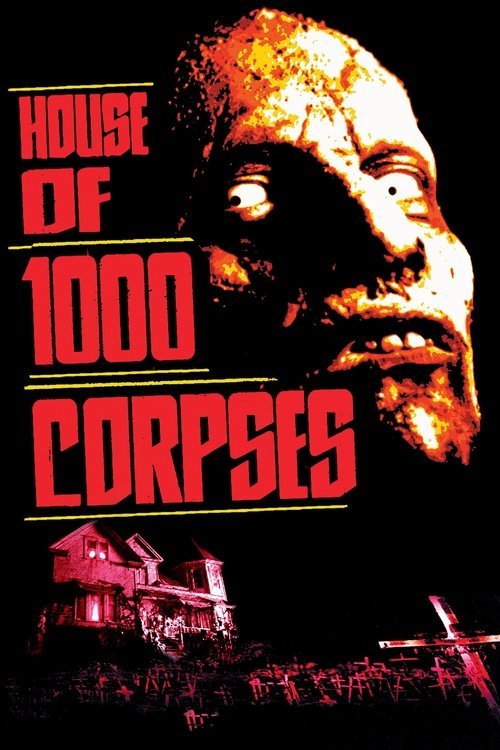
House of 1000 Corpses
2003 · Rob Zombie
For a late-October night when you want horror that feels like a dare — trashy, mean, and pure Halloween-attraction energy. This is a challenge watch, not a comfort watch; reach for it with friends and a strong stomach.
What it's about
Two young couples on a cross-country road trip, collecting roadside oddities and serial-killer legends for a book, make one wrong stop in the Texas backwoods and fall into the hands of the Firefly family — a clan of murderers who treat cruelty as home entertainment. What starts as a kitschy detour into a murder-ride tourist trap becomes a night of captivity in their funhouse of a farmhouse.
The experience
Loud, garish, and deliberately abrasive — it plays like a haunted-house ride crossed with a heavy-metal music video, cutting to grainy film stock and lurid color at will. Less scary than relentless: it wants to grind you down and gross you out, and it does both with a carnival grin.
Performances
Sid Haig's Captain Spaulding, a foul-mouthed clown running a murder-ride museum, became an instant horror icon, and Bill Moseley brings genuine menace to the family's ranting philosopher Otis.
The craft
Rob Zombie directs his debut like the musician he is: collaged film stocks, jump-cut montages, TV static, and lurid production design stuffed into every frame like a haunted attraction you can't leave. It's intentionally ugly-beautiful, channeling 1970s drive-in exploitation through a maximalist, sensory-overload filter.
Why it matters
Dismissed on release, it grew into a cult object and launched both the Firefly trilogy and Rob Zombie's second career as one of horror's most recognizable directorial voices, helping fuel the 2000s revival of grimy 1970s-style American horror.
Horror · Backwoods & survival · Exploitation & grindhouse · Splatter & gore. A garish, mean backwoods funhouse of a killer family: a 1970s grindhouse throwback played as a haunted-house ride, gore with a carnival grin.
Snapshot
House of 1000 Corpses is the feature directorial debut of musician Rob Zombie, a deliberately abrasive backwoods-horror throwback that filters the 1970s American exploitation film through the sensibility of a heavy-metal frontman raised on drive-in double bills, EC horror comics, and late-night monster movies. Nominally a road-horror tale — two young couples, driving cross-country and collecting oddball roadside attractions and serial-killer legends for a book, stumble into the orbit of the murderous Firefly family — the film is less a plot than a descent into a funhouse. Its reputation is bifurcated: dismissed on release as an incoherent, ugly student-film pastiche, it has since hardened into a cult object and, crucially, the origin point of the "Firefly trilogy" that Zombie would extend with the far better-received The Devil's Rejects (2005) and 3 from Hell (2019). It matters less as a self-contained artwork than as a statement of arrival — the moment a genre fan turned his encyclopedic love of grindhouse into an authorial position.
Industry & production
The film's tortured path to release is central to its history. Zombie shot the picture around 2000 under a production arrangement associated with Universal Pictures, which had a relationship with the musician. After viewing the finished film, the studio balked — the material was widely reported to be heading toward an NC-17 from the MPAA, and its content and tone were judged a liability for a major distributor. Universal severed ties. The project then reportedly circulated among other studios before being shelved for roughly three years, becoming something of a horror-fan cause célèbre during its limbo. It was ultimately acquired and released theatrically by Lions Gate Films in April 2003, a distributor then building its identity on transgressive genre fare.
The budget was modest by studio standards, and the film was shot economically. Against that low cost it performed respectably in theaters and found a durable second life on home video, where much of its cult following consolidated. In keeping with the instruction not to fabricate figures, precise budget and gross numbers should be treated as uncertain here; the safe generalization is that House of 1000 Corpses was inexpensive to make, turned a modest profit relative to that cost, and earned far more culturally than commercially. Its real return on investment was reputational: it established Zombie as a bankable horror brand and cleared the runway for its sequel.
Technology
Technically the film is a hybrid, and that hybridity is its signature. The principal photography is 35mm, but Zombie interlards the narrative with sequences shot or finished on degraded and alternate formats — grainy 16mm and Super 8-style inserts, video artifacts, still photography, and animated or collaged interstitials. These interruptions function like corrupted archival footage or a killer's home movies. The film was made at the tail end of the fully photochemical era for this budget tier, before digital intermediate finishing became standard for low-end genre pictures, and its look leans on in-camera and optical/lab-based degradation rather than the software grading that would soon make "grindhouse" texture a preset. The result reads as genuinely handmade grunge rather than the more polished faux-scratch aesthetic that Robert Rodriguez and Quentin Tarantino would systematize a few years later in Grindhouse (2007).
Technique
Cinematography
The photography (credited to a cinematography team reflecting the film's protracted, patchwork production — the record on exact camera credits is worth verifying against the film's titles) is aggressively unpretty: high-contrast, color-saturated, often lit in sickly reds and greens, with deliberate over- and under-exposure. Zombie favors the visual grammar of the carnival and the sideshow — spinning attractions, neon, tableaux vivants of the grotesque. Where a conventional thriller withholds, his camera gorges, staging violence and freakery as spectacle to be looked at. The interstitial footage supplies a second, degraded register of imagery that fractures the "clean" narrative photography, so the film never settles into a single stable image quality.
Editing
The editing is the film's most divisive tool. Rather than build suspense through continuity, Zombie and his cutters assemble a barrage: rapid intercutting of the narrative with the degraded inserts, freeze frames, negative-image flashes, title cards, and near-subliminal snatches of gore. The effect is closer to a music video or a nightmare collage than to classical horror pacing — unsurprising given Zombie's background directing his own promos. Detractors read this as chaos masking a thin story; admirers read it as a formal analog to the family's derangement. Either way, the cutting is a statement of method: the movie wants to feel like something a killer edited.
Mise-en-scène / staging
Production design is where the film is most confident. Captain Spaulding's roadside "Museum of Monsters and Madmen" — a fried-chicken-and-gas stop fronting a "Murder Ride" — establishes the tone: lurid Americana rotted from within. The Firefly homestead is dressed as an accretion of decades of junk, taxidermy, religious kitsch, and human remains, a hoarder's shrine to death. Zombie stages Halloween-season set pieces, masks, and theatrical reveals (the "Dr. Satan" mythology, the underground lair, the surgical grotesques) as a haunted attraction the viewer is dragged through. The staging privileges the tableau — carefully composed grotesque images held for the audience's horror and, uneasily, delight.
Sound
The soundtrack is a curated collision of eras. Period country, pop, and novelty records are set against Zombie's own industrial-metal-inflected score (co-composed with his longtime collaborator Scott Humphrey), plus distorted radio, carnival barking, and dense sound design. A recurring device is the ironic use of gentle vintage recordings under acts of violence — the friction between a soothing crooned tune and on-screen atrocity is one of Zombie's most characteristic effects and one his sequel would refine. The mix is loud, layered, and often deliberately unpleasant, of a piece with the visual assault.
Performance
Casting is the film's most enduring contribution. Sid Haig's Captain Spaulding — a foul-mouthed, clown-painted carnival barker — became an instant horror icon and arguably the franchise's mascot. Bill Moseley, already a genre fixture from The Texas Chainsaw Massacre 2, plays the sadistic Otis Driftwood with theatrical menace. Sheri Moon (later Sheri Moon Zombie), the director's wife, plays the giggling Baby, and the veteran actress Karen Black — a genuine New Hollywood presence — lends the ensemble a shot of legitimacy and camp gravity as Mother Firefly. The young "victims" (a cast including performers who would go on to broader recognition) are comparatively thin, by design: the movie's energy belongs entirely to its monsters, who perform at a pitch of vaudevillian excess.
Narrative & dramatic mode
Structurally the film is anti-conventional. It opens as a road picture with a metafictional hook — protagonists literally collecting the kind of lurid legends the film then delivers — and abandons that framework once the couples are captured, dissolving into episodic captivity, torture, and hallucination. There is little of the escalation-and-relief rhythm of the well-made slasher; instead the film offers a mounting, disorienting descent, punctuated by the family's monologues and "performances." The dramatic mode is closer to the carnival dark-ride than to the thriller: a series of shocks and grotesque tableaux strung on a thin narrative thread. This is both the film's boldest gesture and its most common critical liability.
Genre & cycle
House of 1000 Corpses sits at the head of the early-2000s revival of 1970s American backwoods and "family of killers" horror. It is openly a throwback — to The Texas Chain Saw Massacre, to hicksploitation and drive-in shockers — arriving at a moment when mainstream horror was dominated by the post-Scream self-aware slasher and the J-horror remake wave. Zombie's film pointedly rejects both irony-as-armor and glossy PG-13 spookiness in favor of grime. In hindsight it reads as a hinge: it anticipates the visceral, cruelty-forward horror ("torture"-inflected films such as Saw and Hostel) that would define the middle of the decade, and it belongs to the broader "grindhouse revival" cycle that would culminate in the Rodriguez/Tarantino Grindhouse project. It is also a prime specimen of the musician-turned-horror-auteur phenomenon.
Authorship & method
The film is unmistakably an author's work, for better and worse. Zombie writes, directs, and shapes the music, and imports his stage and music-video persona wholesale: the fixation on grindhouse iconography, sideshow grotesquerie, and 1970s Americana; the collage aesthetic; the industrial-metal soundscape. His method is that of a superfan-curator, assembling and remixing a lifetime of genre reference into a personal idiom — a strategy critics initially mistook for mere derivativeness and later reassessed as a genuine sensibility once The Devil's Rejects proved he could discipline it into character and consequence.
Key collaborators: composer Scott Humphrey, Zombie's frequent studio partner, co-authored the score and helped realize the dense sound world. Sid Haig, Bill Moseley, and Karen Black are effectively co-authors of the film's tone, importing decades of genre and New Hollywood association. Sheri Moon Zombie becomes the recurring on-screen avatar of the director's imagination across the trilogy. The cinematography and editing credits reflect the film's fractured, reshoot-and-shelf production history, and specific individual attributions there are best confirmed against the film's own titles rather than asserted from memory.
Movement / national cinema
This is thoroughly American independent horror, regional-gothic in flavor — its imaginative territory is the roadside attraction, the flyover backwoods, and the rot beneath small-town Halloween Americana. It participates in no organized "movement" in the art-cinema sense, but it is a keystone of an informal 2000s tendency: the nostalgic reconstruction of American exploitation cinema by filmmakers who grew up on it. Within that tendency Zombie is a purist, prizing texture and attitude over the wink.
Era / period
Made circa 2000 and released in 2003, the film is a product of the millennial transition in horror. Its shelving means it reached audiences slightly out of its moment, landing just as the genre's center of gravity was shifting toward extremity. Diegetically it is period-set — the iconography evokes the late 1970s, the era Zombie mythologizes — so the film is doubly retrospective: a turn-of-the-millennium production dreaming of the drive-in past. That double temporality is essential to reading it.
Themes
The film's governing theme is the American family as monster — the homestead not as refuge but as abattoir, kinship weaponized. Around that it circles several obsessions: the corruption of wholesome Americana (roadside diners, holidays, folk songs turned sinister); the carnival and the freak show as models for how the film itself displays horror to a paying audience; the folklore of the serial killer as national mythology, with the protagonists' legend-hunting implicating the viewer's own appetite; and the aestheticization of violence, staged as spectacle rather than moral problem. The film is generally uninterested in condemnation or catharsis; it wants to immerse, not to judge — a stance critics found nihilistic and admirers found honest.
Reception, canon & influence
On release the critical reception was predominantly hostile. Reviewers widely found the film incoherent, visually punishing, derivative of superior 1970s models, and more interested in style-as-assault than in character or story. It was frequently cited as a case of a music-video sensibility failing to sustain a feature. Yet it opened a durable cult constituency, especially among horror fans who prized exactly the qualities critics rejected — its grime, its abandon, its refusal of the era's slick irony.
Backward, its influences are worn openly: The Texas Chain Saw Massacre (1974) above all, alongside a broad inheritance of drive-in and hicksploitation horror, EC and monster-magazine comics, carnival and sideshow culture, and the visual language of Zombie's own music videos. Forward, its legacy is disproportionate to its initial reputation. It launched Rob Zombie as a working horror director and franchise author; its immediate sequel, The Devil's Rejects, retooled the same family into a leaner, far more critically respected road-crime picture and is often credited with retroactively validating the debut. It helped seed the grindhouse-revival aesthetic that the decade would elaborate, and it minted a genuine modern horror icon in Sid Haig's Captain Spaulding, a figure who long outlived the film's mixed notices in fandom, cosplay, and convention culture. As a canon entry, then, House of 1000 Corpses is remembered less as a great film than as a consequential one — the raw, unruly first draft of an authorial project that its maker would soon bring under control.
A Deleuzian reading
A fried-chicken stand on a Texas road.
The full Deleuzian reading of House of 1000 Corpses →
Reception
Dumped by critics in 2003 as music-video excess after years on the shelf, it's since been embraced as a garish cult favorite — the chaotic haunted-house-ride debut that launched the Firefly trilogy and Rob Zombie's whole filmmaking career.
How House of 1000 Corpses was received, from release to now →
How to watch House of 1000 Corpses: what to notice on a first viewing
- Watch the roadside museum staged like a carnival ride. Zombie dresses Spaulding's gas station and 'Murder Ride' as a lurid theme park attraction, all neon and tableaux, before the story ever leaves the road. The film announces upfront that horror here is something sold and watched for fun, not hidden.
- Notice the sickly red and green light soaking every room. Zombie lights scenes in high contrast, oversaturated reds and greens, with deliberate over and under exposure rather than naturalistic light. The color itself feels diseased, so the rot is visible before anything happens on screen.
- Watch for sudden freeze frames and bursts of grainy film. Zombie cuts degraded 16mm and Super 8 inserts, negative flashes, and title cards into the story like a corrupted home movie, breaking the clean image apart. The picture itself keeps failing to hold together, so the film never settles into a stable space to watch from.
- Watch Captain Spaulding perform for the camera, in full clown paint. Sid Haig plays Spaulding as pure showman, barking and mugging with theatrical relish, never dropping the act even in ordinary conversation. The monsters get all the performance's energy and swagger; the young travelers are written thin by comparison, on purpose.
- Listen for gentle old songs playing under the ugliest moments. Zombie repeatedly sets soothing vintage recordings against on screen violence, a friction between a crooned tune and what you're watching that he uses again and again. The mismatch between what you hear and what you see is the film's most calculated joke, and its cruelest one.
The whole guide to watching House of 1000 Corpses, with the keys for a rewatch →
Influences: the films it descends from and the films it influenced
- The Texas Chain Saw Massacre (1974) — Supplies the template Zombie restages wholesale: grain-choked 16mm degradation, a degenerate clan nested in a rotting rural house, and the dinner-table torment set piece as the film's terminal ordeal.
- Spider Baby (1967) — Models the murderous-cannibal-family-as-black-comedy tone and Sid Haig's grinning ghoul; Zombie imports the idiom literally by casting Haig as Captain Spaulding.
- Freaks (1932) — Establishes the sideshow-performer tableau and 'one of us' carnival grotesquerie that Zombie recycles in Spaulding's museum-of-monsters and the film's freakshow staging.
- Two Thousand Maniacs! (1964) — Originates the roadside-trap plot in which travelers are lured into a Southern festival of gore, plus H.G. Lewis's garish primary-color splatter aesthetic.
- The Hills Have Eyes (1977) — Provides the stranded-travelers-hunted-by-a-degenerate-clan predator/prey structure that the Firefly family inherits.
- The Last House on the Left (1972) — Bequeaths the hicksploitation grime and documentary-raw brutality of captured youths, the drive-in nastiness Zombie prizes over slick irony.
- Natural Born Killers (1994) — Direct source for the mixed-format collage editing — abrupt film-stock switches, back-projection, interpolated found footage — that becomes Zombie's music-video montage grammar.
- Creepshow (1982) — Models the EC/monster-magazine comic framing with saturated colored-gel lighting that informs the film's high-contrast palette and the 'Dr. Satan' comic-book iconography.
- Faster, Pussycat! Kill! Kill! (1965) — Sets the precedent for high-contrast desert-pulp compositions and vaudevillian, oversized performance excess pushed past realism into camp menace.
- The Funhouse (1981) — Zombie's 'Murder Ride' roadside attraction and its showman host Captain Spaulding update Hooper's barker-run dark ride as the gateway to a murderous family.
- The Texas Chainsaw Massacre Part 2 (1986) — Zombie cast Bill Moseley as Otis because of Chop Top and rebuilt Part 2's design: a garish roadside murder-ride attraction, saturated carnival lighting, and a comic cannibal family run as a business.
- The House by the Cemetery (1981) — Dr. Satan, the deformed surgeon in tunnels beneath a house who keeps himself alive through experiments on victims, is an open homage to Freudstein and his cellar of harvested bodies.
- The Devil's Rejects (2005) — Retools the same Firefly family into a sun-blasted 70s road-crime picture, disciplining the collage assault into character and consequence while keeping the hicksploitation texture.
- Halloween (2007) — Extends Zombie's white-trash-realist authorship — grimy backstory naturalism and industrial-scored dread — applied to an inherited slasher franchise.
- 3 from Hell (2019) — Completes the Firefly trilogy, continuing the vaudevillian-grotesque ensemble performance and grindhouse iconography seeded in the debut.
- Terrifier (2016) — Builds a modern horror icon (Art the Clown) on the same sideshow-grotesque showmanship that made Captain Spaulding a cult figure, carnival menace as brand.
- The Texas Chainsaw Massacre (2003) — A same-year glossy remake of Zombie's chief ancestor, part of the millennial grindhouse-revival wave reprocessing 70s backwoods horror for multiplex audiences.
- Wrong Turn (2003) — Contemporaneous revival of the inbred-cannibal-clan-in-the-woods premise, extending the same backwoods-horror lineage in the same release window.
- Planet Terror (2007) — Elaborates the grindhouse-revival aesthetic of simulated print damage, missing reels, and photochemical degradation deployed as deliberate style.
- 2001 Maniacs (2005) — Direct remake of Two Thousand Maniacs that revives carnival-of-death hicksploitation gore for the 2000s, sharing the festival-trap staging Zombie also draws from.
Similar films
- The Texas Chain Saw Massacre (1974) — influence & lineage · same viewing thread
- Evil Dead Rise (2023) — same viewing thread
- X (2022) — same viewing thread
- The Cabin in the Woods (2012) — same viewing thread
- Evil Dead (2013) — same viewing thread
- Mandy (2018) — same viewing thread
- Final Destination Bloodlines (2025) — same viewing thread
- Malignant (2021) — same viewing thread
All the films related to House of 1000 Corpses →
Watch it with: curated runs of related films
- Blood by the Bucketload — A run of horror that treats gore as showmanship: elaborate death set-pieces, practical effects by the gallon, and the giddy, squirming fun of watching it with a crowd, from Jigsaw's traps and Final Destination's chain reactions to Ready or Not's wedding-night bloodbath and The Substance's body-horror finale.
- Out Past the Last Gas Station — A run of films about people who go somewhere remote (woods, caves, a quarry lake, a backwoods club, an island, the frontier) and find that the usual rules stop applying out there. Watched near each other, they show the 'city folk take a wrong turn' story played as dread, as Western, as revenge and as a joke on itself.
- The Grindhouse and Its Heirs — A run from the 70s–80s drive-in and 42nd Street originals (Texas Chain Saw, Maniac, Basket Case, Chopping Mall, Near Dark) to the filmmakers who grew up on them and rebuilt their grime, roadside dread and gleeful excess (Rodriguez, Zombie, Ti West, Cosmatos, Mollner, Leone). Watched near each other, the lineage plays…