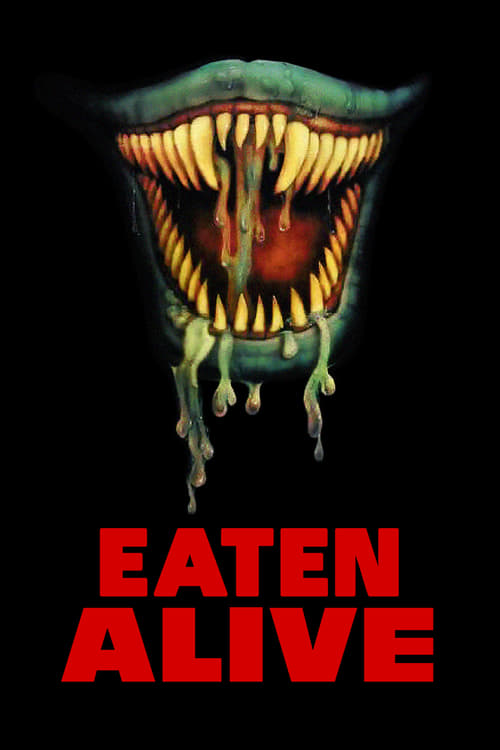
Eaten Alive
1976 · Tobe Hooper
For when you're craving the deep end of 1970s grindhouse — something sweaty, lurid, and unwholesome to watch late at night, ideally with a strong stomach. This is a challenge watch, not comfort food.
What it's about
At the rotting Starlight Hotel deep in rural East Texas, the mumbling, unhinged proprietor Judd greets his guests with a scythe and feeds what's left of them to the enormous crocodile living in the swamp off his porch. Over one long night, a runaway, a fraying family, and a father searching for his missing daughter all check in. Nobody's stay goes well.
The experience
Feverish and claustrophobic — the whole thing unfolds on a soundstage swamp drenched in red and blue light and fake fog, so it feels like a nightmare staged inside a carnival haunted house. It's sleazy, loud, and relentless, less a story than a sustained attack of grimy Southern-gothic delirium.
Performances
Neville Brand is unforgettable as Judd, muttering and lurching through the film with a scrambled menace that feels genuinely off; a young Robert Englund also turns up as a local lout, years before horror stardom.
The craft
Tobe Hooper swaps the documentary grit of his debut for total artifice: a hand-built swamp, saturated colored lighting, and a droning, oppressive soundscape that never lets the tension drain. The deliberate fakeness is the point — it turns backwoods horror into something theatrical and hallucinatory, and it looks remarkable in a good restoration.
Why it matters
Hooper's notorious follow-up to his Texas breakthrough, it landed on Britain's banned 'video nasty' list and became a cult object for fans of grindhouse excess — a key specimen of the killer-hillbilly and animal-attack cycles of the seventies.
Snapshot
Eaten Alive was Tobe Hooper's first feature after The Texas Chain Saw Massacre (1974), and it is a deliberately strange follow-up. Where Chain Saw was shot on location in the Texas heat with a documentary-like grain, Eaten Alive was shot almost entirely on a Los Angeles soundstage. Its swamp, its run-down Starlight Hotel and its night sky are all built sets, lit in saturated reds and blues and filled with artificial fog. The plot is close to an anecdote. Judd (Neville Brand), the hotel's mumbling, unstable proprietor, kills the guests and visitors who wander onto his property, armed with a scythe, and feeds them to a large crocodile kept in the pond beside the porch. A runaway prostitute, an unravelling family, a father and sister searching for a lost daughter, and a local hellraiser all pass through in the course of one long night.
The film has been released under several titles, including Death Trap, Starlight Slaughter, Legend of the Bayou and Horror Hotel, and that alone shows how unsettled its commercial identity was. For a long time it was treated as a minor, compromised work: proof that Hooper could not repeat Chain Saw. Later criticism has been kinder. It now tends to read the film as a conscious move away from naturalism into artificial, theatrical, almost comic-book grotesque, and as an early sign of the style Hooper refined in The Funhouse (1981). It sits where the 1970s American regional horror film meets the drive-in exploitation picture, and it is a useful case study in how an independent director's second film gets shaped by producers, budgets and the pressure to deliver a known commodity.
Industry & production
The film was produced by Mardi Rustam's Mars Productions. Rustam is also credited as a co-writer, alongside Kim Henkel, Hooper's co-writer on Chain Saw, and Alvin L. Fast. It came out of the independent exploitation economy of the mid-1970s. Chain Saw's commercial success had made Hooper and Henkel bankable on a small scale, and producers wanted a follow-up that traded on the same Texas-grotesque setup.
Two production decisions matter most. First, the film was made on soundstages in Los Angeles rather than on location in Texas. It is usually said to have been shot at what is now Raleigh Studios. The swamp, the hotel exterior and the surrounding woods were all constructed indoors. Second, the cast mixed young or genre performers with Hollywood veterans whose careers had moved into lower-budget work: Neville Brand, Mel Ferrer, Carolyn Jones (best known to television audiences as Morticia Addams) and Stuart Whitman. Mixing name actors from older Hollywood with unknowns was a standard exploitation strategy. Recognisable names could be put on posters and sold to distributors and foreign buyers.
Accounts from participants indicate that the production was difficult and that Hooper's relationship with the producers was strained. Several retrospective sources report that Hooper was not present for the very end of the shoot or for all of post-production. The documentary record on how much of the final cut reflects his intentions is thin and partly anecdotal, so it should be treated with caution. What is clear is that the film was then sold under multiple titles to different markets, which suggests distributors were unsure how to position it.
In Britain the film, as Death Trap, was caught up in the early-1980s "video nasties" panic and appeared on the Director of Public Prosecutions' list of prosecutable videocassettes. That history gave it a notoriety in the UK that went well beyond its original theatrical profile.
Technology
Eaten Alive used conventional mid-1970s low-budget 35mm production methods. What sets it apart is that it chose studio artifice over the lightweight location shooting that defined Chain Saw and much of the American independent horror around it.
The soundstage made possible the film's most distinctive technical feature: lighting design that makes no attempt at realism. Gelled light in deep red, magenta and blue floods the exteriors. Fog machines fill the space, and the painted or constructed backgrounds stay visibly theatrical. The crocodile is a mechanical prop, used sparingly and mostly in partial views: a snout, a splash, a lunge out of murky water. Like many creature effects of the period, it was built for suggestion more than sustained exposure, and the editing and lighting work hard to hide its limits.
The makeup and gore effects are modest by later standards. The film relies more on implication, screaming and the steady threat of the scythe than on elaborate prosthetic work.
Technique
Cinematography
Robert Caramico photographed the film. He later worked extensively in television. His images are defined by colour and enclosure. The palette is saturated and expressionistic, with the swamp exteriors bathed in red light suggesting a world lit by a permanent neon sign or an infernal glow. Interiors in the hotel are cramped, tawdry and shadowed.
The camera often holds characters inside the hotel's small spaces (the reception desk, narrow rooms, the porch) so that the geography feels claustrophobic even outdoors. Because the "outside" is itself a set, the film never offers the open horizon that Chain Saw repeatedly uses. Everything feels sealed.
Critics have often linked the lighting to Italian horror of the period, particularly the coloured gels of Mario Bava and the early work of Dario Argento. That is a critical comparison, not a documented influence claimed by the filmmakers, but the visual kinship is striking within American horror of 1976.
Editing
The editing favours abrupt, shock-driven cutting during attacks: the scythe swinging into frame, the crocodile surging up, bodies dragged toward the water. Hooper and his team carry over from Chain Saw a taste for sustained, exhausting stretches of screaming and pursuit, especially the long sequences in which a captive is tied up under the hotel and the camera keeps returning to her ordeal.
Unlike Chain Saw's rising, almost musical structure, the overall rhythm of Eaten Alive is episodic. Characters arrive in sequence, each storyline is cut into Judd's derangement, and the film keeps several parallel threads going until they converge in a final melee. Some critics find this structure diffuse. Others see it as a deliberate night-long portrait of a place, not a single line of suspense. Given the reports of a troubled post-production, it is hard to say how much of the final shape was planned.
Mise-en-scène / staging
The Starlight Hotel is the film's central achievement and its main expressive tool. It is a dilapidated roadside establishment with moth-eaten fixtures, a stuffed monkey, peeling surfaces and a general air of rot. It stands next to a stagnant pond the audience is told holds a crocodile. The film builds its unease from the closeness of the ordinary and the monstrous. The registration desk sits a few steps from the water where bodies are disposed of.
The staging is theatrical, at times deliberately so. Characters often perform within a confined, stage-like playing area. The soundstage swamp lets Hooper control fog, light and space so precisely that the setting comes to feel like a dream, or an outdoor horror attraction. That carnivalesque quality looks ahead to The Funhouse.
Hooper also stages domestic horror alongside the slasher material. A family of three arrives: a father on the edge of breakdown, a mother and a small girl whose dog has been eaten. Their scenes mix pathos, grotesquerie and dark comedy.
Sound
The score is credited to Tobe Hooper and Wayne Bell. Bell had worked with Hooper on the sound and music of Chain Saw. As in that film, the soundtrack blurs the line between music and noise, using unsettling textures, dissonant tones and a constant layer of ambient discomfort.
A notable element is the diegetic country music that plays from a radio in the hotel. It is a cheerful, mundane counterpoint to the violence, and it fixes the setting as rural Texas despite the obviously artificial look. Judd's own vocal performance (mutterings, half-formed sentences, sudden shouts) works almost as part of the sound design, a running stream of disorder. The film is also loud with screaming, especially from the women held captive, which some critics have found deliberately abrasive and others merely relentless.
Performance
Neville Brand anchors the film as Judd. Brand was a decorated Second World War veteran and a character actor who often played heavies in 1950s and 1960s Hollywood. Here he gives an unhinged, mumbling, tic-ridden performance that keeps Judd at the edge of coherence. Judd is less a calculating villain than a man consumed by private grievance and dislocation. Critics have described the performance as either powerful or overpitched, but rarely as forgettable.
The supporting cast deliberately mixes registers. Mel Ferrer and Carolyn Jones bring a faded Hollywood polish to small roles. Jones plays the madam of a local brothel in a jarringly stylised manner. Marilyn Burns, the surviving heroine of Chain Saw, returns as Faye, a wife and mother who spends much of the film bound and terrorised, an echo of her earlier screen ordeal. William Finley, known for Brian De Palma's Phantom of the Paradise (1974), gives an erratic, physically twitchy turn as Faye's husband Roy.
A young Robert Englund plays Buck, a crude local who introduces himself with a vulgar line ("My name's Buck, and I'm rarin' to fuck") that has become one of the film's most quoted moments. The line is especially notable given Englund's later stardom as Freddy Krueger in A Nightmare on Elm Street (1984). Stuart Whitman plays the sheriff, and Kyle Richards plays the young daughter.
Narrative & dramatic mode
The narrative is loose, episodic and night-bound. It opens with a young prostitute who has fled a brothel and ends up at the Starlight Hotel, where Judd kills her. A sequence of other arrivals follows. A couple and their daughter stop at the hotel after their dog is devoured. A father and his surviving daughter come looking for the missing girl. Buck brings a young woman to the hotel. The local sheriff is drawn in. All of these strands converge as Judd's violence escalates.
The dramatic mode is a mix of grotesque melodrama and black comedy, sometimes close to farce. Characters behave erratically, scenes swing between shrill terror and absurdity, and the storytelling is closer to a lurid tableau than to tightly plotted suspense. The film has the structure of a campfire tale or local legend: a place where people go in and do not come out, given a night of escalating mayhem. It is less interested in investigation or psychology than in the atmosphere of a festering, isolated institution.
Genre & cycle
Eaten Alive sits at the crossroads of several 1970s horror strands:
- The rural or backwoods horror film. It belongs to the strand of American horror that cast rural America, especially the South and Southwest, as a site of decay, violence and isolation. It is a direct descendant of Chain Saw, and kin to films like The Hills Have Eyes (1977) and the many lesser regional horror productions of the decade.
- The "psycho" motel or roadside horror. The isolated hotel run by a disturbed proprietor inevitably recalls Psycho (1960), and critics routinely place Eaten Alive in that lineage. Like Norman Bates, Judd runs an off-highway lodging that becomes a trap.
- The animal-attack film. The killer crocodile links it, loosely, to the 1970s cycle of nature-attack films that followed Jaws (1975). The crocodile here, though, is more an extension of Judd's madness than an independent menace.
- The drive-in exploitation picture. The film's nudity, sexual content, violence and marketable cast place it firmly in the exploitation economy.
It arrived before the American slasher cycle crystallised around Halloween (1978) and Friday the 13th (1980). Some of its elements, such as a disturbed killer with a signature weapon and a run of victims dispatched over a single night, anticipate that cycle without fully belonging to it.
Authorship & method
Tobe Hooper (director, co-composer). Hooper came to features from documentary and commercial work in Austin, Texas. Eaten Alive shows him pursuing stylisation over the docudrama texture that made Chain Saw famous. Its recurring Hooper concerns include the grotesque family and the decaying household, the closeness of comedy and horror, women held captive in extended scenes of terror, and the idea of a place (house, hotel, funhouse) that is itself monstrous. Because of the reported conflicts with producers and his uncertain involvement in post-production, critics often hesitate to read the finished film as a pure expression of his intentions. Even so, many recurring stylistic choices fit his later work.
Kim Henkel (co-writer). Henkel co-wrote Chain Saw with Hooper. His involvement provides continuity in the Texas-gothic sensibility and the dark humour, though it is not clear from the public record which contributions are his and which came from Rustam and Fast.
Mardi Rustam (producer, co-writer) and Alvin L. Fast (co-writer). Rustam's Mars Productions financed and steered the project. His role as both producer and credited writer suggests a strong commercial hand in shaping the film.
Robert Caramico (cinematographer). Caramico's colour-saturated, enclosed photography is central to the film's identity, and he deserves substantial credit for its look.
Wayne Bell (co-composer). Bell's collaboration with Hooper carries the experimental sound design of Chain Saw into a different setting.
Editing. Detailed documentation of the editor's specific role and working method is not readily available in the critical record.
The film is also often read through the true-crime story of Joe Ball, a Texas tavern owner of the 1930s who was alleged to have fed victims to alligators he kept on his property. Retrospective accounts commonly cite Ball as a loose inspiration. As with Chain Saw's loose debt to Ed Gein, the film transforms the source material rather than dramatising it.
Movement / national cinema
Eaten Alive belongs to the American independent and exploitation cinema of the 1970s. That cinema flourished outside the major studios, made films cheaply for drive-ins, grindhouses and international markets, and gave directors like Hooper, Wes Craven, John Carpenter and George A. Romero room to develop personal styles within commercial genres.
More specifically, it is part of the Texas and Southern strand of that cinema. Regional filmmakers turned the rural South and Southwest into a horror landscape that drew on gothic tradition, local legend and post-Vietnam anxieties about violence and social breakdown. Its Los Angeles soundstage production makes it a hybrid: a Texas story made in Hollywood conditions, and a regional film shot by people working within Hollywood's low-budget periphery.
Its visual style also invites comparison with European horror of the 1960s and 1970s, especially Italian gothic and giallo cinema with their expressive use of colour. As already noted, that is a critical observation, not a documented line of influence.
Era / period
The film was made in the mid-1970s, a period of upheaval in American cinema and society. The New Hollywood had legitimised darker, more violent and more morally ambiguous filmmaking, while the exploitation sector pushed explicit sex and violence to new extremes. Audiences had grown used to horror films that rejected the reassurances of older studio genre pictures. Night of the Living Dead (1968), The Last House on the Left (1972) and Chain Saw had changed what horror could show and imply.
The era's broader cultural moment includes the aftermath of Vietnam, the Watergate period and widespread anxiety about institutions and the family. Critics have often read 1970s American horror as a response to these pressures, and Eaten Alive's depiction of fractured families, transient people and decaying rural institutions fits that critical frame. Its release came just before the great commercial horror boom of the late 1970s and early 1980s, which it partly anticipates.
Themes
- The monstrous place. The Starlight Hotel functions as a living organism of decay, a trap where hospitality turns into predation. The film links Hooper's earlier and later interest in houses and attractions that consume their occupants.
- Rural decay and isolation. The film presents the backwoods South as a place of stagnation, poverty and buried violence, cut off from the modern world and from law and order.
- Masculine breakdown. Judd, Roy and Buck are each examples of male aggression, instability or crude sexual entitlement. The film's men are often unravelling, violent or absurd.
- Women as captives and survivors. The film repeatedly places women in situations of entrapment and terror. Critics have both questioned and defended the long scenes of female suffering.
- The fractured family. Faye, Roy and their daughter arrive already fractured. The film's interest in dysfunctional households continues the domestic-horror concerns of Chain Saw.
- Sex and commerce. The brothel, the prostitute fleeing it and the sexual crudeness of several characters tie violence to transactional, degraded sexuality.
- Animal and human predation. The crocodile serves as a literal and figurative extension of Judd's appetite for violence, collapsing the line between human and animal predator.
Reception, canon & influence
Critical reception. On release, Eaten Alive was generally received as a disappointing or minor follow-up to Chain Saw. Critics who admired Hooper's first film tended to find this one cruder, more chaotic and less coherent, and its marketing under multiple titles did not help it build a stable reputation. In Britain, its place on the video nasties list gave it notoriety more than critical attention.
Later reappraisal, aided by home-video releases and by growing critical interest in Hooper's whole career, has been more generous. Many writers now emphasise the film's audacious artificiality, its lighting, its unhinged lead performance and its place as a bridge between Chain Saw and The Funhouse. It is still divisive. Some value it as a cult object of considerable stylistic interest; others see a messy, uneven exploitation picture.
Influences on the film (backward).
- Psycho (1960), for the isolated lodging run by a disturbed proprietor.
- The Texas Chain Saw Massacre (1974): Hooper's own earlier work, its rural-gothic sensibility and several of its key collaborators.
- The true-crime legend of Joe Ball, frequently cited as a loose inspiration.
- The broader traditions of Southern gothic fiction and regional folklore.
- By critical comparison, not documented influence, the colour-saturated style of Italian horror.
Legacy (forward).
- Hooper's own work. The film's studio-bound artifice and carnival grotesquerie point directly toward The Funhouse (1981).
- Robert Englund. The film is often noted as an early role for Englund before A Nightmare on Elm Street.
- Quentin Tarantino. In Kill Bill: Vol. 1 (2003), a character named Buck delivers a near-verbatim variant of Englund's line, a frequently noted homage.
- Rob Zombie. Critics have often traced a debt in House of 1000 Corpses (2003), with its lurid colour, roadside grotesquerie and backwoods-murder setting.
- Later backwoods and hotel-of-horrors films. It belongs to a broader lineage in which isolated lodgings and swampland become sites of slaughter, though direct lines of influence beyond those noted above are hard to document.
Eaten Alive now holds a secure if modest place in the canon of 1970s American horror. It is studied less as a masterpiece than as a revealing transitional work: a director's attempt to redefine his style under commercial pressure, and an early example of horror that finds its terror in an openly artificial, painted world.
Influences: the films it descends from and the films it influenced
- Psycho (1960) — Gives Hooper his template of the isolated roadside lodging run by a disturbed proprietor, where the reception desk and guest rooms become the killing floor and the building itself is the monster.
- The Texas Chain Saw Massacre (1974) — Hands on its core team (co-writer Kim Henkel, Wayne Bell's sound work, Marilyn Burns as the captive woman) and its method of drawn-out scenes of a bound woman screaming, now moved from documentary-style location shooting onto a soundstage.
- Blood and Black Lace (1964) — Sets the precedent for lighting horror with strong red, green and magenta gels that have nothing to do with realistic light sources, which is the look Robert Caramico gives the Starlight Hotel set (critics draw this link, but it isn't documented as an influence).
- Two Thousand Maniacs! (1964) — Starts the Southern exploitation mode where yokel murderers play gore as hick comedy with a country-tinged soundtrack, the mix of slapstick and slaughter that Neville Brand's Judd carries on.
- Spider Baby (1967) — Shows how to cast a fading Hollywood name (Lon Chaney Jr.) among a degenerate household in a crumbling house and play the result as grotesque black comedy, the same strategy Eaten Alive uses with Carolyn Jones and Mel Ferrer.
- Hush... Hush, Sweet Charlotte (1964) — Sets up the 'hagsploitation' Southern Gothic, where studio-era stars play decayed, grotesque versions of themselves on a sound stage, which Hooper follows in Carolyn Jones's ruined brothel madam.
- Jaws (1975) — Its full-scale mechanical shark makes an animatronic animal a selling point, and Hooper's hydraulic crocodile in a studio tank is a low-budget answer to it, shot in brief glimpses because the prop barely worked.
- Motel Hell (1980) — Takes the rural-motel-owner-as-killer premise and the deadpan grotesque comedy straight on, with an old Hollywood character actor (Rory Calhoun) running the slaughterhouse inn.
- Alligator (1980) — Carries on the man-eating crocodilian exploitation picture, built around a full-size mechanical alligator and quick cutting to hide how stiff the prop is.
- The Funhouse (1981) — Hooper returns to a single garish, artificially lit fairground set at night, with the carnivalesque grotesquerie and monstrous-place staging Eaten Alive first tried.
- A Nightmare on Elm Street (1984) — Robert Englund turns the sleazy, motor-mouthed menace of his early role as Buck into Freddy Krueger, a slasher villain who mixes threat with leering jokes.
- The Texas Chainsaw Massacre 2 (1986) — Moves the Chain Saw family into a lurid, gel-lit, built-on-the-soundstage underground lair and plays the horror as broad grotesque comedy, finishing the turn from docudrama to stylisation that Eaten Alive started.
- Kill Bill: Vol. 1 (2003) — Has a sleazy hospital orderly named Buck deliver a near-word-for-word version of Englund's opening line, a well-known nod to the film's exploitation-cinema voice.
- House of 1000 Corpses (2003) — Copies its look of saturated-gel colour, a roadside attraction run by a grotesque showman, and backwoods murder staged as a carnival funhouse on obviously artificial sets.
- Crawl (2019) — Brings back the confined, rising-water fight with alligators under a single isolated house, using the tight enclosure and swamp-reptile threat of Hooper's flooded crocodile pit.
- The Texas Chainsaw Massacre Part 2 (1986) — Hooper's first try at a soundstage-bound, red-and-green gelled rural grotesque is the template for Part 2's artificial, carnival-colour lighting, which drops the 1974 film's documentary daylight.
- Suspiria (1977) — Made almost alongside it, Suspiria pushes the same idea of a fully artificial set flooded with primary colour to the limit, the kinship critics see between Hooper and Bava/Argento.
- Tourist Trap (1979) — Another remote roadside business run by an unhinged, folksy proprietor (Chuck Connors, a TV-era star cast against type) who picks off travellers inside a cluttered, theatrical, mannequin-filled set.
Similar films
- The Texas Chain Saw Massacre (1974) — influence & lineage
- House of 1000 Corpses (2003) — influence & lineage
- The Funhouse (1981) — influence & lineage
- The Texas Chainsaw Massacre Part 2 (1986) — shared sensibility
- The Beyond (1981) — shared sensibility
- When Evil Lurks (2023) — shared sensibility
- Near Dark (1987) — shared sensibility
- Castle Freak (1996) — shared sensibility