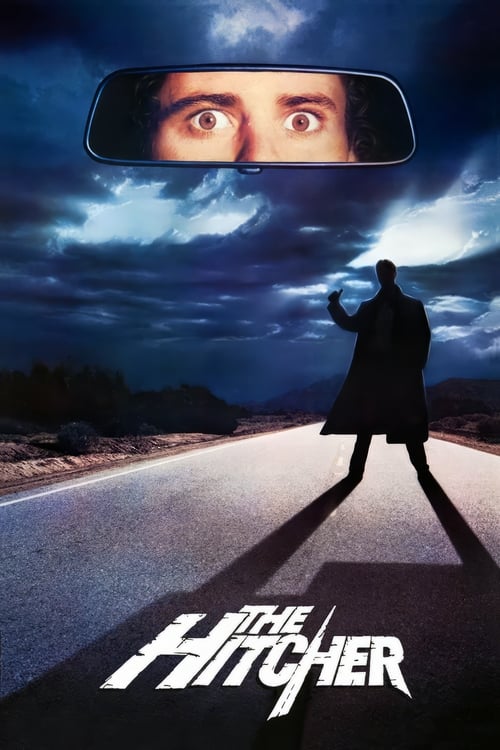
The Hitcher
1986 · Robert Harmon
For when you want pure white-knuckle suspense — a one-sitting, lights-off thriller that grabs early and squeezes. Choose it when you're up for something harsh and stark, not a comfort watch.
What it's about
A young man ferrying a car from Chicago to California picks up a hitchhiker on a rain-black desert highway, hoping conversation will keep him awake. The stranger turns out to be a killer of almost mythic patience, who spends the rest of the drive hunting him, framing him for his own murders, and turning the empty Southwest into a trap with no witnesses and no way out.
The experience
Lean, relentless, and genuinely frightening — a chase film pared down to two men, a highway, and the horizon. It plays like a nightmare with the logic of one: escape routes keep dissolving, and the tension barely lets you exhale.
Performances
Rutger Hauer is the whole dark heart of the film: still, soft-spoken, and terrifying, playing the killer as something closer to a force of nature than a man. C. Thomas Howell charts a convincing collapse from boyish innocence into desperation.
The craft
Eric Red's script strips the chase thriller to its bones, and Robert Harmon shoots the desert in widescreen like a Western — vast, beautiful, and indifferent, with the violence mostly kept just off-frame where imagination does the damage. The highway photography alone makes it worth a big screen.
Why it matters
Dismissed by critics on release as nihilistic, it was rebuilt into a cult classic by video and cable, and its unstoppable, unexplained highway predator became a template for road thrillers ever after.
Snapshot
The Hitcher is a stripped-down road thriller. A young man driving a car across the American Southwest picks up a hitchhiker who turns out to be a near-mythic killer. The killer then spends the rest of the film hunting him, framing him and, in a strange way, schooling him. It was directed by Robert Harmon in his feature debut, from the first produced screenplay by Eric Red. Rutger Hauer plays John Ryder, C. Thomas Howell plays Jim Halsey, and Jennifer Jason Leigh plays Nash, a truck-stop waitress. The film combines the slasher's relentless antagonist, the chase mechanics of the action film, and the open spaces and moral starkness of the Western.
Many critics, most famously Roger Ebert, condemned it on release as nihilistic and repugnant, and it was not a significant theatrical success. Home video and cable later turned it into a cult object. Its standing now rests on Hauer's performance, on John Seale's widescreen desert photography, and on the film's refusal to explain Ryder at all. He has no backstory, no stated motive, and the film keeps hinting that he wants to be stopped. The film shaped the "highway terror" thriller of the following two decades. It produced a direct-to-video sequel (2003) and a studio remake (2007).
Industry & production
The film came out of the mid-1980s mid-budget genre market, when studios and new financing entities were backing modestly priced thrillers and horror films for both theaters and the growing video and pay-cable market. TriStar Pictures released it in February 1986. It is commonly credited as a co-production involving HBO Pictures and Silver Screen Partners, the financing vehicles that supplied product to TriStar and HBO in this period. The producers were David Bombyk and Kip Ohman, with Edward S. Feldman and Charles R. Meeker among the executive producers.
Eric Red has said in interviews that the script grew from the Doors song "Riders on the Storm," whose lyrics describe a killer on the road. He reportedly developed the idea while driving across the country himself. Harmon was a former stills photographer who had drawn attention with China Lake (1983), a short about a violent highway patrolman. That short is generally cited as the calling card that got him the job. Hauer was cast after his European work with Paul Verhoeven and his international breakthrough as Roy Batty in Blade Runner (1982). Howell was a rising teen lead after The Outsiders (1983) and Red Dawn (1984).
The film was shot on location in desert landscapes of the American Southwest. Published accounts of the exact locations differ, and this dossier does not specify them. The production was not lavish, but it staged a number of vehicle stunts, crashes and explosions on a scale usually found in bigger action films. Its theatrical gross was modest. Its reputation was built afterward, chiefly through VHS rental and cable showings.
Technology
The Hitcher is a 35mm anamorphic widescreen production (2.35:1). That format matters to its effect: the horizon becomes the main compositional element, and cars, figures and roadside buildings sit small against it. The action work uses the practical tools of the period: stunt driving, camera cars, full-scale vehicle crashes, pyrotechnic explosions and a helicopter sequence. There is no optical spectacle to speak of. The film's force comes from real objects in real landscapes.
Mark Isham's score relies heavily on synthesizers, as many mid-1980s scores did, and that matched the economics of a mid-budget production. Isham turned the instrument's sustained, airless textures into an atmosphere of desolation rather than using it for pulse-driven action cues. The film's later life depended on home-video technology. Its cult was made partly by the pan-and-scan VHS era, which cropped Seale's compositions, and later widescreen video and disc releases restored the original framing.
Technique
Cinematography
The Australian cinematographer John Seale had just shot Peter Weir's Witness (1985). His work here is the film's most praised element. He shoots the desert at the edges of the day: dawn, dusk, storm light and deep night lit by headlights. The opening rainstorm, in which Halsey stops for Ryder, is rendered in blue-black darkness broken by headlight glare and windscreen rain. It establishes the film's way of seeing: a small lit space, the car interior, surrounded by darkness it cannot penetrate.
In daylight, Seale lets the widescreen frame flatten the landscape into bands of sky, mountain and road, which gives the film its Western iconography. He often places Ryder at a distance or framed against the horizon. The killer appears as a figure in the landscape before he becomes a character. Low sun, lens flare and dust make the light itself seem hostile.
Editing
Frank J. Urioste edited the film. He later cut RoboCop (1987) and Die Hard (1988) and was already an experienced action editor. The cutting is economical: the film runs well under two hours and moves almost entirely by escalation. The vehicle set pieces are built through clear spatial cutting, and the film is largely free of the fragmented style of later action cinema.
The editing is equally notable for what it withholds. Ryder's appearances are often elliptical. He is simply there: in the back of a family's station wagon, in a police car, in a motel room. The cuts make his presence feel like a materialization. Several of his worst acts happen off screen or are conveyed through aftermath, so the audience's imagination does the work.
Mise-en-scène / staging
The film's world is reduced to a few elements: the road, the car, the diner or gas station, the motel and the police station. These are the places of American transit, and they are staged as almost empty, with the people in them tired, suspicious or vulnerable. Ryder's costume, a long dark coat, recalls the Western drifter and the noir heavy without fully becoming either.
Several staged images became the film's best-known moments. One is the severed finger Halsey finds in his diner food. Another is the confrontation in which Nash is bound between a truck cab and a trailer, with Ryder controlling the truck while Halsey is forced to watch. A third is the gun Ryder hands Halsey that turns out to be empty. These are moral traps as much as shocks. Each puts Halsey, and the viewer, in the position of witness or accomplice.
Sound
Isham's score favors drones, sustained synthetic tones and sparse melodic phrases over conventional suspense stingers, giving the desert a haunted emptiness. The sound design leans on the physical noise of the road: engines, tires, rain, wind and the metallic violence of crashes. These are set against long stretches of near-silence. Ryder speaks rarely, and his soft, unhurried voice is itself a sound effect, a calm that makes the violence around it feel more arbitrary.
Performance
Hauer's John Ryder is the film's center and the main reason it lasts. He plays the role with stillness, mild amusement and a peculiar tenderness toward his victim. He is threatening without raving. His early line to Halsey, delivered after Halsey asks what he wants, has become a signature, and his willingness to let the character seem tired, even wistful, gives him a strange depth. Critics have compared the role with Roy Batty: another doomed, eloquent antagonist who seems to want something from the hero that violence alone cannot provide.
Howell plays Halsey as an ordinary, frightened young man, and the role's arc is a hardening. By the end, Halsey has taken on some of Ryder's coldness. Leigh's Nash is underwritten but grounded, and her fate is the film's harshest moment. Jeffrey DeMunn plays the police captain who comes to believe Halsey, and he gives the institutional world a voice of weary decency.
Narrative & dramatic mode
The narrative is linear and episodic, organized as a pursuit. After the opening encounter, in which Halsey forces Ryder out of the car, the story becomes a series of meetings on the road. Ryder kills, plants evidence and frames Halsey. The police become a second pursuer, and Halsey becomes a fugitive. The structure is close to a nightmare's: causality is loose, Ryder's movements are physically implausible, and the film does not explain how he anticipates Halsey's location.
The film's mode is mythic rather than realist. Ryder works less as a psychologically motivated killer than as a test or a force. The script's recurring suggestion is that he wants Halsey to stop him, so the pursuit is also an initiation. The ending, in which Halsey finally confronts and kills Ryder outside the legal process, completes that arc in an ambiguous way. Halsey survives, but only by becoming capable of what Ryder demanded. The film leaves the cost of that change unresolved.
Genre & cycle
The Hitcher sits where several 1980s genres meet:
- The slasher, from which it takes the nearly unkillable antagonist and the ordeal of a single survivor, moved from the suburb or summer camp to the open road.
- The action film, whose vehicle mayhem and escalating set pieces it adopts.
- The Western, through its landscape, its lone drifter and its final showdown that law cannot settle.
- Highway and road-terror fiction, with roots in the hitchhiker legend, the urban folklore of the dangerous stranger, and earlier films about menace on the road.
Its marketing positioned it as a horror thriller, but its tone is austere rather than gory. Much of the violence is implied, which partly explains why its reputation for brutality exceeds what it actually shows. It fits within the mid-1980s cycle of mid-budget thrillers that turned American open spaces into sites of threat, and it anticipated the 1990s and 2000s cycle of highway thrillers.
Authorship & method
Robert Harmon (director). A photographer turned filmmaker, Harmon brought a strong pictorial sense to his debut. His later career included Nowhere to Run (1993), the horror film They (2002), the road-killer thriller Highwaymen (2004), which returns to the territory of The Hitcher, and several of the Jesse Stone television films starring Tom Selleck. The Hitcher remains his most discussed work. Critics generally credit him with its restraint and atmosphere.
Eric Red (writer). Red's spare, archetypal script established his voice. He went on to co-write Near Dark (1987) with Kathryn Bigelow, a vampire Western that shares The Hitcher's desert night and road-predator imagery. He also co-wrote Blue Steel (1990) with Bigelow and later directed his own features. His work repeatedly mixes genre conventions with Western mythology and violence.
John Seale (cinematographer). Seale's career later included Rain Man (1988), The English Patient (1996, Academy Award) and Mad Max: Fury Road (2015). His desert photography in Fury Road has prompted retrospective comparisons with his work here.
Mark Isham (composer). Isham was a jazz trumpeter and electronic musician. His score here is an early example of the ambient, synthesized approach he took into a long film and television career.
Frank J. Urioste (editor). Urioste was a veteran Hollywood editor and soon became central to late-1980s action cinema, cutting RoboCop and Die Hard.
Movement / national cinema
The film is a product of 1980s American commercial genre cinema, the post–New Hollywood studio system and its satellite financing. It belongs to no formal movement. Its creative team, however, links American genre craft with an international sensibility: a Dutch star shaped by Verhoeven's films, an Australian cinematographer from the Australian New Wave, and a script that reads American landscape through a European-tinged existential lens.
Some critics have connected its vision of the open road to Australian outback cinema and road-violence films such as Mad Max (1979). That is a reasonable affinity, but the record does not establish it as a stated influence.
Era / period
The Hitcher belongs to the Reagan-era genre landscape. The slasher was by then established and declining in prestige. Action cinema was growing more spectacular, and home video was changing how films found audiences. The film can be read against several features of the period:
- Moral panic over screen violence. Its harsh critical treatment reflects contemporary unease with films that seemed to offer violence without moral framing.
- Anxiety about strangers. Hitchhiking was already declining in the United States, and the hitchhiker had become a figure of suspicion in public warnings and folklore.
- The Western's afterlife. As the Western faded as a production genre, its imagery and moral structure moved into thrillers, horror and action films. The Hitcher is a clear example.
Themes
- Initiation and the double. Ryder acts as a dark mentor, and Halsey's ordeal is a coming of age through violence. The film keeps pairing the two men, through mirrored shots, shared spaces and the final standoff, until the line between hunter and hunted blurs.
- The death wish. The script persistently suggests that Ryder seeks his own end, which recasts the pursuit as an elaborate act of self-destruction carried out through another man.
- Law and its failure. The police misread events, arrest the wrong man and cannot contain Ryder. Final justice happens outside the institutions.
- The road as void. American open space, often a symbol of freedom, here becomes an emptiness with no help in it.
- Complicity and witnessing. Several set pieces force Halsey to watch or choose, which implicates both him and the audience.
- Male intimacy and threat. Critics have long noted a homoerotic undercurrent in the bond between Ryder and Halsey. The film leaves it unspoken but plainly present in the staging. It is one of the most discussed elements of its later critical life.
Reception, canon & influence
Critical reception. On release, reviews were sharply divided and often hostile. Roger Ebert gave the film zero stars and condemned it as morally repugnant. His review is the most cited example of the negative response. Other reviewers praised Hauer, Seale's photography and the film's craft while objecting to its bleakness. Theatrical returns were modest.
Its reputation grew steadily through video and cable. Writing on horror and thrillers has since treated it as a cult classic and one of the most distinctive genre films of the 1980s. Hauer's performance is routinely listed among the great screen villains of the decade.
Influences on the film (backward).
- *Steven Spielberg's Duel (1971):* the most frequently cited precedent, with its lone driver menaced by an almost faceless pursuer on desert highways.
- The noir hitchhiker tradition: Edgar G. Ulmer's Detour (1945) and Ida Lupino's The Hitch-Hiker (1953).
- The Western: its iconography, especially the lone gunman and the landscape of the Leone and Ford traditions.
- *The relentless killers of the slasher cycle and The Terminator (1984):* for the figure of an antagonist who will not stop.
- "Riders on the Storm": the Doors song, which Red has acknowledged as the script's starting point.
- *Harmon's own short China Lake:* an earlier rehearsal of highway violence.
Legacy (forward).
- Highway thrillers: the film is regularly named as a forerunner of Breakdown (1997), Joy Ride (2001) and similar films about menace on the road and predatory strangers, as well as of Harmon's own Highwaymen.
- **Near Dark (1987):** Red's own script extends its vision of nocturnal desert predators.
- The franchise: a direct-to-video sequel, The Hitcher II: I've Been Waiting (2003), with Howell returning, and a 2007 remake directed by Dave Meyers and produced by Platinum Dunes, with Sean Bean as Ryder. The remake was widely judged inferior, and much of that judgment rested on the original's restraint and on Hauer's irreplaceable performance.
- Hauer's legacy: Ryder became, alongside Roy Batty, the role most closely tied to Hauer in obituaries and retrospectives after his death in 2019.
Today The Hitcher is a reference point for minimalist genre filmmaking and for the American road as a place of horror. Its reputation has moved from scandal to cult to canon.
Influences: the films it descends from and the films it influenced
- Duel (1971) — Sets up the faceless, motive-less pursuer on two-lane desert roads and builds the whole film from roadside set pieces (diner, gas station, broken-down car). The Hitcher takes over this nightmare-pursuit structure and gives the pursuer a face but still no explanation.
- Detour (1945) — Its hitchhiking drifter is framed by a roadside death he didn't cause and swallowed by fate. The Hitcher reuses that mechanism: Jim Halsey is blamed for Ryder's killings and the law turns on him.
- The Hitch-Hiker (1953) — Lupino holds two ordinary drivers hostage in a car with a psychopath through the open desert, building tension from confinement in the car and the killer's watchful stillness. Ryder's opening ride with Halsey restages this.
- Road Games (1981) — An Australian outback thriller with a trucker, a hitchhiker, a hidden killer and roads where no one can see what happens. It merged the Hitchcock-style suspense thriller with highway terror on long empty roads a few years before Harmon did.
- Once Upon a Time in the West (1968) — Leone's anamorphic framing of a landscape against an extreme close-up of a nearly silent gunman gives Seale and Harmon their slasher-western grammar. Ryder is framed like a Leone avenger against the horizon.
- Halloween (1978) — Michael Myers is a killer with no stated motive who keeps coming back, scored by minimal synthesizer pulses. The Hitcher carries both into daylight on the open road: the unexplained antagonist and Isham's drone score.
- Mad Max (1979) — Miller cut highway violence for impact and aftermath: wrecks found after the fact and predators who own the road. The Hitcher's burned-out cars and its way of showing violence through what is left behind follow from this.
- The Terminator (1984) — The Terminator has an expressionless antagonist who cannot be stopped and a police-station massacre that proves the law useless. The Hitcher repeats both: Ryder's slaughter of the station house and the police failing to protect Halsey.
- Near Dark (1987) — Eric Red co-wrote it with Bigelow, and it reuses the Hitcher's desert night lit by headlights, its roadhouse massacre and its initiation of a young man by a predator figure, now as a vampire western.
- Cohen and Tate (1988) — Red's debut as director almost entirely confines a captive boy and two killers to a car on a highway at night. It narrows the Hitcher's car-interior hostage dynamic and its theme of a boy's initiation through violence.
- Kalifornia (1993) — It reworks the predator who shares the ride as a cross-country road movie: a killer-passenger slowly pulls a passive man into violence and becomes his dark double.
- Breakdown (1997) — An everyman stranded on desert highways faces predators hiding in plain sight, and local law enforcement can't help him. It reuses the Hitcher's roadside set pieces, truck-stop menace and climax built around a big rig.
- Joy Ride (2001) — 'Rusty Nail' is heard only over CB radio and seen as headlights. The film turns the Hitcher's unexplained tormentor into one who sets up moral traps, punishing the young protagonists with staged ordeals in roadside motels and cornfields.
- Jeepers Creepers (2001) — Its opening act is a pure highway-terror chase in which an unseen driver's truck torments a brother and sister on rural roads. It deliberately restages Duel and the Hitcher before turning into creature horror.
- Highwaymen (2004) — Harmon returns to the highway-killer premise: the murderer uses his car as the weapon and is hunted across empty roads at night by a pursuer obsessed with him. It is a deliberate revisit of his debut's pursuit structure.
- Wolf Creek (2005) — A friendly stranger offers help on an empty road and turns into a sadistic, motive-less hunter. The film uses the Hitcher's widescreen emptiness to stress isolation, and much of its violence is discovered after the fact.
- Blue Steel (1990) — Another Red co-script built on the initiation-and-the-double pattern. A killer fixates on one rookie, frames her, and forces her to become violent herself while police procedure fails.
- No Country for Old Men (2007) — Chigurh is a killer of soft-spoken stillness who moves through empty Southwestern highways and motels. Key killings happen offscreen and are shown only by what remains, which mirrors Hauer's Ryder and the Hitcher's aftermath editing.
- Mad Max: Fury Road (2015) — John Seale goes back to anamorphic desert highway photography, with saturated sun-bleached skies and widescreen vehicle pursuit. Critics directly connect its look to his Hitcher compositions.
- Shallow Grave (1987) — A traveler stalked across desolate highway by a predator who weaponizes the trappings of help and authority, framing the protagonist as the suspect — the inverted-authority-isolation device in parallel.
- Dead Calm (1989) — A peak entry in the psychopathic-interloper cycle. A charming stranger picked up in isolation becomes an unkillable tormentor, the same character mechanics Billy Zane plays.
Similar films
- No Country for Old Men (2007) — influence & lineage
- Duel (1971) — influence & lineage
- Near Dark (1987) — influence & lineage
- The Texas Chain Saw Massacre (1974) — shared sensibility
- H-8... (1958) — shared sensibility
- Two-Lane Blacktop (1971) — shared sensibility
- Paris, Texas (1984) — shared sensibility
- The Vanishing (1988) — shared sensibility