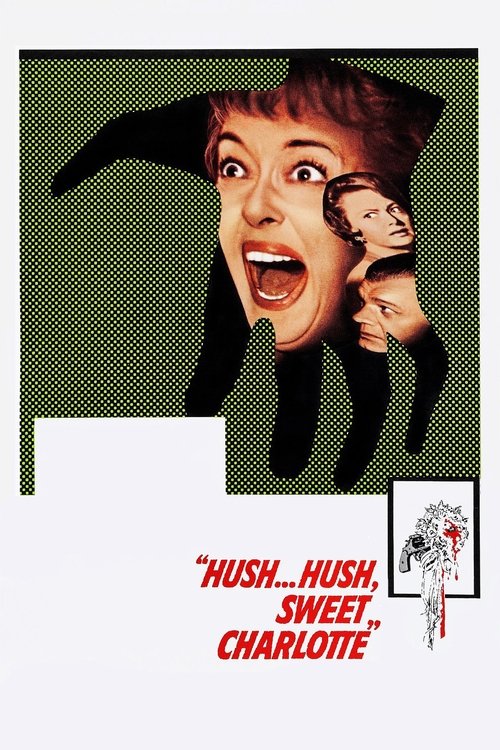
Hush... Hush, Sweet Charlotte
1964 · Robert Aldrich
For a stormy night when you want old-Hollywood glamour gone rotten — a black-and-white gothic to watch with the lights off, campy enough to grin at and nasty enough to keep you on edge.
What it's about
A reclusive Southern heiress has spent thirty-seven years alone in her decaying Louisiana mansion, whispered about as the woman who butchered her married lover at a plantation ball. When the state moves to demolish the house for a highway, a poised cousin arrives, supposedly to help — and Charlotte's grip on reality begins to slip as the old family secret claws its way back to the surface.
The experience
Deliciously overripe and genuinely creepy: a slow-tightening screw of gaslighting, gothic decay, and sudden shocks, played at full melodramatic volume. It's lurid fun that keeps curdling into real dread.
Performances
Bette Davis goes for broke as Charlotte, swinging between wounded fragility and full-throated madness, while Olivia de Havilland weaponizes her trademark graciousness in a role that plays chillingly against type; Agnes Moorehead nearly steals the film as the feral, suspicious housekeeper.
The craft
Aldrich shoots the antebellum mansion like a haunted house, all shadowed staircases and moss-hung dread in lustrous black and white, and the title song became a hit in its own right. The film earned seven Academy Award nominations — remarkable for something this pulpy — and its set-piece shocks are staged with real showmanship.
Why it matters
With its predecessor in Aldrich's run of aging-star shockers, it defined the 1960s wave of gothic horror vehicles built around Hollywood's grande dames, a template genre filmmakers have been riffing on ever since.
Horror · Gothic · Psychological horror · Horror comedy & camp. Southern gothic gaslighting in lustrous black and white: an overripe grande-dame melodrama that curdles from camp into real dread.
Snapshot
Hush... Hush, Sweet Charlotte is Robert Aldrich's lavish Southern Gothic melodrama-horror, conceived as a companion piece to his 1962 sensation What Ever Happened to Baby Jane? Bette Davis anchors it as Charlotte Hollis, a reclusive Louisiana heiress who has been whispered about for thirty-seven years as the woman who hacked her married lover to death at a plantation ball. As the state prepares to demolish her mansion for a highway, a poised cousin arrives, ostensibly to help her — and instead orchestrates an elaborate campaign to convince Charlotte she is insane. The film fuses antebellum decay, a genuine murder mystery, and the sadistic star-vehicle horror that Aldrich had pioneered, and it earned seven Academy Award nominations. Alongside Baby Jane, it is the founding text of the 1960s "Grande Dame Guignol" cycle — the wave of films built on aging female stars in states of terror and derangement.
Industry & production
The picture is inseparable from the commercial logic of its predecessor. Baby Jane, made cheaply and profitably, proved there was a large audience for horror-inflected melodrama starring former A-list actresses, and 20th Century-Fox backed Aldrich's follow-up on the strength of that proof. Aldrich again worked from a Henry Farrell property; Farrell reportedly developed the story specifically as a reunion vehicle, and it was originally titled around "Cousin Charlotte" before the more lurid final name (drawn from the film's title ballad) was adopted.
The production's central drama is one of the most-told anecdotes in Hollywood lore: the film was designed to re-team Davis with Joan Crawford, her Baby Jane co-star and famous antagonist. Crawford was cast as cousin Miriam and began work, but withdrew during production, citing illness — she was hospitalized — while the widespread industry account holds that the toxic on-set atmosphere and Davis's dominance made her position untenable. Aldrich replaced her with Olivia de Havilland, whom Davis is generally credited with recruiting personally. The recasting delayed the shoot and became a publicity event in itself. Beyond the broad outlines, the precise mixture of genuine illness and interpersonal warfare is not cleanly documented, and accounts differ; the honest summary is that both elements were present.
The film was shot partly on location in Louisiana, using an actual plantation house to supply the mildewed grandeur the story requires, supplemented by studio interiors. Its supporting cast reflects Aldrich's habit of assembling seasoned character players and fading stars: Joseph Cotten, Agnes Moorehead, Mary Astor (in what became her final film), Cecil Kellaway, and Victor Buono, with a young Bruce Dern in the early flashback role of the murdered lover.
Technology
Technologically the film is conservative by design. It was shot on 35mm black-and-white at a moment when the industry had largely gone to color, and that choice is central rather than incidental: monochrome ties the picture to the Gothic-horror and film noir traditions and to Baby Jane, and it lets the cinematography exploit deep shadow and high-contrast texture that color would have flattened. The film is presented in a widescreen ratio, giving Aldrich a broad frame for the plantation's cavernous rooms and for staging figures against the architecture. No significant technical innovation is associated with the production; its ambition lies in classical craft — sustained mood, elaborate camera setups, and effects work for the film's shock imagery — rather than novel apparatus.
Technique
Cinematography
Joseph F. Biroc, a frequent Aldrich collaborator, photographed the film and received an Academy Award nomination for black-and-white cinematography. His work is the picture's dominant expressive instrument. The plantation interiors are rendered in pooled light and heavy shadow, the camera prowling through corridors and up staircases; the mansion becomes a labyrinth in which Charlotte can be surprised, watched, and deceived. Biroc leans on chiaroscuro to externalize psychological states — Charlotte lit as a haunted figure, the conspirators moving in and out of concealing dark. The most cited image is the recurring nightmare motif: the spectral severed hand and the disembodied head that Charlotte glimpses, staged for maximum grotesque effect. Where the flashback prologue is bright and formal, the present-day sequences grow increasingly nocturnal and unstable as Charlotte's grip loosens.
Editing
Michael Luciano, another Aldrich regular, edited the film and was Oscar-nominated for it. The cutting balances two registers: the slow, oppressive accumulation of dread in the long house sequences, and the sharp shock-montage of the horror set pieces and Charlotte's hallucinations. The construction of the mystery depends on withholding — the audience, like Charlotte, must be kept uncertain whether she is guilty and whether she is losing her mind — and the editing carefully rations information about the 1927 killing until the late revelation reorders everything seen before.
Mise-en-scène / staging
The decaying plantation is the film's governing image and its true subject. Production and art direction (also Oscar-nominated) fill the house with faded opulence — dust, heavy furniture, portraits, the residue of a vanished order — so that the setting embodies both Charlotte's arrested past and the dying agrarian South. The impending demolition for a highway is staged as literal encroachment: modernity, in the form of construction crews, physically presses on the estate. Aldrich stages the gaslighting plot architecturally, using the mansion's stairs, balconies, and shadowed thresholds as the machinery of deception, and the climactic reversal is delivered through the building itself, when Charlotte drops a massive stone planter from an upper balcony onto her tormentors below.
Sound
Sound is organized around Frank De Vol's score and, above it, the title song "Hush... Hush, Sweet Charlotte," with lyrics by Mack David. The melody functions diegetically and thematically — associated with Charlotte's lost love and her fixation on the past — recurring as a haunting motif, including as a music-box or played refrain that unsettles her. The song became a genuine popular hit in recorded versions outside the film and was nominated for the Academy Award for Best Original Song, while De Vol's score received a separate nomination. Beyond the music, the sound design exploits the creaks, echoes, and silences of the empty house to sustain menace.
Performance
The film is above all a performance vehicle, and its actors work in a heightened, theatrical register appropriate to Southern Gothic. Bette Davis plays Charlotte across an enormous range — regal defiance, childlike vulnerability, screaming terror, and near-catatonic collapse — in the grand, unguarded manner that defined her late horror period. Olivia de Havilland's Miriam is the counterweight: composed, gracious, and quietly ruthless, her restraint concealing the cruelty of the scheme. Agnes Moorehead's Velma, the fiercely loyal, unkempt housekeeper who sees through the plot, earned an Academy Award nomination for Best Supporting Actress and is often singled out as the film's most vivid turn. Joseph Cotten as the complicit Dr. Drew Bayliss, Mary Astor as the dying Jewel Mayhew (whose confession completes the mystery), and Victor Buono in flashback as Charlotte's tyrannical father fill out an ensemble of veterans playing at full pitch.
Narrative & dramatic mode
Structurally the film is a hybrid: a psychological-horror gaslighting thriller wrapped around a whodunit. A 1927 prologue shows the brutal murder of John Mayhew — Charlotte's married lover — and establishes Charlotte as the presumed killer without ever confirming her guilt. The main action, decades later, follows Miriam and Drew as they systematically manufacture visions and terrors to drive Charlotte to madness (and toward her fortune), while Velma and a visiting insurance investigator probe the old crime. The dramatic mode is that of the "persecuted woman" thriller descended from Gaslight, but pushed toward horror through explicit grotesquerie. The film's engine is a double question — is Charlotte a murderer, and is she insane — and its late reversal resolves both: Charlotte is neither the killer nor truly mad, the conspirators are exposed as the guilty parties acting for gain, and Jewel Mayhew's confession supplies the truth of 1927. The Gothic convention of the family secret buried in the house is thus made literal.
Genre & cycle
Hush... Hush, Sweet Charlotte is a cornerstone of the mid-1960s cycle variously called "Grande Dame Guignol," "psycho-biddy," or, more crudely, "hagsploitation." Launched by Baby Jane, the cycle paired aging female stars with horror-thriller material that traded on their former glamour and their present decline, extracting frisson from the spectacle of once-idolized actresses reduced to terror, cruelty, or derangement. Charlotte sits squarely in this cycle while also drawing on Southern Gothic — the tradition of decaying aristocracy, buried sins, and grotesque family history associated with Faulkner and Tennessee Williams — and on the woman-in-peril thriller. It also participates in the broader 1960s trend, catalyzed by Psycho (1960), toward domestic, psychological horror rooted in ordinary settings and disturbed minds rather than supernatural monsters.
Authorship & method
As auteur, Robert Aldrich brings a career-long interest in violence, cruelty, and institutions or individuals in decay, visible across Kiss Me Deadly, The Big Knife, and What Ever Happened to Baby Jane?. His method here is that of a producer-director controlling a major star vehicle: he assembles trusted craftsmen, foregrounds bravura performance, and stages melodrama without irony while indulging horror's capacity for shock. Aldrich's key collaborators are largely his repertory company. Cinematographer Joseph Biroc supplies the monochrome expressionism; editor Michael Luciano shapes the film's rhythm of dread and shock; composer Frank De Vol provides the score and the pervasive title theme. The screenplay is by Henry Farrell and Lukas Heller — the same writing pairing behind Baby Jane, with Farrell originating the story material and Heller (a frequent Aldrich screenwriter) helping build the dramatic architecture. This continuity of personnel is why the film reads as a deliberate sibling to Baby Jane rather than a mere imitation.
Movement / national cinema
The film belongs to American studio filmmaking in its late-classical, transitional phase — the moment when the old star system had collapsed but its stars remained, and when the Production Code's grip was weakening enough to permit more explicit horror and psychological darkness. It is not part of any organized movement; rather, it exemplifies Hollywood's early-1960s turn toward lower-budget, sensationalist genre pictures that could exploit both nostalgia and shock. Its aesthetic lineage runs through American Gothic literature and the domestic horror opened up by Psycho.
Era / period
1964 places the film at the hinge between classical Hollywood and the New Hollywood soon to come. Color and widescreen spectacle dominated the market, making the film's black-and-white intimacy a pointed throwback. The picture's own narrative is obsessed with period rupture: an antebellum world, a 1927 crime, and a 1960s present in which bulldozers and highways are literally demolishing the past. That tension — old order against encroaching modernity — mirrors the industry's own moment, with veteran stars performing their obsolescence even as they command the screen.
Themes
The film's central themes are guilt and the past that will not stay buried; the decay of the aristocratic South and its genteel violence; and the persecution of a woman by those who would profit from redefining her as mad. Gaslighting — the deliberate manufacture of insanity — is dramatized with unusual thoroughness, making the film a study in how reputation and rumor can imprison a person as effectively as any crime. Memory and fixation drive Charlotte, arrested for decades at the night of her lover's death. Greed and betrayal within the family supply the mechanism, and the recurring motif of the severed hand and head literalizes a history that keeps returning in mutilated form. Underlying all of it is the spectacle of female aging and abjection that the cycle both exploits and, at moments, treats with real pathos.
Reception, canon & influence
The film was a commercial and awards success on release, drawing on the audience Baby Jane had built. Its seven Academy Award nominations — spanning Agnes Moorehead's supporting performance, Biroc's cinematography, Luciano's editing, De Vol's score, the title song, art direction, and costume design — mark it as one of the more institutionally honored entries in a disreputable cycle, though it won none of them. Critical reception at the time and since has generally regarded it as a handsome, effective, somewhat overwrought companion to Baby Jane, with particular admiration for Davis's commitment, Moorehead's ferocity, and Biroc's photography.
Looking backward, the film's influences are clear: the Gothic tradition of the doomed Southern house, the Gaslight model of the woman driven toward madness, the shock grammar loosed by Psycho, and above all Aldrich's own Baby Jane, whose formula it deliberately reworks. Looking forward, its legacy is chiefly as a load-bearing pillar of Grande Dame Guignol, a cycle that ran through the 1960s and gave numerous aging stars late horror roles; the film helped codify the template of the imperiled or deranged older woman in a decaying house that later psychological horror and camp-inflected melodrama would draw upon. The precise lines of specific-film influence beyond the cycle are harder to document firmly, and it is more accurate to describe Charlotte as a defining example within a movement than as the direct progenitor of individual later films. Its enduring cultural footprint is also carried by the title ballad, which outlived the picture as a standard.
A Deleuzian reading
A harpsichord plays in a house where nobody is playing it.
The full Deleuzian reading of Hush... Hush, Sweet Charlotte →
Reception
A hit in its day but often shrugged off as a Baby Jane cash-in, it's since been reclaimed as the richer, stranger half of Aldrich's Grand Guignol diptych — with the Feud: Bette and Joan era sending a new wave of viewers its way.
How Hush... Hush, Sweet Charlotte was received, from release to now →
How to watch Hush... Hush, Sweet Charlotte: what to notice on a first viewing
- Watch the shadows pool in the corridors and stairwells. Biroc lights the mansion in heavy chiaroscuro, letting darkness gather around Charlotte in corridors and on the stairs. The house itself decides who gets seen clearly and who stays in shadow.
- Look at the dust, portraits, and heavy old furniture. The plantation is filled with faded opulence, the residue of a vanished order, while highway crews wait outside to tear it down. This is a whole world rotting from the inside while it still keeps its manners.
- Listen for the title song returning as a music-box refrain. The title song recurs as a music-box refrain tied to Charlotte's dead lover, carrying 1927 into the house. The melody keeps 1927 alive in the house instead of letting it stay in the past.
- Watch Davis move from regal calm to childlike fear in one scene. She plays Charlotte across an enormous range, from defiance to near-catatonic collapse, often without the film cutting away to help the transition land. The performance alone does the work a cut would normally do for you.
The whole guide to watching Hush... Hush, Sweet Charlotte, with the keys for a rewatch →
Influences: the films it descends from and the films it influenced
- What Ever Happened to Baby Jane? (1962) — Direct progenitor: same Farrell/Heller screenwriting team and same Davis-in-a-decaying-house formula of two aging women locked in a cruelty duel that resolves into a buried-guilt reveal, which Charlotte deliberately reworks.
- Gaslight (1944) — Supplies the core mechanism — a woman methodically driven to doubt her own sanity by scheming relatives staging false phenomena — that becomes Miriam and Drew's plot to unhinge Charlotte with harpsichord music and a severed hand.
- Les Diaboliques (1955) — Provides the structural engine of conspirators faking the return of a corpse to frighten a woman toward death or madness, with the killing twist withheld until late — the exact architecture of the scheme against Charlotte.
- Psycho (1960) — Loosed the shock-montage grammar of sudden domestic violence and legitimized black-and-white horror shot in the color era, the editorial and technical license Biroc and cutter Michael Luciano exploit for the film's dread-and-jolt rhythm.
- Rebecca (1940) — Codifies the gothic staging of a great decaying house poisoned by a dead woman and a suppressed past, the model for the plantation-as-tomb where guilt over a decades-old killing festers.
- Sunset Boulevard (1950) — Establishes the foundational image the Grande Dame cycle exploits — a faded female star entombed in a rotting mansion clinging to lost glory — giving Charlotte its 'female aging abjection' iconography.
- The Little Foxes (1941) — Gave Davis her definitive imperious Southern matriarch inside a deep-staged, chiaroscuro milieu of scheming genteel families, the performance-and-setting register she reprises as the ruined heiress Charlotte.
- The Spiral Staircase (1946) — Perfects the woman-imperiled-in-an-old-dark-house thriller through expressionist chiaroscuro and subjective terror, the night-lit visual idiom Biroc echoes in Charlotte's staircase and shadow work.
- Autumn Leaves (1956) — Aldrich's earlier Crawford star-melodrama rehearses his method of staging a star's psychological unraveling without irony, the tonal bridge from straight melodrama toward his Guignol vehicles.
- Die! Die! My Darling! (1965) — Hammer's contribution to the cycle casts an aging star (Tallulah Bankhead) as a deranged captor ruling a decaying house, directly extending the deranged-older-woman template Charlotte cemented.
- The Nanny (1965) — Gives Davis another monochrome psychological-horror vehicle trading explicitly on the aging-woman-as-menace persona Baby Jane and Charlotte built for her.
- What Ever Happened to Aunt Alice? (1969) — Aldrich-produced continuation of his own 'Whatever Happened to…' brand, franchising the deranged-older-woman-with-a-buried-body formula (Geraldine Page) as a marketable cycle.
- What's the Matter with Helen? (1971) — Late Grande Dame Guignol pairing two aging stars (Reynolds, Winters) around a buried-guilt-and-encroaching-madness structure lifted wholesale from the Aldrich model.
- The Beguiled (1971) — Transposes the decaying-Southern-mansion-as-hothouse of repressed and vengeful women into Civil War gothic, extending Charlotte's plantation-bound staging of feminine menace.
- The Skeleton Key (2005) — Revives the rotting-Louisiana-plantation gothic and the gaslighting-of-a-woman thriller mechanism, updating Charlotte's decaying-house-and-manipulated-mind grammar for modern horror.
- Feud: Bette and Joan (2017) — Meta-descendant dramatizing the Davis/Crawford/Aldrich production world itself, self-consciously reconstructing Grande Dame Guignol's chiaroscuro look and bravura-performance grammar.
- Eaten Alive (1976) — Sets up the 'hagsploitation' Southern Gothic, where studio-era stars play decayed, grotesque versions of themselves on a sound stage, which Hooper follows in Carolyn Jones's ruined brothel madam.
- Strait-Jacket (1964) — Contemporaneous Grande Dame Guignol entry built on the Baby Jane/Charlotte template, casting an aging star (Crawford) around axe-murder shock set-pieces marketed as hag horror.
- Lady in a Cage (1964) — Same-year variation trapping a genteel older woman (de Havilland) inside her own decaying house under siege, extending the imperiled-matriarch-in-her-home premise.
Similar films
- What Ever Happened to Baby Jane? (1962) — influence & lineage · same viewing thread
- Gaslight (1944) — influence & lineage · same viewing thread
- The Little Foxes (1941) — influence & lineage
- Rebecca (1940) — influence & lineage
- Sunset Boulevard (1950) — influence & lineage
- Psycho (1960) — influence & lineage
- Shadow of a Doubt (1943) — shared sensibility
- Nosferatu (2024) — shared sensibility
All the films related to Hush... Hush, Sweet Charlotte →
Watch it with: curated runs of related films
- Hollywood Gothic Psychodrama — Watch these when you want horror that lives in the mind instead of the crypt. They rhyme on gloomy houses, buried pasts, and people who are manipulated or obsessed until they can't trust what they see.