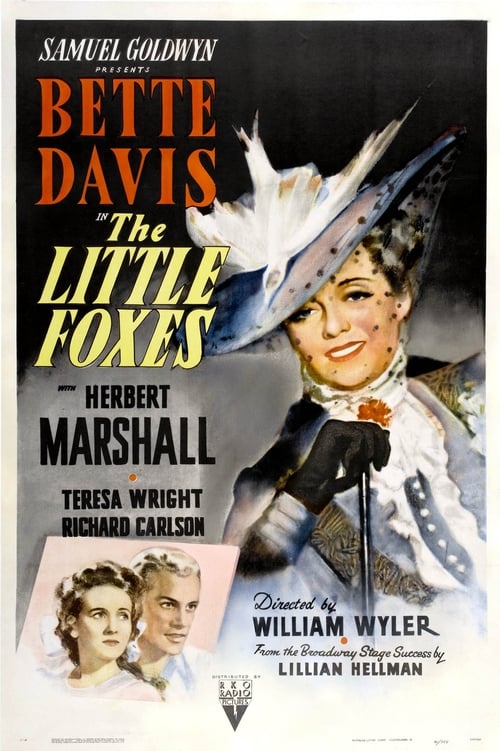
The Little Foxes
1941 · William Wyler
For when you're in the mood for magnificent villainy — a classic Hollywood drama with teeth, best on a night you want sharp dialogue and a family more toxic than your own. More bracing than cozy.
What it's about
Alabama, 1900. The Hubbards — two scheming brothers and their steel-willed sister Regina — are on the verge of a deal with a Chicago industrialist to bring cotton mills south and make the family rich. But Regina, locked out of the family fortune by inheritance laws that favored her brothers, needs her ailing husband's money to buy her share, and he wants no part of it. What follows is a war fought at dinner tables and on staircases, in a family where everyone is calculating everyone else's price.
The experience
Coldly gripping — a chamber drama that tightens like a vise, all silken menace and knives hidden in polite conversation. You watch it the way you watch a snake: with fascination and a low hum of dread.
Performances
Bette Davis as Regina Giddens is one of the definitive screen portraits of ambition — powdered, poised, and terrifying, doing more with stillness than most actors do with a monologue.
The craft
Shot by Gregg Toland the same year he photographed Citizen Kane, the film is a landmark of deep-focus cinematography: William Wyler stages whole battles of will in single layered frames, with characters plotting in the background while others suffer up front. Lillian Hellman adapted her own stage play, and the dialogue cuts like glass. It's a film where where people stand in the frame tells you who's winning.
Why it matters
One of the defining achievements of Hollywood's deep-focus era and a peak of the Davis–Wyler collaboration, it set the template for the poisonous-family drama that American film and television still draws on.
Snapshot
The Little Foxes is William Wyler's adaptation of Lillian Hellman's 1939 stage drama, a coldly precise anatomy of avarice set among the Hubbards, a rising merchant family in a small Alabama town at the turn of the twentieth century. Bette Davis plays Regina Giddens, a woman locked out of her father's estate by the customs of inheritance and determined to claw her way into the cotton-mill fortune her brothers are assembling with a Chicago industrialist. The film is at once a chamber piece of poisonous family politics and a parable about the New South selling itself to Northern capital. It is also one of the signal artifacts of Hollywood's deep-focus moment: shot by Gregg Toland the same year he photographed Citizen Kane, it translates Hellman's tight proscenium architecture into long, layered compositions where moral relationships are staged in depth. Nominated for nine Academy Awards and winning none, it stands today as one of Wyler's most controlled achievements and one of Davis's most severe, divisive performances.
Industry & production
The film was a Samuel Goldwyn production, made by the independent producer's unit and released through RKO Radio Pictures in 1941. Goldwyn had acquired the screen rights to Hellman's hit Broadway play, which had opened in 1939 with Tallulah Bankhead as Regina. Wyler was Goldwyn's most prestigious contract director, fresh from a run of literary adaptations and prestige dramas for the producer, and the project fit squarely within Goldwyn's strategy of mounting expensive, tasteful pictures drawn from established theatrical and literary properties.
The central casting decision shaped the production. Bankhead's stage Regina was celebrated, but Goldwyn wanted a screen name, and Bette Davis — by then Warner Bros.' reigning dramatic star — was borrowed for the role, reuniting her with Wyler after Jezebel (1938) and The Letter (1940). The collaboration was famously fraught. Davis, who reportedly studied Bankhead's interpretation, chose to play Regina as a hard, frozen figure, pale and masklike; Wyler pressed for more shading and human warmth, arguing that a more seductive, less monolithic villainy would be both truer and more cinematic. Their disagreements escalated to the point that Davis briefly left the production. The friction is well documented in the historical record, though accounts of exactly how it was resolved vary, and the finished performance reflects Davis's conception more than her director's.
The supporting company was drawn substantially from the Broadway production, lending the film a theatrical pedigree: Charles Dingle as Ben Hubbard, Carl Benton Reid as Oscar, Patricia Collinge as the broken, alcoholic Birdie, and Dan Duryea as the weak son Leo all reprised or had played their stage roles. Herbert Marshall played the ailing husband Horace, and the film marked the screen debut of Teresa Wright as the daughter Alexandra, launching a Goldwyn contract career.
Technology
The Little Foxes was produced with the standard professional apparatus of the early-1940s studio system: 35mm black-and-white nitrate photography, recorded optical sound, and Academy-ratio framing. Its technological interest lies less in novel equipment than in the deliberate exploitation of the period's fast emulsions, coated lenses, and high-intensity arc lighting to achieve extreme depth of field. The deep-focus aesthetic that Toland was pioneering in this period depended on stopping the lens down to very small apertures, which in turn required enormous quantities of light — a practical demand that conditioned the look of the interiors, with their pools of brightness and deep, architecturally complex backgrounds held in sharp relief. The collaboration of Toland and Wyler here is one of the foundational instances of deep focus being used not as a stunt but as a sustained dramatic grammar.
Technique
Cinematography
Gregg Toland's photography is the film's most studied technical element. Working with Wyler, Toland built compositions that keep foreground and far background simultaneously legible, so that dramatic power could be distributed across the depth of the frame rather than parceled out through cutting. The most celebrated instance is the climactic heart-attack sequence: when Horace, having discovered Regina's treachery, suffers an attack and begs for the medicine she will not fetch, the staging holds Regina rigid and sharply rendered in the foreground while Horace struggles, smaller and toward the back of the shot, to climb the staircase out of focus's mercy. The composition makes Regina's stillness an act — her refusal to move is the murder, and the camera makes us watch it as inaction held in unbroken depth. Throughout, Toland's lighting carves the Hubbard interiors into zones of glare and shadow that mirror the family's calculations.
Editing
Daniel Mandell edited the film. Consistent with the Wyler–Toland method, the cutting is restrained: where deep-focus staging allows a scene's tensions to play out within a single composition, the film holds the shot rather than fragmenting it into shot-reverse-shot. This produces long takes in which the spectator's eye is invited to scan the frame and choose where to look, a technique the critic André Bazin would later champion as a more democratic, less coercive form of montage. The economy of cutting also preserves the theatrical integrity of Hellman's scenes, letting performances build across sustained durations.
Mise-en-scène / staging
The film's mise-en-scène is built around the Giddens house — its parlor, dining room, and that decisive staircase — a single architecture within which the drama's power shifts are blocked. Wyler, a director famous for staging in depth and for his exacting demands on actors across many takes, choreographs the family's encounters as spatial contests: who stands and who sits, who commands the foreground, who is pushed to the edges. The staircase recurs as both literal set piece and metaphor for ascent and fall. The period decor — the heavy turn-of-the-century furnishings of a prosperous Southern household — situates the Hubbards precisely at the moment of the New South's commercial awakening.
Sound
Meredith Willson composed the score, one of his relatively few film assignments before his later fame as a Broadway composer. The musical accompaniment is used with restraint typical of Wyler's prestige dramas, supporting the drama rather than overwhelming Hellman's dialogue, which is the film's true engine. Sound design otherwise favors the spoken word; the film's theatrical origins are audible in its reliance on language — the Hubbards' sparring, insinuation, and euphemism — as the primary vehicle of action.
Performance
Performance is where the film's interpretive debates concentrate. Davis's Regina is a study in calculated coldness: imperious, still, her face often a white mask, her cruelty expressed through composure rather than heat. Whether this hardness is a limitation or a triumph has been argued since the film's release; Wyler thought it too unvaried, while many viewers have found it mesmerizing and definitive. Around her, the ensemble supplies the human texture: Patricia Collinge's Birdie, the faded aristocratic wife crushed into drink and timidity, gives the film its register of pathos; Charles Dingle's Ben is genially ruthless; Teresa Wright's Alexandra carries the story's moral awakening as she comes to see her mother clearly and chooses to leave. Herbert Marshall's Horace is the conscience the family lacks, and his physical frailty makes him the still point against which Regina's ambition becomes lethal.
Narrative & dramatic mode
The narrative is classical and tightly bounded, faithful to its stage source: a near-unity of place and a compressed span of time, driven by a single engine — the Hubbards' scheme to finance a cotton mill with Northern capital and Regina's maneuvering to secure her share. The dramatic mode is that of the well-made play turned toward moral exposure: secrets (a stolen bond, a loveless marriage, a withheld medicine) are planted and detonated in sequence. It is melodrama in the serious sense — a drama of moral legibility in which greed is anatomized and punished, or rather, in which greed triumphs financially while exacting a private cost. The ending withholds easy justice: Regina wins the money but loses her daughter, isolated at the top of the stairs, and Hellman refuses to soften the victory into comeuppance.
Genre & cycle
The film belongs to the cycle of prestige literary adaptations that defined Hollywood's relationship with Broadway and the novel in the late 1930s and early 1940s — the same impulse that produced Wyler's other Goldwyn and Warner literary pictures. Generically it is a family melodrama and a Southern drama, part of a broader screen fascination with the South as a site of decayed gentility and rising commercialism, though it is far more astringent than the romantic Southern pageantry of the era. It can also be read within the cycle of strong-woman vehicles built for Davis, in which she played willful, transgressive figures; Regina is among the hardest and least sympathetic of these, a woman whose ambition is given no romantic alibi.
Authorship & method
The film is a meeting of strong authorial sensibilities. William Wyler, the director, brought his characteristic method: meticulous, demanding, famous for extracting performances through many takes and for staging in deep, integrated compositions rather than relying on montage. His three films with Davis form a distinct chapter in both careers, and The Little Foxes is its capstone and its rupture. Lillian Hellman adapted her own play, preserving its structure and its mordant moral vision; additional dialogue and scenes were contributed by Arthur Kober, Dorothy Parker, and Alan Campbell, who opened the play out modestly for the screen, including the addition of a subplot of young romance for Alexandra. Gregg Toland, the cinematographer, supplied the deep-focus visual language that has made the film a textbook case. Daniel Mandell edited, and Meredith Willson composed the score. The result is genuinely collaborative authorship: Hellman's architecture, Wyler's staging, Toland's depth, and Davis's interpretation — the last of these arrived at against the director's wishes, which makes the film an unusually visible record of creative disagreement.
Movement / national cinema
The film is a product of the classical Hollywood studio system at its mature height, made within the independent-producer model that Goldwyn exemplified. It is not affiliated with a self-conscious movement, but it sits at the leading edge of the deep-focus tendency that flourished in American cinema around 1941 — the annus mirabilis that also produced Citizen Kane, photographed by the same cameraman. In the longer view of film theory, the Wyler–Toland depth style became central to Bazin's argument, in French postwar criticism, for a realism of the long take and deep space as an alternative to the analytic montage tradition, giving the film a place in the international theoretical conversation about cinematic style.
Era / period
Made in 1941, the film arrived at the close of the Depression decade and on the eve of America's entry into the Second World War, at a moment when Hollywood prestige drama was confident in its literary ambitions. Its own setting — the Deep South in 1900 — looks back four decades to the period of Reconstruction's aftermath, when Northern industrial capital was beginning to remake the agrarian South. The film's drama of cotton mills, cheap labor, and the courting of a Chicago investor is rooted in that specific historical transformation, and Hellman's portrait of the Hubbards is partly a portrait of a class — the rapacious New South bourgeoisie supplanting the old planter gentility embodied by the ruined Birdie.
Themes
The governing theme is greed and its corrosion of family and self, signaled by the title, drawn from the Song of Solomon — "the little foxes, that spoil the vines" — which frames the Hubbards as small predators ruining what they touch. Closely bound to it is the theme of women and money: Regina's ruthlessness is inseparable from her exclusion, as a woman, from direct inheritance and economic power, so that her villainy is also a distorted bid for autonomy in a system that denied it to her. The film examines class displacement — the mercenary Hubbards rising as the genteel old order decays — and the moral economy of capitalism, with the cotton-mill deal standing for an extractive modernity built on cheap Southern labor. Against this, the film sets the possibility of moral refusal, embodied in Alexandra's final decision to leave: the one character who looks at the family clearly and walks away from it.
Reception, canon & influence
On release the film was received as a major prestige picture and drew nine Academy Award nominations — including Best Picture, Best Director for Wyler, Best Actress for Davis, and Best Supporting Actress nods for both Collinge and Wright — though it won none, in a year dominated by Wyler's own How Green Was My Valley. Critical opinion then and since has admired its craftsmanship while debating Davis's performance, with some finding her Regina a hard, airless triumph and others, including Wyler, judging it too unyielding.
The influences on the film are clear and acknowledged: Hellman's stage play (and behind it the well-made-play tradition) supplied the structure, while the immediate context of Toland's experiments with deep focus shaped its visual method. Its legacy runs along two main lines. Within film style, it became one of the canonical exhibits — alongside Citizen Kane and Wyler's later The Best Years of Our Lives — in the critical case for deep-focus staging and the long take, securing it a permanent place in histories of film technique and in Bazin's theoretical writing. Within performance and adaptation history, Davis's Regina entered the gallery of definitive screen villainies and remains a touchstone in discussions of her career and of Hellman's work on screen; the play itself has continued to be revived and was later adapted by Hellman into the opera Regina. The collaboration's behind-the-scenes rupture — the end of the Wyler–Davis partnership — has itself become a durable part of the film's lore, frequently cited in studies of both artists.
A Deleuzian reading
Start with the shot everyone remembers.
The full Deleuzian reading of The Little Foxes →
Reception
A prestige hit in 1941 — nine Oscar nominations — yet it went home with zero, and it's spent decades slightly overshadowed by Citizen Kane, the other Gregg Toland deep-focus landmark from the very same year. Cinephiles have long since reclaimed it as one of Wyler's very best.
How The Little Foxes was received, from release to now →
Influences: the films it descends from and the films it influenced
- Wuthering Heights (1939) — Wyler and Toland's first sustained collaboration, where they began developing the deep-focus, staging-in-depth method that The Little Foxes brings to maturity.
- Dead End (1937) — Earlier Wyler–Toland film working a single confined set in depth, blocking multiple character actions across foreground and background rather than cutting between them.
- These Three (1936) — Wyler's first adaptation of a Lillian Hellman stage play, establishing his method of opening out her tight dramatic architecture for the screen while preserving its moral structure.
- Jezebel (1938) — Wyler–Davis Deep-South strong-woman vehicle built through his many-takes performance method, the immediate template for shaping Davis into another unyielding Southern antiheroine.
- Greed (1924) — Bazin's cited precedent for deep-space realism that lets an unbroken composition carry moral meaning, applied here to the same subject of money corroding character.
- The Rules of the Game (1939) — Renoir's deep-focus staging-in-depth, where simultaneous actions unfold across planes of a single shot, forms with The Little Foxes the core of Bazin's deep-focus canon.
- The Long Voyage Home (1940) — Toland and Wyler push staging-in-depth further, composing action across sharp fore/background planes descended from these deep-focus experiments.
- The Best Years of Our Lives (1946) — Wyler and Toland's reunion that perfects the deep-focus long take, staging emotionally decisive moments (the drugstore, the piano) in sustained depth without cutting.
- The Heiress (1949) — Later Wyler adaptation of a well-made stage play that reprises the cold-woman performance and turns a staircase into the central instrument of cruelty, echoing Regina's heart-attack scene.
- The Magnificent Ambersons (1942) — Carries forward the deep-focus chronicle of a dynasty's decline, using staircases and depth-staged interiors to register a family eaten by money and pride.
- Mildred Pierce (1945) — Extends the strong-woman melodrama of women-and-money, organizing a star vehicle around a heroine's acquisitive drive and the corrosion of family by capital.
- All About Eve (1950) — Hands Davis another dialogue-driven, well-made-play vehicle, foregrounding the sharp theatrical script and a calculating woman as the engine of the drama.
- Written on the Wind (1956) — Continues the family melodrama of dynastic greed, staging the rot of a wealthy clan through composed, status-laden interiors.
- Long Day's Journey Into Night (1962) — Inherits the filmed-stage-play tradition, using staging-in-depth and long takes to keep a fixed family group dramatically alive within confined rooms.
- A Streetcar Named Desire (1951) — Adapts a single-set stage play by blocking the cast in claustrophobic depth, sustaining the theatrical text's pressure through spatial confinement rather than montage.
- Cat on a Hot Tin Roof (1958) — Toland's deep-focus compositions stage the Hubbard family power struggle with multiple figures simultaneously visible at opposing depth planes without cutting—establishing the power-geometry logic of keeping antagonists in the same frame that Brooks and Daniels translate into CinemaScope's horizontal axis.
- Hush... Hush, Sweet Charlotte (1964) — Gave Davis her definitive imperious Southern matriarch inside a deep-staged, chiaroscuro milieu of scheming genteel families, the performance-and-setting register she reprises as the ruined heiress Charlotte.
- The Children's Hour (1961) — Establishes the Wyler-Hellman method of the drawing-room domestic tragedy staged in depth, with Gregg Toland composing action across sharp foreground/background planes that Planer's later deep focus continues.
- The Big Country (1958) — Wyler and cinematographer Gregg Toland's deep-focus staging — action played simultaneously across sharp foreground and background planes in sustained takes — is the depth-staging grammar Wyler later transposes to the range.
- Citizen Kane (1941) — Shot the same year by the same cinematographer, Gregg Toland, using the identical wide-angle deep-focus technique with ceilinged sets and figures held in sharp foreground-to-background planes within a single shot.
- The Letter (1940) — The Wyler–Davis melodrama made just before, using deep-space blocking and held compositions to trap Davis's hard, controlled woman inside the frame.
Similar films
- The Magnificent Ambersons (1942) — influence & lineage
- The Heiress (1949) — influence & lineage
- All About Eve (1950) — influence & lineage
- Citizen Kane (1941) — influence & lineage
- The Best Years of Our Lives (1946) — influence & lineage
- A Streetcar Named Desire (1951) — influence & lineage
- The Rules of the Game (1939) — influence & lineage
- Hush... Hush, Sweet Charlotte (1964) — shared sensibility