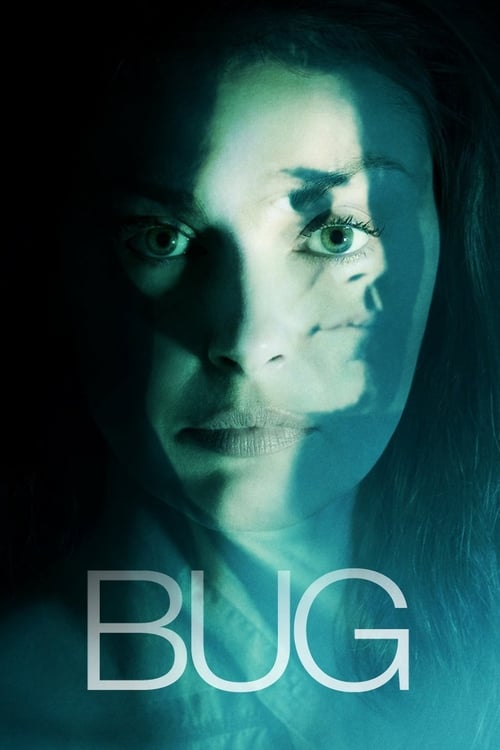
Bug
2007 · William Friedkin
For when you want to be put through something — a harrowing, go-for-broke psychological descent, not a fun scare. Best watched alone, late, when you're ready to feel claustrophobic on purpose.
What it's about
Agnes, a lonely waitress living out of a run-down Oklahoma motel room, drinks and dreads the return of her ex-husband from prison. A friend introduces her to Peter, a soft-spoken drifter and Gulf War veteran, and the two form an intense, needy bond. Then Peter becomes convinced the room is infested with insects tied to a military experiment, and Agnes's loneliness makes his conviction contagious.
The experience
Claustrophobic and feverish — almost the whole film happens in one room that gets stranger and more sealed-off as it goes. It plays less like a horror movie than like being locked inside two people's spiraling minds, and it builds to a pitch of intensity that's genuinely hard to shake.
Performances
Michael Shannon, reprising his stage role, is terrifyingly committed — he makes delusion feel like charisma. Ashley Judd matches him with raw, unguarded work that charts how grief and loneliness can make madness look like love.
The craft
Tracy Letts adapted his own play, and William Friedkin directs it like a pressure cooker: one motel room transformed scene by scene into a foil-lined bunker lit by bug-zapper blue. The sound design — helicopters, hums, things you can't quite place — does as much to unmoor you as anything on screen.
Why it matters
It announced Michael Shannon to a wider audience and marked a fierce late-career turn for Friedkin, and it has grown into a cult favorite as one of the most uncompromising portraits of shared delusion in American film.
Snapshot
Bug is a chamber piece about madness. Its setting is a run-down motel room on the edge of an Oklahoma highway. Agnes White (Ashley Judd) is a waitress at a lesbian bar. She lives alone, drinks, takes drugs, and is afraid of an ex-husband just released from prison. Through her friend R.C. she meets Peter Evans (Michael Shannon), a soft-spoken drifter and Gulf War veteran. Peter becomes convinced that tiny insects are infesting the room and his own body, and that a military experiment planted them in him. Agnes's grief and loneliness draw her into his belief. Over the course of the film the room becomes a sealed world of tinfoil, flypaper and bug-zapper light, and a private delusion turns into a shared one: a folie à deux.
Tracy Letts adapted the film from his own stage play. It belongs to the late phase of William Friedkin's career and began a short but productive partnership between the two men. The marketing presented it as a supernatural horror film, but it is really a psychological study and a portrait of paranoid America. Reception was sharply split. Its reputation has grown steadily since, and it is now widely regarded as one of Friedkin's strongest late works and a key early showcase for Michael Shannon.
Industry & production
The source is Letts's play Bug. It premiered in London in the mid-1990s and was later staged in Chicago and off-Broadway, where a 2004 production ran successfully. Michael Shannon played Peter on stage before taking the role on screen, which was unusual. Studios often recast stage roles with bigger stars, but Friedkin kept the actor who had built the part.
The film was made independently on a modest budget, with financing from several producers and international partners. It was shot quickly with a small cast and essentially one main set. Production took place in Louisiana, standing in for Oklahoma. The single-location premise suited the budget: nearly all the money and time could go into the performances and the gradual transformation of the motel room.
The film premiered at the 2006 Cannes Film Festival in the Directors' Fortnight sidebar, where it won the FIPRESCI (international critics') prize. Lionsgate released it in the United States in May 2007. The distributor's campaign framed it as a creature-horror film and leaned heavily on Friedkin's identity as "the director of The Exorcist." That framing became central to its commercial fate. Audiences expecting a monster movie got a claustrophobic two-hander about psychosis, and exit polling reportedly gave the film an exceptionally poor grade. Theatrical returns were weak. Its later life has been on home video, in repertory screenings and in critical reassessment.
Technology
Bug is not a technologically ambitious film, and that is deliberate. Its effects are mostly practical and environmental. The key "special effect" is the progressive redressing of the motel room: walls covered in aluminum foil, flypaper hanging from the ceiling, rows of bug zappers whose ultraviolet glow eventually floods the space. The film never shows a convincing insect. Viewers are invited to look closely, as Peter and Agnes do, and see nothing, or see only what the characters claim to see.
Detailed technical records of the shoot (camera systems, stocks and so on) are not widely documented in standard sources. What matters is how practical lighting, built into the set, does the work that effects shots would do in a more conventional horror film.
Technique
Cinematography
Michael Grady shot the film, and the photography follows the room's decline. Early scenes use the dim, naturalistic light of a cheap motel: lamps, daylight through blinds, the drab colours of a life on hold. As Peter's delusion takes over, the palette shifts to the hard silver reflections of foil and finally the cold, saturated blue-violet of the bug zappers. By the climax the room looks like an alien interior or a laboratory. The film's visual style has caught the characters' psychosis.
The camera stays close to the actors and often frames them tightly against walls and doorways. Exteriors are rare and brief: a wide shot of the motel isolated in the landscape, glimpses of the road. Their scarcity makes the interior feel all the more like a trap. Friedkin's background in vérité-influenced realism, from The French Connection (1971) onward, shows in the restless, observational handling of the early scenes. That restraint gives way to near-expressionist stylisation as the film goes on.
Editing
Darrin Navarro, who would continue working with Friedkin, edited the film. The cutting respects the long, performance-driven scenes of the play. Several of the major dialogue passages play out with few interruptions, letting rhythm and escalation come from the actors. In the final act the editing speeds up, with sharper cuts and more fragmented coverage, as Peter's monologues turn into torrents and the violence arrives suddenly. The film builds pressure by holding back and then releasing, rather than through constant montage.
Mise-en-scène / staging
The motel room is the film's main expressive instrument. It goes through three broad states:
1. Shabby normalcy. A lonely woman's dwelling, cluttered and anonymous. 2. Fortification. Foil on the walls to block surveillance, insect traps and sprays as Peter's theory takes hold. 3. Sanctuary or laboratory. A glowing blue enclosure, sealed off from the world. In the logic of the delusion it is both a defence against the conspiracy and its proof.
Friedkin keeps the play's near-unity of place. The few scenes outside the room (the bar, the motel exterior) mainly establish how isolated Agnes already is. Staging inside the room is physical and close. Characters circle one another, tear at their own skin and crouch over imagined specimens. The room is a classic theatrical space reimagined as a cinematic pressure chamber.
Sound
The soundtrack plays a crucial role in building the paranoid atmosphere. A recurring motif is the sound of a helicopter overhead, which may or may not be real and which the characters read as surveillance. The constant electrical hum and crackle of the bug zappers becomes more oppressive as they multiply. Unexplained phone calls Agnes receives, which she assumes come from her ex-husband, add to the sense of being watched. Brian Tyler's score is used sparingly, adding unease without overpowering the dialogue-driven drama. Throughout, sound blurs the line between external threat and internal hallucination, and the film refuses to settle the question.
Performance
The film rests on its two lead performances. Michael Shannon, who knew the role intimately from the stage, plays Peter as gentle, shy and courteous at first, a man whose strangeness reads as vulnerability. The performance's power lies in how gradually and convincingly that gentleness reveals the depth of his psychosis. His final monologues, dense with conspiracy logic (government experiments, implanted devices, a vast web of connections), are delivered with a terrifying, articulate conviction that has made the role a reference point for his later career.
Ashley Judd, until then best known as the heroine of mainstream thrillers, takes on a raw and largely unglamorous role. Her Agnes is worn down by grief over the son who disappeared years earlier and by fear of her abusive ex-husband. She embraces Peter's delusion not because she is persuaded by it but because it offers connection and meaning. Many critics considered it the strongest performance of her career. Harry Connick Jr., as the menacing ex-husband Jerry Goss, plays against his usual charming persona. Lynn Collins (R.C.) and Brian F. O'Byrne (Dr. Sweet, the man who claims Peter has escaped from a psychiatric institution) represent the outside world that tries, and fails, to break into the shared delusion.
Narrative & dramatic mode
The film follows the play's structure: a slow first act of loneliness and tentative intimacy, then a long middle section of escalating paranoia, then an explosive climax. The dramatic engine is contagion. Peter's delusion does not stay his own. Agnes takes it up, and finally she surpasses him: in the famous climactic sequence she spins her own elaborate, ecstatic version of the conspiracy, which absorbs her lost son and casts herself as "the super mother bug."
The narrative mode is psychological realism pushed into dark absurdity and tragedy. The film never confirms the existence of the bugs or the conspiracy, but it tilts strongly toward reading them as delusion. Dr. Sweet's appearance supplies an outside explanation (Peter is an escaped mental patient), yet that explanation is itself dismissed within the couple's logic and ends in violence. The ending, in which the couple set themselves alight, completes the tragic arc: a sealed world consumed from within.
Genre & cycle
Bug uses horror conventions (isolation, an encroaching threat, body anxiety) while largely subverting them. The marketing promised creature horror. The film delivers psychological horror closer to Repulsion (1965) than to an insect-attack movie. It also belongs to the long tradition of paranoid and conspiracy cinema, but displaces the political thriller of the 1970s (The Parallax View, The Conversation) into a pathological domestic register. Here paranoia is a psychiatric condition and a form of intimacy, not an investigation.
It also connects with body horror, in the line of Cronenberg, through its obsession with the skin, infestation and self-mutilation. That connection is psychological rather than literal: the body horror is entirely self-inflicted. The film can be grouped with a cluster of mid-2000s and early-2010s American films about paranoia, contagion and apocalyptic anxiety, though it is more theatrical and less genre-bound than most of them.
Authorship & method
William Friedkin came to Bug well after his 1970s peak (The French Connection, The Exorcist, Sorcerer). His career since had been uneven, and his previous feature was the action thriller The Hunted (2003). Bug marked a turn in his late work toward intimate, low-budget adaptations of stage material, a mode he had first explored with The Boys in the Band (1970). His long-standing interests run through the film: obsession, the line between faith and madness, and the porous border between good and evil. The relationship with The Exorcist is more thematic than generic. Both are about belief, a body seen as possessed, and the inability of rational authorities to bring a person back. Friedkin's memoir, The Friedkin Connection (2013), discusses his late career.
Tracy Letts wrote the screenplay from his own play. He was a member of Chicago's Steppenwolf ensemble and would win the Pulitzer Prize for Drama for August: Osage County (2007). His writing is known for its dark comedy, its working-class settings and its sudden violence. The Friedkin–Letts partnership continued with Killer Joe (2011), another adaptation of a Letts play, which also gave its star (Matthew McConaughey) a defining late-career role.
Michael Grady (cinematography), Darrin Navarro (editing) and Brian Tyler (music) were the main technical collaborators. Navarro would also edit Killer Joe. Friedkin's method here was performance-centred. He trusted the theatrical material, kept the original actor in the lead role and concentrated the production in one controllable space.
Movement / national cinema
Bug is an American independent film shaped by the American theatre, specifically the Chicago tradition of muscular, actor-driven ensemble drama associated with Steppenwolf and similar companies. It does not belong to a defined film movement. It sits instead among American films that look at the economically and socially marginal heartland: roadside motels, bars, drifters, veterans. Its Oklahoma setting and its concern with the anxieties of the American periphery tie it to Letts's broader portrait of the region, also seen in August: Osage County and Killer Joe.
Era / period
The play was written in the 1990s, an era when American paranoid culture was on the rise. Militia movements, Gulf War syndrome and a general distrust of government surfaced in popular culture, including The X-Files. The film appeared in the mid-2000s, during the Iraq War, the expansion of post-9/11 surveillance and a culture of fear around terrorism and government secrecy. Peter's identity as a Gulf War veteran who believes the military experimented on him took on new force in that context. Around the same time, the condition reported under the name "Morgellons," in which sufferers believe fibres or parasites are emerging from their skin, received growing media attention. That gave the film's imagery an uncomfortable topicality, though the play predates the term's popularity. The film's distribution history, with its misleading genre marketing, is also typical of how mid-2000s distributors handled awkward hybrid films.
Themes
- Shared madness and the need for belonging. The central paradox is that delusion functions as love. Peter's paranoia gives Agnes a place in a meaningful story. Belief creates intimacy, and intimacy reinforces belief.
- Grief and lost children. The disappearance of Agnes's son is the wound the delusion eventually explains: in her final reconstruction, her loss becomes part of the conspiracy. The film suggests that paranoia can be a way of making unbearable randomness meaningful.
- Surveillance, the state and the veteran. Peter's story echoes real historical abuses (government experiments, veterans' unexplained illnesses), which makes his fantasy hard to dismiss outright. The film asks where reasonable distrust ends and psychosis begins.
- The body as battlefield. Infestation, scratching, the extraction of imaginary insects, self-mutilation: the body becomes the site where invisible forces prove their existence.
- Isolation and the margins. The motel, the bar and the empty landscape portray a social periphery where loneliness leaves people vulnerable to any story that offers connection.
- Violence and masculine threat. Jerry Goss represents the familiar, concrete danger of domestic abuse, in contrast to the abstract, imaginary threat of the bugs. Ironically, the imagined danger ends up more destructive than the real one.
Reception, canon & influence
Critical reception. The FIPRESCI prize at Cannes signalled strong festival enthusiasm. On US release, reviews were divided. Some critics praised the performances and the film's relentless intensity, others found it overwrought and too theatrical. The gap between the marketing and the actual film produced a notably hostile audience response and poor box office. Over time the film's standing has improved considerably. It is now regularly cited as one of Friedkin's best late films, and Shannon's and Judd's performances are counted among the best of their careers.
Influences on the film (backward). Its sources include Letts's stage play and the American theatre tradition behind it. Its cinematic precedents include Repulsion (madness in an enclosed apartment), the 1970s paranoid thriller (The Parallax View, The Conversation), Cronenberg's body horror, and Friedkin's own The Exorcist (a body perceived as invaded, rational explanation powerless) and The Boys in the Band (stage adaptation, a single space under pressure). The broader American paranoid culture from the Cold War through the 1990s, along with the psychiatric concept of folie à deux, frames its subject.
Legacy (forward). The most direct line runs to Killer Joe (2011), which continued the Friedkin–Letts collaboration in the same register of claustrophobic, violent Southern Gothic. Friedkin's final feature, The Caine Mutiny Court-Martial (2023), was another adaptation of stage material, showing how lasting this late mode was. For Michael Shannon, Bug established the persona of disturbing intensity and articulate unease that defined his later career. Critics often link it to Jeff Nichols's Take Shelter (2011), in which Shannon again plays a man gripped by apocalyptic visions whose sanity is in doubt. More broadly, the film has become a reference point in discussions of on-screen paranoia, conspiracy thinking and contagious belief. As conspiracy culture spread through online communities in the 2010s and 2020s, its portrait of two people sealing themselves into a self-confirming worldview has struck many viewers as increasingly prescient.
Influences: the films it descends from and the films it influenced
- The Boys in the Band (1970) — Friedkin's first stage adaptation keeps the off-Broadway cast and confines the drama to one apartment, letting the pressure come from the actors and the walls. Bug repeats the method, keeping Michael Shannon from the stage production.
- The Exorcist (1973) — It films a body seen as invaded with flat, clinical procedure, as in the arteriogram and other medical tests, and medicine fails to explain what it finds. Bug turns this method inward when Peter examines his own skin and pulls his own tooth.
- Repulsion (1965) — A woman's mental collapse shows up in the physical decay of her sealed apartment. This is the model for Bug's motel room, which becomes a sign of the shared delusion as the tinfoil and flypaper go up.
- The Tenant (1976) — Persecution paranoia builds up inside a single rented room, where neighbours and noises are read as proof of a plot. Bug uses the same staging, with offscreen sounds read as surveillance and the room as the evidence.
- The Conversation (1974) — It ends with a surveillance expert tearing his apartment apart to find a bug he can't locate. Bug expands that final image into its whole third act, in which Peter and Agnes take apart their room and their bodies to find the implant.
- The Parallax View (1974) — It sets the 1970s paranoid thriller's logic of a plot so total that every clue confirms it. Bug moves that logic out of corporate and political spaces into a working-class motel room.
- Who's Afraid of Virginia Woolf? (1966) — This stage-play adaptation is built on a couple's private, jointly maintained fiction, their imaginary son, which is acted out in front of a stranger in one house. It is the dramatic model for a folie à deux played as a two-hander under escalating pressure.
- Possession (1981) — Its frenzied performances push a couple's breakdown in an apartment into physical hysteria, with a monster that may only be a sign of grief and obsession. This anticipates Judd's and Shannon's escalation in the climax.
- Videodrome (1983) — Cronenberg merges conspiracy and the body, so that a protagonist comes to believe a hidden apparatus has been put inside his flesh. Bug borrows this body-horror logic but puts the infestation entirely in belief, with no effects.
- Safe (1995) — It films an illness with no clear cause, possibly environmental and possibly psychosomatic, without ever settling which, and it ends with the heroine shut away in a sealed porcelain-lined safe room. Bug's foil-lined room and its ambiguity about Gulf War syndrome come straight from this.
- Pi (1998) — A paranoid pattern-finder holed up in a cramped apartment ends by drilling into his own skull. It is the indie model for a conspiracy delusion that ends in self-surgery, as Bug's does.
- Killer Joe (2011) — Friedkin and Letts work together again, with Darrin Navarro editing, on another Letts play confined to a trailer. It uses the same long-take build-up to a sudden, theatrically staged eruption of violence in a cramped Southern domestic space.
- Take Shelter (2011) — It gives Shannon the persona of articulate apocalyptic dread that Bug established. A man's possibly psychotic visions drive him to physically rebuild his home's defences, a hand-dug storm shelter, while his family is pulled into his belief.
- The Lighthouse (2019) — In this two-hander in a single location, two isolated men's shared descent into delusion is told through stage-style monologues and escalating physical frenzy. It extends Bug's chamber-piece folie à deux into period Gothic.
- The Caine Mutiny Court-Martial (2023) — Friedkin's last film is a stage adaptation shot almost entirely in a single courtroom, and it focuses on a commander's paranoid unravelling under questioning. It shows the late mode Bug set up: actor-centred, single-room, from the stage.
- 10 Cloverfield Lane (2016) — A paranoid conspiracy is acted out in one sealed room, and the audience can't tell whether the man insisting on unseen threats is mad or right. That unreliable information is the uncertainty Howard's prepper speeches rely on.
- Spider (2002) — It locks the camera inside a delusional mind and turns the protagonist's room into a web of string and hoarded scraps. Spider and Bug both use a hand-transformed set in place of VFX to show a psychosis.
Similar films
- Invasion of the Body Snatchers (1978) — shared sensibility
- The Hitcher (1986) — shared sensibility
- The Invitation (2016) — shared sensibility
- May (2003) — shared sensibility
- Skinamarink (2023) — shared sensibility
- Single White Female (1992) — shared sensibility
- Oddity (2024) — shared sensibility
- Gonjiam: Haunted Asylum (2018) — shared sensibility