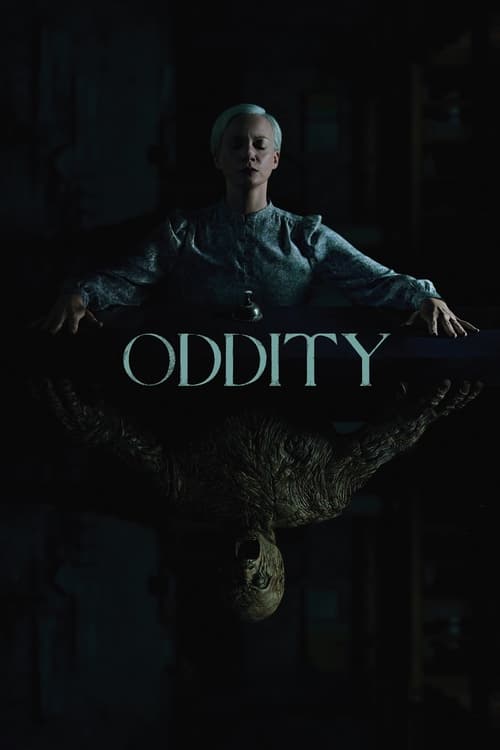
Oddity
2024 · Damian McCarthy
For when you're craving a real scare — the kind of horror night where you turn the lights off, jump, laugh at yourself for jumping, and then jump again.
What it's about
A year after her twin sister was brutally murdered in an isolated stone house, Darcy — a blind medium who deals in cursed and haunted curios — arrives for an uneasy stay with the sister's widower. She brings one item from her shop: a life-size wooden man. What follows is part whodunit, part supernatural reckoning, as Darcy uses her haunted objects to go after those responsible.
The experience
A slow tightening of the screws — long silences, a near-empty house, and one of the most unnerving props in recent horror — punctuated by jolts that genuinely land. It's creepy in the old-fashioned, look-behind-you way, with a wicked streak of dark humor.
Performances
Carolyn Bracken plays both twins — the murdered sister and the blind, unnervingly serene medium — and gives Darcy a sly, needling confidence that makes every scene she's in feel dangerous.
The craft
Damian McCarthy builds dread out of almost nothing: one house, a handful of characters, patient framing that teaches you to fear empty doorways. The scares are engineered with real discipline — held shots, silence, and impeccable timing — and it plays best loud, in the dark.
Why it matters
One of the breakout horror films of its year, it confirmed McCarthy as a leading craftsman of the low-budget supernatural revival and turned its wooden mannequin into an instant genre icon.
Snapshot
Oddity is the film that confirmed Damian McCarthy as one of the most disciplined craftsmen of the contemporary low-budget supernatural horror revival — a director who builds dread out of stillness, single rooms, and inanimate objects that refuse to stay inanimate. His second feature, after the confined ghost story Caveat (2020), it grafts a classical whodunit onto a revenge-from-beyond-the-grave fable. A year after her twin sister Dani is bludgeoned to death in the isolated stone house her psychiatrist husband Ted was renovating, the blind medium and curio-dealer Darcy (Carolyn Bracken, in a dual role) arrives for an uneasy stay, bringing with her a life-size wooden man from her shop of cursed and "haunted" objects. The film's wager is one of radical economy: that a near-empty house, a handful of characters, a glass eye, and a hand-carved figure sitting silently in a chair can generate more sustained tension than spectacle ever could. It premiered at SXSW in March 2024, where it took the Midnighters Audience Award, and went on to a striking critical consensus that placed it among the best-reviewed horror films of its year.
Industry & production
Oddity is an Irish independent production, made on the modest scale characteristic of Ireland's increasingly fertile genre sector — the same low-budget, high-craft ecosystem that has produced figures such as Lee Cronin (The Hole in the Ground) and the broader wave of Irish folk-horror and dread cinema. The film was produced through Irish company Keeper Pictures, with international sales handled by Blue Finch Film Releasing, which boarded the title ahead of its SXSW premiere and the European Film Market. The precise financing structure is not something I can detail with confidence, and rather than guess at budget figures or the full slate of funding bodies, I'll note only that it belongs unmistakably to the sub-multimillion tier where constraint is the governing creative fact.
Distribution placed the film well for its register: IFC Films released it theatrically in the United States in mid-2024, with streaming on Shudder, the AMC-owned horror platform that has become the natural home for exactly this kind of festival-validated, craft-forward genre title. That IFC/Shudder pairing — limited theatrical exposure feeding a dedicated streaming audience — is the standard contemporary pathway for a film of Oddity's scale and was instrumental in carrying its festival buzz to a wider horror readership.
The casting is compact and theatrical. Carolyn Bracken carries the film in a dual role as the murdered Dani and her blind, watchful sister Darcy; Gwilym Lee (familiar from Bohemian Rhapsody and Midsomer Murders) plays Ted, the husband whose composure the film steadily pressurizes. Tadhg Murphy, Caroline Menton, and Steve Wall fill out the small ensemble. The intimacy of the cast list is itself a production fact: this is chamber horror, staged for a few bodies in a few rooms.
Technology
Oddity is not a film of technological novelty, and its power is partly a rebuke to the idea that horror needs it. The decisive technological choice is the commitment to practical, in-camera effects over digital ones — above all the central prop, the carved wooden man, realized as a physical build (the figure's fabrication is credited to effects artist Paul McDonnell). The film's most discussed sequences depend on the audience's certainty that the thing in the chair is really there in the room with the actors, an object of wood and weight and not a composited element. This places Oddity squarely within the practical-effects ethos that defines much of the current "elevated" and Shudder-adjacent horror movement, where tactility reads as authenticity and digital smoothness reads as cheating. Beyond that, the production used conventional contemporary digital capture and naturalistic lighting; the relevant "technology" is craftsmanship — carpentry, prosthetics, and the staging of practical reveals — rather than any tool of capture or post-production.
Technique
Cinematography
Shot by cinematographer Colm Hogan, Oddity works in a controlled, low-key palette of shadow and lamplight appropriate to its renovated-house setting, where exposed stone, unfinished surfaces, and pools of warm interior light coexist with the cold dark beyond the windows. Hogan's camera is patient and composed rather than restless: McCarthy and Hogan favor the held frame, the slow push, and the deliberately loaded composition in which the viewer is invited to scan the edges and backgrounds for what might be moving — or, more unnervingly, for what is conspicuously not moving. The film's signature visual strategy is the use of static or near-static wide and medium shots in which the wooden man sits in frame, daring the audience to watch it, so that dread accrues from duration and stillness rather than from camera movement. It is a cinematography of withheld information and patient framing, trusting the spectator's own eye to do the frightening.
Editing
Edited by Brian Philip Davis, Oddity is structured with the precision of a mystery as much as a horror film, and the cutting carries much of that double burden. The film parcels out information deliberately — the circumstances of Dani's death, the identity and fate of a glass-eyed psychiatric patient, the true purpose of Darcy's visit — so that the assembly functions as a slow reveal of a buried crime even as it manages the rhythm of fright. The editing's most celebrated achievement is its handling of the scare beat: the film became known for jolts engineered through cutting and framing rather than noise, where the timing of a reveal or the precise moment a held shot is allowed to break is calibrated for maximum shock. The control of tempo — long, quiet accretions of unease punctuated by sharp, exact jolts — is among the film's most praised technical features.
Mise-en-scène / staging
The staging is the film's beating heart. Oddity is essentially a single-location piece set in and around the isolated house, and McCarthy treats that space as a stage to be exhaustively mapped: doorways, the dinner table, the chair, the dark corridors are established so that the audience comes to know the geography and therefore to fear its disturbances. The wooden man is a masterclass in object-staging — placed in the frame, repositioned, made the silent fourth presence at a dinner, its very stillness charged with threat. The production design (by Lauren Kelly) gives the house the in-between quality of a renovation: half-finished, structurally exposed, a home that is not yet a home, which doubles the film's sense of a life interrupted by violence. The film's curio shop of "cursed" objects — and the conceit that Darcy traffics in haunted things — extends this object-centered mise-en-scène into the premise itself.
Sound
The score is credited to composer Richard G. Mitchell, and the film's sound design works hand in glove with its commitment to stillness. Oddity belongs to the school of horror that values silence and ambient texture — the creak, the breath, the small domestic sound rendered ominous — over wall-to-wall scoring, and it conspicuously avoids leaning on the loud musical sting as its primary tool. The most admired scares are frequently the quiet ones, built on the absence of expected sound or on a single precise auditory event in a hush. This restraint is integral to the film's effect: by keeping the soundscape sparse and the score withheld, it makes the auditorium itself feel like the dark room the characters inhabit.
Performance
Carolyn Bracken's dual performance is the film's centerpiece and its most lauded element. As Darcy she is blind, still, and unnervingly self-possessed — a figure who seems to know more than the sighted around her, whose calm becomes its own source of menace — while as Dani she supplies the warmth and vulnerability that the murder forecloses. The two characterizations have to feel like one bloodline and two distinct people, and Bracken's calibration of stillness against feeling carries that weight. Gwilym Lee plays Ted as a man of professional composure whose rationalism is steadily eroded, and the supporting players sustain the chamber-piece intimacy. Because so much of the film is two or three people in a room with an object, the performances must hold the frame against long takes and minimal incident; the acting is correspondingly precise and contained.
Narrative & dramatic mode
Oddity's dramatic mode is a deliberate hybrid: a supernatural horror film built on the skeleton of a classical whodunit and a revenge tale. The engine is investigative — who killed Dani, and why — but the detective is a blind medium, and her instruments are not deduction but haunted objects and the dead's capacity to act. The narrative withholds and reorders, springing reversals about who knew what and who did what, in the manner of a mystery, while its emotional logic is that of grief turned to retribution. This braiding gives the film a double pull: the intellectual pleasure of a puzzle and the visceral dread of the ghost story, with the revelation of the crime and the supernatural reckoning timed to converge. It is a tightly closed, almost theatrical structure — few characters, one principal location, a chain of cause and consequence — and that closure is itself a source of tension, since the audience senses early that everyone in the house is trapped inside the same machinery of payback.
Genre & cycle
The film sits at the crossroads of supernatural horror, the haunted-object subgenre, and the mystery-thriller, with a strong undertow of the revenge narrative. It belongs to the 2010s–2020s wave of craft-driven, atmosphere-first horror — the milieu of A24 and especially of Shudder, whose brand has been built on exactly this kind of low-budget, high-control international genre cinema. Within that wave, Oddity is part of a distinctly Irish strand of contemporary horror that has drawn increasing notice, and it is most directly the companion piece to McCarthy's own Caveat, with which it shares a fixation on confined spaces and on a single uncanny object (the mechanical drumming rabbit of Caveat; the wooden man here) as the locus of fear. In the longer genre lineage it descends from the haunted-doll and possessed-effigy tradition and from the chamber ghost story, but its whodunit scaffolding and its medium-as-investigator premise give it a particular, recognizable signature.
Authorship & method
Oddity is an unambiguous authorial work: Damian McCarthy wrote and directed it, and it reads as a refinement of the method he established in Caveat. That method is one of extreme economy turned into a virtue — minimal locations, minimal cast, a central uncanny object, and dread generated through patient staging, held frames, and precisely engineered scares rather than gore, spectacle, or scale. McCarthy's authorship is legible in the throughline from his debut: the confined house, the malevolent inanimate figure, the slow-burn architecture of unease, and a fondness for the single, indelible image of horror.
His key collaborators give the film its finish. Cinematographer Colm Hogan supplies the controlled, shadow-built look that lets stillness do the frightening; editor Brian Philip Davis structures the whodunit reveals and times the jolts on which the film's reputation rests; composer Richard G. Mitchell scores with the restraint that keeps the soundscape tense and sparse; production designer Lauren Kelly builds the half-renovated house and curio world that ground the mise-en-scène; and effects artist Paul McDonnell realized the wooden man, the practical creation around which the whole film is organized. The collaboration is notably tight-knit, as befits a production of this scale, and the consistency of vision across these departments is part of why the film feels so singularly controlled.
Movement / national cinema
Oddity is a clear instance of the recent flourishing of Irish genre cinema — a national-cinema development in which Irish writer-directors, supported by a maturing domestic production and funding infrastructure, have made internationally visible horror that competes on craft rather than budget. It is not a "movement" in the manifesto sense, but it belongs to a recognizable institutional and aesthetic moment: Irish horror as a calling card on the festival circuit and on platforms like Shudder. Just as relevantly, the film is part of the streaming-era international horror ecosystem, in which a small Irish production can premiere at a major American festival, secure US theatrical and streaming distribution, and reach a global audience on the strength of reviews and word of mouth.
Era / period
Oddity is very much a film of the early-2020s horror landscape. It arrives in a period defined by the prestige of "slow-burn," atmosphere-driven horror, by the cultural centrality of streaming gatekeepers such as Shudder, and by a renewed valorization of practical effects and craft as marks of authenticity against an era of digital saturation. Its grief-driven premise and its patient, interior dread are consonant with the broader 2020s tendency to treat horror as a vehicle for processing loss and trauma, though Oddity wears that lightly, never sacrificing its primary commitment to fright. It is, in short, a characteristic artifact of a moment in which the most admired horror is small, controlled, and precisely engineered.
Reception, canon & influence
Critically, Oddity was among the best-received horror films of 2024. It premiered at SXSW in March 2024 and won the Midnighters Audience Award, then took the Audience Award for Feature Film at the Overlook Film Festival in April; it accumulated an unusually strong critical consensus, with reviews repeatedly praising its restraint, its precisely timed scares, Bracken's dual performance, and the indelible wooden man. (Aggregate scores reported at the time placed its critical approval in the mid-90-percent range; I cite the figure as widely reported rather than as a fixed fact, since such tallies shift.) The recurring note in its reception is admiration for how much fear it extracts from how little — a film that earns audible reactions through fundamentals rather than excess.
Looking backward, its influences are legible: the haunted-object and possessed-effigy tradition; the classical whodunit, whose structure it borrows wholesale; the chamber ghost story; and, most directly, McCarthy's own Caveat, which established the confined-space, single-uncanny-object grammar that Oddity perfects. The broader debt is to the contemporary craft-horror movement that prizes atmosphere, silence, and practical effects.
Looking forward, Oddity's most concrete legacy is what it did for its author: it elevated Damian McCarthy from a promising debut feature to a horror filmmaker of real standing, and his subsequent projects carry the expectations the film created. More diffusely, it stands as a strong recent argument — frequently cited within horror criticism and fandom — for economy as a creative strategy, a demonstration that a small Irish production can become a widely seen genre success through craft and precision alone. Its longer canonical position is still settling, as is inevitable for so recent a film, but it has already secured a place in the conversation about the best horror of its decade and about the continuing rise of Irish genre cinema.
Sources: Wikipedia — Oddity (film)), Variety — Blue Finch / SXSW, The Hollywood Reporter — review, IndieWire — Overlook Film Festival 2024 winners, IMDb — full credits.
A Deleuzian reading
Start with the chair.
The full Deleuzian reading of Oddity →
Reception
Premiered at SXSW 2024, took the Midnighter Audience Award, then rode a rare word-of-mouth wave through its summer IFC/Shudder run — no reappraisal needed; it went straight from festival buzz to 'best horror of 2024' lists and has stayed there.
How Oddity was received, from release to now →
Influences: the films it descends from and the films it influenced
- Caveat (2020) — McCarthy's debut established the exact grammar Oddity refines: a single confined location, a tiny cast, and dread engineered around one malevolent inanimate figure (the crossbow-wielding rabbit toy) staged in held frames rather than gore.
- Dead of Night (1945) — Its ventriloquist-dummy episode is the foundational template for the uncanny effigy as the film's single indelible horror image — a man-shaped object whose stillness and ambiguous agency carry the fear, exactly the role Oddity gives its wooden man.
- Magic (1978) — Builds terror from a possessed wooden figure paired with a dual-register performance, using restraint and the dummy's inert gaze to blur whether menace is supernatural or psychological — the same object-plus-performer mechanism Oddity runs on.
- The Innocents (1961) — Defined the chamber ghost story's deep-focus, low-key visual language — figures held motionless in shadowed frames so the eye searches the dark for a presence — the held-frame, shadow-built look Colm Hogan reprises.
- The Changeling (1980) — A chamber haunted-house mystery solved by séance and investigation, structured as a slow reveal where an object (the wheelchair, the ball) becomes the engine of dread — the haunted-object-as-evidence logic Oddity inherits.
- Don't Look Now (1973) — Pioneered the precision-cut jolt and the psychic/medium as truth-teller whose visions structure the plot, with editing that withholds and detonates information — the calibrated-jolt and medium-as-investigator devices central to Oddity.
- Les Diaboliques (1955) — The model for the whodunit-horror hybrid: a tightly confined cast, a death to be solved, and a climactic scare engineered as the mystery's reveal rather than a separate shock — the structural marriage Oddity borrows wholesale.
- The Others (2001) — A single-location chamber ghost story built as a mystery whose final twist recontextualizes every prior scare, proving the whodunit-reveal architecture can govern a slow-burn haunting — Oddity's exact ambition.
- Hokum (2026) — The wooden man proves the thesis Hokum extends — a physically constructed object placed in an unmoving wide, the horror executed within the take so no edit can be suspected of faking it.
- The Autopsy of Jane Doe (2016) — Confines its entire horror to one room and one inert body, escalating through slow examination of an object that reveals its menace by degrees — the single-location, object-centered slow-reveal method Oddity mirrors.
- The Babadook (2014) — Anchors a domestic chamber horror to a single uncanny object (the pop-up book) and lets practical, hand-made design plus restraint generate dread — the elevated-horror, object-as-locus approach Oddity shares.
- Hereditary (2018) — A keystone of elevated craft-horror that times its scares with surgical patience and uses a constructed object (the miniatures, the severed figure) as the film's organizing image — the calibrated-dread economy Oddity exemplifies.
- Saint Maud (2019) — A small, restraint-driven slow burn that extracts fear from stillness and silence and a near-single performer, part of the same early-2020s atmosphere-over-spectacle movement Oddity belongs to.
- Relic (2020) — Confines its horror to one decaying house and builds through patient staging and silence toward a single physical manifestation — the single-location slow-burn-with-practical-payoff structure Oddity uses.
- His House (2020) — A chamber horror trapped in one haunted dwelling, using low-key lighting and precisely placed jolts within static frames to make the architecture itself threatening — the contained, held-frame scare design Oddity employs.
- Talk to Me (2022) — Organizes its entire horror around a single tactile object (the embalmed hand) used as a medium to contact the dead, with sharply timed jolts — the haunted-object-plus-séance-investigator engine Oddity runs in parallel.
- Skinamarink (2022) — Pushes the early-2020s slow-burn ethos to its extreme — minimal location, near-silence, dread from withheld information and ambient sound — the silence-and-ambience economy Oddity practices in a more conventional frame.
Similar films
- The Autopsy of Jane Doe (2016) — influence & lineage
- The Babadook (2014) — influence & lineage
- Smile (2022) — same viewing thread
- Evil Dead Burn (2026) — same viewing thread
- When Evil Lurks (2023) — same viewing thread
- Hokum (2026) — shared sensibility
- Bring Her Back (2025) — shared sensibility
- A Tale of Two Sisters (2003) — shared sensibility
All the films related to Oddity →
Watch it with: curated runs of related films
- Cursed and Contagious — Watch these back to back for how each imagines evil as something that moves — a curse handed off by a smile, a demon incubated in a neighbor, a possession creeping family member by family member.