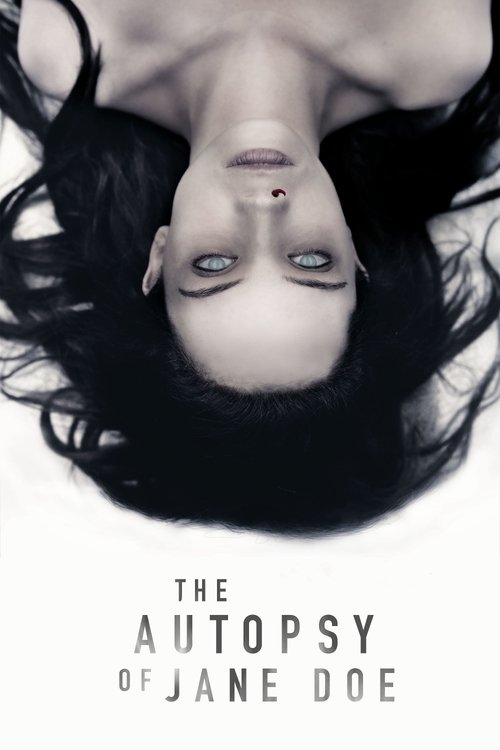
The Autopsy of Jane Doe
2016 · André Øvredal
For when you're craving a real scare — a lights-off, no-distractions horror night. Best with the sound up and someone beside you; not the pick for a squeamish or anxious evening.
What it's about
Late one night, a father-and-son team of small-town coroners takes delivery of an unidentified young woman's corpse — found half-buried at a crime scene, with no visible cause of death. As their autopsy proceeds step by careful step, what they find inside the body makes less and less sense, and the mortuary around them starts to feel less and less safe. Almost the whole film unfolds in that one basement examination room.
The experience
Relentlessly tense — it ratchets dread through clinical procedure, each incision revealing something more impossible than the last. The claustrophobia builds until every creak and bell in the building feels like a threat; it's genuinely scary without leaning on gore for its own sake.
Performances
Brian Cox grounds the whole film as the veteran coroner, playing scientific method as a kind of faith under siege, and his warm, prickly rapport with Emile Hirsch makes you care what happens in that basement.
The craft
André Øvredal, in his English-language debut, wrings maximum terror from a single location through precise staging, patient editing, and superb sound design — bells, storm, ventilation, silence. The autopsy effects are unnervingly convincing, and the film shows how far discipline and craft can outperform budget in horror.
Why it matters
An instant word-of-mouth favorite among horror fans — championed by genre filmmakers on release — it became a modern reference point for contained, procedure-driven horror and opened Hollywood doors for Øvredal.
Horror · Witchcraft · Possession & occult. Two coroners work through one stormy night on a corpse that makes no sense, and the dread tightens with every cut and every sound.
Snapshot
The Autopsy of Jane Doe is a tightly bounded supernatural horror film that stages nearly its entire running time inside a single location — the basement examination room of a family mortuary — and derives its terror from procedure rather than spectacle. Father-and-son coroners Tommy and Austin Tilden (Brian Cox and Emile Hirsch) take delivery, late one night, of the unmarked corpse of a beautiful young woman found half-buried at a rural crime scene with no evident cause of death. As their autopsy proceeds, the interior of the body yields impossible findings — intact skin over shattered bones, blackened lungs, a scrap of cloth and a tooth in the stomach, ligature scars — and the world outside the theater turns hostile. The film was Norwegian director André Øvredal's English-language debut following his found-footage cult success Trollhunter (2010), and it became one of the more admired horror pictures of its year on the festival and genre circuit, prized for craftsmanship, restraint, and a central performance delivered by a motionless actor. It is a compact, disciplined work — a "procedural gothic" — rather than a landmark, but within its self-imposed limits it is close to exemplary.
Industry & production
The film sits squarely in the mid-2010s independent-horror economy, in which modestly budgeted genre pictures were financed through international sales companies and routed to audiences via specialty distributors and premium video-on-demand. It was produced under the IM Global banner (with its genre arm) alongside Impostor Pictures and the UK company 42, and it was shot in the United Kingdom despite its ostensibly American small-town setting — a common cost-driven arrangement for this tier of production. The screenplay, by Ian Goldberg and Richard Naing, had circulated with attention before Øvredal came aboard; I do not have a reliable figure for the production budget and will not invent one, but the single-set design, small cast, and contained schedule are consistent with a lean independent shoot.
The picture premiered in the Midnight Madness program at the Toronto International Film Festival in September 2016, the genre showcase that has launched numerous horror careers, and traveled the festival circuit before a US release through IFC Midnight, IFC's horror-and-genre label built around simultaneous limited-theatrical and VOD windows. That distribution path — festival buzz converted into on-demand availability — was the standard route by which a film like this reached its audience, and it accounts for the film's strong critical reputation relative to its comparatively quiet commercial footprint. Precise box-office and viewership figures for a title released primarily on demand are not something I can state with confidence, so I will not.
Technology
The Autopsy of Jane Doe was made and finished digitally, in line with the near-total standardization of digital acquisition for independent features by the mid-2010s. I do not have verified camera-and-lens documentation for the production and will not fabricate a package, but the visible image — clean shadow detail in a low-key, lamp-lit interior, controlled highlights on stainless steel and pale skin — reflects the latitude of a contemporary digital sensor working in a deliberately dark space. The film's technological interest lies less in acquisition than in physical effects: the corpse and the progressive interior discoveries of the autopsy are practical constructions — prosthetic bodies, organs, and anatomical inserts — favored over digital augmentation. This practical-first approach is central to the film's credibility, because the horror depends on the audience believing in the tactile reality of a body being opened. The single-set staging also allowed for carefully engineered lighting and sound infrastructure — flickering fluorescents, a failing power supply, a storm outside — that the narrative weaponizes as the night goes on.
Technique
Cinematography
The photography, by Roman Osin, is organized around confinement and revelation. The camera lives at close and medium range within the examination room, using the geometry of the morgue — drawers, the central steel table, corridors, an elevator — to structure space and, later, to trap the characters within it. Lighting is low-key and motivated: overhead surgical lamps, task lights, and the cold institutional glow of the mortuary, all of which the film can dim, cut, or make flicker to collapse the safe clinical order into gothic murk. Crucially, the visual grammar treats the corpse itself as a landscape to be surveyed — the camera studies the pale, unblemished exterior of Jane Doe and then follows the incisions inward — so that cinematography and narrative discovery become the same act. The restraint is deliberate: the film withholds wide, explanatory coverage, keeping the viewer's knowledge as bounded as the coroners'.
Editing
Patrick Larsgaard's cutting follows the logic of the autopsy, which supplies the film with a ready-made procedural structure: each stage of the examination — external inspection, the Y-incision, organ by organ, layer by layer — is a beat that advances both the medical process and the mystery. The editing paces these discoveries as a slow accumulation of wrongness, letting the first two acts breathe with near-clinical patience before compressing time and space in the panicked final movement. The film also uses cross-cutting between the underground theater and the increasingly threatening exterior sparingly, so that the eventual sense of entrapment lands hard. The rhythm is one of the film's most praised assets precisely because it resists the modern horror reflex toward relentless acceleration.
Mise-en-scène / staging
The single set is the film's defining formal decision. The mortuary is dressed as a plausible working environment — instruments, scales, a body-storage wall, a radio, family photographs upstairs — and the film exploits every element as either procedural detail or eventual threat. The corpse on the central table is the fixed point around which all staging orbits; the Tildens circle it, lean over it, and are watched by it. As the night deteriorates, the same objects and spaces that established professional normalcy — drawers, the elevator, the lights — are re-staged as instruments of dread. This economy of means, where a strictly limited world is made to yield escalating horror, is the film's signal achievement of mise-en-scène.
Sound
Sound is arguably the film's most aggressive tool. The score, by Danny Bensi and Saunder Jurriaans — a duo associated with unsettling, texture-forward independent scoring — works in low drones and dissonant swells rather than conventional stingers. Diegetic sound is exploited with equal care: the wet, specific noises of dissection; a small bell on the corpse's ankle whose ring becomes a recurring signal of dread; a radio that malfunctions; the storm and failing electricity outside. The film repeatedly uses the contrast between clinical quiet and sudden acoustic intrusion to unsettle, and much of its suspense is carried by what the characters (and audience) hear from just beyond the frame.
Performance
Brian Cox anchors the film with a grounded, authoritative turn as the veteran coroner, lending the pseudo-scientific dialogue the weight of genuine expertise and supplying the emotional register — a widowed father, quietly grieving — that gives the horror human stakes. Emile Hirsch, as the son weighing whether to leave the family trade, provides the audience's more skeptical, vulnerable point of entry, and the two build a believable working intimacy across the examination. The film's most discussed performance, however, is the one that never moves: Olwen Kelly, an Irish model and actress, plays the corpse. Sustaining complete stillness while nude on a steel table through extended takes, she makes the body a continuous, uncanny presence, and the production has spoken of her using breath-control techniques associated with yoga to hold the pose — a widely repeated account I'll flag as a production claim rather than an independently verified fact. The effect is essential: the horror depends on a corpse that seems to watch.
Narrative & dramatic mode
The film's dramatic mode is the investigative procedural turned inside out. Its engine is epistemic — the drive to know what happened to this woman — and its structure literalizes that drive as a physical descent into a body. Each layer opened is a revelation that deepens rather than resolves the mystery: preserved organs that should be decayed, internal trauma with no external wound, foreign objects lodged inside. The dramatic irony is that the coroners' professional commitment to explanation is exactly what dooms them; the more completely they read the body, the more fully the curse is activated. This yokes the rationalist detective form to the supernatural, so that method and doom advance in lockstep. The two-hander intimacy of father and son — with an unresolved emotional thread about the son leaving, and the memory of a dead wife and mother — supplies the film's dramatic interior beneath the mystery machinery.
Genre & cycle
The picture belongs to the wave of restrained, craft-forward "elevated" or arthouse-adjacent horror that gained critical traction in the mid-2010s, marked by slow-build dread, strong sound design, and a preference for atmosphere over gore-for-its-own-sake. More specifically it is a single-location horror film — a lineage of contained-space genre pictures where budget limitation becomes aesthetic virtue — and a body-horror–inflected supernatural mystery. It also participates in a small tradition of morgue-and-autopsy horror, joining a set of films and stories that mine the mortuary for dread, and in the older gothic pattern of the beautiful, dangerous, seemingly dead woman. Its most distinctive generic move is grafting the coroner procedural onto a witchcraft-curse premise, so that clinical realism and folk-supernatural horror occupy the same room.
Authorship & method
The controlling authorial intelligence is André Øvredal's, and the film reads as a deliberate demonstration of range after Trollhunter: where that debut was expansive, comic, and found-footage, this is contained, sincere, and classically shot. Øvredal's method here is patience and restraint — trusting procedure, withholding explanation, and building terror through accumulation and sound. He works from an original screenplay by Ian Goldberg and Richard Naing, whose script supplies the strong structural conceit of an autopsy as narrative spine. His key collaborators shape the film decisively: cinematographer Roman Osin renders the confined morgue in motivated low-key light; composer-duo Danny Bensi and Saunder Jurriaans supply the dread-laden, texture-based score; and editor Patrick Larsgaard sustains the deliberate procedural rhythm. The casting of Brian Cox is itself an authorial decision — importing gravitas that legitimizes the film's pseudo-clinical world — as is the audacious choice to build the film's uncanny center on a performer required to remain perfectly still.
Movement / national cinema
The film resists tidy national placement. It is the English-language work of a Norwegian director, produced with British money and shot in the United Kingdom, set nominally in small-town America, and pitched at an international genre market. In that sense it is best understood as transnational independent horror rather than an expression of any single national cinema — a product of the globalized festival-and-VOD system in which a Scandinavian genre filmmaker makes an "American" horror film in Britain. It also marks a specific career vector: the movement of a distinctive European genre voice into the Anglophone horror industry, a path Øvredal continued with subsequent English-language studio work.
Era / period
The Autopsy of Jane Doe is very much a film of the mid-2010s horror moment. It arrived when critical and audience appetite had shifted toward atmosphere, craft, and dread-based horror, and when the festival-to-VOD pipeline — with IFC Midnight as a signature label — gave such films a viable commercial life outside wide theatrical release. Its practical-effects emphasis, single-location economy, and sound-driven suspense are all characteristic of the period's independent horror. The film neither anticipates a new style nor closes an old one; it is a polished, representative instance of its exact moment, executed at a high level.
Themes
Beneath its scares the film is organized around a few persistent ideas. The first is the limit of rational knowledge: it stages the collision between the coroner's empirical, explanatory worldview and a phenomenon that cannot be explained, and it punishes the pursuit of total knowledge — to fully understand the body is to be destroyed by it. Second is the body as text: the corpse is a document to be read, and the horror lies in what a body can secretly contain and testify to. Third, the film gestures toward historical violence against women — the buried backstory concerns cruelty inflicted on an accused woman — so that the curse becomes a return of suffering that was meant to be erased, the victim's ruined interior a record of what was done to her. Finally, running under the mystery is a quieter theme of grief and inheritance: a widowed father, a son deciding whether to carry on the family's work with the dead, a household that lives above a place of death.
Reception, canon & influence
Critically, the film was well received, singled out for its atmosphere, its disciplined single-location construction, its sound design, Brian Cox's grounding performance, and the sustained uncanny effect of its motionless Jane Doe; a common critical reservation held that its final act, once the supernatural rules become explicit, is less potent than its superbly withheld build-up. It earned a reputation as one of the stronger genre offerings of its release window and a strong entry in the single-location horror subgenre.
Its influences point backward to several traditions: the classical autopsy-and-morgue horror strain, the gothic figure of the deadly beautiful woman, the contained-space thriller where a limited set generates escalating threat, and the folk-horror interest in historical persecution and curses. The rationalist-investigator-undone-by-the-supernatural pattern connects it to a long lineage of detective-meets-the-uncanny storytelling.
Its forward legacy is best described as reputational rather than transformative. The film did not spawn an imitative cycle, but it consolidated André Øvredal's standing as a serious horror craftsman and helped carry him toward larger Anglophone projects, and it is frequently cited in discussions of effective single-location horror and of how procedural structure can power a genre film. Given the recency and modest scale of the picture, claims about a broad, traceable influence should be made cautiously; the honest assessment is that it endures as a well-regarded, frequently recommended example of contained, craft-driven horror rather than as a film that redirected the genre.
Reception
It slipped out via IFC Midnight in late 2016 with barely a theatrical footprint, then word-of-mouth and streaming turned it into one of the decade's most recommended horror sleepers — now a fixture on 'best horror of the 2010s' and 'hidden gem' lists.
How The Autopsy of Jane Doe was received, from release to now →
How to watch The Autopsy of Jane Doe: what to notice on a first viewing
- Watch the camera study the corpse's skin before the first cut. Osin surveys the body like a landscape, then follows each incision inward, so the camera's discovery matches the coroners' own. You learn what's inside her exactly when the characters do, nothing withheld or revealed early.
- Notice how the film paces itself around each stage of the autopsy. Larsgaard cuts patiently through external inspection, incision, and organ after organ, letting each discovery land before moving to the next. The procedure itself sets the pace, so dread accumulates instead of jumping out at you.
- Listen for the hum, the tools, and the radio in the basement. Dissection sounds, a ventilation hum, and a radio that keeps drifting between stations fill the examination room. Ordinary sounds set the pace of the autopsy.
- Notice how few locations the whole film actually uses. Almost everything happens in the same basement examination room, its drawers, table, and elevator doing double duty as the story develops. The same ordinary objects that once meant routine work start to feel like a trap.
- Watch how completely still the actress playing the corpse stays. Through long, unbroken takes she holds total stillness, nude on the steel table, so the body itself becomes a constant, watching presence. A performance built entirely on not moving is what makes the corpse feel alive.
The whole guide to watching The Autopsy of Jane Doe, with the keys for a rewatch →
Influences: the films it descends from and the films it influenced
- Cat People (1942) — Val Lewton's economy of suggestion — dread manufactured from off-screen diegetic sound, shadow, and a threat withheld from view rather than shown — is the direct grammar of Jane Doe's slow-build terror.
- The Haunting (1963) — Establishes the single-location model where an unseen force manifests purely through sound design (booming, breathing, warping walls) and motivated low-key photography of the enclosing set, never a revealed antagonist.
- The Exorcist (1973) — Pioneers the pseudo-clinical procedural realism — cold documentary observation of medical tests and instruments — that legitimizes the supernatural, the same authenticating strategy the morgue autopsy provides.
- The Wicker Man (1973) — The template of a rational investigator methodically gathering evidence toward a folk-supernatural truth that annihilates him — the investigative-procedural structure inverted into doom.
- Blood on Satan's Claw (1971) — Folk-horror of witch-persecution in which marks and mutilations on a woman's body become legible historical text — the exact 'body-as-record-of-cruelty' conceit the layered autopsy discovers.
- Alien (1979) — The contained-vessel model in which a methodical crew is picked apart and horror advances through slow, withheld reveals punctuated by wet practical-effect anatomizing of the body.
- The Thing (1982) — Practical-effects 'body-as-landscape' — horror staged by literally opening and dissecting a body on a table within a sealed set, distrust escalating with each anatomical reveal.
- Session 9 (2001) — Single decaying institutional location where dread is built through immersive sound design and slow procedural exploration as the characters' rationality dissolves.
- Trollhunter (2010) — Øvredal's own prior method — the deliberate opposite pole (expansive, comic, found-footage) against which Jane Doe's contained, sincere, classically-shot restraint is a demonstration of range.
- Saint Maud (2019) — Elevated body-horror sustaining terror through restraint, a sound-forward textural score, and the collision of clinical/rational and religious frames of explanation.
- Scary Stories to Tell in the Dark (2019) — Øvredal extends his own patient withheld-reveal method around a cursed book whose text literally writes itself onto and destroys bodies — the 'body-as-text' motif carried forward.
- The Autopsy (2022) — A near-literal descendant: a single-location autopsy procedural in which a body on the slab is dissected to expose a slowly revealed supernatural horror, extending the morgue-as-narrative-spine device.
- Pontypool (2008) — Contained-space escalation driven almost entirely by diegetic sound and voice, proving a single room and an audio channel can generate mounting supernatural threat.
- Enemy (2013) — Scored by Danny Bensi and Saunder Jurriaans in the same texture-forward, string-scraping idiom of sustained low dread they bring to Jane Doe — a shared composer method.
- The Conjuring (2013) — Applies a quasi-clinical investigative method to the paranormal, treating period artifacts as forensic evidence — the procedural-investigator-versus-uncanny structure run in parallel.
- The Corpse of Anna Fritz (2015) — Single-location morgue horror built entirely on a motionless female corpse, using the perfectly still body of a performer as the film's uncanny engine.
- The Void (2016) — Same-year practical-effects Lovecraftian body horror confined to a hospital, staging the limits of rational medical knowledge overrun by the supernatural.
- Oddity (2024) — Confines its entire horror to one room and one inert body, escalating through slow examination of an object that reveals its menace by degrees — the single-location, object-centered slow-reveal method Oddity mirrors.
Similar films
- The Conjuring (2013) — influence & lineage
- The Haunting (1963) — influence & lineage
- The Witch (2016) — same viewing thread
- The Conjuring: The Devil Made Me Do It (2021) — same viewing thread
- The Thing (1982) — influence & lineage · often watched together
- undertone (2026) — shared sensibility
- Hereditary (2018) — shared sensibility
- Hallow Road (2025) — shared sensibility
All the films related to The Autopsy of Jane Doe →
Watch it with: curated runs of related films
- Curses You Can't Hand Back — They rhyme on one cruel idea: a curse, a ritual or a wish gets passed on or triggered, and after that every film is a countdown — so watch them in a row as variations on the same trap.
- Hexes, Covens and Curses — A run through horror's oldest fear, the witch and the curse she leaves behind, from Häxan's silent lecture and Bava's masked revenant through the Polanski coven and Argento's dance academy to Eggers' Puritan forest and Cregger's vanished schoolchildren; watch them near each other to see how each era recasts the same…