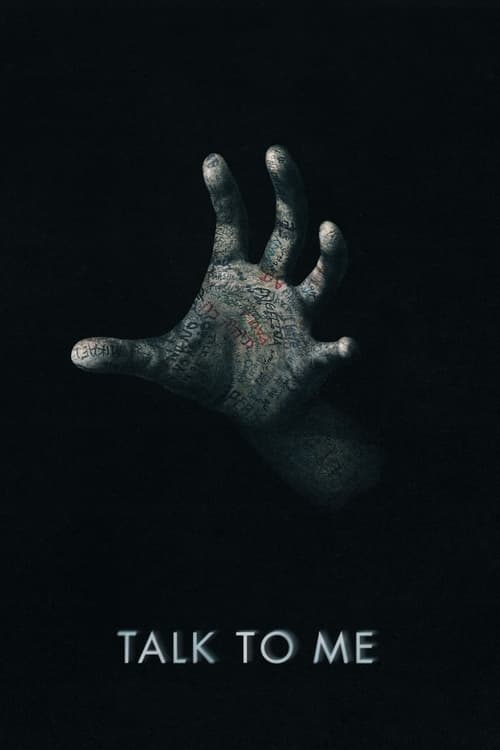
Talk to Me
2023 · Danny Philippou
When you're craving a real scare with teeth — not a cozy spooky night but the kind of horror that rattles you. Best with friends and the lights off, though it earns its emotional bruises too.
What it's about
A group of Adelaide teenagers discover an embalmed severed hand that lets anyone who grips it invite a spirit into their body — for ninety seconds, no more — and they turn it into a party game, filming each possession on their phones and passing the hand around like a drug. At the center is Mia, a girl still unmoored by her mother's death a year earlier, who finds in these séances something dangerously close to contact with the other side. Then one session goes too far, and the door doesn't close.
The experience
Relentless once it gets moving — the possession scenes hit with a physical, jolting force, but the real dread comes from grief curdling into obsession. It's scary in the moment and genuinely upsetting afterward, the kind of horror that follows you to bed.
Performances
Sophie Wilde is the reason the film cuts so deep — she plays Mia's grief and craving for connection so nakedly that the supernatural premise feels like an addiction story, and her possession scenes are frighteningly committed.
The craft
Twin brothers Danny and Michael Philippou came out of YouTube and it shows in the best way: the scares are staged with kinetic, handheld immediacy, and the possessions land through unnerving practical makeup and sound design that gets under your skin. Loud speakers and a dark room pay off — the sound is doing half the terrifying work.
Why it matters
One of the breakout horror hits of 2023, it announced the Philippou brothers as major new genre voices and became A24's biggest horror success to date, proof that a lean original premise could still own a cultural moment.
Snapshot
Talk to Me is an Australian supernatural horror film built on one of the most efficient genre premises of its decade: a severed, embalmed hand sealed in ceramic that lets whoever grips it invite a spirit into their body — provided they say "talk to me," then "I let you in," and provided someone breaks the connection within ninety seconds. A group of Adelaide teenagers treat this as a party game, film it on their phones, and pass it around like a drug. The film's protagonist, Mia (Sophie Wilde), is a girl whose mother died the previous year under circumstances she cannot settle, and who finds in possession something she has been looking for elsewhere: contact.
The credit line above requires a correction of record. Talk to Me was co-directed by twin brothers Danny and Michael Philippou, who share the directing credit; treating it as a single-authored film misrepresents its making. It was their feature debut after roughly a decade running the YouTube channel RackaRacka. It premiered at the Sundance Film Festival in January 2023, was acquired by A24 for North American distribution, and became — by widely reported accounts — the company's highest-grossing horror release, taking roughly $90 million worldwide against a budget in the low single-digit millions. It is, in commercial terms, one of the most successful Australian films of its era, and in craft terms one of the cleanest demonstrations of what a strict rule-set can do for a horror screenplay.
Industry & production
The film was produced by Causeway Films, the Sydney company run by Kristina Ceyton and Samantha Jennings — the producers of Jennifer Kent's The Babadook (2014), The Nightingale (2018), and Natalie Erika James's Relic (2020). That lineage is not incidental. Causeway had spent a decade demonstrating that Australian horror could be financed through public money, premiere at Sundance, and travel internationally on critical rather than exploitation terms, and Talk to Me is the clearest payoff of that model. The screenplay is credited to Danny Philippou and Bill Hinzman, from a concept by Daley Pearson; Pearson's involvement connects the project to Brisbane's Ludo Studio, better known for Bluey — an odd, telling adjacency in a small national industry where the same handful of companies cover very different terrain.
Financing came through Screen Australia and the South Australian Film Corporation, with production based in Adelaide, the brothers' home city and the site of the SAFC's Adelaide Studios facility. Shooting a horror film in the suburb you grew up in is a budgetary decision that becomes an aesthetic one: the houses, the parks, the roads and the light in Talk to Me have the specificity of places known rather than dressed.
The Sundance-to-A24 pathway is the industrial story of the film. A24 had by 2023 built a distribution identity around horror that critics were willing to take seriously, and Talk to Me arrived as a genuinely commercial proposition rather than a difficult one — a teen-facing, high-concept scare picture with a hook that could be communicated in a single image. A24 released it theatrically in North America in July 2023. Its performance reframed the company's horror slate from prestige oddity to reliable business, and it made the Philippous, on a first feature, bankable.
Technology
Two technologies matter here, and only one of them is a camera. The film was captured digitally on a modest package; the specific camera and lens choices are not well documented in the public record, and it would be false precision to name them. What is visible on screen is a preference for available and practical sources, shallow-focus close work, and a grade that keeps domestic Australian interiors warm and slightly overlit rather than pushing toward the desaturated blue that had become horror's default.
The technology the film is actually about is the smartphone. Every séance is filmed. The ritual's spectators hold up phones, and the possessions circulate as clips — the film's characters are simultaneously participants, audience, and distribution network. The Philippous stage this without converting the film into found footage: phone imagery appears as an inset texture, vertical and blown-out and grainy, cut against conventional coverage rather than replacing it. The argument is embedded in the form. The hand is a supernatural object; the phone is the one that makes the possession spread.
On the effects side, the film is aggressively practical. Prosthetics, contact lenses, blood rigs, and above all physical performance carry the possessions; digital work is used sparingly and mostly for cleanup and for the brief, deliberately unstable glimpses of the spirit world. This is a direct inheritance from RackaRacka, where the brothers built an audience on in-camera stunts and gore executed for almost nothing. The economics of YouTube taught them how to make violence look expensive without paying for it.
Technique
Cinematography
Aaron McLisky's photography does the film's most important structural work by refusing to signal. The camera is handheld but not frantic, close but not disorienting, and it stays with faces during the possessions rather than cutting around them. The ritual scenes are lit largely by a single candle and by the phones of the onlookers — a light source that is both diegetically motivated and thematically exact, since the audience's devices are literally illuminating the transgression.
The opening sequence is the film's formal thesis: a long, mobile handheld move through a house party, following a boy filming on his phone, that arrives at an act of violence with no cut to protect the viewer. It establishes both the film's willingness to hold on horror and its equation of camera with complicity. Elsewhere the visual grammar is domestic and unfussy — suburban kitchens, bedrooms, a car interior — which is what makes the intrusions land. The spirit-world material is differentiated by grade and texture rather than by design excess: colder, sicklier, spatially uncertain, and used briefly enough that it never has to explain itself.
Editing
Geoff Lamb's cutting is organized around a countdown. The ninety-second rule is not exposition; it is an editing device installed into the script, giving every possession scene a built-in clock and a built-in reason for the characters to argue about when to stop. The film exploits this ruthlessly — the tension in the middle act comes almost entirely from watching a timer that the audience has been trained to feel.
The other decisive choice is the refusal of the ellipsis. In the film's central catastrophe, when the youngest character self-harms under possession, the cutting holds rather than jumps. Mainstream horror typically buys its violence with a cutaway and a sound effect; Talk to Me pays in full, and the scene's notoriety derives from that duration. Conversely, the film cuts fast and comically through its early, giddy possession montage — the ritual as party trick, scored to laughter and phone flashes — so that the tonal fall, when it comes, is a collapse rather than an escalation.
Mise-en-scène / staging
The hand is a superb prop: ceramic-white, graffitied over by successive owners, mundane enough to sit on a coffee table. Its provenance is rumor within the film — a medium's hand, maybe — and the script never resolves this, which is correct. An object with a settled backstory is a lesser object.
The ritual itself is staged as protocol: candle lit, subject seated, hands bound or held, the two phrases spoken in sequence, a fixed release. The film's suspense is procedural. Deviations from the protocol are the plot. Bethany Ryan's production design keeps the world resolutely ordinary — the sort of Australian house with a laminate kitchen and a back deck — so that the only theatrical space in the film is the small circle around a candle. Miranda Otto's Sue and her household function as the film's ground floor of normality, which the possessions then undermine from inside.
Sound
The sound design is the film's most inventive department. Possession is rendered vocally: a wet, glottal, layered register in which the performer's own voice is doubled and detuned, with jaw and breath noise pushed forward in the mix. There is a low sub-bass presence that arrives before the visitors do and lingers after they are dismissed. The release from possession is marked by an abrupt drop to room tone — a silence that plays as a physical relief.
Cornel Wilczek's score, from an electronic rather than orchestral tradition, works in textures and sustained tones rather than themes, and it is frequently indistinguishable from the sound design, which appears to be the point. Against this sits the diegetic party music of the first act, loud and ordinary, which the film gradually strips away.
Performance
Sophie Wilde's Mia is the film's center and its riskiest element: a grieving girl whose grief presents as gregariousness, and whose descent is legible as need rather than stupidity. Wilde plays the possessions physically — rolled eyes, slackened jaw, a shift in the spine — with prosthetic and lens work supporting rather than replacing her. She won the AACTA Award for Best Lead Actress for the role, and the film was among the more prominent Australian releases at that year's awards.
Joe Bird, as the younger Riley, carries the film's most difficult scene and does so without the protection of a cut. Alexandra Jensen, Otis Dhanji, Zoe Terakes and Chris Alosio fill out an ensemble that behaves credibly like teenagers — talking over each other, filming everything, escalating for status. Miranda Otto, the one established screen name, is deliberately unshowy; her authority as a parent is what the film needs to break.
Narrative & dramatic mode
The dramatic engine is addiction, structured as such. The first hit is euphoric and communal; the dosage escalates; the rules get bent; the consequences land on someone other than the user. Mia's motive is not curiosity but contact with her dead mother, which makes her the one participant who cannot treat the game as a game.
The film's metaphysics remain deliberately unstable. Are these the dead, or things pretending to be the dead? The script offers competing accounts and adjudicates none of them, and the horror depends on that gap — every consoling interpretation Mia reaches for is available and unverifiable. The final movement turns the film inside out: Mia's attempt at sacrifice delivers her not to resolution but to the other side of the ritual, summoned by strangers through a hand. It is a Möbius ending that reframes every spirit seen earlier as a person with a story the film declined to tell.
Genre & cycle
Talk to Me is a possession film with no exorcist, no priest, and no institutional response — its adults are absent, uninformed, or overwhelmed. It sits in the séance subgenre alongside Witchboard (1986) and Mike Flanagan's Ouija: Origin of Evil (2016), but its true structural relative is Flatliners (1990): young people using a controlled brush with death as a recreational high, with a hard time limit and an escalating dare.
In cycle terms it belongs to the post-2018 grief-horror wave — Hereditary, Relic, The Babadook before them — and to the phone-native horror of Unfriended (2014), Rob Savage's lockdown séance Host (2020), and Smile (2022). Its teen-social-contagion logic recalls It Follows (2014). What distinguishes it within that field is tonal: it is funnier and more physical than the "elevated horror" label suggests, and it is willing to be genuinely nasty in a way its more tasteful contemporaries are not.
Authorship & method
The Philippous' authorship is the most interesting thing about the film industrially. RackaRacka, founded in the early 2010s, produced hyper-violent, stunt-heavy comedy shorts for a subscriber base in the millions — an apprenticeship in choreographed brutality, practical effects, and, crucially, in reading an audience's reaction data in real time. Danny Philippou has spoken about early hands-on exposure to Australian genre production, including work around Jennifer Kent's The Babadook, which closes the loop with Causeway neatly.
The method visible on screen is a synthesis: YouTube's commitment to in-camera physicality, married to a script discipline the brothers did not bring with them — Hinzman's and Pearson's contributions matter here, as does Causeway's development apparatus. The key collaborators are McLisky (photography), Lamb (editing), Wilczek (score) and Ryan (design), all Australian, all working at a scale where decisions are made in the room rather than in post.
Movement / national cinema
The film is the current peak of a long Australian genre tradition: the Ozploitation era of the 1970s–80s, then the 2000s revival — Wolf Creek (2005), Lake Mungo (2008), The Loved Ones (2009) — then the Causeway-era art-horror of The Babadook, Hounds of Love (2016), Cargo (2017) and Relic. Australian horror has a persistent preoccupation with the ordinary suburb as a site of dread and with grief that will not stay buried; Lake Mungo, in particular, prefigures Talk to Me's conviction that the dead are less frightening than the survivors' need for them.
It is also a case study in public financing. Screen Australia and the SAFC underwrote a first feature by two YouTubers, which then out-earned virtually every subsidized Australian drama of its year. That outcome has become an argument in Australian screen policy debates, and it has an obvious sequel-risk: the Philippous' subsequent work, like Kent's and James's before them, is financed with international money.
Era / period
2023 was the year horror confirmed itself as the last reliably theatrical genre after the pandemic, and Talk to Me is a pure product of that moment — a film whose marketing hook, ritual, and set pieces were all natively clippable. It is also a landmark in the creator-economy pipeline that runs from short-form video to studio features, a route previously walked by David F. Sandberg (Lights Out), Andy Muschietti (Mamá), Fede Álvarez and Rob Savage, but never before with this commercial result.
Themes
Grief is the engine: Mia's refusal to accept an unbearable account of her mother's death makes her exploitable by anything willing to impersonate her. Addiction supplies the shape — the film is precise about the sociability of using, the way a group both enables and polices a habit. Consent runs through the ritual's own language: "I let you in" is an invitation, and the film is interested in what it means to authorize your own violation for the thrill of it.
Beneath these sits spectatorship. Every possession has an audience, and the audience is filming. The film implicates its viewers with unusual directness — we are watching teenagers watch teenagers be hurt, and enjoying it on comparable terms.
Reception, canon & influence
Critical reception was strongly positive from Sundance onward, with particular praise for Wilde's performance, the sound work, and the discipline of the premise; the most common reservation was that the mythology behind the hand is thinner than the drama it generates — a criticism the film's ambiguity partly answers and partly earns. Commercially it outperformed every expectation for a first-feature Australian horror.
Backward, its debts are legible: The Exorcist for the grammar of possession, Raimi's Evil Dead for kinetic cruelty and the horror-comedy tonal whiplash, Flatliners for the structure, The Craft for the teen-occult social dynamics, and The Babadook and Lake Mungo for the Australian conviction that mourning is a haunted state.
Forward, its effects are already measurable. A sequel has been announced at A24 with the brothers involved, and their second feature, Bring Her Back (2025), confirmed them as a directing brand rather than a one-off — a bleaker, more sustained work about grief and substitution that read to many critics as the harder film of the two. Talk to Me has become a standard reference point for post-2020 teen horror pitches, its ninety-second rule cited as a model of legible, tension-generating premise design. For the Australian industry it stands as the proof that a genre film made in Adelaide for a few million dollars can set the international conversation — a claim the industry has made before, but rarely with these numbers behind it.
Reception
It arrived at Sundance 2023 with 'the YouTube guys made a horror movie' skepticism attached — and left as the year's word-of-mouth horror hit, going on to become A24's highest-grossing horror film ever, past Hereditary. Three years on it's settled in as the flagship of Gen-Z possession horror, its status only cemented by the Philippous' follow-up Bring Her Back.
How Talk to Me was received, from release to now →
How to watch Talk to Me: what to notice on a first viewing
- Listen for the low hum that arrives before anything appears. A sub-bass presence turns up before the visitors do and hangs around after they are dismissed. Cornel Wilczek's electronic score works in sustained tones, so score and sound design blur together. The film tells your body that something is in the room before it shows you anything.
- Look at what is lighting the room during the ritual. Aaron McLisky lights the seances with a single candle and the phone screens of the kids watching. The onlookers' devices are the light source for the thing they are filming. The people watching supply the light, so the filming is part of what makes the ritual happen.
- Count the ninety seconds along with the characters. The rule is installed in the script as a clock, and Geoff Lamb cuts to it. Every possession runs against the timer, and the arguing about when to stop is the drama. Your dread comes from a countdown rather than a monster, and you learn to feel it running.
- Watch Wilde's jaw, eyes and spine when the spirit lands. Sophie Wilde plays the possessions physically: rolled eyes, a slackened jaw, a shift through the back. Prosthetics and lens work support her rather than replace her. The change happens inside an actor's body, so it reads as something happening to a person you know.
- Notice the graffiti on the ceramic hand. The prop is mundane enough to sit on a coffee table, scribbled over by everyone who has owned it. Where it came from stays a rumor the script declines to settle. An object no one can explain stays frightening. The film never hands it a backstory that would defuse it.
The whole guide to watching Talk to Me, with the keys for a rewatch →
Influences: the films it descends from and the films it influenced
- The Exorcist (1973) — Friedkin's practical possession grammar — a degraded second vocal track (McCambridge's) laid under the performer's own so mouth and voice never quite belong to the same body — is the direct source of Talk to Me's glottal doubled voice on Wilde and the possessed teens.
- Evil Dead II (1987) — Raimi's rule that a possessed friend is hilarious for about four seconds before it isn't: the lurching handheld rig and the willingness to let one body perform slapstick and atrocity inside a single unbroken take.
- Flatliners (1990) — The structural engine wholesale — a friend group takes turns dying under timed peer supervision, each round pushed longer than the last, and every returnee drags back a haunting tailored to their own guilt.
- The Craft (1996) — Ritual as adolescent social capital: the object confers status, the circle polices who gets to hold it, and the outsider's escalation is a bid for belonging rather than for power.
- Requiem for a Dream (2000) — Addiction rendered as form — the first hit staged as ecstatic sensory rush, then the identical ritual re-shot as degradation, with the group's supply logistics, not psychology, driving each act break.
- Lake Mungo (2008) — The Australian mourning-as-haunting mode plus the discipline of withholding: the dead parent appears only in degraded, half-legible glimpses whose reality the film pointedly refuses to adjudicate.
- The Loved Ones (2009) — Proof that Australian teen horror could carry feature-scale practical prosthetic cruelty played dead straight against a party setting — the low-budget in-camera brutality template the Philippous inherited.
- The Babadook (2014) — Causeway Films' house grammar of grief-as-intruder built from domestic single-location staging and practical effects; Danny Philippou's hands-on exposure to this production is the literal transmission line.
- It Follows (2014) — A supernatural rule set legible in one sentence and enforced on a clock, with a foregrounded synth score (Disasterpeace, as Wilczek here) carrying the dread that a jump-scare would otherwise have to.
- Climax (2018) — Noé's long-take party choreography: an unbroken handheld push through rooms of intoxicated bodies that maps the geography before it introduces the threat — the architecture of Talk to Me's opening shot.
- Hereditary (2018) — The amateur domestic séance staged in an ordinary lit room, and the refusal of the cutaway — holding frame on a mutilated body well past decorum so the audience has nowhere to look away to.
- Host (2020) — Séance protocol spoken aloud as explicit rules, voided by one participant's lie, with the entity's arrival lit and framed entirely by the consumer devices the participants are recording on.
- Bring Her Back (2025) — Same crew — McLisky's photography, Wilczek's score, Lamb's cutting — extending the held-shot practical mutilation and grief-as-substitution logic across a longer, bleaker structure.
- Relic (2020) — Contemporary Australian grief horror that trusts practical decay makeup and a patient, unhurried camera on a body coming apart rather than digital augmentation.
- Bodies Bodies Bodies (2022) — Phone flashlights and screen glow used as the sole key light for a Gen Z ensemble, so the instrument of illumination is also the social medium — the same lighting logic as Talk to Me's candles and handsets.
- Smile (2022) — Post-2020 trauma horror built on a transmissible, rule-bound curse with an explicit countdown and a mandated bodily performance as the delivery mechanism — the pitchable premise design Talk to Me perfected.
- Late Night with the Devil (2023) — The other Australian possession film of its year to run its supernatural event through a recording apparatus, committing to in-camera practical effects staged for a diegetic audience.
- Oddity (2024) — Organizes its entire horror around a single tactile object (the embalmed hand) used as a medium to contact the dead, with sharply timed jolts — the haunted-object-plus-séance-investigator engine Oddity runs in parallel.
- Evil Dead Burn (2026) — Contemporary possession horror built character-first around an authentic relationship web, then governed by sound design leading the scares — the same emotional-architecture-then-terror sequence.
- Obsession (2026) — YouTube horror creators (RackaRacka) making the creator-to-studio jump with tight authorial control, the pipeline Obsession is credited with validating at scale.
- Smile 2 (2024) — A contagious possession spread through a viral ritual object among a phone-camera generation, turning attention-economy transmission itself into the delivery mechanism of the curse.
Similar films
- Bring Her Back (2025) — influence & lineage · same viewing thread
- Hereditary (2018) — influence & lineage
- Smile (2022) — influence & lineage
- The Babadook (2014) — influence & lineage
- Leviticus (2026) — same viewing thread
- Possessor (2020) — shared sensibility
- Oddity (2024) — shared sensibility
- Hokum (2026) — shared sensibility
All the films related to Talk to Me →
Watch it with: curated runs of related films
- Whatever's Wearing That Face — A run of horror-thrillers where the real terror is that you can't trust what a person appears to be — a double, a shapeshifter, a smiling stranger, the one you desire.